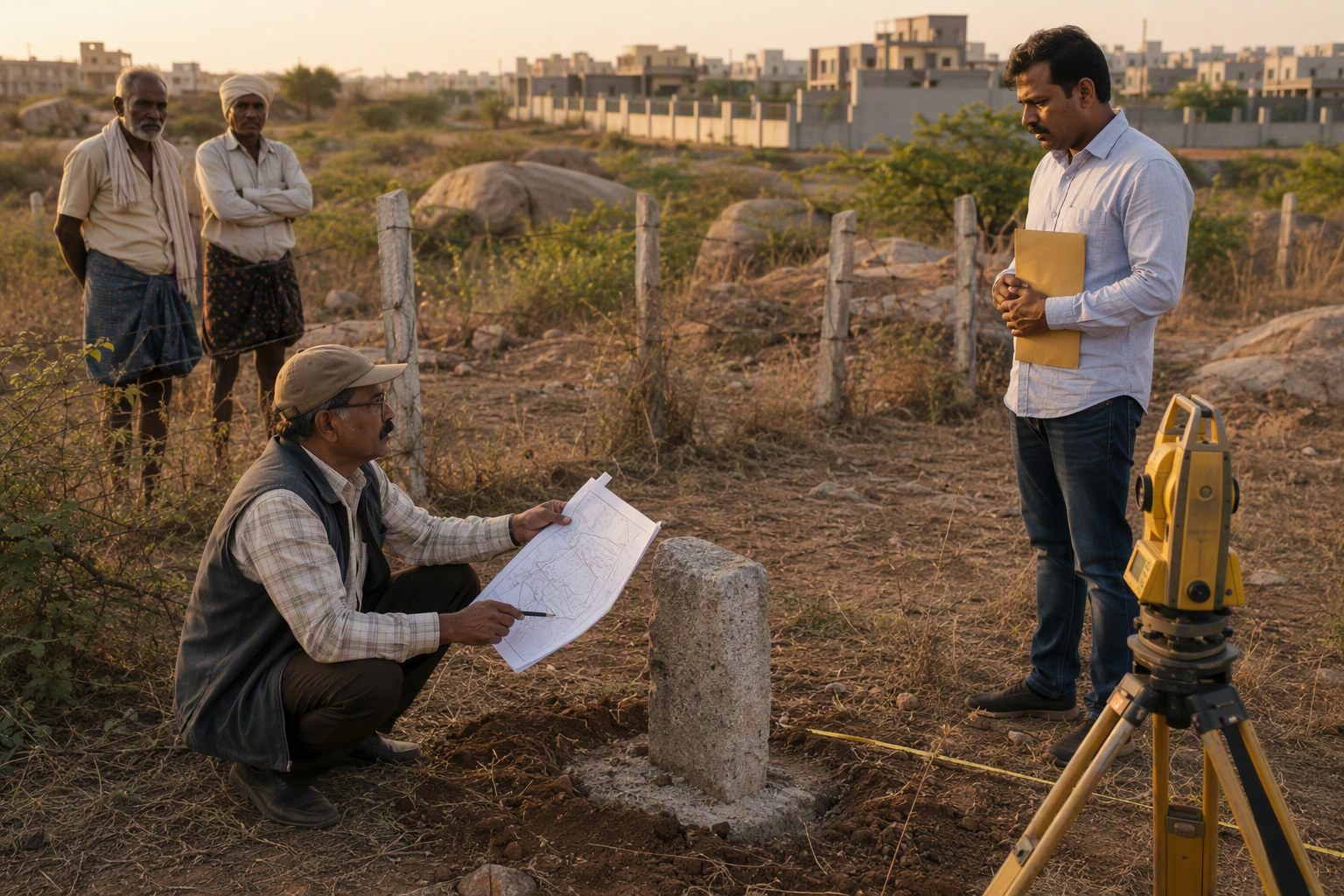



What Do Telangana Lawyers Check Before Token Payment? The short answer: title flow, Section 22-A risk, encumbrances, Dharani entries, survey number consistency, seller capacity, layout approvals, RERA status where applicable, and the exact SRO position before a buyer parts with even a small token amount. In Telangana, a token is often treated casually over tea at a site office in Gachibowli, Kompally, Shadnagar or Kollur. A good property lawyer treats it like the first legal commitment in the transaction.
For this interview-style piece, we spoke with the working approach of Telangana conveyancing lawyers who handle Hyderabad, Rangareddy, Medchal-Malkajgiri, Sangareddy and Yadadri-Bhuvanagiri transactions. The backdrop is serious: government records show 3,076,153 prohibited properties under Section 22-A. That single number is enough reason not to pay token money based only on a glossy brochure, a WhatsApp location pin or the seller’s confidence.
What Do Telangana Lawyers Check Before Token Payment? The first answer is Section 22-A
When I asked a Hyderabad property lawyer what he checks first before advising token payment, his reply was blunt:
“Before title, before negotiation, before draft agreement, I want to know whether the property is even capable of registration. If it is hit by 22-A, the buyer’s token is already in danger.”
Section 22-A prohibited properties are properties restricted from registration due to government classification, assigned land issues, endowment claims, wakf claims, ceiling matters, court orders, or other statutory blocks. The exact reason varies from case to case. The buyer’s problem is simple: if the property cannot be registered, the seller’s promise to “manage it later” should not be accepted at face value.
In our experience, this risk comes up in different forms across Telangana. In peri-urban belts like Shankarpally mandal, Moinabad mandal, Maheshwaram mandal, Kandukur mandal, Medchal mandal, Ghatkesar mandal and Shamirpet mandal, old agricultural records, conversion status and survey number boundaries need careful reading. In core Hyderabad apartment deals, the risk may be less about agricultural classification and more about land title, ULC history, litigation or project-level permissions.
Before paying token, buyers should run the property through Section 22-A Prohibited Property Check. It does not replace legal opinion, but it gives a sensible first filter. If a lawyer sees a 22-A flag, the conversation changes immediately. The buyer may still investigate, but token should usually wait until the restriction is understood in writing.
What Do Telangana Lawyers Check Before Token Payment? Title chain, not just latest sale deed
Many buyers ask only for the latest sale deed. Lawyers ask for the chain. That means the previous registered documents through which the present seller got ownership. In simple Hyderabad language: “How did this seller get the property, and was every earlier transfer valid?”
For an open plot in Adibatla, for example, the lawyer may ask for parent documents, link documents, layout approval, land conversion papers if applicable, and survey number records. For a flat in Kondapur or Nallagandla, the lawyer will ask for the landowner’s title documents, development agreement, general power of attorney if any, sanctioned plan, occupancy certificate status, and the builder-buyer agreement draft. For a resale flat in Kukatpally or Miyapur, the earlier sale deed, possession proof, mutation or municipal tax records, association NOC and loan closure documents become relevant.
Good lawyers do not treat “registered document” as automatic proof of safe title. Registration proves a document was registered. It does not by itself cure defective ownership. This is where many token disputes start. The seller says, “My document is registered, what else do you want?” The buyer’s lawyer says, “I want to know whether the seller had the right to sell in the first place.”
Typical title papers asked before token
- Latest registered sale deed or gift deed or partition deed.
- Parent and link documents showing title flow.
- Pattadar passbook and title deed details where agricultural land is involved.
- Pahani or adangal entries, especially in land deals outside dense urban areas.
- Dharani record details for agricultural lands.
- Mutation entries, municipal assessment or property tax records, where relevant.
- Layout approval or building permission papers.
- Death certificate and legal heir documents if title came through inheritance.
- Power of attorney document, if seller is acting through an agent.
A lawyer’s job before token is not to finish the full conveyance file. It is to identify red flags strong enough to stop the buyer from paying. If the seller refuses even basic papers before token, I would personally treat that as a warning sign.
Encumbrance Certificate check before token payment in Telangana
The Encumbrance Certificate, commonly called EC, is one of the most practical checks before token payment. It shows registered transactions affecting the property during the selected period. Lawyers use it to verify sale deeds, mortgages, releases, agreements, court attachments where recorded, and other registered instruments.
For buyers, the EC is helpful because it catches mismatches quickly. If the seller shows one sale deed but the EC shows a later mortgage, the buyer must ask for loan closure and release proof. If the EC shows a transaction the seller has not disclosed, the lawyer will pause the deal. If survey numbers or flat numbers do not match cleanly, the lawyer will compare the schedule in each document.
You can start with Encumbrance Certificate Search and then ask the lawyer to interpret it. Raw EC reading is not always straightforward. Abbreviations, old document references and schedule wording can confuse even regular buyers.
“An EC is not a title certificate. But if the EC itself is messy, I will not allow my client to pay token in a hurry,” says the lawyer.
That is the right approach. EC is a filter. It cannot detect every unregistered claim, family dispute or possession issue, but it gives the first documentary view of registered history.
Dharani, pahani and survey number checks before token payment
In Telangana land transactions, survey number accuracy is not a small clerical issue. A wrong survey number can change the property completely. This is common in village-side plots sold near ORR growth corridors, where buyers are attracted by location names like Tukkuguda, Mucherla, Kandukur, Chevella, Shankarpally, Bibinagar or Bhongir, but the actual village and survey number tell the legal story.
Lawyers check whether the survey number in the sale deed, Dharani record, pahani, layout plan, conversion order and physical possession all talk about the same land. If one document says one survey number and the layout drawing shows another, the buyer should not pay token until the mismatch is explained.
For agricultural land, Dharani entries are central to ownership and transaction readiness. For non-agricultural converted plots, the lawyer will also look at land conversion, layout sanction and whether the plotted land came out of a legally traceable parent parcel. Buyers can use Survey Number Finder and Property Verification Tool for a first-level check before sending papers for legal scrutiny.
One practical tip: do not rely only on the venture name. “Near Shamshabad”, “close to Pharma City side”, “beside ORR exit”, “Kollur extension” and similar phrases are marketing descriptions. A lawyer wants village, mandal, survey number, extent, boundaries and SRO.
Seller capacity: can this person legally take token money?
This is a very underrated point. Telangana lawyers check not only the property but also the person collecting token. The person at the site may be a broker, marketing employee, GPA holder, family member, developer representative or one of several co-owners. If the wrong person takes token, the buyer may later struggle to enforce the understanding.
For individual resale deals, lawyers check the seller’s identity, marital and family context where needed, co-owner consent, legal heir position and any pending dispute. If the property was inherited, the lawyer will ask whether all legal heirs are parties. If it is a jointly owned property, all owners should sign the token receipt or at least authorise one person in writing.
In builder projects, lawyers check whether the person signing booking papers is authorised by the developer entity. The entity name must match the land and project documents. In Hyderabad, it is common for marketing names and legal entity names to differ. That is not always a problem, but the buyer should know who is legally receiving the money.
If a GPA holder is selling, the lawyer will read the GPA carefully. Is it registered where required? Is it still valid? Does it authorise sale, receipt of money and execution of documents? Has the principal died? These are not academic questions. They decide whether the token receipt has any real value.
RERA, permissions and layout approvals before paying token
For under-construction apartments and many plotted development projects, RERA status is a key check. A Telangana lawyer will compare the project name, promoter name, land details, approvals and promised specifications with RERA records. Buyers can use RERA Project Lookup before visiting the sales office again.
In apartment transactions, the lawyer will ask for sanctioned building permission, land title documents, development agreement, sharing agreement if any, commencement details, and occupancy certificate status for completed projects. In HMDA or municipal limits, building permission and sanctioned plan matter. In gram panchayat or newly merged areas, the approval trail must be checked with more care because older layouts may have different approval histories.
For plots, the lawyer checks whether the layout is approved by the competent authority. A colourful venture map is not an approval. Road widths, open space, mortgage plots, plotted area and land use all need to match the sanction. Tools like Road Width Check, Land Use Zone Finder and OSR Calculator help buyers ask sharper questions before token.
We’ve seen buyers get impressed by entrance arches, compound walls and street lights. Those are good for site feel, not legal safety. Approval papers matter more than landscaping when token money is on the table.
SRO, market value and stamp duty checks before token
Before token payment, lawyers also confirm the correct Sub-Registrar Office jurisdiction. The SRO determines registration handling and is tied to village, locality and property classification. A property marketed as being in one premium locality may legally fall under a different village or SRO area. That affects searches and document verification.
Buyers can use Find Your SRO Office and SRO Village Directory to identify the relevant SRO. This is especially useful in edge localities where Hyderabad naming is loose: Tellapur versus adjoining villages, Kokapet versus nearby survey areas, Patancheru side villages marketed under ORR branding, and Medchal belt ventures using broader locality labels.
Lawyers also check government market value, commonly called guideline value or ready reckoner value. This helps the buyer understand stamp duty exposure and whether the draft sale consideration is being structured properly. Use Market Value / Guideline Value Search and Stamp Duty Calculator before signing any token receipt. If there is a built-up component, Composite Value Calculator may also be useful.
I do not like token receipts that mention vague terms like “final price as discussed” or “registration charges extra as applicable” without clarity. A clean token document should state the property schedule, agreed consideration, token amount, payment mode, due diligence period, refund condition if title is defective, and timeline for agreement or sale deed.
What the token receipt should say in a Telangana property deal
A token receipt is not just a casual acknowledgement. It can become the first written evidence of the transaction. Lawyers usually prefer a carefully worded receipt or memorandum rather than a one-line WhatsApp confirmation.
| Clause | Why lawyers check it |
|---|---|
| Full property schedule | To avoid confusion on flat number, plot number, survey number, extent, village, mandal and SRO. |
| Seller details | To confirm the person receiving token has legal authority. |
| Buyer details | To record who has paid and who will proceed with purchase. |
| Token amount and mode | To create a clear payment trail through bank transfer, cheque or recorded mode. |
| Due diligence condition | To protect the buyer if title, EC, 22-A, RERA or approval checks fail. |
| Refund wording | To avoid fights if the property is legally defective. |
| Timeline | To prevent open-ended pressure from seller or broker. |
My opinion is simple: if the seller is genuine, a due diligence condition should not scare him. If he insists that token is non-refundable even if title fails, the buyer should slow down. A serious seller will allow reasonable legal verification.
Lawyer’s red flags before token payment in Hyderabad and Telangana
Here are the red flags lawyers repeatedly flag before buyers pay token:
- The seller refuses to share parent documents before token.
- The property appears in prohibited property records or has unclear 22-A status.
- EC entries do not match the seller’s story.
- Survey number differs between deed, Dharani, layout and site plan.
- Only photocopies are shown and originals are “with someone else”.
- GPA holder is pushing for quick token without principal confirmation.
- Multiple family members claim rights but only one person is negotiating.
- Project is marketed as approved, but approval copy is not shared.
- RERA details do not match what the sales team is saying.
- Token receipt has no refund clause for title defect.
- Broker says legal checks can happen after payment.
The last point is the most common. Brokers are not always wrong; many are professional. But their incentive is to close. Your lawyer’s incentive is to protect. Listen to both, but sign only after legal comfort.
How buyers should sequence checks before token payment
A practical Telangana buyer can follow this sequence:
- Step 1: Get village, mandal, survey number or flat details, and SRO information.
- Step 2: Run a 22-A prohibited property check.
- Step 3: Pull EC and compare document numbers.
- Step 4: Check Dharani or revenue records where land is involved.
- Step 5: Verify RERA for applicable projects.
- Step 6: Confirm approvals, layout or building permission.
- Step 7: Ask lawyer to review title chain and seller authority.
- Step 8: Pay token only with written refund protection for failed legal due diligence.
This sequence works whether you are buying a flat in Manikonda, a resale apartment in Hitec City, a plot near Shadnagar, a villa in Mokila, or agricultural land in a village belt. The papers differ, but the discipline is the same.
Final view: pay token only after minimum legal comfort
What Do Telangana Lawyers Check Before Token Payment? They check whether the property can be registered, whether the seller can sell, whether the title has continuity, whether the EC is clean enough, whether Dharani and survey records match, whether approvals are genuine, and whether the token receipt protects the buyer if legal defects come out.
The large count of 3,076,153 Section 22-A prohibited properties should make every buyer cautious. It does not mean every property is risky. It means Telangana has enough restricted-property history for buyers to verify first and pay later. In Hyderabad’s active market, good properties move fast, yes. But a bad token payment moves faster into regret.
Use the tools, collect the papers, ask direct questions, and put the due diligence condition in writing. That is how careful Telangana buyers protect themselves before token money leaves their account.
Frequently Asked Questions
What Do Telangana Lawyers Check Before Token Payment?
They check Section 22-A prohibited status, title chain, EC, Dharani or revenue records, survey number match, seller authority, RERA status, approvals, SRO jurisdiction and token refund wording.
Should I pay token before getting legal opinion in Telangana?
Preferably no. If you must block the property, pay only a small token through recorded mode and insist on written refund protection if legal due diligence fails.
Is Encumbrance Certificate enough to confirm safe title?
No. EC is useful, but it is not a complete title certificate. A lawyer must also check link documents, seller capacity, revenue records, approvals, possession and possible litigation risks.
Why is Section 22-A check needed before token payment?
If a property is restricted under Section 22-A, registration may be blocked. Since government records show 3,076,153 prohibited properties, checking this before token is a sensible first step.
What should a Telangana token receipt include?
It should include full property schedule, seller and buyer details, token amount, payment mode, agreed price, due diligence period, refund clause for title defect and next-step timeline.