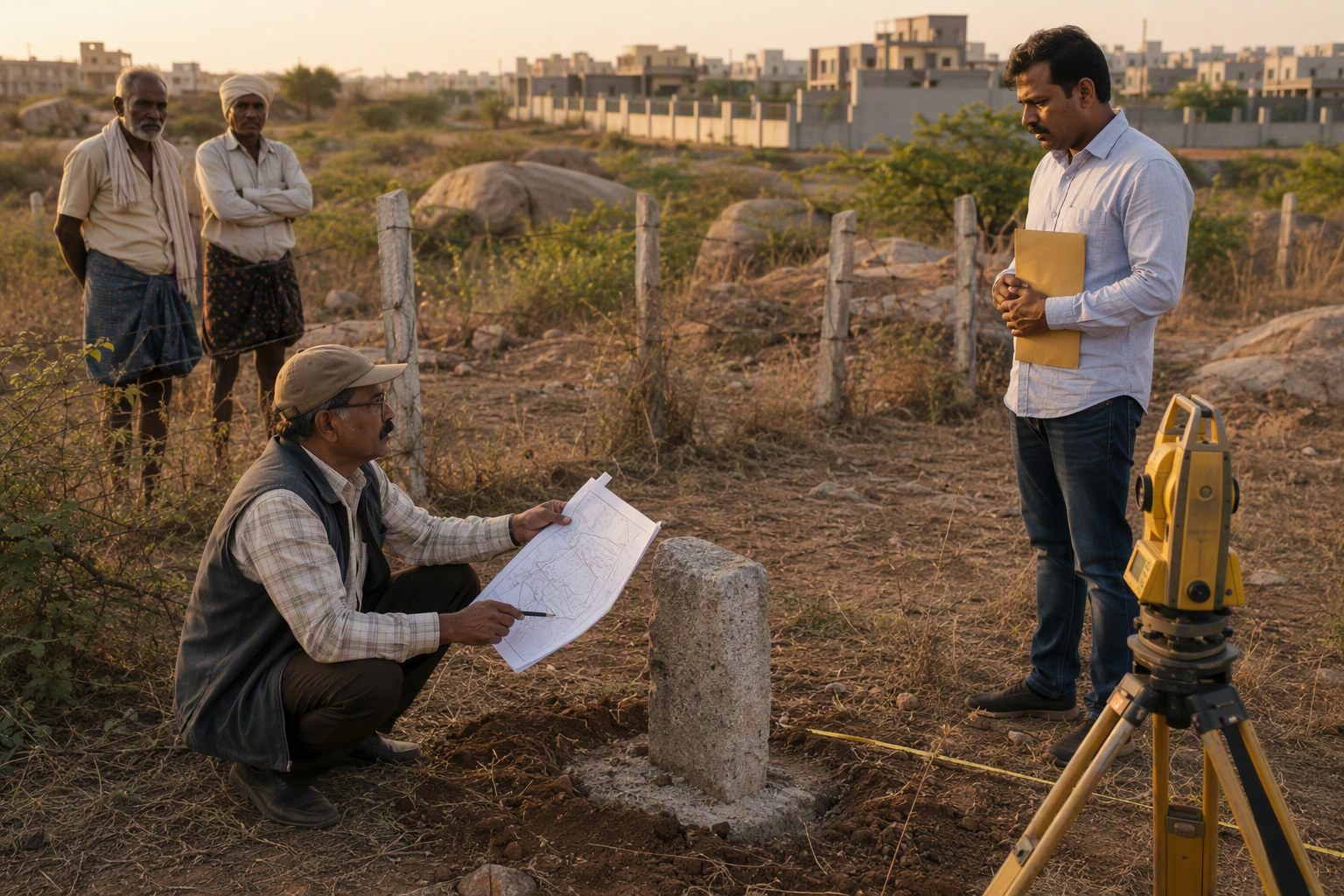



Valuer vs Broker is not a fight between paperwork and street sense. For a Hyderabad resale flat buyer, the registered valuer is usually better at reading the property’s defensible price, while the broker is better at reading the price at which the flat may actually move in the market. If you are buying in Kondapur, Manikonda, Miyapur, Nallagandla, Kukatpally, Uppal or LB Nagar, you need both views before you pay token advance.
My blunt opinion: never depend only on the broker’s quoted resale rate, and never treat a valuation report as the final market truth. A valuer sees risk, depreciation, title gaps and bank comfort. A broker sees buyer mood, owner urgency, floor preference, community reputation and negotiation room. The true resale flat price sits somewhere between these two readings.
Valuer vs Broker: the short answer for resale flat buyers
A registered valuer reads a resale flat like a banker or court would read it. The broker reads it like a buyer standing in the corridor, asking: will my family like this block, this lift, this road and this maintenance bill?
In our experience, buyers overpay when they hear only the broker’s story: ‘Last month one flat went at this rate’, ‘owner is not negotiable’, ‘only one flat available in this tower’, or ‘IT crowd is buying here’. Some of it may be true. Some of it may be positioning. A registered valuer, on the other hand, may under-read emotional demand in a strong gated community where families are waiting for a particular school bus route or clubhouse access.
The best approach is simple. Use the broker for live market pulse. Use the valuer for disciplined pricing. Then verify documents independently through tools like Encumbrance Certificate Search, Market Value / Guideline Value Search, Section 22-A Prohibited Property Check and CERSAI Charge Check.
Valuer vs Broker: how each person builds the price
For this comparison-led expert piece, I am using the standard methods we regularly see in Hyderabad resale transactions. A registered valuer generally works from documents, age of construction, undivided share of land, approved built-up area, depreciation, locality position and comparable registered transactions. A seasoned broker works from active enquiries, recent negotiations, unsold inventory, owner pressure, floor demand, view, vastu, maintenance culture and society reputation.
| Pricing factor | Registered valuer’s reading | Experienced broker’s reading |
|---|---|---|
| Land and title | Checks sale deed, link documents, UDS, EC, mortgage history and SRO records | Checks whether buyers are comfortable with the project and whether banks are lending |
| Location | Looks at official market value, access roads, approvals and comparable registrations | Looks at demand from IT employees, schools, metro access, ORR access and daily convenience |
| Building age | Applies depreciation and condition-based adjustment | Sees whether buyers still like the project compared to newer stock nearby |
| Flat features | Measures area, floor, parking, construction quality and usable space | Reads emotional value of corner flat, east facing, higher floor, view and balcony privacy |
| Risk | Flags title, mortgage, approval, litigation and valuation gaps | Flags slow-selling towers, weak maintenance, water issues and resident complaints |
| Final price | Gives a defensible value | Gives a market-negotiable asking and closing expectation |
Where a registered valuer reads a resale flat better
A valuer is stronger when the buyer needs a sober answer: what is this flat really worth if the noise is removed? This matters a lot in Hyderabad because the same locality can carry very different pricing logic from street to street.
Take Serilingampally mandal areas such as Kondapur, Gachibowli, Hafeezpet, Miyapur and Nallagandla. A broker may club them under the broad IT corridor story. A valuer will not. A flat near a wide approach road, clean title, healthy UDS and good construction quality cannot be priced the same way as a flat inside a cramped lane with unclear parking and poor document trail. Both may be marketed with the same locality tag.
In Rajendranagar and Gandipet side markets like Manikonda, Narsingi and Kokapet, the document layer becomes even more serious. Buyers are often attracted by ORR access and the new-city feel. A valuer will ask harder questions: what is the land history, which survey number is involved, whether the project approvals match the built structure, whether the EC shows clean transfers, and whether there is any risk from prohibited property classification.
According to government records in our database, Telangana has 3,076,153 prohibited property records under Section 22-A. That number is not meant to scare every flat buyer. It is meant to remind buyers that land status cannot be casually ignored, even for an apartment. Before paying token, run a check through Section 22-A Prohibited Property Check and cross-check the survey details where available through Survey Number Finder.
A registered valuer also reads the building itself without getting carried away by interiors. Hyderabad resale flats often come with modular kitchen, false ceiling, wardrobes and premium lighting. Useful, yes. But a valuer will separate movable interior value from immovable property value. That is a big help when the seller says, ‘I spent heavily on interiors, so the price is fixed.’
A valuer’s quiet strength is this: he can tell you whether the bank, the SRO record and the physical asset are broadly speaking the same language.
Where an experienced broker reads a resale flat better
A good broker knows the pulse inside an apartment community in a way no valuation sheet can capture. In Kukatpally, KPHB, Pragathi Nagar, Bachupally and Nizampet, we have seen projects where two similar flats in the same building receive different buyer interest because of tower position, lift waiting time, seepage complaints, parking ease and even which side the balcony opens.
In Uppal, Nagole, LB Nagar, Kothapet and Saroornagar, metro access, road widening expectations, school commute and old-vs-new apartment preference influence buyer behaviour. A valuer may assign a disciplined value based on area, age and comparable transactions. A broker can tell you if buyers are avoiding one lane because of traffic choke points or preferring another because autos, supermarkets and hospitals are walkable.
In Banjara Hills, Jubilee Hills, Somajiguda and Begumpet, older resale flats are a different game. Many have large rooms and good central locations, but maintenance, redevelopment possibility, parking limits and association strength drive pricing. A broker who has actually shown flats in that building will know whether buyers are rejecting it after the first visit.
Still, broker intelligence needs filtering. A broker earns when the transaction closes. That does not make every broker biased, but it does mean buyers should test every claim. Ask which SRO the property falls under using Find Your SRO Office. Check the guideline value through Market Value / Guideline Value Search. Calculate stamp duty impact before agreeing on consideration through Stamp Duty Calculator.
Valuer vs Broker in Hyderabad: who is more reliable for the final offer?
For the final offer, I would give more weight to the valuer on the floor price and more weight to the broker on the negotiation range. The floor price is the amount below which the asset appears under-supported by land, documents, quality and comparables. The negotiation range is the band within which a real buyer and real seller may settle.
Let us say you are considering a resale flat in Nallagandla. The broker says demand is strong because families want access to the Financial District, Gachibowli and Tellapur side schools. Fair. The valuer says the building age, UDS, carpet efficiency, maintenance condition and registered comparables do not justify the seller’s top-end quote. Also fair. Your job is not to choose one person and ignore the other. Your job is to ask: what price is justified on paper, and what premium am I paying for convenience?
This difference becomes sharper in gated communities. A broker may argue for premium because of clubhouse, security, power backup, landscaping and brand name. A valuer may not give full credit for every amenity if the flat is ageing or if the super built-up loading is high. Both are seeing real things, just from different windows.
In Hyderabad resale, I prefer this working rule: if the valuer’s number and broker’s closing expectation are close, the deal may be sensible subject to clean documents. If they are far apart, slow down. Do not let FOMO push you into a bad registration.
Document checks that change the true price of a resale flat
Many buyers discuss price before documents. That is backward. Documents decide whether the quoted price deserves respect. A clean resale flat with proper EC, link documents, occupancy status, parking clarity and no visible charge will always command better confidence than a flat where the seller says documents will be shown ‘after token’.
Start with the Encumbrance Certificate. Use Encumbrance Certificate Search and, if you already have the document, run a deeper review through EC Analyzer. Look for sale deed flow, mortgages, releases, gift deeds, settlement deeds and any unusual entries. If the seller took a home loan, check whether the loan is active and whether the bank will issue a proper closure process.
Next, check CERSAI. Buyers often skip this because the seller says the original documents are with him. That is not enough. Use CERSAI Charge Check to see whether any registered charge appears against the property. For flats with past loans, this is a sensible layer.
For newer projects or recently completed projects, use RERA Project Lookup. RERA details do not replace legal due diligence, but they help you match the project identity, promoter details and declared information. If the flat is in a project where extensions, phase approvals or common areas are confusing, RERA lookup can give the buyer a better starting point.
Then check market value and registration costs. The SRO market value is not the same as market price, but it matters for stamp duty, registration and undervaluation risk. Use Market Value / Guideline Value Search and Stamp Duty Calculator before finalising consideration. A buyer who forgets registration cost often stretches the budget and then compromises on verification.
How brokers may over-read price in hot localities
Hot locality language can be dangerous. ‘Near Financial District’, ‘close to ORR’, ‘walkable to metro’, ‘premium gated community’, ‘limited resale stock’ — these phrases influence buyers. Some properties deserve the premium. Many do not.
In Kondapur, a flat near HITEC City access may be genuinely liquid. But if the internal road is narrow, visitor parking is painful and maintenance is weak, the premium should be questioned. In Manikonda, a nice-looking flat may still suffer if the approach road, drainage or water dependency is poor. In Miyapur and Hafeezpet, metro access matters, but so do noise, traffic turns and society upkeep. In LB Nagar and Nagole, connectivity can support demand, but building quality and parking remain decisive.
A broker may focus on the best story of the locality. A buyer must price the actual flat, not the locality poster. The flat’s tower, floor, ventilation, seepage, parking slot, legal clarity and society accounts should pull the quote up or down.
How valuers may under-read buyer emotion
Valuers also have limits. A valuation report may not fully capture why a particular family pays extra for a lower floor for elderly parents, a specific school bus pickup, a temple nearby, a pet-friendly society, or a balcony facing open space. Hyderabad buyers are practical, but they are not machines.
We have seen buyers choose an older flat in Begumpet over a newer one farther out because office commute saved daily stress. We have seen families prefer Nallagandla or Tellapur side communities because children’s schooling and peer group felt better. These emotional and lifestyle factors do influence price, even if they do not sit neatly inside a valuation format.
So, do not use the valuer’s report as a bargaining weapon alone. Use it as a sanity check. If the broker can explain why real buyers are paying more for that specific project, listen. Then verify whether the premium is acceptable for your life and budget.
My practical price-check method before paying token advance
Before token, I suggest buyers prepare a simple pricing note. Write the seller’s asking price, the broker’s expected closing price, the valuer’s view, the SRO market value, registration cost, visible repair cost, loan closure status, and document red flags. This note need not be fancy. It should stop emotional decision-making.
Visit the flat at different times if possible. Morning light, evening traffic, lift usage, parking movement and generator noise can change your opinion. Speak politely to residents near the lift or parking area. They will often tell you what the sales pitch hides.
Ask for the sale deed, link documents, latest EC, tax receipts, association NOC process, maintenance dues statement, parking allotment proof and loan closure letter if any. If land survey details are available, run a quick check using Property Verification Tool. For area confusion between sq ft, sq yard and local terms, use Area Unit Converter.
When there is a doubt about constructed area value versus land share value, Composite Value Calculator and Building Value Calculator can help you think more clearly. Tools do not replace a lawyer or valuer, but they reduce blind spots.
Red flags where neither valuer nor broker should be your only advisor
- Seller refuses document review before token: Walk carefully. A genuine seller can share basic copies with sensitive numbers masked where needed.
- Price is justified only by future promises: Metro, road widening, new mall or future office demand should not be the only reason for today’s premium.
- Parking is verbally promised: Get the allotment or sale deed reference checked. Parking disputes reduce resale comfort.
- EC shows entries you do not understand: Do not guess. Use professional help and run the EC through EC Analyzer.
- Land status is unclear: With 3,076,153 prohibited property records in government data, Section 22-A checking is not optional in doubtful cases.
- Association dues or litigation rumours exist: Speak to the association office before registration.
Valuer vs Broker: final opinion for Hyderabad resale flat buyers
If you ask me who reads the true price better, I will say this: the registered valuer reads the safer price better; the experienced broker reads the sellable price better. A buyer needs the safer price first. Only after that should he decide whether the market premium is worth paying.
In strong Hyderabad micro-markets like Gachibowli, Kondapur, Nallagandla, Kokapet, Manikonda, Kukatpally, Miyapur, Uppal and LB Nagar, sellers often quote with confidence. Buyers also fear losing a good flat. That is exactly when discipline matters. Do the EC, SRO, guideline value, CERSAI, RERA and Section 22-A checks. Take the broker’s ground intelligence, but do not outsource your judgement to the broker. Take the valuer’s report, but do not ignore the lived reality of the apartment community.
A resale flat is not just square feet. It is title, building health, society culture, commute, parking, sunlight, noise, water, bankability and exit value. The right price is the price that survives all these questions.
Frequently Asked Questions
Is a registered valuer better than a broker for resale flat pricing?
A registered valuer is better for a defensible, document-backed value. A broker is better for current buyer demand and negotiation mood. For Hyderabad resale flats, use both before finalising the offer.
Should I check guideline value before buying a resale flat in Hyderabad?
Yes. Guideline value or SRO market value is not the same as market price, but it affects registration and stamp duty planning. Use the Market Value / Guideline Value Search before agreeing on the final consideration.
Can Section 22-A prohibited property issues affect apartment buyers?
Yes, especially where land history or survey details are unclear. Telangana government records in our database list 3,076,153 prohibited property records, so buyers should check land status in doubtful cases.
What documents should I verify before paying token advance for a resale flat?
Check the sale deed, link documents, latest EC, loan closure status, CERSAI charge, parking proof, tax receipts, association dues and SRO details. Do not wait until after token to start basic verification.