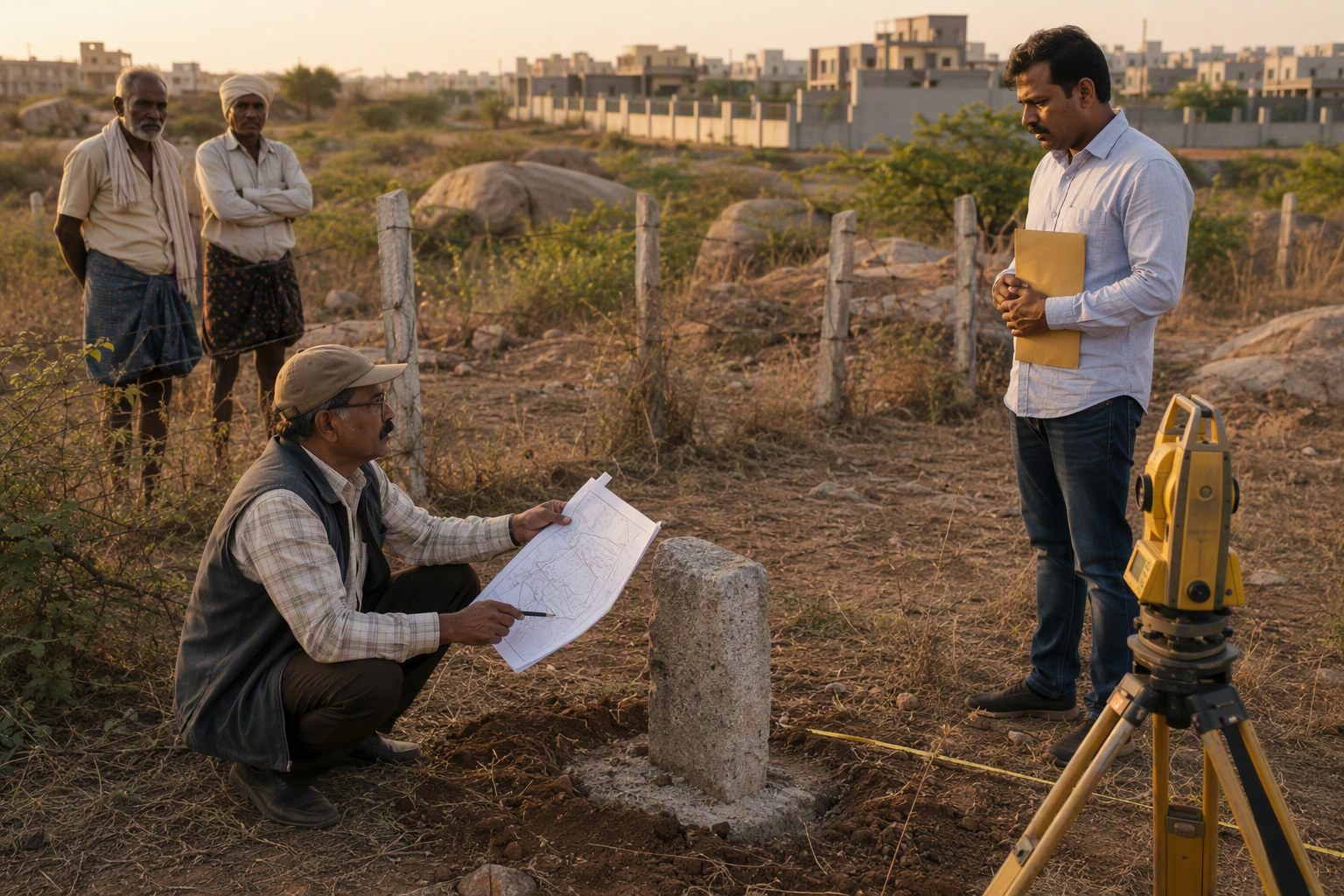



What a RERA Consultant Spots in a Brochure Before Buyers Do
Last month, a buyer from Madhapur called us after visiting a project counter near Kokapet. The brochure had sunset views, a clubhouse with blue water, a bold possession promise, and a payment plan that looked friendly. By Sunday evening, the family was almost ready to block a flat. Then a RERA Consultant looked at the same brochure for ten minutes and asked one simple question: “Where is the approval file backing this claim?”
That is usually where the glossy paper starts losing its shine.
In Hyderabad’s property market, a brochure is not a legal document. It is a sales document. It may be truthful, partly accurate, outdated, or cleverly worded. A good RERA Consultant does not get carried away by tower names, launch offers, or lifestyle images. They match every attractive claim against verifiable records: RERA registration, sanctioned plan, land title, survey number, EC, building permission, phasing details, and Section 22-A risk.
We’ve seen this pattern across Kokapet, Narsingi, Tellapur, Kollur, Bachupally, Mokila, Tukkuguda, and Kompally. The buyer reads the brochure emotionally. The consultant reads it like a cross-examination.
Why a RERA Consultant Reads a Brochure Differently
A normal buyer starts with the hero image. A RERA Consultant starts with the fine print. Not because consultants are negative people. Because the biggest problems in property buying often hide in harmless-looking lines.
For example, a brochure may say “HMDA approved gated community”. That sounds comforting. But the consultant asks: approved for what exactly? Is it a layout approval, building permission, revision approval, or just an application under process? Is the approval for the same survey numbers being sold? Is the tower in Phase 1 or a later phase? Is the amenity block part of the registered project or shown only as a future development?
In our experience, many disputes do not start from open cheating. They start from buyer assumptions. The buyer assumes “approved” means everything is clear. The builder assumes “subject to approvals” was enough disclosure. Between these two assumptions sits the consultant, checking documents before token money leaves the buyer’s account.
“A brochure tells you what the project wants to be. RERA filings and land records tell you what the project is allowed to be.”
That difference matters in Telangana, where land history can be layered. A single parcel may have old pattadar names, development agreements, family partitions, mortgage entries, court disputes, road-widening impact, assigned land questions, or Section 22-A restrictions. As per latest IGRS data, prohibited properties under Section 22-A cover 3,076,153 entries. That one figure is enough reason to verify before believing any land claim casually printed in a brochure.
RERA Consultant Brochure Check: The First Red Flags
The first thing a consultant checks is not the swimming pool image. It is whether the project name in the brochure matches the project name in the RERA record. Small variation? Maybe harmless. Big variation? Check deeper.
Use the RERA Project Lookup before treating the brochure as reliable. The project registration should show the promoter name, project location, approved plans, timelines, and other filings. If the brochure is speaking about one brand name but the RERA record shows another entity or different project scope, ask for a written explanation.
Here are the first brochure lines I personally circle:
- “Proposed” amenities: Proposed by whom, approved where, and included in which phase?
- “Possession soon”: Does the RERA timeline support this, or is it just sales language?
- “Premium tower”: Is it a separate RERA phase or part of the same registered project?
- “Open view forever”: Is the neighbouring land government land, private land, lake buffer, road, or future development parcel?
- “Pre-launch”: If RERA registration is not available, a buyer should be very careful.
In Narsingi and Kokapet, buyers often get impressed by road connectivity and skyline talk. Fair enough, those areas have strong buyer interest. But a consultant still asks basic questions: which village, which mandal, which survey number, which SRO, which permission authority, and which land title chain?
RERA Consultant View on Land, Survey Number and Mandal Details
Every good brochure should identify the project location clearly. Not just “Financial District extension” or “near ORR”. For verification, those phrases are too loose. A consultant wants the village name, mandal, district, survey numbers, and SRO jurisdiction.
Take a few examples from the Hyderabad growth belt. Kokapet comes under Gandipet mandal in Rangareddy district. Tellapur and Kollur are commonly checked with Sangareddy district records, especially around Ramachandrapuram mandal limits. Mokila falls in the Shankarpally belt. Tukkuguda is usually checked around Maheshwaram mandal. Bachupally comes under the Medchal-Malkajgiri side. Each location has its own record trail and SRO mapping.
That is why the brochure’s location map alone is never enough. Some maps stretch distances creatively. A project described as “near Gachibowli” may be a very different commute depending on the exact village and road access. A consultant checks actual location through survey records and registration jurisdiction.
For land-side checks, start with the Survey Number Finder and confirm the SRO through the Find Your SRO Office. If the land parcel has a government restriction risk, run a check through the Section 22-A Prohibited Property Check.
A serious buyer should also ask for the land title flow: parent document, link documents, pahanis where relevant, development agreement, GPA if any, and owner-consent documents. If the promoter says “all clear, sir”, that is not verification. That is assurance. Assurance has value only when backed by records.
The Brochure Claim Versus Document Reality
A RERA Consultant converts brochure statements into document questions. That is the main skill. Below is the way we usually read a sales brochure during a buyer review.
| Brochure claim | What the consultant checks | Why it matters |
|---|---|---|
| “RERA approved” | RERA project number, promoter name, phase, completion timeline | Buyer must confirm the exact project being sold |
| “HMDA approved” or “municipal approved” | Sanctioned plan, layout approval, building permission, revisions | Approval type and scope can differ |
| “Clear title land” | EC, link documents, pahani, Dharani records where relevant | Title comfort should come from record checks |
| “No legal issues” | EC entries, court case disclosure, mortgage and charge checks | Many risks are not visible in site visits |
| “Clubhouse and amenities” | Sanctioned plan and RERA common area disclosures | Amenity promises must match approved scope |
| “Great offer price” | Agreement value, market value, stamp duty impact | Low quote can hide extra charges or valuation issues |
For resale and under-construction deals, the Encumbrance Certificate Search and EC Analyzer help buyers see whether the document trail is clean enough for the next step. For bank-funded deals, also check charges using the CERSAI Charge Check. A brochure will rarely mention these things, but banks and lawyers will not ignore them.
Carpet Area, Saleable Area and the Brochure Trap
One of the most common brochure traps is area presentation. The buyer sees a spacious floor plan and assumes the usable area is close to the advertised size. A consultant immediately asks: is this carpet area, built-up area, super built-up area, or saleable area?
Under RERA, carpet area has a specific meaning. Marketing teams may still speak in saleable area because the number sounds bigger. A buyer comparing two flats in Gachibowli, Nanakramguda, Kondapur, or Miyapur must compare like with like. Otherwise, the cheaper-looking unit may not really be cheaper.
The consultant also checks whether balconies, utility areas, common walls, service shafts, and common areas are being presented clearly. A beautiful floor plan is not a measurement certificate. Ask for the RERA carpet area statement and draft agreement schedule.
If you are comparing apartment sizes or converting square yards to square feet for plot-linked offers, use the Area Unit Converter. If FSI or built-up potential is part of the sales pitch, especially in villa plots or redevelopment-style discussions, check assumptions with the FSI/FAR Calculator.
What a RERA Consultant Asks About Price, Stamp Duty and Ready Reckoner Value
Brochure pricing is often written to attract attention. “Starting price”, “limited period offer”, “all-inclusive”, “floor rise extra”, “view premium”, “club charges”, “corpus”, “maintenance advance” — each phrase has a money impact.
Because we are not working from a live official valuation sheet inside this article, I will not quote rupee rates for any locality. In real work, a consultant checks the ready reckoner or market value applicable at the SRO level, then compares it with the proposed agreement structure. Hyderabad buyers should not rely only on the brochure price. Registration cost depends on the official value and the transaction structure.
Use the Market Value / Guideline Value Search before finalising the payment understanding. Then estimate registration outflow with the Stamp Duty Calculator. For villas, plotted development with construction component, or mixed value quotes, the Composite Value Calculator can help you see the numbers more clearly.
A consultant also checks the agreement clauses for escalation. Is GST included or separate? Are legal charges fixed? Is car parking included? Are clubhouse charges one-time or recurring? What happens if approvals get delayed? Brochures are usually silent or soft on these points. Agreements are not.
RERA Consultant Take on Amenities: Approved, Shared or Imaginary?
Amenity pages are the emotional centre of most brochures. Infinity pool, co-working lounge, sky deck, cricket net, mini theatre, senior citizen court, pet park — these sell the dream. No issue with that. Buyers deserve good living spaces. But a RERA Consultant checks whether the dream has an approval trail.
Three questions matter:
- Is the amenity inside the registered project boundary?
- Is it part of the current phase or a later phase?
- Who owns and maintains it after handover?
In large projects around Tellapur, Kollur, and the ORR belt, phasing becomes a serious issue. A buyer booking in one tower may assume access to the entire township amenity plan. The RERA record and agreement may say something narrower. That difference should be understood before booking, not during handover.
Open space is another area where brochures can sound better than documents. If a layout talks about open space reservation or community area, verify the plan instead of trusting the graphic. For layout-linked checks, the OSR Calculator and Road Width Check are useful starting points.
Road Access, Land Use and Neighbourhood Claims
Brochure maps often use bold lines to show access. A consultant checks whether those roads exist on ground, whether they are public roads, and whether the road width supports the building permission being claimed.
This matters in developing pockets like Mokila, Shankarpally, Patancheru side, Tukkuguda, Adibatla, and parts of Dundigal-Gandimaisamma. A site may look peaceful today, but the legal access, land use zone, and surrounding parcels can decide long-term value.
Land use is equally relevant. If the sales team says the area is fully residential, ask for zoning confirmation. Industrial influence, conservation zones, lake buffers, and master plan roads can affect enjoyment and resale. Use the Land Use Zone Finder and Geo Insights when the brochure is making big claims about future surroundings.
We’ve seen buyers accept “just five minutes from ORR” without checking the actual entry point. In Hyderabad, five minutes can mean many things depending on service road, U-turn, traffic, and access permissions. A consultant does not debate the salesman. They verify the route.
The Interview: How One RERA Consultant Breaks Down a Brochure
I asked a Hyderabad-based RERA documentation consultant how he reads a new launch brochure. His answer was blunt.
“First I ignore the images. Then I check the RERA number, land schedule, approval authority, possession date, carpet area, and the draft agreement. If these six items are weak, the brochure is decoration.”
He said buyers often call after paying a token. By then, their bargaining power is lower. “Before token, the sales team will share documents faster. After token, the buyer starts requesting. That is a bad position,” he said.
His checklist for a Hyderabad apartment brochure is practical:
- Match promoter name with RERA record.
- Match project land extent and survey numbers with the brochure location.
- Check whether the advertised tower is part of the registered phase.
- Read the possession date from the RERA record, not from the hoarding.
- Compare carpet area with agreement schedule.
- Check EC for mortgages, releases, and title movement.
- Check if the land appears in prohibited property records.
- Confirm SRO and market value before registration planning.
That last point is not a formality. Telangana buyers deal with multiple record systems: Registration Department records, Dharani for agricultural land history, municipal or HMDA permissions, RERA disclosures, and bank legal checks. The brochure sits outside all these systems. It must be tested against them.
Before You Believe the Brochure, Ask for These Documents
If you are considering a flat, villa, or plotted development in Hyderabad, ask for documents before paying a booking amount. A genuine developer may not share every internal paper immediately, but the basic verification set should not be treated like a secret.
- RERA registration certificate and project details
- Approved building plan or layout plan
- Land title documents and link documents
- Latest EC for the project land
- Development agreement and GPA details, if landowner share is involved
- Draft agreement of sale
- Carpet area statement
- Payment schedule with all charges
- Possession and delay clause
- Maintenance and handover terms
For a first-level risk scan, use the Property Verification Tool. If you are tracking a land parcel or project over time, the Property Change Tracker is helpful because property records can change between enquiry and registration.
Buyers who are not comfortable with Telugu property terms should also refer to the Telugu-English Property Terms Dictionary. Words like pahani, khata, pattadar, link document, schedule, and mutation are not decorative terms. They affect ownership understanding.
Final Opinion: A Brochure Can Start Interest, Not Trust
I like good brochures. They help buyers understand layout, design intent, amenities, and positioning. Hyderabad has many serious developers who present their projects well and also maintain clean documentation. But a brochure should only start the conversation. It should not close the decision.
A RERA Consultant brings discipline to an emotional purchase. They slow down the buyer at the right time. They ask boring questions that save painful disputes later. They separate brand promise from statutory disclosure. In a market where one family’s savings can go into a single flat, that caution is not negativity. It is common sense.
If a brochure claim is true, the documents will support it. If documents do not support it, the claim should not decide your purchase.
Frequently Asked Questions
What does a RERA Consultant check first in a project brochure?
A RERA Consultant first checks the RERA registration, promoter name, project phase, approved plan, possession timeline, survey numbers, and carpet area. The aim is to match marketing claims with official records.
Is a builder brochure legally binding in Telangana?
A brochure can support buyer understanding, but the main legal weight usually comes from RERA filings, sanctioned plans, agreement of sale, title documents, and registration records. Do not rely only on brochure wording.
How can I verify if a Hyderabad project is RERA registered?
You can check the project through the RERA Project Lookup tool and match the project name, promoter, location, phase, and completion details with what the sales team has shared.
Why is Section 22-A checking needed before buying property?
Section 22-A relates to prohibited properties where registration restrictions may apply. As per latest IGRS data, Telangana records show 3,076,153 prohibited property entries, so buyers should check this risk early.
Should I pay token amount before document verification?
In our experience, it is safer to review basic documents before paying token money. Once payment is made, buyers often lose negotiating strength and may struggle to get detailed clarifications.