


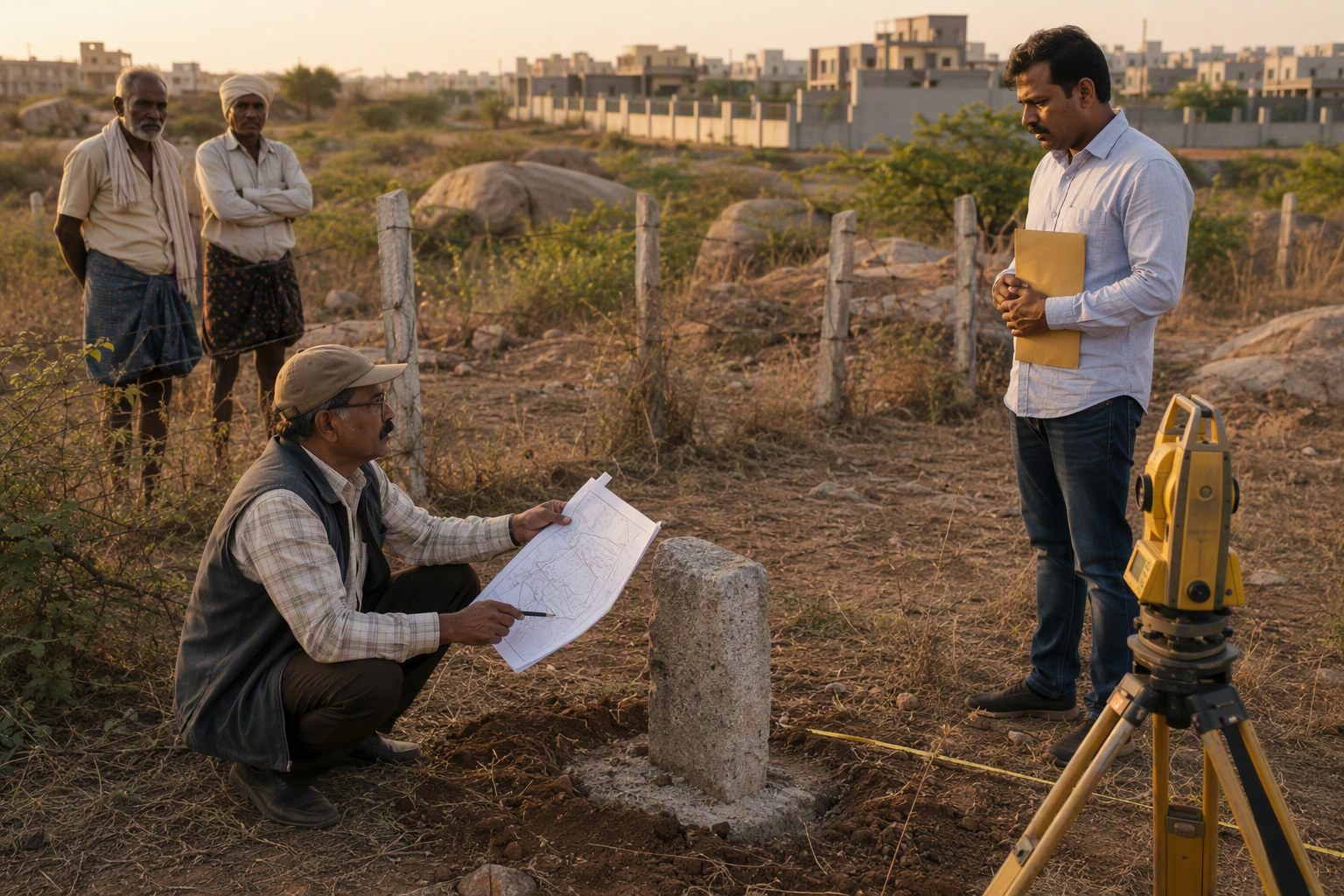
Surveyor’s View: Boundary Stones Before a Plot Token
Boundary stones before a plot token sounds like a small precaution, but in Hyderabad’s outskirts it can decide whether your land purchase is clean or painful. Last month, a buyer from Kukatpally called us after seeing an open plot near Mokila in Shankarpally mandal. The location was good, approach road was decent, and the seller wanted a token advance the same evening. One issue remained: the boundary stones were not matching the site sketch shown on WhatsApp.
The buyer did the sensible thing. He paused the token payment and called a licensed land surveyor. That one decision saved him from entering a deal where the physical possession, survey number extent, and neighbour’s fencing were all telling different stories.
“If stones are unclear, don’t give token. First fix the land on ground, then discuss price,” says a Hyderabad-based land surveyor we interviewed for this story.
In our experience, many plot disputes around Hyderabad do not start with fraud in the dramatic sense. They start with casual words: “Sir, boundary later adjust chestham.” That “later” can become a civil dispute, a police complaint, or a registration that does not match actual possession.
Boundary Stones Before a Plot Token: What the Surveyor First Checks
The surveyor we spoke to works across Shankarpally, Moinabad, Chevella, Maheshwaram, Abdullapurmet, Ghatkesar, Medchal and Keesara mandals. His first rule is simple: a plot is not only its sale deed. It is also its physical limits on the ground.
When he reaches a site, he does not begin with the seller’s sales talk. He asks for the survey number, village name, mandal, layout copy if any, link documents, pahani or Dharani record reference, and the latest encumbrance details. Then he walks the four sides.
“I see whether the boundary stones are old, newly planted, disturbed, or missing. If stones look freshly placed just before sale, I ask why. If one side has a neighbour’s compound wall and another side has open land, I take that seriously,” he says.
For buyers looking at plots in Tellapur, Kollur, Mokila, Nandigama, Adibatla, Tukkuguda, Ghatkesar, Kompally or Patancheru, this matters even more. These are not sleepy land pockets anymore. Every bit of road frontage, corner advantage, and plotted extent has money attached to it. A few feet difference can change the deal completely.
His basic field checklist
- Are all four corner stones visible?
- Do the stone positions match the sketch or layout plan?
- Is the road width on ground matching what the seller claims?
- Is there any overlap with a neighbour’s fence, wall, borewell, shed or pathway?
- Is the plotted land part of a larger survey number or already sub-divided?
- Does the seller have possession of the exact portion being sold?
- Is the land in a prohibited property list, assigned land issue, ceiling case, lake buffer, road widening line or government claim?
Before site visit, a buyer can at least run the survey number through Survey Number Finder and then check the broader risk using Property Verification Tool. These tools will not replace a physical survey, but they help you ask sharper questions before paying a rupee.
Boundary Stones Before a Plot Token: Why Buyers in Hyderabad Outskirts Get Trapped
Hyderabad buyers are often quick with token advance because good plots appear to move fast. Brokers create urgency. Sellers say another party is ready. Family members say prices will rise after the next road or project announcement. This pressure is common in areas like Shankarpally, Sadashivpet side, Maheshwaram, Ibrahimpatnam, Kandukur, Yacharam, Ghatkesar and Bibinagar belt.
But land is not like buying an apartment in a finished gated community. In plotted land, you are buying a piece of earth with a legal identity and a physical boundary. Both must match. If they don’t, the buyer is the one who runs from SRO to survey office to advocate.
The surveyor gave us a blunt line: “Token advance is emotional money. Survey is factual work. Do factual work first.”
We agree. A token receipt may mention the plot number and survey number, but if the seller later says “actual extent is slightly less” or “neighbour has occupied one side for years”, recovering the token itself becomes a headache. Some buyers accept adjustment and move on. Some fight. Both are avoidable.
Common boundary problems we see
| Problem on ground | Why it matters | Buyer action before token |
|---|---|---|
| Missing corner stones | Exact plot limits are not established | Ask for demarcation by surveyor before paying |
| Neighbour fencing inside claimed plot | Possession dispute may already exist | Speak to neighbour and verify records |
| Road shown wider in layout than on ground | Access, approval and future building permission may be affected | Use Road Width Check and verify at site |
| Survey number mismatch | Document may refer to different land | Check village, mandal, survey and sub-division carefully |
| Freshly planted stones | May be a last-minute marking without proper measurement | Demand measurement sketch and seller confirmation |
One practical tip: do not inspect only from the road. Walk the full boundary. In rainy season, stones may be hidden under grass. In newly levelled land, stones may be removed by JCB work. In agricultural land converted informally into plots, old field bunds may mislead you.
What a Proper Plot Boundary Survey Looks Like
A good survey is not just one man pointing and saying, “This is your land, sir.” It is a process. The surveyor studies documents, identifies the correct survey number location, compares nearby fixed features, checks village maps where available, and measures the site with suitable equipment.
In some cases, he may suggest official demarcation through the concerned revenue/survey authorities, especially where the land is agricultural, part of a larger survey number, or involved in neighbour disputes. Private measurement is useful for buyer confidence, but official demarcation carries more weight when boundaries are contested.
For buyers, the key is not to become a survey expert overnight. The key is to know what to demand. Ask the surveyor for a simple written note or sketch showing the measured boundaries, side lengths, road side, neighbour details, and any mismatch noticed. If the seller refuses such checking, that itself is a signal.
Documents to keep ready before calling the surveyor
- Latest sale deed or link deed copy
- Plot layout copy, if it is a plotted venture
- Survey number and village details
- Pahani or Dharani extract reference, wherever applicable
- EC details checked through Encumbrance Certificate Search
- Market value check from Market Value / Guideline Value Search
- SRO jurisdiction from Find Your SRO Office
Buyers also ask us about “real rates”. For Telangana, the safer starting point is the official guideline or market value used for registration, not a random broker quote. Rates vary by village, locality, property type, road access and official classification. So we advise buyers to check the current ready reckoner value through the market value tool and then compare it with local transaction quotes. If the quoted price is far away from the government value, ask why. Sometimes there is a genuine premium. Sometimes there is a hidden problem.
Section 22-A Risk: Boundary Is Not the Only Red Flag
Even if boundary stones are perfect, title risk can still exist. Telangana has a large list of properties where registration can be restricted under Section 22-A. As per the database available to us, 3,076,153 prohibited properties are recorded in this category. That number alone should make every plot buyer slow down and verify before paying token.
Section 22-A issues can include government lands, assigned lands, endowment-related properties, wakf claims, court-related restrictions and other notified categories. A buyer may not identify this by visiting the land. The plot may look open, clean and saleable. The seller may show old documents. But at registration stage, the SRO can refuse or flag the transaction if the property falls under a prohibited category.
Before token advance, use Section 22-A Prohibited Property Check. If the land is part of an approved plotted project, also use RERA Project Lookup where applicable. For open plots in revenue layouts or gram panchayat layouts, RERA may not always answer your concern. You still need title, land use, road and survey verification.
Another point buyers miss is land use. A plot may be sold as “future residential” but fall in a zone where permissions are not straightforward. For this, check Land Use Zone Finder. If you plan to build later, do not assume that every open plot can take a house approval simply because nearby houses exist.
Interview Notes: What the Surveyor Wants Buyers to Stop Doing
We asked the surveyor what habits create the most trouble for buyers. He laughed first, then gave a serious list.
“Buyers trust colourful layout brochures more than stones on ground. Brochure is marketing. Stone is possession. Record is title. All three must speak the same language.”
His first complaint is that buyers visit only once, usually in the evening, when visibility is poor. In outskirts, sellers sometimes show a plot from a distance: “From that stone to this tree.” That is not enough. Go in daylight. Take photos and videos from all corners. Record the approach road. Note neighbouring survey numbers if visible.
His second complaint is blind faith in token receipts. A token receipt can record intention, not cure a defect. If the seller does not have clear possession, your receipt will not move the neighbour’s wall. If the survey number is under dispute, your receipt will not clear it at the SRO.
His third complaint is family pressure. Many buyers bring parents, spouse, friends and broker to the site, but no technical person. Everyone discusses vastu, distance from ORR, future metro rumours, school access and resale. Very few ask: “Where exactly does this plot start and end?”
His no-token rule
The surveyor follows a simple no-token rule. If any of these are pending, he advises the buyer to wait:
- Boundary stones not fixed on all corners
- Seller cannot identify exact plot on ground
- Survey number is unclear or differs between documents
- Neighbour objects during site inspection
- Road access is not physically available
- Land falls under a restriction or unclear government record
- Layout approval, if claimed, is not produced
In our opinion, this rule is practical for Hyderabad’s current land market. It may cost you one “hot deal”, but it can save years of stress.
How to Handle Token Advance Safely After Boundary Verification
Once the boundary is verified, token can still be structured carefully. Do not pay large token amounts casually. Keep the payment traceable. Mention the property clearly with village, mandal, survey number, plot number if any, extent, boundaries on all four sides, agreed price, timeline for document verification, and refund condition if title or survey issues arise.
Use clear language. Avoid vague lines like “subject to satisfaction”. Say what must be satisfied: EC, title flow, Section 22-A check, land use, boundary demarcation, road access, family consent, pattadar details and SRO registration feasibility.
If you need a draft, use Legal Document Generator as a starting point, then get it reviewed by a local property advocate. For stamp duty planning, check Stamp Duty Calculator. If you are comparing built-up value in a plotted house deal, Building Value Calculator may also help.
For buyers in villages around Hyderabad, one more local tip: verify the SRO correctly. Some buyers assume an area falls under a familiar SRO because the nearest town is popular. Registration jurisdiction can differ based on village mapping. Use the SRO village details and do not depend only on broker memory.
Local Examples: What Changes from Mandal to Mandal
Land checking in Telangana is local work. A plot in Mokila, Shankarpally mandal, is not checked the same way as a plot in Tukkuguda, Maheshwaram mandal. A site near Ghatkesar has different pressure points from one near Moinabad. Around Kollur and Tellapur, plotted land often gets compared with villa and apartment development nearby, so access roads and layout approvals become sensitive. Around Adibatla and Kongara Kalan, buyers focus on growth stories, but survey number clarity is still basic.
In Patancheru and Ameenpur side, older layouts, industrial influence and mixed land uses need careful verification. In Keesara and Medchal belts, many buyers look at open plots as long-term investments, but that does not reduce the need for demarcation. In Abdullapurmet and Hayathnagar side, road expansion rumours and changing urban edges can confuse buyers. The document may look acceptable, but the ground position must be checked.
We have seen buyers ask, “If registration happens, is everything safe?” Not always. Registration is a strong step, but it is not a magical shield against wrong possession, boundary encroachment or future neighbour claims. Clean purchase means title, possession, boundary and use must align.
Final View: Pay for Measurement Before You Pay Token
Boundary stones before a plot token is not a conservative idea. It is common sense in Telangana land buying. A surveyor’s fee is small compared with the cost of a disputed plot. If the seller is genuine, he should not object to measurement. Many good sellers welcome it because it reduces later arguments.
My advice is direct: before you pay token, stand on the land with the seller, surveyor and broker present. Identify all corners. Photograph them. Match them with documents. Check government records. Confirm road access. Then discuss advance.
A plot is attractive only when you can point to it confidently and say, “This exact piece is what I am buying.” Until then, keep your money in your account.
Frequently Asked Questions
Should I pay token advance if boundary stones are missing?
No. First ask the seller to get the plot measured and corner stones fixed. Pay token only after the exact boundaries, survey number and possession are clear.
Can a private surveyor confirm the legal title of land?
A surveyor can help confirm physical boundaries and measurement. Legal title needs document verification through sale deeds, EC, Dharani or revenue records, SRO checks and advocate review.
Why is Section 22-A check needed before buying a plot in Telangana?
Section 22-A lists properties where registration may be prohibited or restricted. Even a good-looking plot can face registration issues if it falls under a prohibited category.
What details should a token receipt mention for an open plot?
It should mention village, mandal, survey number, plot number if any, extent, four boundaries, agreed price, payment details, verification conditions and refund terms if title or boundary issues are found.
Is guideline value enough to decide plot price?
No. Guideline value is a government reference for registration. Market price depends on locality, road access, approvals, demand, land use and title quality. Use it as a starting point, not the final price.