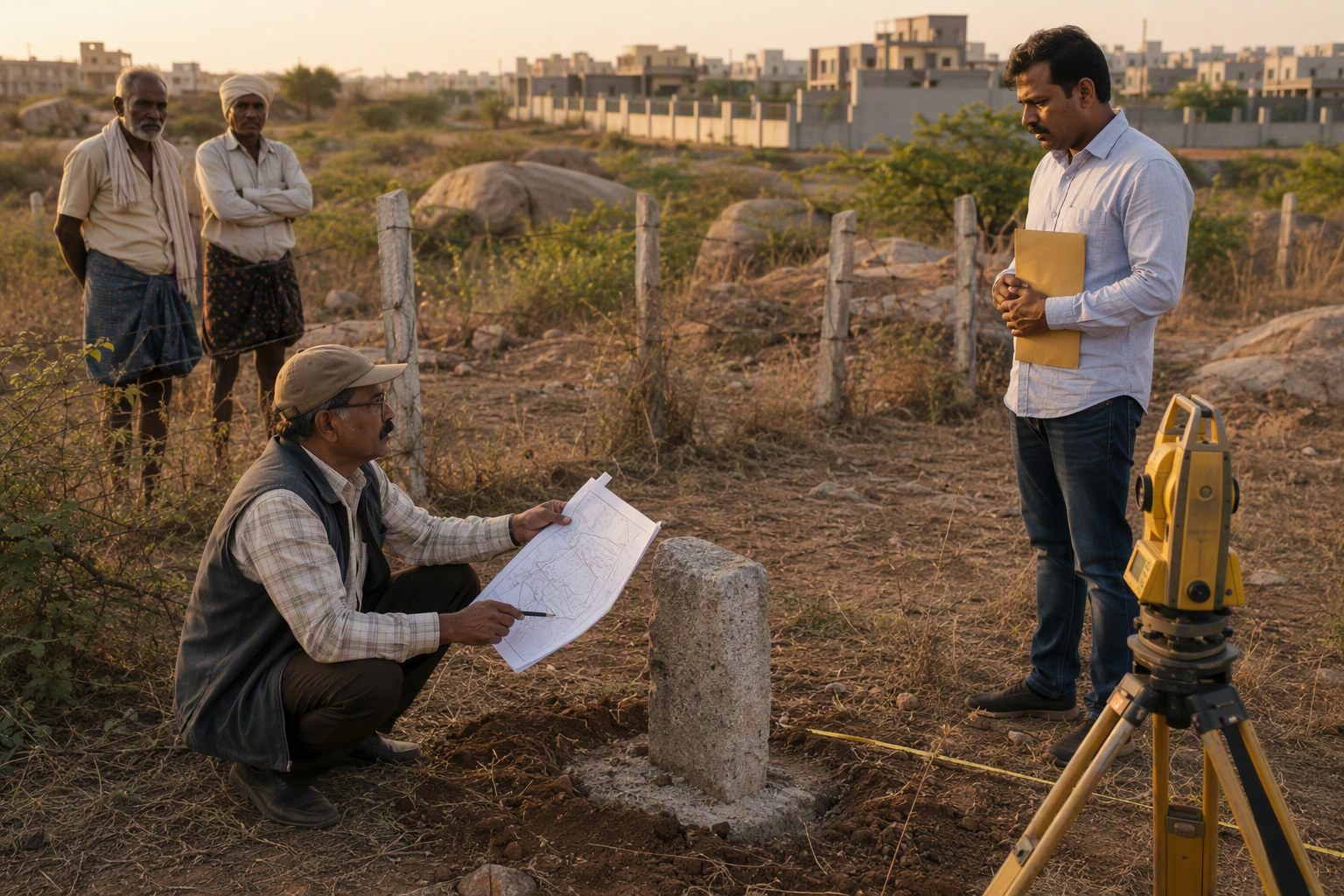



Lawyer View: Why 22-A Must Come Before Negotiation
Lawyer View: Why 22-A Must Come Before Negotiation is no longer a cautious buyer’s slogan. It has become basic survival in Telangana property buying. As per latest IGRS data available in our database, Telangana has 3,076,153 prohibited properties under Section 22-A. That is 30.76 lakh entries where registration can be refused or stopped because the land falls under a prohibited category.
For buyers looking at plots, villas, farm lands or old houses across Hyderabad’s growth corridors — Serilingampally, Rajendranagar, Shankarpally, Shamshabad, Medchal, Hayathnagar, Uppal, Ghatkesar and beyond — the message from property lawyers is becoming very direct: do the 22-A check before price negotiation, not after token payment.
In our experience, many buyers still treat legal verification as a post-bargain step. They first like the location, negotiate, pay a small advance, then ask for documents. That order is risky. If the survey number or sub-division is found in the prohibited list, the attractive price becomes meaningless. You may not get registration. You may not get bank funding. You may spend months chasing refunds.
Before any serious discussion on price, start with the Section 22-A Prohibited Property Check, confirm the survey number using the Survey Number Finder, and cross-check transaction history through the Encumbrance Certificate Search. This is not over-caution. It is the new normal in Telangana due diligence.
Why 22-A Must Come Before Negotiation in Telangana
Section 22-A is not a small technical entry sitting somewhere in the registration system. It directly affects whether a document can be registered at the SRO. If a property is covered by a prohibited category, the Sub-Registrar can refuse registration. For a buyer, that means the whole deal can collapse even after weeks of negotiation.
The legal view is simple: price is relevant only after transferability is clear. A land parcel may be in a hot location like Kokapet, Tellapur, Mokila, Narsingi, Adibatla, Kompally or Bachupally. The approach road may look good. The seller may show old link documents. The layout may have compound walls and neighbouring houses. Still, if the land is hit by 22-A, the buyer’s ability to register title becomes doubtful.
Lawyers are seeing a pattern. Buyers get emotionally locked into a property first. Then they try to justify the legal risk because they already negotiated hard or paid token money. That is exactly why experienced conveyancing lawyers now insist that 22-A screening must come before bargaining.
Our practical view is this: a buyer should not discuss final price, advance amount or registration date until the survey number has cleared the 22-A check. Otherwise, you are negotiating on an assumption, not on a saleable property.
This matters even more in Hyderabad’s outer growth areas. Many parcels in and around HMDA limits have complex histories — assigned lands, government claims, old pahanis, ceiling issues, endowment references, wakf claims, missing mutation records, family partitions, unregistered agreements and layout regularisation doubts. A 22-A hit may not always be visible from the ground. It has to be checked in records.
The 30.76 Lakh 22-A Prohibited Properties Context
The number that should make every buyer pause is 3,076,153. That is the prohibited property count in our database context for Telangana Section 22-A records. In plain buyer language, it means there are 30.76 lakh property entries where registration-related restrictions may apply.
This does not mean every attractive plot is unsafe. It also does not mean every 22-A entry is permanently unsellable in every possible situation. Some entries may need clarification, rectification, government permission or legal action depending on the category and facts. But for a buyer, the first question is not “Can this problem be solved someday?” The first question is: “Should I pay advance today?”
Usually, the answer from a careful lawyer will be no until the documents are tested.
In Telangana, land records are spread across different layers: Dharani records, old pahani, ROR entries, mutation proceedings, registration records, EC, layout permissions, local body approvals and SRO-level checks. A clean-looking sale deed alone is not enough. A clean EC alone is also not enough. The EC tells you registered transactions and charges reflected in registration records. It does not automatically certify that the land is free from all government prohibitions.
That is why we advise buyers to treat 22-A as a front-door check. If it fails, do not go deeper into price, interiors, vastu, bank loan eligibility or registration date. First ask: why is it listed, who listed it, which survey number is affected, and whether the proposed portion is the same land.
What Section 22-A Actually Means for a Buyer
Section 22-A of the Registration Act, as applicable in Telangana, deals with properties where registration is prohibited or restricted due to specified reasons. In practical Hyderabad market language, people call it “prohibited property list”. The issue may relate to government land, assigned land, endowment land, wakf property, ceiling surplus land, court or authority restrictions, or other notified categories.
For the buyer, the risk is not theoretical. A 22-A entry can affect the deal in several ways:
- Registration refusal: The SRO may not register the sale deed if the property is in the prohibited list.
- Loan difficulty: Banks and housing finance companies may avoid lending if title is affected by 22-A.
- Advance money dispute: Once token is paid, the seller may delay refund or blame the buyer for backing out.
- Title uncertainty: Even if there are old documents, government prohibition can create a serious transfer issue.
- Time loss: Rectification, clarification or legal proceedings may take time and may not be suitable for an end-user buyer.
This is why “we will check before registration” is a weak answer. By then, the buyer may have already paid money, arranged loan processing, sold another asset, or fixed family plans around the purchase.
Why 22-A Must Come Before Negotiation, Not After Token Money
Token money changes the psychology of a deal. Before payment, the buyer can walk away with a clear head. After payment, even a small amount creates pressure. Sellers may say, “Sir, this is only a technical issue.” Brokers may say, “Many registrations happen like this.” Relatives may say, “Don’t lose the plot; rates are increasing.” In that noise, legal judgement gets diluted.
We have seen this especially in land-heavy transactions around Shankarpally, Moinabad, Maheshwaram, Kandukur, Yacharam, Ibrahimpatnam, Chevella, Medchal and Ghatkesar. The location story is attractive. The road connectivity pitch is strong. The seller wants a quick token because there are “other buyers”. But the survey number is not checked properly.
A lawyer looks at the same situation differently. For a lawyer, there are only three stages:
- First: Is the land identifiable by survey number, extent, village and mandal?
- Second: Is it transferable and free from 22-A or other registration blocks?
- Third: Is the price commercially acceptable?
Many buyers reverse this order. They first ask whether the price is a bargain. That is how bad purchases happen. A discount on a non-transferable property is not a discount. It is a warning sign.
Hyderabad Localities Where 22-A Screening Needs Extra Care
22-A checking is relevant across Telangana, but the risk gets sharper in fast-moving Hyderabad markets because buyers are under pressure to decide quickly. In premium apartment zones like Gachibowli, Kondapur, Madhapur and Financial District, the common checks may include RERA, UDS clarity, development agreement, title flow and building permissions. In land and villa belt transactions, 22-A becomes even more central.
Areas where buyers should be particularly disciplined include:
- Serilingampally mandal: Kondapur, Gachibowli, Nanakramguda and surrounding pockets where old title chains can be complex.
- Gandipet and Rajendranagar side: Narsingi, Kokapet, Manikonda, Puppalaguda and adjoining areas where land values are high and title scrutiny must be strict.
- Shankarpally and Mokila belt: Popular for plotted developments and weekend-home buyers, but survey-level checks are essential.
- Shamshabad and Maheshwaram corridor: Strong demand due to airport-side growth, with mixed agricultural, layout and conversion histories.
- Medchal, Kompally and Dundigal belt: Active plotted and villa markets where buyers should verify village, mandal and SRO mapping carefully.
- Hayathnagar, Abdullapurmet and Ghatkesar side: Growth corridors with many land parcels changing hands; document discipline matters.
None of this means these areas are unsafe. Hyderabad’s growth story is real. But a good location does not cure a bad title. A wide road does not remove a 22-A entry. A broker’s confidence does not override government records.
Documents to Ask Before You Discuss Final Price
A serious seller should be able to share basic identification documents before asking for token money. If the seller refuses and says documents will be shown only after advance, that itself is a red flag. At minimum, ask for:
- Survey number and sub-division number, if any
- Village name, mandal and district
- Extent being sold and total extent in the survey number
- Latest pattadar passbook or Dharani details, wherever applicable
- Old pahani or ROR extracts, if land history is relevant
- Link documents showing title flow
- Latest EC for the relevant period
- Layout approval or local body permission, if it is a plotted layout
- Mutation proceedings or family partition records, where applicable
- SRO details for the property location
Use the Find Your SRO Office tool to identify the correct registration office. If the seller gives one SRO name and the records point elsewhere, pause and verify. For land parcels, the SRO Village Directory also helps buyers avoid confusion between similar village names.
For apartments and gated community projects, do not stop with brochure-level checks. Run the project through RERA Project Lookup, review the EC using EC Analyzer, and check whether the underlying land has any restriction before relying on marketing material.
22-A Check vs EC: Both Are Needed
A common buyer mistake is assuming that a clean Encumbrance Certificate means the property is safe. EC is useful, but it has a specific role. It shows registered transactions, mortgages and encumbrances reflected in registration records for the selected period. It is not a full legal title certificate.
22-A is different. It is about whether the property is prohibited or restricted for registration due to government-notified reasons. A property may have past sale deeds and still face a 22-A issue. That is why lawyers read EC and 22-A together.
| Check | What it tells you | What it does not fully answer |
|---|---|---|
| 22-A prohibited property check | Whether the survey number or property is listed under prohibited/restricted categories | Complete title flow, private disputes, unregistered agreements |
| Encumbrance Certificate | Registered sales, mortgages and charges reflected for the selected period | Government prohibition, missing old title defects, possession disputes |
| Dharani / revenue records | Revenue ownership and mutation position for agricultural land | Building permissions, private claims, complete registration history |
| RERA lookup | Registered project details for applicable real estate projects | Every land title defect unless disclosed or linked in records |
For a safer first round, combine the Section 22-A Prohibited Property Check, Encumbrance Certificate Search, Market Value / Guideline Value Search and Property Verification Tool. This gives you a stronger base before you spend on a full legal opinion.
How Lawyers Read a 22-A Result
A 22-A result should not be read casually. Lawyers usually ask a few follow-up questions:
- Is the exact survey number listed, or only a neighbouring survey number?
- Is the entire survey number affected or only part of it?
- Does the proposed plot fall within the affected extent?
- What is the nature of prohibition — government, assigned, endowment, wakf or another category?
- Are there old proceedings, court orders or deletion orders?
- Do Dharani and registration records match each other?
- Has the seller disclosed the issue in writing?
This is where local knowledge matters. A survey number in a revenue village may have multiple sub-divisions. Old documents may mention an earlier mandal or village spelling. Some sellers quote layout plot numbers, but the legal check has to go back to survey numbers. A plot number alone is not enough.
If the land is agricultural or converted from agricultural use, pahani, Dharani, mutation and conversion records need careful reading. If it is a layout, the parent land has to be checked. If it is a flat, the underlying land title and development rights must be reviewed. The format changes, but the principle remains: verify transferability before price.
Where Price Negotiation Can Mislead Buyers
A low price can hide title problems. A seller may say the property is being offered below the usual market level because of urgent need. Sometimes that is genuine. But sometimes the price is low because the seller knows the legal file is weak.
Buyers should be careful when they hear these lines:
- “Registration problem is only temporary.”
- “Everyone in this layout bought like this.”
- “Pay token first, then we will give full documents.”
- “Our lawyer has already checked, no need for your lawyer.”
- “The land is in Dharani, so there cannot be any issue.”
- “SRO will register if we manage properly.”
Good property does not need pressure tactics. A clean seller will normally allow reasonable document verification. In fact, sellers with good title benefit from early checks because the buyer gains confidence and negotiation becomes more serious.
Before discussing rate, buyers can also check government guideline value through the Market Value / Guideline Value Search and estimate registration costs through the Stamp Duty Calculator. But these come after the 22-A screening. Ready reckoner or market value is useful only for a property that can be validly transferred.
Practical Buyer Workflow: 22-A First, Then Bargain
Here is the workflow we prefer for Hyderabad and Telangana buyers:
Step 1: Identify the property correctly
Get the survey number, village, mandal, extent and SRO. If it is a flat, get the project land details and sale deed schedule. If it is a plot, get both plot number and parent survey number.
Step 2: Run the 22-A check
Check whether the property appears in the prohibited list. If there is a match, do not pay token money. Ask the seller for clarification documents and get a lawyer to review them.
Step 3: Check EC and title flow
Use EC records to understand registered transactions. Look for gaps, sudden transfers, old mortgages, releases and family settlements. EC is not the whole story, but it is a strong early filter.
Step 4: Verify revenue and approval records
For land, review Dharani, pahani, mutation and conversion records. For layouts, check approval status. For apartments, check RERA, building permission, development agreement and UDS details.
Step 5: Discuss price only after legal filters are passed
Once the property clears first-level legal screening, then discuss price, payment schedule, registration expenses, TDS if applicable, possession date and document handover.
Step 6: Put conditions in writing
If you still pay advance before final legal opinion, the agreement should clearly state refund conditions if 22-A, title, bank loan or approval defects are found. Oral assurances are weak in property disputes.
Seller Side View: Clean 22-A Status Improves Trust
This discussion is not only for buyers. Sellers with clear title should also run a 22-A check before listing the property. When you can show clean survey details, EC, link documents and SRO mapping, serious buyers respond faster. It reduces suspicion and prevents last-minute fallouts.
In premium Hyderabad markets, buyers are becoming sharper. NRIs, salaried families, startup employees, doctors, business owners and retirees are all asking better questions now. Many will not pay token without a basic legal pack. Sellers who prepare documents early usually negotiate from a stronger position.
If there is a 22-A issue, hiding it is a bad strategy. Disclose it, explain the status, provide supporting records and price the risk honestly. A buyer may still consider the property if the issue is curable and properly documented. But if the issue appears after token payment, trust breaks immediately.
Lawyer View: Why 22-A Must Come Before Negotiation in 2026 Buying Decisions
The Telangana property market is moving towards record-led decision-making. Buyers no longer have to depend only on broker talk or photocopied link documents. Tools, government records and digital checks have made early screening easier. That also means there is less excuse for skipping 22-A before negotiation.
My own view is firm: if the seller cannot provide survey details for a 22-A check, the buyer should not discuss final price. If the property appears in the prohibited list, the buyer should not pay token unless an independent lawyer gives a written comfort after reviewing the specific facts. If the seller pushes urgency without records, walk away.
Hyderabad will continue to grow. The demand for land, villas, plots and apartments will remain strong in many pockets. But growth does not remove legal risk. A disciplined buyer may lose one tempting deal, but will save years of stress.
So the working rule is simple: 22-A first, negotiation next, token last. That one change can protect buyers from the most painful type of property mistake — paying money for a property that cannot be registered smoothly.
Frequently Asked Questions
What is Section 22-A in Telangana property registration?
Section 22-A refers to properties where registration is prohibited or restricted due to government-notified reasons. It can include categories such as government land, assigned land, endowment or wakf-related property, ceiling issues or other restricted entries. Buyers should check this before paying token money.
Why should I check 22-A before negotiating the property price?
Because price matters only if the property can be legally transferred. If the survey number is listed as prohibited, registration may be refused at the SRO. Checking 22-A first helps you avoid advance payment disputes and wasted negotiation.
Is a clean Encumbrance Certificate enough to buy land in Hyderabad?
No. EC is useful for checking registered transactions and mortgages, but it does not fully answer whether the property is prohibited under 22-A. A buyer should check EC, 22-A, revenue records, title flow and approvals together.
What details are needed for a 22-A prohibited property check?
You generally need the correct survey number, village, mandal, district and extent. For plotted layouts and flats, the parent land survey details are also needed. Do not rely only on plot number or flat number.
What should I do if the property appears in the 22-A list?
Do not pay token money immediately. Ask the seller for clarification records, deletion orders if any, title documents and revenue papers. Get an independent property lawyer to review the exact survey number and affected extent before taking a decision.