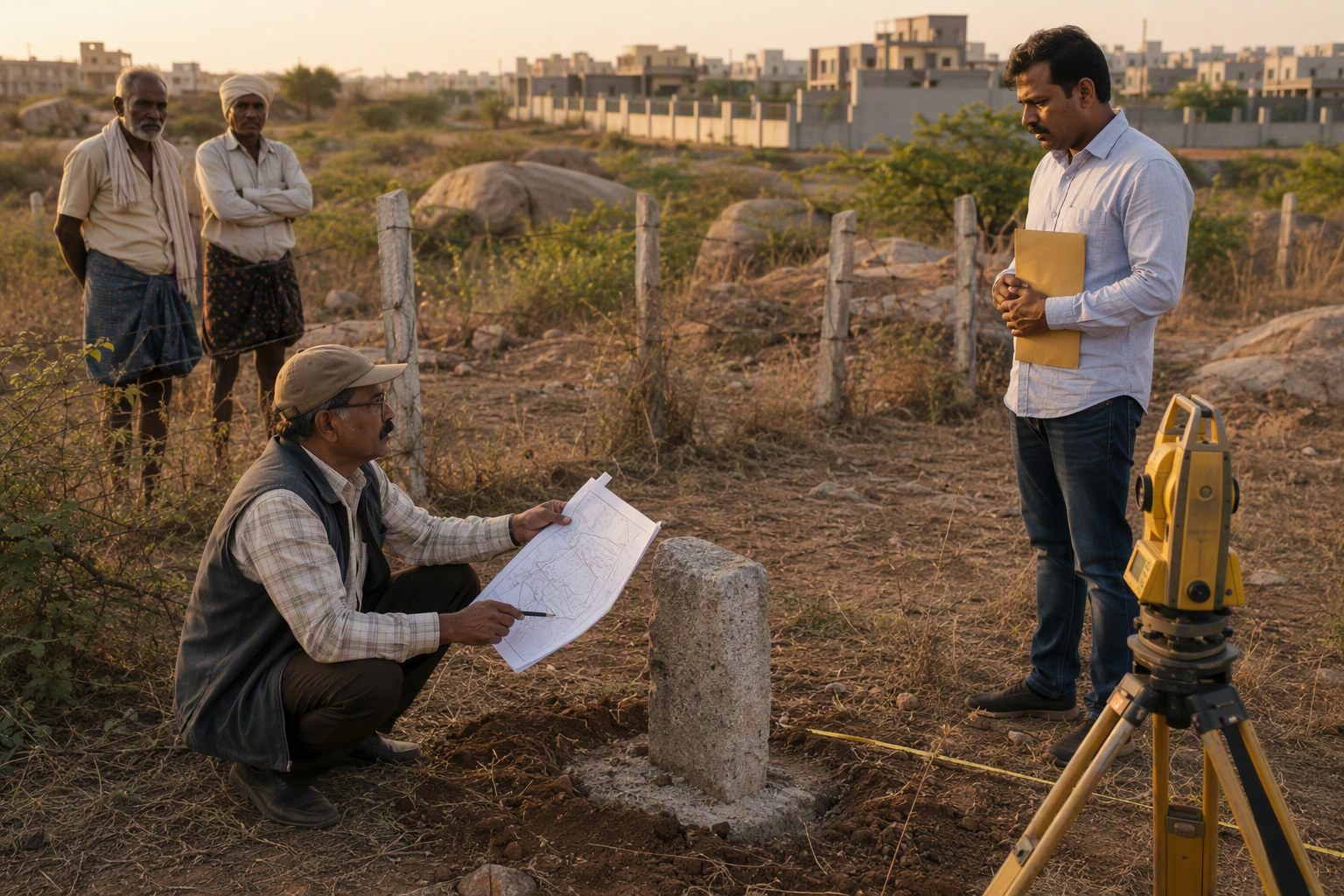



Mutation Alone Cannot Prove Title — that is the blunt legal message Hyderabad buyers are hearing more often as land deals move through Dharani, SRO records, bank scrutiny and court checks. A mutation entry may show whose name is entered in revenue records, but a senior Telangana property lawyer says it cannot replace the registered deed, Encumbrance Certificate, link documents, pahani, 1-B, layout approvals and Section 22-A checks.
The warning matters because many buyers in places like Serilingampally, Rajendranagar, Gandipet, Shankarpally, Medchal, Hayathnagar and Maheshwaram still treat a pattadar passbook or Dharani mutation as the final word on ownership. In our experience, this is where expensive mistakes begin. Mutation can support possession and revenue recognition. Title is a deeper legal story.
“Mutation is not a title deed. It is an entry for revenue administration. If the parent sale deed, succession chain or partition record is defective, mutation will not cure that defect,” a senior Hyderabad property lawyer told Verified.RealEstate.
Why Mutation Alone Cannot Prove Title in Telangana
Mutation is mainly the process of updating government revenue records after a sale, inheritance, gift, partition, court order or other transfer. In Telangana, agricultural land buyers often look at Dharani entries, pattadar passbooks, pahani and 1-B. For urban properties, people also check municipal assessment and property tax name changes. These records are useful, but they are not the same as ownership proof.
A registered sale deed at the SRO shows a transfer document. An EC shows registered transactions recorded for a period. Revenue records show who is recognised for land revenue purposes. Court records may show pending disputes. Section 22-A records may block registration. RERA records may matter for apartments and plotted developments. Each document tells one part of the story.
The lawyer’s practical point is simple: if one record says one thing and another record says something else, the buyer should not choose the most convenient record. The buyer should pause, compare, and ask why the mismatch exists.
Why Mutation Alone Cannot Prove Title When EC and Deeds Say Something Else
In Hyderabad’s growth corridors, we have seen buyers produce a clean-looking Dharani entry while the EC carries an older mortgage, a court attachment, a gift deed in favour of another family member, or a sale agreement that needs explanation. Sometimes the EC is clean for the selected period, but the earlier link documents show a break in chain. Sometimes the mutation is in one person’s name, but the registered deed indicates joint family property.
The safest approach is not to worship one document. A buyer should create a title file and compare the following:
- Latest registered sale deed, gift deed, partition deed, release deed or succession document.
- Parent documents covering the chain of title.
- Encumbrance Certificate for the relevant period through Encumbrance Certificate Search.
- Revenue records such as pahani, 1-B, pattadar passbook and Dharani status.
- Section 22-A status through Section 22-A Prohibited Property Check.
- SRO jurisdiction through Find Your SRO Office.
- Survey number and village cross-check through Survey Number Finder.
For apartments, the file must include sanctioned plan, occupancy certificate where applicable, UDS details, RERA registration where applicable and the builder’s development documents. Use RERA Project Lookup before assuming that a project’s marketing material is enough.
The Section 22-A Angle: A Mutation Entry May Still Sit on a Blocked Property
One of the biggest traps in Telangana land buying is the prohibited property list under Section 22-A of the Registration Act. Verified.RealEstate’s database records 3,076,153 prohibited property entries under Section 22-A. That number alone should make every buyer cautious before paying token advance on agricultural land, assigned land, endowment land, waqf land, ceiling land, government land or properties under dispute.
A seller may show mutation in his or her name. But if the survey number is under a prohibited category, registration can be refused or later challenged. The buyer then gets stuck between the seller, broker, bank and government department. In local language, people say “Dharani lo peru undi sir”, but name entry is not a full legal clearance.
For mandals like Shankarpally, Moinabad, Chevella, Kandukur, Maheshwaram, Yacharam and Medchal, where land demand has been strong, this 22-A check is not a formality. It should be one of the first checks, not the last.
What Mutation Actually Proves — and What It Does Not
| Document / Record | What it usually indicates | What it does not prove by itself |
|---|---|---|
| Mutation / Dharani entry | Name entered in revenue records after transfer, succession or administrative update | Absolute legal title, absence of disputes, or validity of parent documents |
| Registered sale deed | Documented transfer registered at the SRO | That the seller had perfect title, unless link documents support it |
| Encumbrance Certificate | Registered transactions for the selected period | Unregistered claims, family disputes, possession issues or wrong survey boundaries |
| Pahani / 1-B | Revenue and cultivation-related entries | Conclusive ownership in civil law |
| Property tax mutation | Municipal record of taxpayer name | Title to land or building |
| RERA record | Project-level disclosure for applicable developments | Clean title for every individual buyer unless documents are verified |
This table is not theory. It comes up daily in real transactions. A buyer of land near Adibatla may have a registered deed and mutation, but the old survey sketch may not match the physical boundary. A villa buyer in Mokila may rely on a developer’s brochure, but the land conversion and layout approvals need separate reading. A flat buyer in Kokapet may assume bank approval is enough, but the buyer’s UDS, EC and builder title still require independent review.
Lawyer’s Red Flag List Before You Trust a Mutation Entry
The senior lawyer we spoke to was firm on one point: do not treat mutation as a shortcut. It should trigger deeper verification, especially when the deal value is high or the land has changed hands several times. He listed common red flags seen in Telangana property files:
- Mutation done recently after a long gap in the title chain.
- Seller’s name in Dharani but parent deed standing in another family member’s name.
- Mismatch between survey number in deed and revenue record.
- Extent mismatch between pahani and registered document.
- Old mortgage appearing in EC without a registered release deed.
- Property falling under Section 22-A or pending government classification.
- Land shown as agricultural, but marketed as plotted layout without proper approvals.
- Legal heirs not joining the sale despite family property history.
- Possession on ground differing from map, FMB or survey sketch.
In our experience, the most dangerous line from a seller is: “Mutation ayipoyindi, inkem problem undadu.” That may be true in a clean file, but a buyer cannot assume it. Verification is cheaper than litigation.
How Buyers Should Read EC, Registered Deeds and Revenue Records Together
Start with the registered deed, not the mutation entry. Who sold the property? On what basis did that person own it? Was it purchased, inherited, gifted, partitioned, allotted or assigned? Then check whether each step is supported by registered documents or legally acceptable records.
Next, read the EC. A plain EC does not always mean a perfect title. It means no registered encumbrance appears for the selected period and property description, subject to correct search details. If survey number, door number, flat number or village name is entered wrongly, the EC may miss entries. This is why SRO and village identification matters. Buyers can cross-check jurisdiction using SRO Village Directory.
Then review revenue records. In agricultural lands, see pattadar name, extent, nature of land, classification and any remarks. In non-agricultural transactions, check layout approval, land use and conversion records. For the planning side, tools like Land Use Zone Finder, Road Width Check and FSI/FAR Calculator help buyers understand development constraints.
Finally, check financial and registration exposure. Stamp duty and market value should be estimated from official guidance, not broker talk. Use Market Value / Guideline Value Search and Stamp Duty Calculator before planning the registration budget.
Mutation Alone Cannot Prove Title in Family Property Cases
Family property is where mutation creates maximum confusion. Suppose a father’s name was in revenue records, and after his death, one son got the land mutated in his name. Does that mean other legal heirs have no claim? Not necessarily. Mutation based on succession may be administrative. If daughters, other sons, widow or legal heirs were not properly accounted for, civil disputes can arise later.
This is common in older village lands around Patancheru, Narsingi, Shamshabad, Ghatkesar and Ibrahimpatnam. Families may have oral partitions, unregistered arrangements or old panchayat-level understandings. A buyer entering such a file must ask for legal heir details, death certificates, family member certificates where relevant, registered partition or release deeds, and clear consent from all necessary parties.
The lawyer’s view is strict: if the title flows from inheritance, mutation is only one supporting record. It does not replace proper succession proof. A buyer who ignores missing heirs may become the next defendant in a civil suit.
For Flats and Villas, Mutation Is Even Less Useful
Many apartment buyers ask whether property tax mutation or municipal name change proves ownership. The answer is no. It shows that the local body has changed the taxpayer or occupier record. It does not validate the builder’s title to the underlying land or the buyer’s UDS share.
For flats in Madhapur, Kondapur, Gachibowli, Miyapur, Bachupally, Uppal or LB Nagar, buyers should check the registered sale deed, agreement of sale, construction agreement, UDS share, sanctioned plan, occupancy certificate where applicable, EC, RERA status and association handover documents. For villas and gated communities, land title and layout approval become even more sensitive because the buyer is purchasing both built-up space and land share.
If a project is under construction, check RERA. If it is a resale flat, check the original allotment chain, bank release, previous sale deed and current EC. If there is a loan, run a charge check through CERSAI Charge Check.
A Practical Verification Flow Before Paying Advance
Here is the working method I recommend to buyers, especially in land transactions:
- Identify the property correctly: village, mandal, survey number, extent, boundaries and SRO.
- Check Section 22-A first: do not wait until the registration date.
- Collect parent documents: go back through the title chain, not just the latest deed.
- Run EC search: use correct property details and relevant period.
- Compare Dharani, pahani and deed: name, extent, classification and survey number must make sense.
- Check approvals: HMDA, DTCP, GHMC, municipality, gram panchayat or other authority depending on location.
- Verify possession: match ground reality with boundaries, sketch and neighbours’ inputs.
- Get legal opinion: especially for agricultural land, inherited property, old layouts and high-value resales.
For a quick starting point, buyers can use Property Verification Tool and track later changes through Property Change Tracker. These tools do not replace a lawyer, but they help you ask better questions before money leaves your account.
What Sellers Should Do If Mutation and Title Documents Differ
Sellers also face problems when records do not match. If the deed says one extent and Dharani shows another, or if the owner name has spelling differences, banks and buyers may hesitate. The solution is not to pressure the buyer. Clean the file.
Depending on the issue, the seller may need rectification deeds, updated revenue records, legal heir documentation, release deeds from family members, mortgage release, survey correction or clarification from the relevant authority. In some cases, the matter may require a civil court order. A clean title file usually gets better buyer confidence than a rushed explanation at the registration office.
The Bottom Line From the Senior Lawyer
The lawyer’s view is that mutation is a useful record, but a weak foundation if used alone. Title is proved through a chain of legally valid documents supported by possession, revenue entries, registration records, approvals and absence of prohibitions or claims. In Telangana, where Dharani, SRO records and planning permissions often intersect, buyers must read the full file.
My own view is similar. Mutation is a signal, not the final stamp. If the seller has good title, he should not object to EC checks, link document review, 22-A verification, SRO search, survey confirmation and legal opinion. If he objects, that itself is information.
Frequently Asked Questions
Does mutation prove ownership in Telangana?
No. Mutation shows an update in revenue or municipal records. It supports the record of possession or revenue recognition, but it does not by itself prove absolute legal title.
What should I check along with mutation before buying land?
Check registered deeds, parent documents, EC, pahani, 1-B, Dharani status, Section 22-A status, survey number, boundaries, approvals and legal heir documents where applicable.
Can a property be mutated but still be prohibited under Section 22-A?
Yes, it can happen. A mutation entry does not automatically remove restrictions. Always check the Section 22-A prohibited property status before paying advance or planning registration.
Is a clean EC enough to buy a property?
No. A clean EC only reflects registered transactions for the searched period and details. You still need link document verification, revenue record checks, approvals and legal review.
Should I take legal opinion if the seller has Dharani passbook?
Yes, especially for agricultural land, inherited property, assigned land history, old layouts or high-value purchases. A Dharani passbook is useful, but it is not a substitute for title verification.