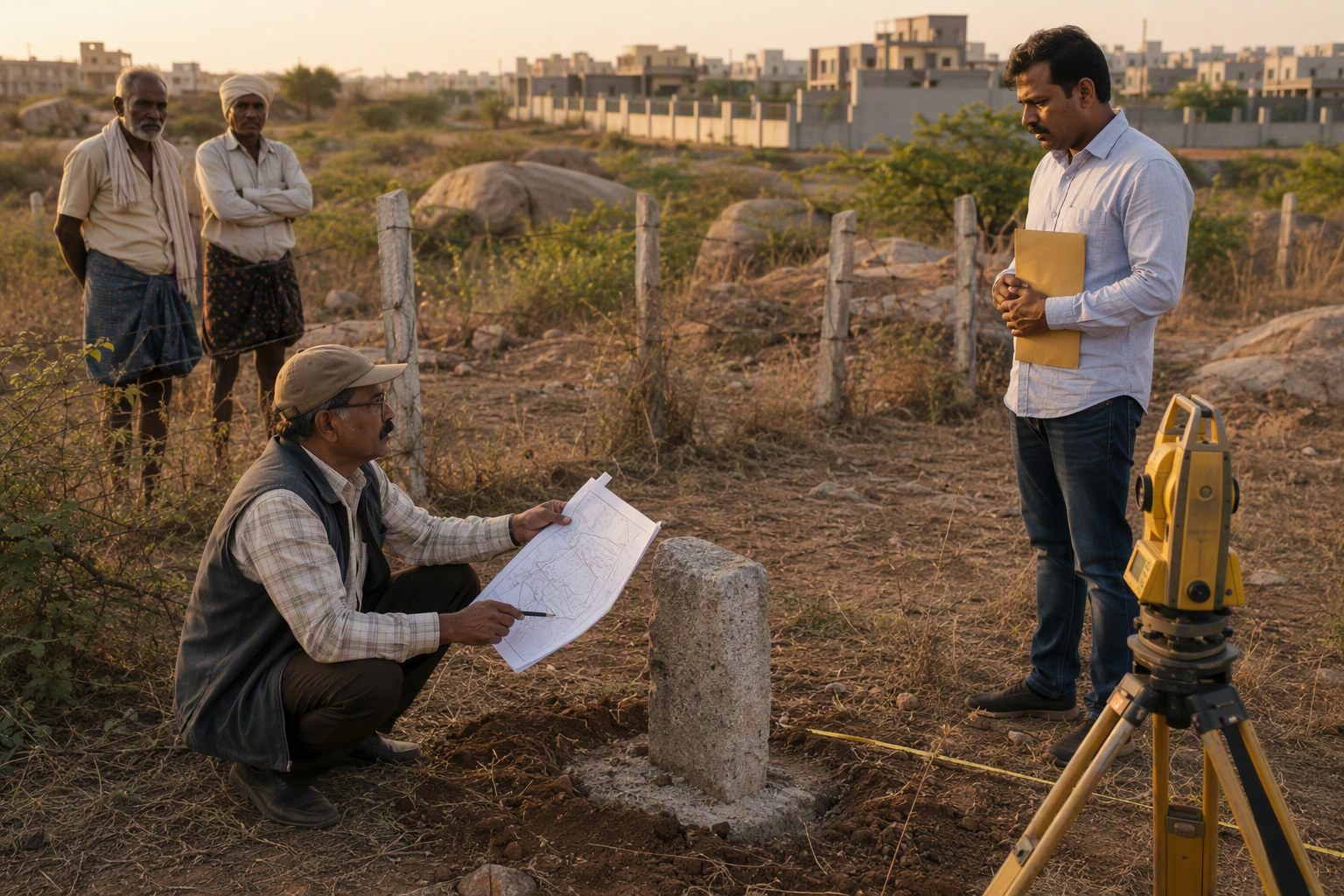



Document Writer View: The Token Receipt Mistake Buyers Regret starts with a very ordinary Hyderabad scene. A buyer likes a flat near Narsingi, the seller says two other parties are waiting, and the broker pushes for token money before dinner. The buyer transfers a token advance, takes a one-page receipt on WhatsApp, and feels relieved. Two days later, while checking papers with a document writer near the SRO, the receipt becomes the problem. Not the sale deed. Not the bank loan. Just that small token receipt.
We have seen this happen in Kokapet, Miyapur, Tellapur, Uppal, Patancheru and Shamshabad. Buyers treat token receipts like a small formality. Document writers read them like warning labels. A good document writer is not only typing sale deeds. He is reading ownership chain, survey number, mandal details, refund wording, witness signatures, EC entries, pattadar passbook details, RERA status if it is a project, and whether the property can even be registered.
For this article, I am taking the view of an experienced Telangana document writer who sits close to registration work every day. His opinion is sharp: token receipts are where many buyers lose bargaining power before legal verification even begins.
Document Writer View: The Token Receipt Mistake Buyers Regret Before Verification
The biggest mistake is simple. Buyers pay token money before writing the conditions under which the amount must be returned. The receipt only says, “Received token advance towards sale of flat/plot.” That line is not enough.
A document writer will first ask: received by whom? On what basis is that person accepting money? Is he the owner, GPA holder, developer, marketing person, broker, family member, or only someone “handling the deal”? In Telangana property transactions, this one question can change everything.
In one recent discussion near a busy SRO belt, a document writer told me, “Buyer thinks receipt means booking confirmed. I read whether it can stand if the deal breaks.” That is the real difference.
A receipt should not be treated as a casual chit. It should record the property identity, parties, payment mode, purpose, time limits, refund grounds and next step. If it does not, the buyer is left arguing on phone calls and broker messages.
“Token receipt should protect both sides. But in Hyderabad, many receipts protect only the seller because buyer is in a hurry.”
Before paying even a small token, buyers should check basics using tools like Encumbrance Certificate Search, Section 22-A Prohibited Property Check and Property Verification Tool. These checks will not replace legal scrutiny, but they slow down the hurry. In property buying, that pause itself saves money.
What A Document Writer Reads First In A Token Receipt
Most buyers read the amount and seller signature. A document writer reads the missing parts. His eye goes to identity, property description, refund clause and authority to receive money.
1. Full owner details, not just a first name
If the seller is “Ramesh garu”, that is not a legal identity. The receipt should carry the full name as per Aadhaar/PAN and as appearing in the link document or revenue record. If there are multiple owners, all names must be checked. In Hyderabad families, one brother may negotiate while the property stands in the name of mother, father, siblings or an HUF-type family arrangement. The receipt must match the real ownership position.
For apartments, the document writer will compare the owner name with the sale deed, allotment letter, builder NOC if applicable, and EC entries. For open plots or agricultural converted lands, he will see pattadar details, survey number, village and mandal. Dharani and old revenue records may need comparison, depending on the land type and transaction history.
2. Property description should be exact
A weak receipt says “flat at Narsingi” or “plot near Shadnagar highway”. That is not enough. The property must be identified clearly. For a flat, mention flat number, floor, block/tower, project name, undivided share if already available, village, mandal and registration district where possible. For a plot, mention plot number, survey number, layout name, village, mandal, extent and boundaries as per available documents.
This matters because Hyderabad real estate has many micro-markets where names overlap. A project marketed as Kokapet may fall under a different revenue village. A layout promoted as near Tellapur may be in a different mandal limit. The SRO jurisdiction also has to match. Buyers can use Find Your SRO Office and SRO Village Directory before assuming where the property gets registered.
3. Payment mode must be recorded
A proper receipt should mention how the token was paid: bank transfer, cheque, UPI or other traceable mode. The transaction reference should be written. Cash tokens create avoidable disputes. When a deal later fails, both sides start giving different versions. A document writer prefers traceable payment because the receipt and bank entry can be read together.
4. Who signed and in what capacity?
A broker signing “on behalf of owner” is a red flag unless there is written authority. A son signing for mother, a partner signing for firm, a marketing executive signing for developer, or a GPA holder signing for an NRI owner — each case needs document support. The receipt must say the capacity clearly.
If the seller is a company, firm or developer, the document writer will look for authorised signatory details. For RERA-registered projects, buyers should cross-check project details through RERA Project Lookup. For resale flats, RERA may not answer ownership, but it can help confirm the project background where applicable.
Document Writer View: The Token Receipt Mistake Buyers Regret In Refund Clauses
Refund wording is where buyers usually lose. Many receipts are silent on refund. Some say “non-refundable” without explaining what happens if documents fail verification. That is dangerous.
A fair token receipt should separate buyer default from document defect. If the buyer simply changes his mind after verification is clear, seller may have a case to deduct or retain as agreed. But if title documents are defective, if the seller cannot produce link documents, if EC shows unexpected transactions, if the property falls under prohibited category, if bank loan is rejected due to title issue, or if approvals are not as represented, the token should be refundable.
The document writer will prefer wording like: token amount is refundable if title, ownership, approvals, EC, prohibited property status, bank/legal verification or seller authority is not satisfactory. The exact drafting should be done carefully for the transaction, but the principle is this: refund must not depend only on seller’s mood.
In Telangana, Section 22-A prohibited property checking is not a casual step. According to government records in the Verified database, there are 3,076,153 prohibited property records under Section 22-A. That number itself tells buyers why a token receipt should not say “non-refundable under all circumstances”. If a property cannot move ahead due to legal restriction, why should the buyer lose money?
Use Section 22-A Prohibited Property Check before token, especially for plots, land parcels, assigned land doubts, government land doubts, endowment land concerns, ceiling land references, and older layouts where revenue history is not clean.
The Receipt Should Say What Happens After Token
A token receipt should not stop at “amount received”. It should create a simple path. What documents will seller give? By when? How many days will buyer get for verification? When will agreement of sale be signed? Who will bear registration expenses? What is the tentative registration timeline? These points reduce drama.
In our experience, most disputes start because parties have different assumptions. Seller thinks buyer must finish quickly. Buyer thinks he can take time for bank loan, legal opinion and family decision. Broker thinks his commission is confirmed. Document writer thinks none of this is written properly.
Here is what a sensible receipt can cover:
- Full names and ID references of buyer and seller.
- Complete property description with flat/plot/survey details.
- Token amount and payment reference.
- List of documents seller must share for verification.
- Clear verification period.
- Refund grounds if title, approvals, EC, RERA, bank/legal or prohibited property checks fail.
- Forfeiture condition only if buyer defaults after clear documents.
- Next step: agreement of sale or direct sale deed.
- Signatures of actual owners or authorised persons.
- Witness names, phone numbers and signatures.
For drafting a basic structure, buyers can refer to Legal Document Generator. But for high-value or complicated property, get it reviewed by a qualified professional. A tool can help with format; judgement comes from reading the actual papers.
How Document Writers Check Owner Proof Before Deal Moves Ahead
Good document writers in Telangana do not rely only on what the broker says. They ask for the link documents. In a flat resale, they want earlier sale deed, mother deed where required, EC, property tax details, society or builder records, loan closure documents if any, and ID proofs. In a plot transaction, they ask for layout approval, link documents, survey number details, pahani/adangal where relevant, conversion or permissions if applicable, and revenue records depending on the land type.
For lands around Shamshabad, Maheshwaram, Shadnagar belt, Moinabad side, Kandukur side, Patancheru and Medchal fringes, survey number checking becomes critical. Names used in marketing may not match revenue records. A buyer may say “it is near ORR exit”, but registration happens on survey number and village details. Use Survey Number Finder and Land Use Zone Finder for early screening.
The document writer then reads the Encumbrance Certificate. He checks if the seller’s acquisition deed appears, if any mortgage is reflected, if there are later transactions, and whether names and property identifiers match. Buyers can start with EC Analyzer after pulling the EC through Encumbrance Certificate Search.
If a bank loan was taken, CERSAI check is also useful. Some charges may not be visible in the same way a buyer expects from a plain EC reading. Use CERSAI Charge Check for an extra layer.
Why Hyderabad Buyers Rush Token Payments
There is pressure in many localities. Kokapet and Neopolis side conversations move fast. Narsingi and Puppalaguda resale flats get multiple enquiries if pricing is sensible. Miyapur and Bachupally family buyers worry that a good flat will go. Tellapur, Osman Nagar and Kollur buyers hear constant talk about future growth. Around Uppal, LB Nagar and Nagole, metro access creates urgency. In such a market, the word “token” feels harmless.
But document writers see the other side. Once token is paid, the buyer becomes emotionally committed. He may ignore small mismatches. He may accept weak explanations. He may rush into agreement of sale without full paper verification. Sellers and brokers also become less flexible after receiving money.
My opinion is direct: paying token before minimum checks is not smart negotiation. It is giving away your first protection. If the seller is genuine, he should not object to a proper receipt and basic verification. If he objects too much, that itself is information.
Ready Reckoner, Market Value And Stamp Duty: Do Not Mix Them With Token Logic
Another common confusion is between market value, agreed sale price, ready reckoner value and registration cost. Buyers sometimes think, “We will adjust later during registration.” But the token receipt should clearly mention whether token is part of total consideration, whether it will be adjusted in agreement of sale, and whether any deductions apply if transaction fails due to buyer default.
Before reaching agreement stage, buyers should check government market value through Market Value / Guideline Value Search and estimate registration outgo using Stamp Duty Calculator. For apartments where land share and construction value discussions come up, Composite Value Calculator can help understand the value split.
This is not only about cost planning. If the quoted terms, document value and payment flow are unclear, the receipt should not be vague. The document writer will ask how the token fits into the final registered transaction.
A Practical Token Receipt Checklist From A Document Writer
If I had to condense a document writer’s thinking into one table, it would look like this:
| Receipt Point | What Buyer Should Check | Why It Matters |
|---|---|---|
| Seller identity | Full name must match title papers or valid authority document | Prevents payment to the wrong person |
| Property details | Flat/plot number, survey number, village, mandal, extent, boundaries where applicable | Avoids confusion between marketed name and legal identity |
| Payment proof | Bank/UPI/cheque reference in receipt | Creates traceable evidence |
| Refund clause | Refund if title, EC, approvals, bank/legal or prohibited status fails | Protects buyer during verification |
| Document handover | Seller must provide listed documents within agreed time | Stops delay tactics after token |
| Authority to sign | Owner, GPA holder, authorised signatory or all co-owners | Confirms receipt is binding on the right person |
| Next step | Agreement of sale or sale deed timeline | Gives both parties a clear path |
Keep the receipt short if needed, but do not keep it blind. A one-page receipt can still be strong if the right words are present.
When A Buyer Should Walk Away Before Paying Token
There are situations where the best receipt is no receipt because the token should not be paid at all. Walk away or pause if the seller refuses to show title documents, says EC can be checked only after token, avoids owner meeting, gives only photocopies with key pages missing, pressures for cash, or says refund is impossible even if legal verification fails.
Also be careful when the property is promoted with loose phrases: “HMDA process lo undi”, “regularisation avuthundi”, “Dharani lo small issue undi”, “old family land, papers later”, “bank loan already came for another flat so no problem”. These may be harmless in some cases, but they need proof. Telangana real estate has too many document types for verbal comfort to be enough.
For plots and land parcels, check road access, land use and basic planning constraints before emotional commitment. Tools like Road Width Check, Geo Insights and Area Unit Converter can help buyers ask better questions before sitting with the document writer.
Document Writer View: The Token Receipt Mistake Buyers Regret Most
The mistake buyers regret most is not paying token money. Token payments are normal in property negotiations. The real mistake is paying token without making it conditional on clean verification.
A seller with clean papers should be comfortable with a receipt that says the deal will move ahead after legal, revenue, EC, approval and registration checks. A buyer with genuine intent should be comfortable with a clause that token may be forfeited if he backs out after papers are clear, as per agreed terms. Fair drafting protects both sides.
What should worry buyers is one-sided drafting. “Non-refundable under any circumstances” before document verification is unfair. “Owner details later” is unsafe. “Survey number later” is risky. “Receipt by broker only” is weak. “Documents after agreement” is backwards. First documents, then stronger commitment.
Hyderabad property buying rewards patience. Whether it is a flat in Gachibowli, a resale unit in Kondapur, a villa in Mokila, a plot near Kadthal, or land near Medchal, the token receipt is your first legal checkpoint. Treat it like one.
Final Take For Buyers
Before paying token, ask for papers. Before signing receipt, read refund wording. Before trusting location names, check village, mandal, survey number and SRO. Before believing “all clear”, run basic checks. A document writer may sound strict, but that strictness is often what protects the buyer.
If the other side is genuine, a properly worded receipt will not spoil the deal. It will make the deal cleaner. If the other side refuses even basic protective wording, you have received a warning without losing money. That is the best stage to receive it.
Frequently Asked Questions
Should token money be refundable if property documents fail verification?
Yes, the receipt should clearly say the token is refundable if title, EC, approvals, bank/legal verification or prohibited property checks are not satisfactory. Do not rely on verbal promises.
Can a broker sign the token receipt on behalf of the owner?
Only if the broker has written authority from the owner. Otherwise, insist that the actual owner, all co-owners, GPA holder or authorised signatory signs the receipt.
What property details should be written in a token receipt in Telangana?
Write flat or plot number, project or layout name, survey number where applicable, village, mandal, extent, boundaries for land/plots, and available SRO details. The legal identity of the property matters more than marketing location names.
Should I check Section 22-A before paying token?
Yes, especially for plots and land parcels. Telangana has 3,076,153 prohibited property records under Section 22-A in the Verified database, so this check should be done before stronger financial commitment.
Is a WhatsApp token receipt enough?
A WhatsApp copy is not ideal by itself. Get a properly worded receipt signed by the right person, with payment reference, refund terms, property details and witness details. Keep digital proof also, but do not depend only on chat messages.