


Case Study: A Balcony Enclosure That Delayed a Hyderabad Sale
On paper, it looked like a small interior improvement. A neat aluminium-and-glass balcony enclosure in a 3BHK flat in west Hyderabad. No extra bedroom. No structural beam cut. No dramatic elevation change. Just a balcony converted into a quiet sitting corner with sliding windows, blinds and wooden flooring.
But when the owner tried to sell the flat, this small makeover became the one item that slowed the deal, made the buyer nervous, and pushed the bank valuation into a second round of checking.
This is a common Hyderabad story now. In gated communities from Kondapur to Nallagandla, Kokapet to Miyapur, balconies are being covered to manage dust, pigeons, rain splash and road noise. Some owners use the space as a work-from-home nook. Some merge it visually with the living room. Some put a washing machine, puja corner, storage unit or kids' study table there.
I understand the temptation. Hyderabad weather and high-rise living can make open balconies less useful than the brochure promised. But resale is a different game. The buyer, banker, valuer, association and sometimes the registration-side document reviewer may all look at the flat as per sanctioned plan, sale deed, undivided share, built-up area statement, and actual site condition. If these do not sit well together, a simple interior job can create friction.
A balcony enclosure may feel like an interior choice, but during resale it can become a documentation question: Was the area approved, disclosed, valued correctly, and accepted by the association?
The flat, the owner and the small change
The seller in this case was a mid-career IT professional. He had bought the flat from a reputed developer around the time the project was handed over. The apartment had a living room balcony facing internal landscaping. Initially, the family used it for tea, plants and clothes drying. After two monsoons and one pigeon problem, they enclosed it.
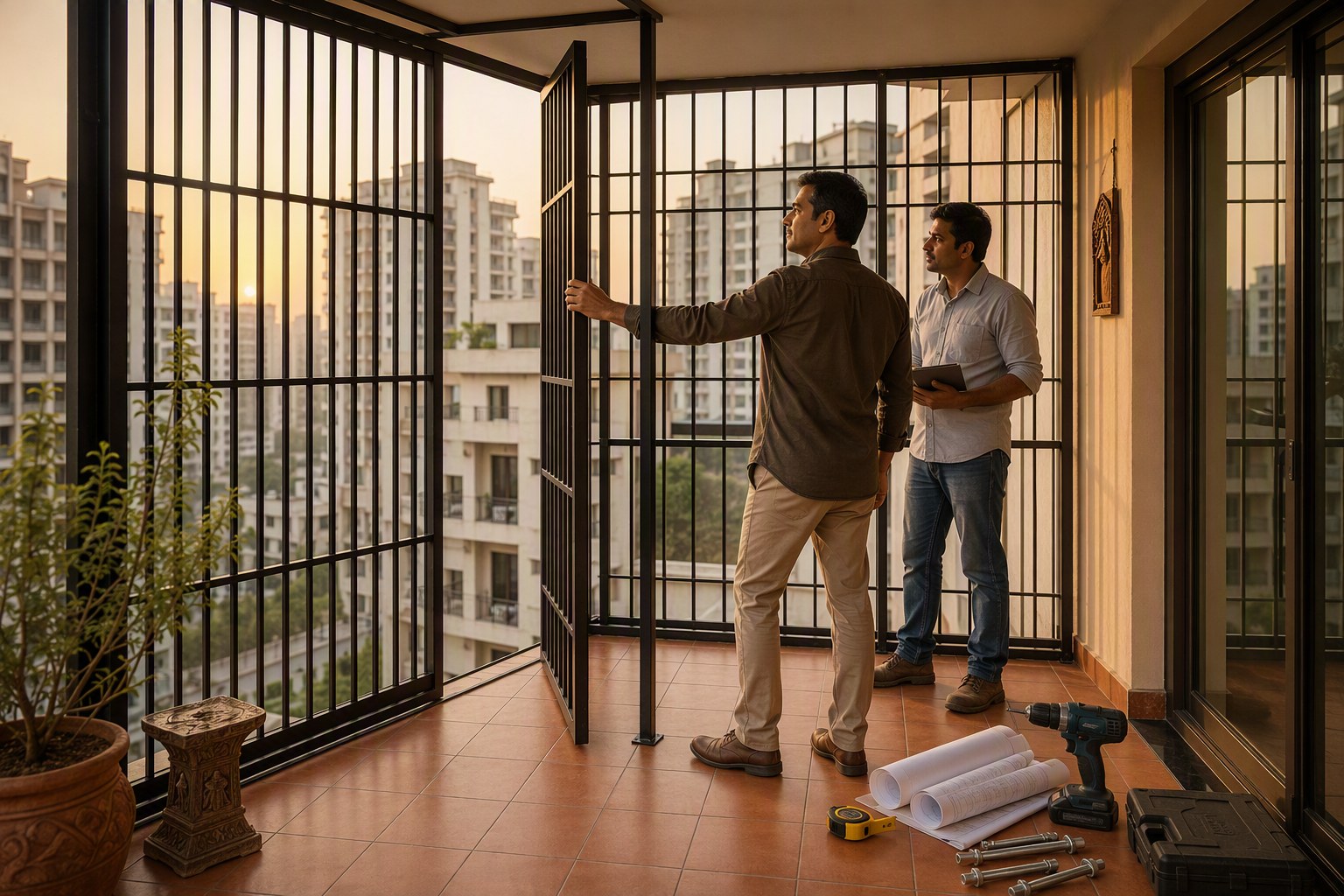
The work was done by a local vendor. Powder-coated frame, clear glass, mosquito mesh, a small sill, and laminate flooring over the balcony tiles. The drain outlet was left in place. No RCC extension was made. The railing was not removed, but it was hidden behind the new frame. From inside, the space looked like part of the living room.
For daily living, it was excellent. The living room felt larger. Dust reduced. The family used the corner for calls and reading. The association did not object because many other flats had similar-looking enclosures. That last line is where many owners become overconfident: others have done it, so it must be fine.
Not always.
Where the sale first got stuck
The owner found a buyer quickly. The flat was well-maintained, the project had good amenities, and the location suited the buyer's office commute. Token advance was paid after basic document sharing. Then the buyer's bank appointed a technical valuer.
The valuer visited the flat, measured the carpet-like usable area, checked the sanctioned layout drawing shared by the seller, and asked one blunt question: “Was this balcony enclosure approved by the builder or association?”
The seller said the association had not objected. The valuer asked for written confirmation. The seller did not have it. The valuer then compared the sale deed area and the approved plan. The balcony was shown as balcony, not enclosed internal living area. The buyer was not against the enclosure as such. In fact, the family liked it. The bank was the cautious party.
The bank did not reject the loan. It kept the case pending and asked for clarification. That delay changed the buyer's mood. Once doubt enters a resale transaction, every small issue starts looking bigger.
Why banks and buyers react to balcony changes
Buyers in Hyderabad have become sharper. Many have seen disputes around carpet area, UDS, deviations, HMDA or GHMC permissions, RERA promises, association rules and resale loan delays. A buyer may like your interiors, but a bank will still ask whether the property being financed matches the approved record.
Balcony enclosures raise four practical questions:
- Is it a permitted enclosure or an unauthorised alteration? Some projects allow uniform balcony glazing. Some ban it. Some allow only after written approval.
- Has the external elevation changed? If the enclosure affects facade uniformity, the association or builder may object, especially in premium communities.
- Has balcony area been merged into internal area? If flooring, sliding doors, partition removal or false ceiling make it look like a living room extension, valuers may flag it.
- Does it affect safety and services? Drainage, fire access, AC outdoor unit placement, railing height and load on slab all matter.
In many resale discussions, the seller says, “Sir, this is only glass work.” That may be true physically. But real estate documentation does not work only on physical effort. It works on sanctioned use, recorded area, approval trail and risk perception.
The association angle: verbal comfort is not enough
In this case, the seller approached the apartment association after the bank query. The association office-bearer gave a verbal answer: “We have no problem, many flats have done it.” But the buyer's bank wanted something in writing.
The association then hesitated. If it issued a letter saying the enclosure was approved, it could be treated as accepting all similar modifications. If it issued a letter saying it had no objection, it might still look like post-facto approval. After a week of follow-up, the association gave a limited note: the flat had no maintenance dues, and the balcony enclosure had not received any pending violation notice from the association.
That helped, but it did not fully solve the bank's concern. The wording was defensive. A buyer reading it could still wonder whether municipal approval was needed.
My view is simple: if your resale depends on an association letter, get it before listing the flat, not after token advance. Last-minute letters are stressful, and office-bearers change. A rule accepted by one committee may be questioned by the next.
Plan comparison: the detail owners skip
The seller had the sale deed, link documents, tax receipts and maintenance receipts ready. But he had not kept a clean copy of the sanctioned floor plan for his specific tower and unit. The buyer's advocate asked for it. The seller forwarded a brochure plan first. That was a mistake.
A brochure plan is marketing material. It is useful for understanding room arrangement, not for legal comfort. For resale, a buyer may ask for sanctioned plan, occupancy certificate references, RERA details where applicable, building permission details and the exact flat schedule in the registered deed.
The balcony issue became bigger because the plan trail was not tidy. The buyer asked whether the enclosed balcony increased saleable area. The seller said no. The buyer asked whether it changed carpet area. The seller said “usable area increased”. That phrase made the buyer nervous because usable area and approved area are not the same thing.
If you are checking a project, start with available project records and official declarations. For RERA-registered projects, use Rera to check basic project information. For title and transaction history, an Ec Search and Ec Analyzer can help you read the encumbrance trail better. These tools do not approve your balcony enclosure, but they reduce blind spots before negotiation.
The buyer's concern was not only the enclosure
Once the balcony question came up, the buyer's family started checking other items. Was the utility area covered? Was a service duct used for storage? Was the main door shifted? Was the car parking number matching the allotment letter? Was the flat in any prohibited property list?
This is how resale friction grows. One unclear item invites ten more questions.
For land and apartment due diligence in Telangana, prohibited property checks are now part of serious buyer behaviour. Verified.RealEstate's database context tracks 3,076,153 prohibited-property records for screening. A seller may feel this is unrelated to a balcony. The buyer will not see it that way. They are looking for a clean transaction, not isolated explanations. A quick Prohibited Property Check gives both sides one more layer of comfort.
What finally happened
The deal did not collapse. But it was delayed.
The seller had to arrange the sanctioned plan copy, association note, vendor invoice for the enclosure, photographs showing the railing was intact, and a written declaration that no structural change had been made. The buyer's bank conducted a second technical review. The buyer's advocate inserted a seller declaration in the draft sale agreement stating that any interior additions were non-structural and that the buyer had inspected the property.
The buyer also negotiated a small price reduction. Not because the balcony enclosure reduced the value in daily use. It reduced certainty. In resale, uncertainty has a cost.
The registration eventually went through. The seller lost time, bargaining strength and peace of mind. The buyer got comfort, but only after repeated calls, documents and site checks. A two-day closing became a multi-week exercise.
Why this matters for Hyderabad apartments
Hyderabad's apartment market has matured. Buyers are not only looking at clubhouse photos and modular kitchens. They are asking about UDS, OC, RERA status, municipal permissions, water connection, association bye-laws, pending litigation, road access, and mortgage closure. Interior modifications sit inside this wider due diligence culture.
Balcony enclosures are especially sensitive because they touch both interior comfort and building appearance. In some communities, uniform glazing is part of the design. In others, every owner uses a different frame colour and glass pattern, making the elevation messy. Associations then bring rules after many flats have already changed. That creates unequal enforcement and resale confusion.
There is also a safety angle. Hyderabad high-rises face wind pressure, heavy rain bursts and heat expansion. Poorly fixed balcony frames can rattle, leak or fail. Drain points blocked by wooden flooring can cause water stagnation. If the enclosure traps heat around AC outdoor units, service problems follow. These are not only engineering issues; they become buyer objections during inspection.
Common balcony makeover mistakes before resale
| Mistake | Why it creates resale friction | Better approach |
|---|---|---|
| Closing the balcony without written association approval | Buyer or bank may ask whether the change is permitted | Take written NOC or rule extract before work |
| Removing railing or changing facade colour | Looks like elevation alteration, not simple interior work | Keep railing and follow project-approved colour scheme |
| Calling balcony area part of living room area | Creates mismatch with sanctioned plan and deed schedule | Disclose it as enclosed balcony, not extra approved room |
| Blocking drains with flooring | Raises maintenance, leakage and safety concerns | Keep drain access visible and serviceable |
| No invoice or work details | Hard to prove the work was light, removable and non-structural | Keep vendor invoice, material details and photos |
What sellers should do before listing a modified flat
If you have enclosed a balcony, made a utility cover, shifted a partition, expanded a kitchen platform or converted a dry balcony into storage, do not wait for the buyer to discover it. Prepare your file first.
- Collect the sanctioned or approved unit plan. Compare it with the present flat condition. Mark changes honestly.
- Check association bye-laws. Look for rules on balcony glazing, facade, grills, safety nets, AC units and utility covers.
- Get written comfort. A no-dues certificate is useful, but a specific note on no pending violation is better if the association is willing.
- Keep work records. Invoice, material details, photos before and after, and vendor contact details can help.
- Do not exaggerate area. Do not market an enclosed balcony as an extra room unless records support that use.
- Tell the broker clearly. Many brokers oversell interiors and create expectations that documents cannot support.
Before pricing the flat, check transaction basics too. Use Guideline Value for government value reference, Stamp Duty Calculator for buyer-side cost estimates, and Composite Value when you want a broader value view. These will not replace a market quote, but they give structure to the discussion.
What buyers should ask when they see an enclosed balcony
Buyers should not panic when they see a balcony enclosure. Many are harmless, reversible and even useful. But ask direct questions.
- Was the enclosure done by the builder, association-approved vendor or private vendor?
- Is there any written approval, circular or association rule allowing it?
- Was the railing retained?
- Was any wall, beam, column or slab altered?
- Is drainage accessible?
- Does the enclosure affect fire safety, ventilation or AC service area?
- Is the balcony still shown as balcony in the deed and plan?
- Will the bank valuer accept it without a qualification?
Also check the larger title and property record. Use Cersai Check for mortgage-related screening where relevant, Find Your Sro for registration office identification, and Property Tracker if you want to keep monitoring key property data points during the transaction.
The grey area: removable versus permanent work
Many owners argue that sliding glass is removable, so approval should not matter. That argument has some practical merit, but it is not a full defence. A removable enclosure can still violate association facade rules. It can still be treated as an alteration by a cautious valuer. It can still create leakage or safety concerns.
Permanent work is more serious. If you remove the balcony door and merge the space fully into the hall, build masonry, change drainage slope, shift external units, or cover open-to-sky areas in a way that changes approved built form, the resale risk increases. The more your flat differs from the sanctioned plan, the more explanation you need.
Owners should also remember that one buyer may accept what another buyer rejects. One bank branch may process a file that another branch escalates. One association committee may ignore an enclosure; another may start enforcement after a complaint. Your safest position is not “nobody objected so far”. Your safest position is “I have records showing what was done and why it is acceptable”.
How to disclose without killing the deal
Some sellers hide modifications because they fear losing buyers. I think that is the wrong approach. Disclosure, if done smartly, builds trust.
Do not start the first site visit with a legal lecture. Show the flat naturally. When the buyer appreciates the balcony corner, say: “We enclosed this balcony with sliding glass for dust and rain protection. The railing is intact. No structural work was done. We have the invoice and association no-violation note.” That sounds confident. It also tells the buyer you are not hiding anything.
If you do not have documents, say so and start arranging them before price negotiation. A serious buyer respects clean answers. They dislike surprises after paying token.
My professional take
A balcony enclosure can improve comfort and even market appeal. In Hyderabad, especially near busy corridors, lake-facing humidity pockets, dusty construction zones and high-rise wind corridors, practical home improvements are part of real living. I am not against them.
But I am against casual modifications made without checking records. Apartment ownership is shared living. Your balcony is attached to your flat, yes, but it is also part of the building elevation, drainage system, fire-safety logic and approved plan. That is why a small glass frame can become a resale issue.
If you are planning a balcony makeover, first check the association rulebook, builder handover manual, sanctioned plan and safety requirements. If you already made the change, organise your file before listing the property. If you are buying, inspect calmly and ask for records.
The lesson from this case is not that every enclosed balcony is a problem. The lesson is that undocumented changes reduce certainty. And in Hyderabad resale, certainty sells.
Frequently Asked Questions
Can I enclose my apartment balcony in Hyderabad?
You may be able to, but first check your apartment association rules, builder guidelines and approved plan conditions. Get written approval or at least written confirmation that the enclosure does not violate community rules.
Will a balcony enclosure affect my resale value?
It can help if buyers see it as useful and well-finished. It can hurt negotiation if approvals, safety, drainage or plan records are unclear. The issue is usually not the glass work; it is the missing paperwork.
Do banks reject home loans because of enclosed balconies?
Not always. Many cases pass after clarification. But a bank valuer may flag the difference between the sanctioned plan and actual flat condition, especially if the balcony looks merged with the living area.
What documents should I keep after enclosing a balcony?
Keep association approval or no-objection note, vendor invoice, material details, photos, and a copy of the approved flat plan. These records help during resale and buyer due diligence.
Should I remove the balcony enclosure before selling?
Not necessarily. If it is safe, neat, removable and accepted by the association, disclose it with records. If it violates rules or creates bank objections, removal may be cheaper than losing a serious buyer.