

False Ceiling Upgrades: The Fire-Safety Check Buyers Miss
False Ceiling Upgrades are no longer just about cove lighting, clean AC lines and that hotel-style living room finish. In Hyderabad’s new apartments and resale flats, buyers are now being forced to treat the ceiling as a safety layer: wiring, sprinklers, smoke sensors, junction boxes, AC drain access and fire alarm cabling often disappear above gypsum or POP work. Once closed, even a small inspection becomes messy, costly and sometimes risky.
That is the quiet shift we are seeing across Gachibowli, Kondapur, Kokapet, Narsingi, Puppalaguda, Manikonda, Miyapur and LB Nagar. Buyers spend serious time checking UDS, carpet area, amenities, SRO registration, pahani history and dharani entries. But after handover, many approve false ceiling work based only on design renders. That gap can create trouble later, especially in high-rise apartments where fire detection, sprinklers and service access are not optional decorative items.
Our view is simple: before you close the ceiling, photograph it, map it, label it and get written confirmation on what can be covered and what must remain accessible.
False Ceiling Upgrades are becoming a buyer safety checklist
In most Hyderabad homes, false ceiling work starts immediately after possession. The carpenter, electrician, AC technician and lighting vendor all enter together. Everyone wants to finish quickly because the family is waiting to move in. That speed is where mistakes happen.
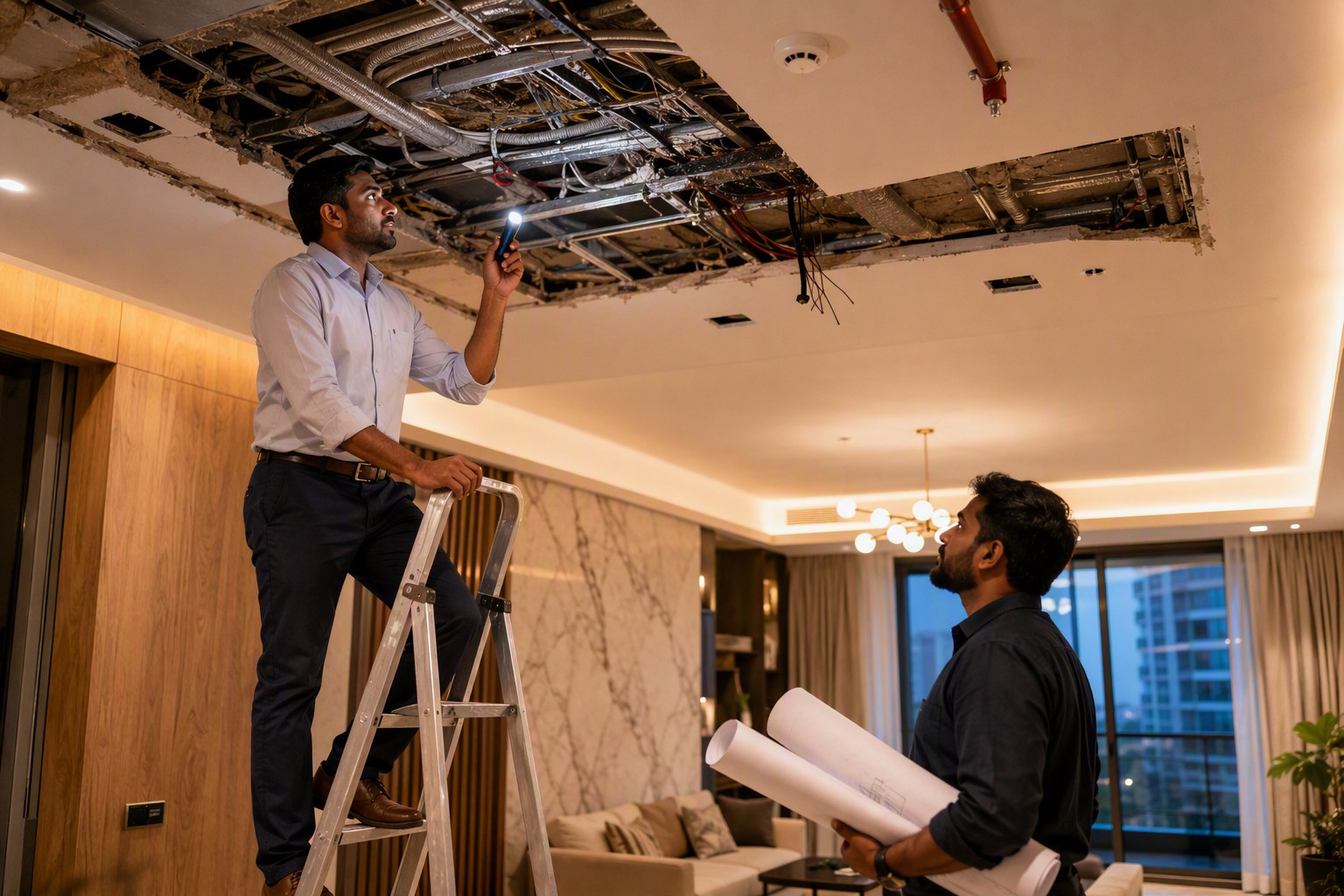
A typical modern apartment ceiling may carry electrical conduits, data cables, fan points, lighting loops, fire alarm wiring, sprinkler heads, smoke detectors, junction boxes, access points for plumbing shafts, AC copper piping and drain lines. In some premium projects around Nanakramguda, Financial District and Kokapet, buyers also add home automation wiring, mood lighting, speakers and concealed curtain tracks. Good design can handle all this. Poor execution can hide critical points behind a neat sheet of gypsum.
The issue is not false ceiling itself. Gypsum, calcium silicate boards, metal grids and POP trims are widely used. The issue is unmanaged false ceiling work. If a junction box is buried without an access panel, a future electrical fault can mean cutting open the ceiling. If sprinkler spray is blocked by a decorative tray, safety performance is affected. If a smoke detector is shifted casually for symmetry, the buyer may not even know whether the change was acceptable.
In resale flats, the risk can be higher. A buyer may admire the lighting during a site visit but never ask what is above it. We have seen older apartments in Banjara Hills, Begumpet, Ameerpet and Himayatnagar where multiple rounds of renovation have left unknown wiring inside ceiling cavities. Nobody has the original map. The seller says, “interior full done.” That is not enough.
False Ceiling Upgrades before wiring, sprinklers and sensors: what buyers should check first
Before any ceiling is closed, the buyer should create a small but clear record. This is not overthinking. It is basic risk control, like checking an Encumbrance Certificate before registration.
Start with the approved electrical layout given by the builder or society. Ask whether the apartment has fire alarm devices, sprinkler points, smoke or heat detectors and any common system cabling passing through the unit ceiling. In high-rise gated communities, buyers should speak to the facility team before moving any device. The interior contractor may be good at design, but fire systems need separate caution.
Then mark all junction boxes. Every junction box should remain reachable through an access panel or removable section. If the electrician says, “Sir, no need, we will remember,” do not accept it. After two years, the same electrician may not be available. Your future buyer, tenant or maintenance vendor will have no clue.
Also check the AC plan. Many Hyderabad homes use concealed copper pipes and drain lines above false ceilings. If the drain line chokes during monsoon, the access point matters. In areas like Kondapur, Hafeezpet and Miyapur, where many flats are rented to working families, quick maintenance access is a practical need. A tenant cannot wait for the whole ceiling to be opened because a small trap was not provided.
| Ceiling item | What can go wrong | Buyer action before closing |
|---|---|---|
| Electrical junction box | Fault location becomes difficult; ceiling may need cutting | Keep access panel and take dated photos |
| Sprinkler head | Decorative tray or panel may obstruct water spray | Do not shift or cover without written technical approval |
| Smoke detector or sensor | Wrong placement can affect detection | Confirm with facility/fire system vendor before relocation |
| AC drain line | Leakage may damage gypsum and paint | Provide service opening near trap or joint |
| Speaker and automation wiring | Future repair becomes guesswork | Label cables and keep a simple ceiling map |
| Bathroom or kitchen duct access | Odour, leakage or exhaust issues become hard to inspect | Keep duct side reachable where required |
Why this matters more in Hyderabad high-rises
Hyderabad’s apartment market has moved vertically. In Kokapet, Narsingi, Puppalaguda, Nanakramguda, Gopanpally and Tellapur, many buyers are choosing high-rise communities with multi-level basements, clubhouses, fire systems and detailed service networks. The flat is not an independent box. It is part of a larger building system.
That means individual interior decisions can affect maintenance and compliance. A buyer may think the false ceiling inside the flat is purely private work. But if it covers a detector, blocks a sprinkler, disturbs fire alarm wiring or prevents inspection of a service line, the issue can involve the facility team and sometimes the association.
We have also noticed that many first-time buyers focus heavily on design packages. The living room should look like the sample flat. The bedroom should have warm cove light. The kitchen should hide every pipe. Fair enough. Hyderabad buyers have become design-aware, and good interiors improve comfort. But sample-flat style should not come at the cost of basic access.
In our experience, the safest interiors are not the most expensive ones. They are the ones where the designer, electrician, AC vendor and facility team coordinate before gypsum work begins. A half-day site meeting can save several future headaches.
The property due diligence link buyers should not ignore
False ceiling work may sound like an interior topic, but it sits inside a larger property verification mindset. The same buyer who checks title flow, SRO details and government records should apply similar discipline after handover.
Telangana property buyers already know that records can be complicated. As per the Verified database context, Section 22-A prohibited properties stand at 3,076,153 entries. That number alone tells us why checking government records is not a casual step. Before buying, use the Section 22-A Prohibited Property Check, verify title movement through the Encumbrance Certificate Search, and confirm jurisdiction with Find Your SRO Office. For land parcels and villa plots, the Survey Number Finder and Property Verification Tool are also useful.
After buying, carry the same habit into interiors. Keep documents. Keep photos. Keep approvals. Keep invoices. If you are changing wiring, lights or ceiling layout, maintain a simple folder. When you sell the flat later in Gachibowli, Nallagandla or Sainikpuri, a sensible buyer will appreciate that record. It shows the property was maintained properly, not just decorated well.
For valuation and registration planning, buyers often check the Market Value / Guideline Value Search and Stamp Duty Calculator. That is good. But once possession is taken, the value of the home also depends on how cleanly the internal systems are handled. Hidden messy work can quietly reduce buyer confidence during resale.
False Ceiling Upgrades checklist for resale flat buyers
Resale buyers should be extra alert because the ceiling is already closed. During a site visit, do not stop at wall paint and wardrobe finish. Ask direct questions.
- Was the false ceiling done by the current owner or previous owner?
- Are there access panels for junction boxes and AC drain points?
- Were any smoke detectors, sprinklers or fire alarm devices shifted?
- Is there a ceiling layout or at least renovation photos?
- Has there been any ceiling leakage, patch repair or electrical burning smell?
- Does the association have rules for interior changes?
- Was permission taken for major electrical load changes?
Look for small signs. A fresh patch of paint on a ceiling corner may indicate past leakage. A sagging gypsum area near an AC duct may mean condensation or drain trouble. Too many downlights connected without visible access can make maintenance difficult. If the seller cannot answer, bring an electrician for a second visit.
In older localities like Secunderabad, Tarnaka, Malkajgiri and Dilsukhnagar, some resale apartments may not have modern fire systems inside each flat, but wiring age and concealed modifications still matter. In newer towers, the fire-safety angle becomes stronger because common systems are integrated. Either way, the ceiling deserves inspection.
What builders, associations and interior teams should do
Builders can reduce confusion by handing over a clear service drawing for each flat. Many do provide electrical points and plumbing drawings, but buyers need more practical marking: where junction boxes are, where fire devices sit, what cannot be shifted, and where access must remain.
Apartment associations should also issue interior guidelines in plain English. Not every owner understands technical language. A simple note saying “do not cover sprinklers,” “do not relocate detectors without approval,” and “keep service panels accessible” can prevent mistakes. Facility teams in large communities at Tellapur, Kollur and Bachupally are already becoming stricter about interior work timings and debris movement. The same discipline should extend to ceiling safety.
Interior contractors must stop treating access panels as ugly compromises. A well-planned access panel can blend with the ceiling. Gypsum channels, removable grid sections and clean inspection hatches are normal in good work. If a contractor says everything can be permanently sealed, that is not a sign of premium finish. It is a maintenance warning.
Material choice: design finish is not the only factor
Most buyers compare POP and gypsum based on finish, speed and cost. But the better question is: will the selected material allow safe installation, proper support and future access? Heavy decorative elements should not be casually fixed near services. Lighting cut-outs should not weaken the frame. Ceiling fans need proper anchoring to the structural slab or approved support, not just the board.
Kitchen and bathroom-adjacent ceilings need more caution because moisture can affect finishes. If an AC drain line or bathroom duct is nearby, provide inspection access. In Hyderabad summers, AC usage is heavy, and ceiling cavities around indoor units can face condensation if insulation or drainage is poor. A beautiful ceiling that stains within one season is bad planning.
Buyers should also avoid overloading the ceiling with too many lights just because the design render shows it. Every light point means wiring, heat, maintenance and future replacement. Ask the electrician to label circuits. Keep driver units and transformers accessible. LED strips hidden inside coves look neat, but their power supply should not be buried where nobody can reach it.
A practical handover record before the ceiling is closed
Before the final board is fixed, take a full video of every room ceiling. Start from the entrance and move clockwise. Say the room name aloud. Capture junction boxes, conduits, sprinkler points, sensors, AC piping, drain lines and any cable loops. Then take still photos and store them with the flat documents.
Make a simple ceiling map. It need not be an architect drawing. Even a room-wise sketch with labels is useful. Mark access panels clearly. Share one copy with your electrician and keep one in your home file. If you are renting the flat, keep a copy for the property manager or trusted local contact.
For buyers still at the agreement stage, check the project and approvals through RERA Project Lookup. For a broader land and planning sense, tools like Land Use Zone Finder, Road Width Check and FSI/FAR Calculator help you understand the built environment before you commit. Interior safety begins after possession, but good property judgement starts much earlier.
False Ceiling Upgrades: our buyer-first opinion
Hyderabad buyers are right to demand good interiors. A well-designed ceiling can improve lighting, reduce visual clutter and make a flat feel finished. But safety access is not a small technical detail. It is part of ownership quality.
We would not approve any false ceiling work without three things: a service map, access panels and written clarity on fire-system changes. If a designer resists these basics, change the design or change the vendor. The best homes are not the ones where every wire is hidden forever. They are the ones where the right things are hidden neatly and the critical things remain reachable.
Before spending on chandeliers, cove strips and profile lights, spend one hour understanding what is above your head. That one hour may protect your family, your maintenance budget and your resale story.
Frequently Asked Questions
Can I cover sprinkler pipes or smoke detectors with a false ceiling?
No, do not cover or shift sprinklers, smoke detectors or fire alarm devices casually. Speak to the builder facility team or authorised fire system vendor before making any ceiling change around them.
What should I check before false ceiling work starts in a Hyderabad flat?
Check electrical junction boxes, AC drain access, sprinkler and sensor positions, service ducts, wiring routes and association interior rules. Take photos and keep a room-wise ceiling map before boards are fixed.
Is gypsum false ceiling unsafe for apartments?
Gypsum false ceiling is commonly used and can be suitable when installed properly. The risk comes from poor planning, blocked fire devices, hidden junction boxes, weak supports and lack of maintenance access.
Should resale flat buyers inspect existing false ceiling?
Yes. Ask when the ceiling was installed, whether access panels exist, whether any leakage happened and whether fire or electrical points were moved. If answers are unclear, take an electrician for inspection.
Which property checks should I do before buying and renovating?
Check EC, SRO jurisdiction, guideline value, RERA status where applicable and Section 22-A prohibited property status. After purchase, apply the same documentation discipline to interiors and ceiling work.