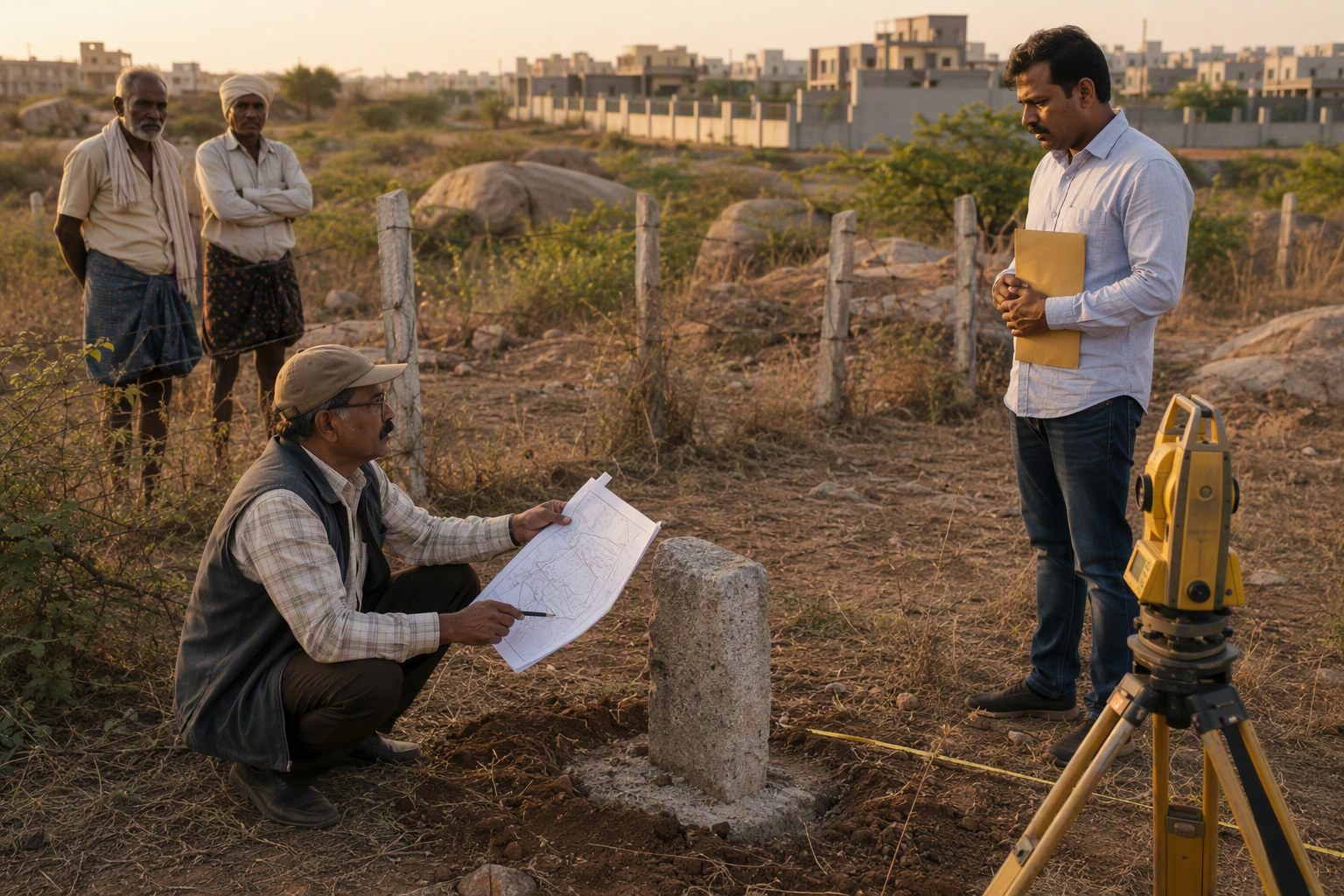



Telangana has 30.76 lakh prohibited properties in the Section 22-A list, recorded as 3,076,153 entries as per latest IGRS data. That single number explains why Registrar’s View: Why a Clear EC Can Still Block Registration is not a theoretical topic for buyers in Hyderabad. A clean Encumbrance Certificate may show no mortgage, sale, gift or registered charge. Still, the Sub-Registrar Office can stop the document at the counter if another government record raises a red flag.
In our experience, buyers in Kokapet, Narsingi, Tellapur, Shankarpally, Maheshwaram, Adibatla, Medchal and Shamshabad often ask one common question: “EC clean undi kada, registration problem enduku?” The answer is simple but uncomfortable. EC is only one layer. Registration officers look at multiple layers: Section 22-A prohibited-property data, Dharani entries, survey number history, pattedar details, village records, court orders, land nature, SRO jurisdiction and sometimes even earlier government communications.
For this article, I am taking a registrar-side view, based on regular conversations with registration-office professionals, document writers and verification teams who deal with these rejections daily. The message is blunt: do not treat a clean EC as the final green signal.
Registrar’s View: Why a Clear EC Can Still Block Registration at the SRO
An Encumbrance Certificate is a useful document, but it is not a full legal title certificate. It mainly reflects registered transactions for a property over a chosen period. If a sale deed, mortgage deed, gift deed, partition deed or release deed was registered, the EC should normally show it. But if a government prohibition exists outside that transaction chain, the EC may not tell you the full story.
A registration-side professional put it well: “EC tells me what was registered. It does not always tell me whether the property is allowed to be registered today.” That is the gap many buyers miss.
At an SRO counter, the officer is not only checking whether the seller has an old deed. The officer must also check whether the property falls in a prohibited category under Section 22-A, whether the details match government records, whether the seller is competent to transfer, and whether the document can be legally admitted for registration.
This is why a buyer can walk in with a clean EC and still face refusal, pending status, query, or a request to bring clarification from revenue authorities.
What a Clean EC Actually Says — and What It Does Not Say
A clean EC generally means no registered encumbrance is visible for the period searched. If you searched 30 years, it speaks for that period. If you searched 13 years, it speaks for that period. It does not automatically confirm that the land is private patta land, free from government claim, free from court dispute, free from acquisition issue, free from endowment or wakf record, or free from wrong survey mapping.
Before paying token advance, buyers should run an Encumbrance Certificate Search and then use the EC Analyzer to understand transaction continuity. But the EC result must be compared with Dharani, pahani or ROR details, old link documents, survey number, sub-division number and Section 22-A data.
For open plots in places like Mokila in Shankarpally mandal, Kadthal side, Adibatla in Ibrahimpatnam mandal, or Tukkuguda and Maheshwaram belt, this becomes even more critical. Many buyers see a layout brochure first and revenue records later. That order is risky.
Registrar’s View: Why a Clear EC Can Still Block Registration Under Section 22-A
Section 22-A is one of the biggest reasons for registration blockage. If a property appears in the prohibited-property list, the SRO cannot casually ignore it because the buyer says the EC is clean. The officer’s system may stop the transaction or require clarification.
The Section 22-A list can include properties connected with government land, assigned land, endowment land, wakf land, ceiling surplus land, court attachment, prohibited survey numbers and other notified restrictions. A buyer may have an old sale deed from a private person, but if the survey number is blocked in government records, registration can hit a wall.
That is why we advise buyers to check the survey number before negotiating. Use the Section 22-A Prohibited Property Check along with the Survey Number Finder. If the land is agricultural or converted from agricultural use, check the village, mandal and exact survey sub-division. One digit mistake can change the result.
“A clean EC is good news, but it is not permission from the government to register. If the survey number is in 22-A, the registrar has to respect that entry unless competent authority clears it.”
This is the registrar’s problem too. If the officer registers a prohibited property, the office can face audit objections and departmental trouble. So buyers should not expect a counter-level officer to take a personal call against system data.
Where Hyderabad Buyers Get Caught: Local Examples We Keep Seeing
Hyderabad’s growth corridors have made verification more difficult, not easier. Earlier, families bought within known colonies. Now buyers are booking plots and flats across multiple mandals: Gandipet, Shankarpally, Moinabad, Maheshwaram, Ibrahimpatnam, Kandukur, Medchal, Quthbullapur, Serilingampally, Ramachandrapuram and Rajendranagar. Each mandal has its own land history.
In Kokapet and Narsingi, buyers usually focus on builder brand, RERA status and tower approvals. That is sensible for apartments, but land title still matters because the project title comes from earlier land pooling, sale deeds, development agreements or GPA structures. For such projects, use the RERA Project Lookup and cross-check the land schedule in the RERA filing with the EC and SRO records.
In Tellapur and Kollur side, buyers often deal with villa projects, plotted developments and joint development lands. Here, the survey number chain and owner consent are very relevant. A clean EC in one owner’s name may not reveal a family dispute unless a case or registered document has entered the registration record.
In Shankarpally and Mokila, many transactions involve agricultural land parcels, old pahanis, mutation records and later conversion or layout activity. A buyer should not depend only on the latest sale deed. The old pahani and Dharani passbook details may tell a different story.
In Maheshwaram, Adibatla, Tukkuguda and Shamshabad, the airport-side growth story has increased demand for open plots. We have seen buyers get excited by road width, HMDA layout talk and future appreciation. But if the basic survey number has a prohibition, wrong classification or pending revenue issue, the SRO will not be impressed by the brochure.
Clean EC, Wrong Property: The Survey Number Trap
One of the most common mistakes is searching the wrong property. EC searches can be done by document number, house number, survey number or owner details depending on availability. If the earlier deed has a spelling variation, old village name, wrong extent, or merged municipal number, the EC can look clean because the search did not hit the right record.
This happens in older areas like Secunderabad, Musheerabad, Chikkadpally, Amberpet and parts of old Hyderabad where house numbers changed over time. It also happens in gram panchayat-to-municipality transition areas such as Bachupally, Nizampet, Kompally and Manikonda, where layouts, door numbers and municipal records evolved separately from old revenue records.
A document writer at an SRO will first ask: village name? mandal? survey number? plot number? extent? boundaries? link document number? If the answers are vague, the clean EC is not enough.
Use Find Your SRO Office to confirm jurisdiction and the SRO Village Directory when the property sits near a boundary. Buyers often assume the nearest SRO is the correct SRO. That assumption can waste time and sometimes hide older transactions.
Why Dharani and Registration Records May Not Match
Dharani brought agricultural land records into a more visible digital workflow, but mismatches still appear. The pattedar name, survey extent, land nature, sub-division, passbook details and registered document schedule may not always read the same way.
For example, a seller may show an old registered sale deed and EC. But Dharani may show a different pattedar, a pending mutation issue, a prohibited flag, or a classification that needs clarification. In agricultural land purchases around Chevella, Moinabad, Shabad, Shankarpally, Yacharam or Kandukur, this is not a small point. The registrar’s office cannot ignore revenue-side restrictions merely because the buyer and seller are ready with stamp duty.
There is another practical issue. The SRO works with document language. Revenue offices work with survey and title records. A small mismatch in extent or sub-division can create a query. If the sale deed says one extent and Dharani shows another, the officer may ask for rectification, clarification or updated records.
Clear EC Does Not Remove Valuation and Stamp Duty Issues
Some registrations get held up not because of title dispute but because of valuation, document structure or stamp duty calculation. A clean EC will not save a document if the market value is wrongly adopted, if building value is missed, if semi-finished construction is not declared properly, or if the schedule is unclear.
Before registration, buyers can check the SRO market value using the Market Value / Guideline Value Search. For duty planning, use the Stamp Duty Calculator. If the transaction includes land plus building, the Composite Value Calculator and Building Value Calculator can help you prepare better before visiting the document writer.
One registrar-side professional told us, “Many buyers come with the mindset that registration is only a signature process. Actually, the document has to match title, valuation, identity and property description. If any one part is defective, the EC will not fix it.”
Flat Buyers: Why Apartment EC Is a Different Animal
For apartments in Gachibowli, Nanakramguda, Financial District, Kondapur, Miyapur, Kukatpally, Uppal and LB Nagar, buyers usually take an EC on the flat or parent land. Both are useful, but both have limits.
A flat EC may start only after the first sale deed or agreement-cum-sale transaction. It may not show the entire land history behind the project. A parent land EC can show earlier transactions, but it may be complex because large land parcels are split, pooled, mortgaged, released or developed under multiple documents.
That is why flat buyers should check builder title flow, development agreement, sanctioned plan, occupancy status where applicable, RERA registration for ongoing projects, and mortgage release documents if the builder has taken project finance. A bank loan approval is helpful, but it is not a substitute for buyer-side verification.
If you are comparing usable area, land share and construction value, use the Area Unit Converter and Property Change Tracker to monitor changes in property records over time.
A Registrar-Side Checklist Before You Pay Advance
Here is the practical checklist I would use before paying a serious advance in Telangana:
- Check EC first: Search by document number, property schedule and owner names where possible.
- Check Section 22-A: Match exact village, mandal, survey number and sub-division.
- Read the link documents: Do not stop at the latest sale deed. Track how the seller got title.
- Match Dharani or revenue record: For agricultural land, compare pattedar name, extent and land nature.
- Confirm SRO jurisdiction: Wrong SRO assumption can lead to incomplete checking.
- Check market value: Use ready reckoner or guideline value before finalising stamp duty.
- Verify approvals: For plots, check layout approval. For apartments, check project and building approvals.
- Look for family rights: Inherited property needs legal heir chain, partition or release clarity.
- Watch GPA transactions: Power of attorney documents need careful reading, especially old or outstation GPAs.
- Do not rely on WhatsApp PDFs: Pull fresh records close to registration date.
When a Clean EC Is Still a Positive Sign
I do not want buyers to think EC has no value. A clean EC is a strong starting point. It can show that no visible registered mortgage or transfer is present for the period searched. It helps banks, lawyers, buyers and document writers trace the property’s registered history.
But the mistake is treating it as the only test. In Telangana, especially after digitised registration and Dharani workflows, registration has become a multi-record check. The registrar’s system may see something that your EC search did not show.
| Buyer Assumption | Registrar-Side Reality |
|---|---|
| EC is clean, so title is clear | EC shows registered transactions, not every legal restriction |
| Seller has sale deed, so registration must happen | Property can still be blocked under Section 22-A or revenue records |
| Bank approved loan, so no issue | Bank due diligence and SRO checks are different |
| Layout brochure is enough | Survey number, approval and land nature still need checking |
| Old family property is safe | Legal heirs, partition, release deeds and pending claims must be reviewed |
What To Do If Registration Is Blocked Despite Clear EC
First, do not panic at the counter. Ask for the exact reason. Is it a Section 22-A hit? Is it a valuation issue? Is it a mismatch in survey number? Is the seller name not matching? Is the land classification unclear? Each problem has a different path.
If it is a Section 22-A issue, you may need clarification or deletion from competent revenue authority, depending on the nature of the entry. If it is a document drafting issue, a corrected deed schedule may solve it. If it is a valuation issue, revise the value calculation. If it is a title mismatch, get the missing link document, mutation record, legal heir document or rectification deed.
Do not accept vague oral assurances like “registration office lo manage chestham.” A genuine title problem cannot be solved by sweet talk at the SRO. The cleaner route is slower but safer: identify the objection, collect the supporting record, and proceed only when the document can stand scrutiny.
My Take: EC Is the First Door, Not the Last Door
After watching Telangana property transactions closely, my view is firm. A buyer who checks only EC is doing half-verification. A buyer who checks EC, Section 22-A, Dharani, link documents, SRO jurisdiction, guideline value and approvals is in a much better position.
The 3,076,153 prohibited-property entries are not sitting in the system for decoration. They are there because the registration department is expected to stop certain transactions. That is why a clear EC can still block registration when another official record says the property cannot move.
Before you pay advance in Hyderabad or any Telangana district, spend one evening on proper verification. It is cheaper than fighting after registration refusal, or worse, after buying a property with a hidden defect.
Frequently Asked Questions
Can a clear EC still block registration in Telangana?
Yes. A clear EC can still block registration if the property appears in Section 22-A prohibited-property records, has revenue record mismatch, wrong survey details, valuation defects, or other legal restrictions visible to the SRO.
Does EC prove ownership of a property?
No. EC shows registered transactions and encumbrances for the searched period. Ownership must be verified through link documents, revenue records, pattedar details, approvals, court checks where needed and seller identity.
What is Section 22-A in Telangana property registration?
Section 22-A deals with properties prohibited from registration. These may include government land, assigned land, endowment or wakf-related property, notified survey numbers and other restricted categories as per government records.
Which records should I check along with EC?
Check Section 22-A status, Dharani or revenue records, pahani where relevant, link documents, SRO jurisdiction, guideline value, layout or building approvals, RERA details for ongoing projects and seller title chain.
What should I do if SRO refuses registration despite clean EC?
Ask for the exact objection. Then address it through the right route: revenue clarification for Section 22-A issues, rectification for document errors, revised valuation for stamp duty issues, or missing title records for ownership mismatch.