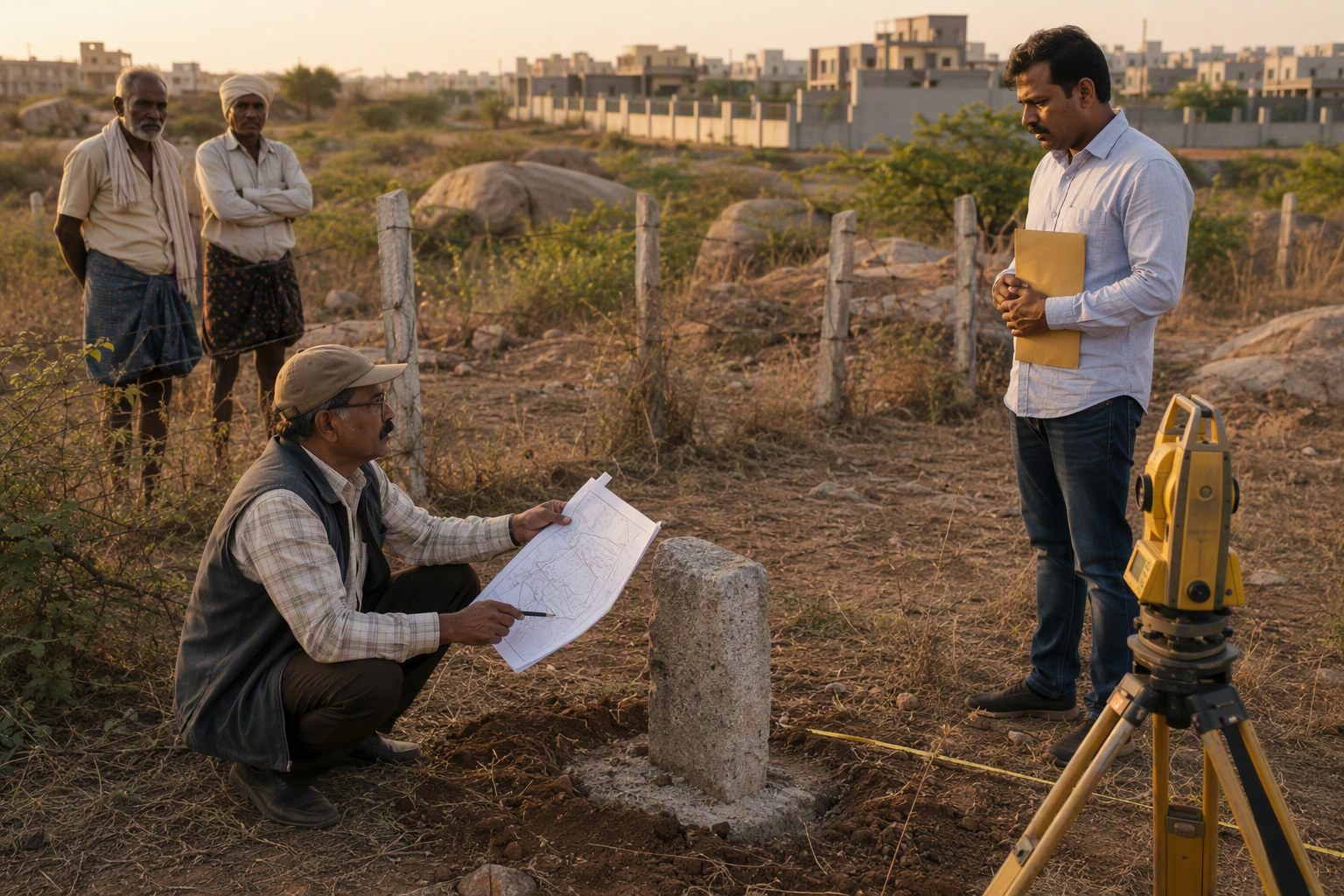



Telangana Experts Say Patta Passbook Alone Can Mislead Buyers
Patta passbook is useful, but it is not the final word on title safety in Telangana. That is the clear warning coming from title lawyers and document consultants who regularly review plots around Hyderabad, especially in growth belts like Kokapet, Mokila, Tellapur, Adibatla, Maheshwaram, Shadnagar and Yacharam. A passbook can confirm a revenue entry. It cannot, by itself, prove that the land is free from past sale disputes, court cases, Section 22-A restrictions, family claims, acquisition risk or layout violations.
As per the verified database available with us, Telangana has 3,076,153 prohibited property records under Section 22-A context. That single number should make every buyer pause. If a property is blocked or restricted in registration records, a neat-looking patta passbook will not rescue the transaction.
In our experience, the biggest mistake buyers make is treating Dharani passbook visibility as equal to marketable title. It is not. It is one checkpoint. A serious buyer must check the chain of title, EC, SRO records, pahani history, mutation trail, land classification, layout status, road access and local planning restrictions before paying an advance.
Why Patta Passbook Alone Is Not Safe Proof Of Title
A patta passbook is a revenue record. It shows who is recorded as pattadar for a land parcel. In village land transactions, especially in mandals like Shankarpally, Gandipet, Ibrahimpatnam, Maheshwaram, Kandukur, Chevella and Moinabad, the passbook is usually the first document shown by the seller. It is also the document most buyers feel comfortable seeing because it carries official-looking details, survey number references and land extent.
But title lawyers we spoke to were blunt: revenue records are not a substitute for a proper title investigation. A Hyderabad-based title lawyer who handles land due diligence for plotted layouts told us that a passbook can reflect possession or mutation, but it may not reveal whether the seller’s predecessor had a valid sale deed, whether legal heirs were left out, whether the land was once assigned land, or whether the survey number falls under a prohibited list.
A passbook can tell you who is recorded in revenue records today. It does not tell you the full legal story of how the land moved from one owner to another.
This is especially relevant for buyers chasing cheaper plots on the city edge. We have seen buyers compare one acre or one gaj rate between villages without checking whether the land is in a conservation zone, whether it needs conversion, whether it falls in a proposed road alignment, or whether the SRO will actually allow registration.
If you are checking a plot, start with the Property Verification Tool, then cross-check survey and registration details through the Encumbrance Certificate Search and Section 22-A Prohibited Property Check. These checks do not replace legal opinion, but they help you ask sharper questions before money leaves your account.
Patta Passbook And Section 22-A: The Risk Buyers Miss
Section 22-A restrictions are among the most serious red flags in Telangana property buying. These restrictions can block registration of certain lands or alert the buyer that the property is not freely transferable. The verified database number of 3,076,153 prohibited property records is not a small clerical issue. It tells us that prohibited-property screening must be treated as a basic step, not as an optional check.
In Hyderabad’s expansion corridors, this becomes very practical. A seller in a village near Shankarpally mandal may show a patta passbook and say, sir, Dharani lo clear undi. Another seller near Adibatla or Yacharam may show pahani copies and old link documents. But the buyer must still ask: Is the survey number blocked under Section 22-A? Is the land assigned, endowment, wakf, government, ceiling surplus or affected by acquisition? Has the classification changed? Is only a portion of the survey number affected, or the entire survey number?
One document consultant put it neatly: the passbook is a photograph of one layer. Section 22-A is another layer. EC is another. SRO records are another. Village revenue history is another. The buyer’s job is to make all layers match.
For this reason, we advise buyers to use the Find Your SRO Office tool before registration planning. Many buyers do not even know the correct SRO for a village or survey number. For example, a plot marketed as being near Kokapet may fall under a different revenue village or registration jurisdiction than what the brochure suggests. The SRO boundary and the village record matter.
What Telangana Title Lawyers Check Beyond Patta Passbook
When lawyers examine a land file, they do not stop at the passbook. They look for continuity, authority and transferability. In simple words: how did the seller get the land, who had it before him, whether each transfer was valid, and whether anyone can stop the next sale.
Here is the usual checklist that experienced consultants follow in Telangana plot and agricultural land due diligence:
| Checkpoint | Why It Matters | Buyer Action |
|---|---|---|
| Patta passbook | Shows current revenue entry and pattadar details | Match name, survey number, extent and village with other records |
| Pahani / Adangal | Shows cultivation and possession history in revenue records | Look for sudden changes, missing years or unexplained mutations |
| Link documents | Shows how title moved from earlier owners | Check registered sale deeds, partitions, gift deeds or inheritance papers |
| EC | Shows registered transactions and charges recorded at SRO | Use Encumbrance Certificate Search and review entries carefully |
| Section 22-A check | Reveals prohibited or restricted property status | Run Section 22-A Prohibited Property Check before token payment |
| Market value / guideline value | Helps understand government valuation used for stamp duty | Check the Market Value / Guideline Value Search |
| Land use and layout status | Confirms whether plotting or construction is legally possible | Verify zoning and approvals before assuming resale value |
The EC deserves special attention. Many buyers think a clean EC means perfect title. That is also wrong. EC shows registered transactions. It may not show unregistered family arrangements, oral claims, pending disputes not reflected in registration records, or mistakes in survey mapping. Still, without an EC review, you are buying blind.
For apartments and villas, a RERA check also becomes relevant. If you are buying in a project around Tellapur, Narsingi, Kollur, Bachupally or Kompally, use the RERA Project Lookup to verify project registration details. A patta passbook in the landowner’s name is not enough when the actual product is a flat, villa or plotted development promoted by a builder.
Patta Passbook Problems We See Around Hyderabad Growth Corridors
The same pattern keeps repeating in land deals around Hyderabad. The marketing starts with location: near ORR, near Pharma City side, near proposed road, near IT corridor, close to Kokapet, close to RRR alignment. Then comes a WhatsApp photo of the patta passbook. Buyers feel reassured. But the document file may have gaps.
In Mokila and Shankarpally mandal, the issue often comes down to old agricultural land converted or marketed as farmhouse plots. In Tellapur and Osman Nagar side, buyers must be alert about project approvals, layout regularity, lake buffer concerns and access roads. In Adibatla and Ibrahimpatnam mandal, industrial and development expectations have pushed buyer interest, but village-level title history still needs careful reading. In Maheshwaram and Kandukur, land classification and government land proximity should be checked with patience. In Yacharam and surrounding villages, buyers must be extra careful about survey accuracy and actual possession on ground.
We are not quoting rupee rates in this article because the verified dataset shared for this piece does not include ready reckoner values or live market prices by village. In Telangana, guideline value and market value can vary by village, survey number, property type and SRO records. Buyers should verify current government value through the Market Value / Guideline Value Search and then estimate registration cost using the Stamp Duty Calculator.
One practical point: the rate printed in a conversation and the value accepted for registration are not the same thing. The ready reckoner or guideline value is a government reference for valuation and duty calculation. The market price is what buyer and seller negotiate. Both need checking, but neither proves title.
How A Buyer Should Read A Patta Passbook
A patta passbook should be read like a starting page, not like the final chapter. First, match the pattadar name with the seller’s identity proof and link document. If the seller is acting through GPA, check whether the GPA is valid, registered where required, and still legally usable. If the pattadar is deceased, insist on succession documents, legal heir clarity and registered transfer documents where applicable.
Second, match the survey number. Telangana land parcels can be confusing because a sale advertisement may mention a village name used locally, while revenue records carry another village or hamlet reference. Buyers should use the Survey Number Finder and also verify on-ground boundaries with a surveyor. A small mismatch in survey number or sub-division can create a serious resale problem.
Third, check the extent. If the passbook shows a larger agricultural extent and the seller is offering a small plot from it, ask whether there is an approved layout, conversion, partition, demarcation and access road. Selling bits from agricultural land without proper approvals can trap retail buyers. A passbook for the parent land does not automatically make each plotted piece legal.
Fourth, see whether the land is fit for the intended use. If you want to build a house, zoning, road width, layout approval and building permission matter. For planning checks, buyers can use the Land Use Zone Finder, Road Width Check and FSI/FAR Calculator. These are practical filters before you approach an architect or local authority.
What Document Consultants Say About Dharani Confidence
Dharani has changed how Telangana land records are accessed and updated. It has reduced some old-style manual confusion, but it has not removed the need for legal due diligence. Consultants say buyers often confuse online availability with legal safety. That is a dangerous shortcut.
If the land is visible online, buyers think the deal is safe. Visibility is not the same as marketable title. The buyer must still test the document chain.
There are situations where the passbook is updated, but old family disputes are not settled. There can be cases where a sale deed exists, but possession is disputed on ground. There can be a mismatch between village map, physical fencing and document extent. There can be missing link documents from older transactions. There can also be bank charges or private agreements that a casual buyer will not detect.
For bank-funded purchases, the lender will conduct its own legal review, but buyers should not outsource their common sense to the bank. Bank scrutiny is for the bank’s risk. Your risk includes resale, possession, mental peace and future construction. If a file looks messy, do not justify it only because the seller is giving a small discount.
Patta Passbook Due Diligence: A Practical Sequence
Based on what we see in Telangana land transactions, this is a sensible order for buyers:
- Identify the exact village, mandal, survey number and sub-division.
- Check the seller’s name in patta passbook and revenue records.
- Review pahani, mutation and link documents for continuity.
- Search EC and analyse all registered transactions.
- Run Section 22-A prohibited property screening.
- Confirm the correct SRO and registration jurisdiction.
- Verify land use, road access, layout approval and building feasibility.
- Check guideline value and stamp duty before agreeing on payment terms.
- Take a written legal opinion from a lawyer who regularly handles Telangana land files.
If you want to track future changes after shortlisting a property, the Property Change Tracker can help you monitor updates. For terminology confusion, especially words like pahani, adangal, pattadar, khata, mutation and SRO, use the Telugu-English Property Terms Dictionary.
Our View: Treat Patta Passbook As Evidence, Not Assurance
Our editorial view is simple. A patta passbook is valuable evidence, but it is not assurance. It should sit inside a larger verification file. If the seller refuses to share link documents, avoids SRO checks, says EC is not needed, or pushes you to pay token amount before Section 22-A verification, walk away or slow down.
Hyderabad buyers are becoming smarter, but land sellers and brokers are also becoming better at packaging documents. A clean PDF, a Dharani screenshot and a confident broker voice can create false comfort. The safer buyer is the one who asks boring questions: Which mandal? Which village? Which survey number? Which SRO? What is the link document? Is it prohibited? Is it approved? Can it be registered? Can it be built upon?
That is how land has to be bought in Telangana. Not by emotion. Not by WhatsApp urgency. Not by one patta passbook.
Frequently Asked Questions
Is patta passbook enough to buy land in Telangana?
No. A patta passbook is only one revenue record. Buyers must also verify link documents, EC, pahani, Dharani records, SRO details, Section 22-A status, land use and layout approvals.
Can a land parcel have patta passbook but still be unsafe?
Yes. The land may still have old title disputes, missing legal heirs, unregistered claims, survey mismatches, government restrictions or Section 22-A issues. That is why independent title verification is needed.
What is the first check before paying token advance for a plot?
Before paying, confirm the exact survey number, village, mandal and seller name. Then check EC, Section 22-A status and SRO jurisdiction. Do not rely only on a passbook photo shared by broker or seller.
Does a clean EC prove perfect title?
No. EC shows registered transactions and recorded encumbrances. It may not show every family claim, possession dispute or unregistered arrangement. A clean EC is useful, but it is not a full title opinion.
Which tools can help Telangana property buyers?
Buyers can start with Property Verification Tool, Encumbrance Certificate Search, Section 22-A Prohibited Property Check, Find Your SRO Office and Market Value / Guideline Value Search before taking legal advice.