


Telangana Case Study: The Missing Link in a Layout Plot
Telangana Case Study: The Missing Link in a Layout Plot starts with one hard number: Telangana has 1,47,934 prohibited property records flagged under Section 22-A. That number matters because many buyers still verify only the final layout plot number, not the parent survey number, pahani trail, link documents, and SRO record chain behind it. In this case, a buyer in Hyderabad almost paid token advance for a plotted layout near the southern growth corridor. The layout looked clean. The plot number looked clean. The brochure looked clean. The missing link was sitting one level above, in the parent land ownership trail.
Our blunt view: a layout plot number is only an address inside a drawing. Ownership lives in the parent survey numbers and link documents.
Telangana Case Study: Why 1,47,934 prohibited records change how we check layout plots
When we discuss land due diligence in Telangana, Section 22-A is not a small side check. The prohibited property list has 1,47,934 records. These may include government lands, assigned lands, endowment lands, wakf lands, ceiling surplus lands, court-attached properties, and other categories where registration can be blocked or disputed. A buyer may see a neat plot in a DTCP or gram panchayat layout, but the parent survey number may still carry a restriction or an unresolved title issue.
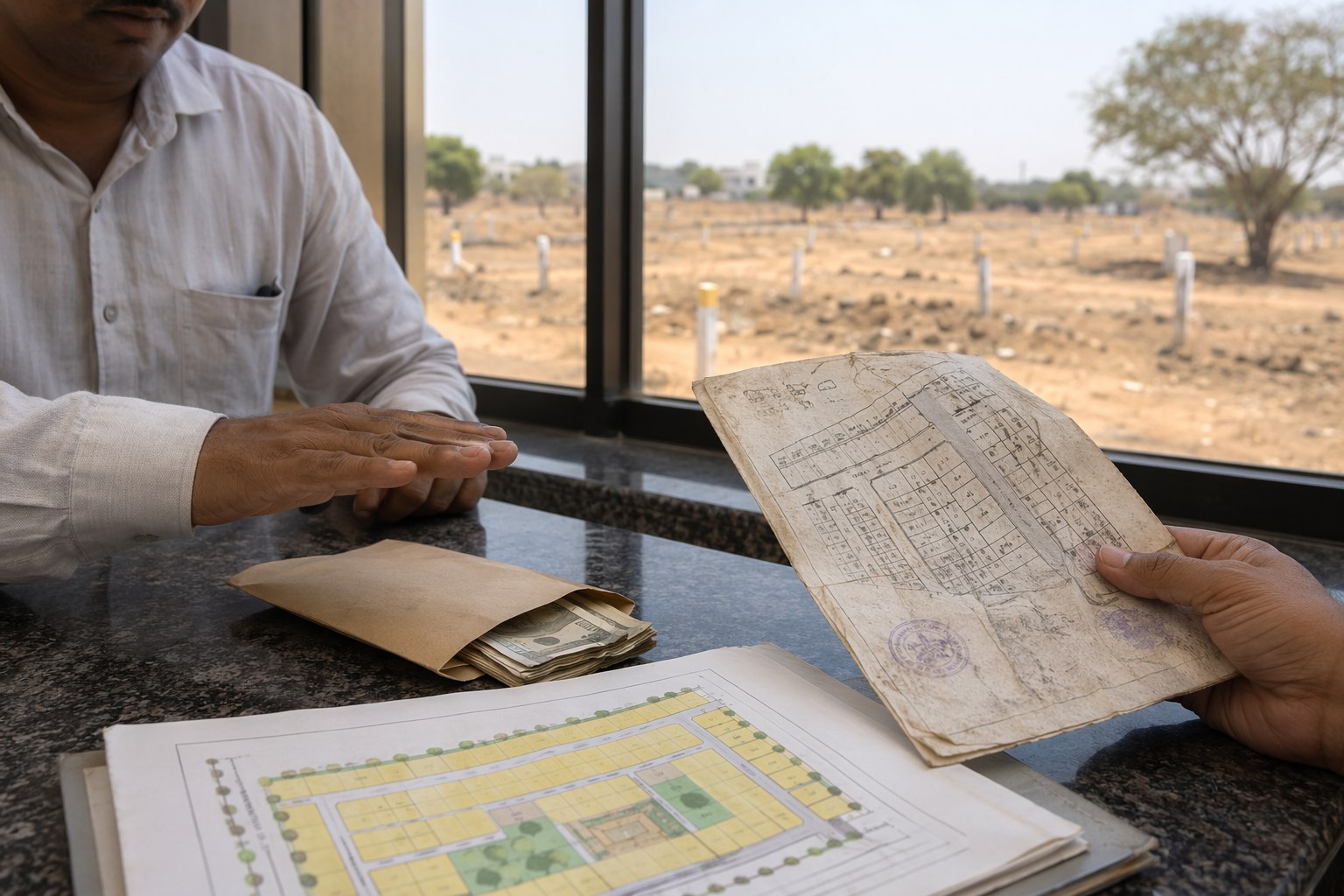
The case we are covering involved a buyer from Madhapur who wanted a 200 sq yd plot in a layout near Maheshwaram mandal, close to the Hyderabad-Srisailam highway side. The quoted rate was ₹24,000 per sq yd, making the basic plot value ₹48 lakh. After stamp duty, registration fee, transfer duty, fencing, and basic development work, the outflow would cross ₹52 lakh. That is not small money for a family buyer.
For comparison, in our regular market tracking, quoted open plot prices in Maheshwaram, Mansanpally and nearby pockets often move between ₹18,000 and ₹35,000 per sq yd depending on road access, HMDA/DTCP approval, development quality and distance from ORR. In Tellapur and Osman Nagar, developed plots can quote much higher, frequently ₹60,000 to ₹90,000 per sq yd. Kokapet and Neopolis-side land parcels are in a different league, with premium quoted rates often above ₹1 lakh per sq yd. So a ₹24,000 rate near Maheshwaram was believable. That believability is exactly why the buyer almost moved fast.
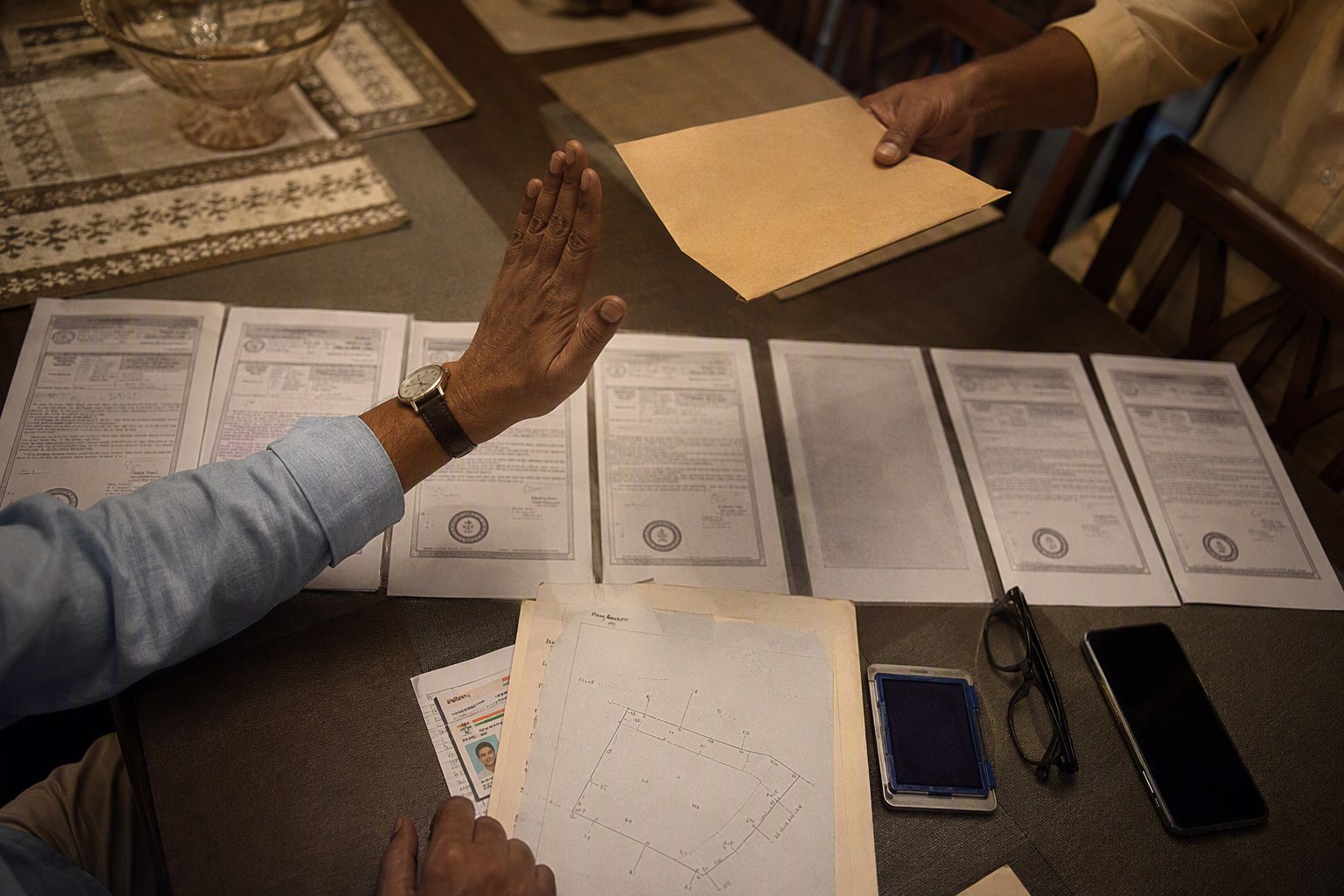
The seller shared a layout copy, plot allotment letter, old sale deed photocopy, and a recent tax receipt. The broker kept repeating that the plot number was not in any dispute. Fair enough. But the correct question was different: does the seller have an unbroken ownership chain from the parent survey number to this exact plot?
Telangana Case Study: The buyer trusted Plot No. 117, but the parent survey told another story
The plot was shown as Plot No. 117 in a private layout spread over multiple survey numbers. The layout map mentioned Survey Nos. 42, 43/AA, 44/E and 45/Part of a village in Maheshwaram mandal, Rangareddy district. The seller claimed his plot fell in Survey No. 44/E. The old sale deed also carried a schedule saying Plot No. 117, admeasuring 200 sq yd, with boundaries on four sides.
At first reading, it looked normal. Plot schedule was there. Boundaries were there. Link deed was attached. EC printout showed one sale transaction from 2016 and one agreement-cum-GPA from 2013. The seller had Aadhaar, PAN, mutation receipt, and electricity connection proof for a temporary room in the layout.
Still, two things disturbed us. First, the EC was searched using the plot number and document number, not the parent survey numbers. Second, the layout approval copy had a different landowner name for Survey No. 43/AA, while the seller's link deed claimed rights through Survey No. 44/E. In Hyderabad land files, this kind of mismatch is not rare. Sometimes it is harmless clerical overlap. Sometimes it is the start of a title headache.
We asked the buyer to pause the ₹5 lakh token payment and run the property through a parent-survey check. The broker was annoyed. That is usually a signal to slow down, not speed up.
The verification route: from layout number to survey number, then to Dharani and SRO trail
Here is the exact checking route we followed. This is the same route I prefer for plotted layouts in Adibatla, Tukkuguda, Shankarpally, Shadnagar, Yacharam, Kandukur, Chevella and Medchal-side villages.
- Step 1: Identify all parent survey numbers from the layout plan, not just the plot schedule.
- Step 2: Map Plot No. 117 to its parent survey portion using the layout drawing and, where needed, village map or FMB sketch.
- Step 3: Search EC by document number, plot number and parent survey numbers through the SRO record trail.
- Step 4: Check Dharani ownership and pahani entries for the parent land period before conversion/layout sale.
- Step 5: Run Section 22-A prohibited property check for all parent survey numbers.
- Step 6: Compare land extent in link deeds with layout extent sold as plots. Overselling is a silent risk in old layouts.
For a buyer doing the first round himself, Verified.RealEstate tools help reduce blind spots. Start with Survey Number Finder to identify the underlying survey number. Then use Encumbrance Certificate Search for the EC trail. Run Section 22-A Prohibited Property Check before committing advance. If you are still comfortable, cross-check value using Market Value / Guideline Value Search and estimate charges with the Stamp Duty Calculator.
For this case, the EC search showed a clean chain only if we searched by the plot number. When we searched by Survey Nos. 42, 43/AA, 44/E and 45/Part, one old transaction appeared that was not disclosed by the seller. That transaction became the turning point.
Where the missing ownership link appeared
The parent land was originally held by three family members. Let us call them A, B and C. In 2008, A and B executed a development agreement with a local layout developer for part of Survey No. 44/E. C did not sign that document. In 2011, the developer sold plots through GPA route. In 2013, one buyer purchased Plot No. 117 from the developer's GPA holder. In 2016, the current seller purchased from that buyer.
On paper, that looks like a normal resale chain. But the issue was C's share. The pahani and old link documents showed C as a co-pattadar for part of the same survey extent before the layout was carved out. There was no registered release deed from C. No partition deed clearly allotting the Plot No. 117 portion to A and B. No court decree. No family settlement registered at SRO. No ratification deed. In simple words, the developer may have sold more confidence than title.
This is the classic missing link in a layout plot. The final plot sale deed can be registered. The buyer can get possession. The layout roads may exist. Houses may come around it. But if one co-owner in the parent survey never transferred rights, that person or legal heirs can raise a claim later. In such cases, the fight is not about Plot No. 117 alone. It goes back to the parent land share.
We then checked whether any portion of the parent survey was on the prohibited list. One sub-entry adjoining the same survey block had a Section 22-A flag in revenue records due to classification dispute. Plot No. 117 itself was not directly shown as prohibited in the EC printout. That is why a plot-only check would not have caught the risk. The warning was visible only when parent survey numbers were searched together.
Data table: what looked clean and what failed in the case file
| Item checked | What the buyer first saw | What deeper verification showed | Risk level |
|---|---|---|---|
| Layout plot number | Plot No. 117, 200 sq yd | Plot existed in the layout map | Low by itself |
| Quoted rate | ₹24,000 per sq yd | Within local Maheshwaram market band of roughly ₹18,000-₹35,000 per sq yd | Medium |
| Plot EC | 2013 and 2016 transactions visible | Plot-level EC did not show parent co-owner gap | Medium |
| Parent survey EC | Not checked by buyer initially | Older co-owner share issue appeared | High |
| Pahani and pattadar trail | Not supplied fully | C's name appeared in past land record chain | High |
| Section 22-A check | Seller said no issue | Nearby sub-entry in parent survey block needed clarification | High |
| Link documents | Two deeds shared | Release or partition from one co-owner missing | High |
This table is why I keep telling buyers: a registered document is not the same as a perfect title. Registration proves that a document was accepted and recorded. It does not automatically cure an ownership defect in the earlier chain.
How much money was at risk?
The visible deal size was simple: 200 sq yd x ₹24,000 = ₹48,00,000. The buyer planned to pay ₹5 lakh as token, ₹20 lakh from savings, and the balance after selling a small flat share in Nizampet. If the transaction had gone through, the stamp duty and registration cost would have been calculated on the higher of market value and consideration value. A buyer can estimate this through our Stamp Duty Calculator, but the bigger risk was not only stamp duty. It was liquidity.
A disputed plot becomes hard to resell. Banks hesitate if the link chain is weak. Future buyers ask for the same missing release deed. If a legal heir of C files a claim, the buyer may spend years dealing with notices, caveats, injunctions or settlement talks. Even if the buyer finally wins, the plot gets stuck during the best appreciation years.
Let us use conservative numbers. If this Maheshwaram pocket appreciates from ₹24,000 to ₹32,000 per sq yd over a few years, the plot value rises from ₹48 lakh to ₹64 lakh. But if title litigation blocks sale, that paper gain is useless. In our experience, market appreciation cannot compensate for a broken link document trail.
Why layout approval does not solve every title issue
Many buyers think HMDA, DTCP or old gram panchayat layout approval means the title is safe. Approval is valuable, no doubt. It confirms planning parameters, road widths, open space allocation, land use compatibility and layout permissions as per the applicable system. But layout approval is not a full legal title certificate for each plot.
For plotted developments, buyers should separately check land use through Land Use Zone Finder, open space share through OSR Calculator, and road access using Road Width Check. These planning checks sit alongside title checks. One cannot replace the other.
In this case, the road width was acceptable and the layout drawing was not the main villain. The villain was the missing consent or transfer from one parent land co-owner. If the developer had obtained a registered release deed from C or a registered partition before selling plots, the risk would have reduced sharply. Since that document was missing, the buyer had three choices: walk away, ask seller to cure title before sale, or demand a heavy risk discount with legal indemnity. We advised walking away unless the missing document could be produced.
What the SRO trail said and why Find Your SRO matters
The relevant registration records fell under the local SRO jurisdiction for that village. Buyers often search at the wrong office or rely only on online snippets. For villages near Hyderabad, SRO jurisdiction can confuse people because the marketing address says Tukkuguda, Maheshwaram, Shamshabad or Adibatla, while the actual village and mandal decide where records sit. Use Find Your SRO Office before ordering certified copies.
We asked for certified copies of the 2008 development agreement, 2011 GPA transaction, 2013 sale deed and 2016 sale deed. The certified 2008 document confirmed only A and B as executants. C was not a confirming party. That one absence carried more weight than all brochure promises.
The seller's side argued that C had orally accepted the layout and never objected. In Telangana land, oral comfort is not enough for a ₹48 lakh purchase. If C had rights, we need a registered release, registered confirmation, registered family settlement, decree, or legally acceptable succession and transfer trail. A buyer cannot build title on chai-table assurances.
Practical checklist before buying a layout plot in Telangana
If you are checking a plot in Shadnagar, Kothur, Maheshwaram, Ibrahimpatnam, Yacharam, Shankarpally, Moinabad, Medchal, Ghatkesar or any fast-moving Hyderabad fringe, use this checklist before advance payment.
- Get the layout approval copy with all parent survey numbers and total extent.
- Match your plot number to the exact parent survey portion. Do not depend only on the broker's marking.
- Take EC for at least 30 years where records permit, using both document numbers and survey numbers.
- Check Dharani pattadar history, old pahani, ROR entries and mutation flow for agricultural parent land.
- Run Section 22-A check on every parent survey number, not only the final plot schedule.
- Check whether all co-owners signed the development agreement, GPA, sale deed, partition or release documents.
- Compare total layout plots sold with land extent available. Oversold layouts create boundary fights.
- Use Property Verification Tool for a structured review before token payment.
- Track later record changes through Property Change Tracker if you are waiting for seller-side corrections.
We have seen buyers spend two hours negotiating ₹500 per sq yd but skip a ₹1,000 certified copy that can save the full investment. That is poor risk management.
Final decision in this Telangana Case Study
The buyer did not proceed with Plot No. 117. He asked the seller to produce either a registered release deed from C or a legally valid document proving that C had no right in the relevant extent. The seller could not provide it within the agreed time. The token was never paid.
Three months later, the buyer selected another plot in a smaller but cleaner layout near Kandukur mandal. The rate was ₹21,500 per sq yd, slightly cheaper, with a clearer parent survey chain and all co-owners appearing in the development and sale documents. Not every cheaper plot is safer, but in this case the paper trail was better.
The lesson is direct. A layout plot number is useful for location. It is not enough for ownership. Telangana's 1,47,934 Section 22-A prohibited property records are a reminder that land checks must start from the parent survey and move forward document by document. If one ownership link is missing, pause. A good plot will survive verification. A risky plot will ask you to hurry.
Frequently Asked Questions
Is a registered layout plot always safe to buy in Telangana?
No. Registration means the document was recorded by the SRO. You still need to verify parent survey ownership, link documents, pahani history, EC, layout approval and Section 22-A status.
Why should I check the parent survey number if I am buying only one plot?
Because the plot is carved out of parent land. If a co-owner, assigned land issue, government claim or prohibited entry exists at parent survey level, it can affect your plot later.
What is the biggest warning sign in a layout plot link document chain?
A missing signature or missing release deed from a parent land co-owner is a serious warning sign. Oral family understanding is not enough for a safe purchase.
Which tools should I use before paying token advance for a Telangana plot?
Use Survey Number Finder, EC Search, Section 22-A Prohibited Property Check, Guideline Value Search, Find Your SRO Office and Property Verification Tool before paying advance.
Can layout approval replace legal title verification?
No. Layout approval checks planning and development permission. Title verification checks ownership. A buyer needs both before registration.