Case Study: The Gift Deed Plot That Failed a 22-A Check
Telangana has 3,076,153 prohibited property entries in government records. That single number should make every plot buyer pause before paying token advance, especially when the title comes through a family gift deed. In this case study, a buyer looking at a plot on the western side of Hyderabad felt the papers were neat: gift deed, EC, link documents, tax receipts, and family confirmation. But one 22-A check against the survey number changed the whole reading of the deal.
This is not a rare kind of confusion. We see it often around fast-moving land pockets such as Shankarpally, Mokila, Kollur, Tellapur, Patancheru, Adibatla, Tukkuguda, and Maheshwaram. The document may look harmless, the seller may be genuine, and the family story may sound believable. Still, if the survey number is sitting inside a prohibited property list, registration can get blocked or questioned at the SRO level.
Our view is simple: a gift deed can transfer family ownership, but it cannot cure a survey-number-level prohibition. The land record decides the risk, not the emotion in the family transaction.
Why a 22-A Check Matters Even When the Gift Deed Looks Valid
Section 22-A issues are tricky because buyers tend to check only the latest registered document. If the latest document is a gift deed from father to son, mother to daughter, or between siblings, many buyers assume the property is safe. That assumption can be costly.
A gift deed mainly tells you that one person gifted his or her rights to another person. It does not automatically prove that the government will allow future sale registration. If the land is recorded as prohibited, assigned land, government land, endowment-related land, ceiling surplus, wakf-related, or falls under another restricted category, the SRO may refuse registration or ask for clarification.
In our experience, the danger is higher in layouts carved from agricultural survey numbers. A buyer may see a plot number in a private layout, but government records still identify the land by survey number, village, and mandal. That is why the first serious check should be at survey number level using tools like Section 22-A Prohibited Property Check and Survey Number Finder.
The Buyer Case: A Family Gift Deed, A Confident Seller, And One Problematic Survey Number
The buyer in this case was a salaried professional from Hyderabad. He was not chasing a very speculative deal. He wanted a plot for future construction, somewhere with access to the western growth corridor. The plot was in a village belt that many buyers associate with Mokila, Shankarpally, and surrounding residential expansion. The seller had received the property through a registered family gift deed.
On paper, the first impression was positive. The seller’s name appeared in the latest registered document. The family members were cooperative. There was no visible dispute between siblings. The layout had internal roads on ground. Neighbouring plots had compound walls. A few buyers had already started basic site works.
The buyer did what many sensible people do. He asked for the gift deed, old sale deed, link documents, and EC. He also checked the market value side through Market Value / Guideline Value Search and wanted to estimate registration charges through the Stamp Duty Calculator. Up to this stage, nothing screamed danger.
The issue came only when the survey number was checked against prohibited property records. The plot number itself was not the problem. The problem was the parent survey number. A portion of that survey number appeared in a restricted category as per latest IGRS data. That meant the buyer was not dealing with just a family-document issue; he was dealing with a government-record issue.
22-A Check Finding: The Risk Was In The Parent Land, Not The Gift Deed
This is the part many buyers miss. A registered gift deed can exist even where the larger land record is messy. In some cases, past registrations happened before stricter digital checks. In some cases, only a part of a survey number is affected, but the plot map is not clear enough to separate safe and unsafe portions. In some cases, mutation entries and registration documents are not speaking the same language.
Here, the buyer’s EC did not show a mortgage or obvious litigation. The seller was not hiding. The family gift deed was not fake. Still, the parent survey number raised a 22-A concern. That made the next registration uncertain.
We advised the buyer not to treat the EC as a final clearance. An EC tells you about registered transactions for the searched property details. It does not certify that the land is free from every government restriction. That is why an Encumbrance Certificate Search is necessary, but not sufficient. For deeper reading, buyers can also use EC Analyzer to understand the transaction chain better.
What The Documents Said, And What They Did Not Say
The gift deed said the property was transferred within the family. The EC reflected registered movements. The layout sketch showed a plot. The seller had possession. Local enquiries suggested there was no open family dispute. These are all good signs, but they are not the full title story.
What was missing? There was no clear official clarification showing that the specific plot portion was outside the prohibited extent. There was no updated government record cleanly matching the plotted site with non-prohibited land. The buyer did not have a revenue record trail strong enough to override the 22-A flag.
This is where local real estate practice in Telangana becomes very practical. You cannot argue with an SRO counter using only sentiment. You need documents. If the survey number is flagged, the buyer or seller must get clarity from the proper authority. Depending on the nature of the entry, that may involve revenue records, Dharani entries, old pahani extracts, proceedings, NOCs, or correction requests. The exact path depends on why the survey number is in the prohibited list.
How We Read A Gift Deed Plot Before Advising A Buyer
For a plot coming through a family gift deed, we usually break the verification into layers. This prevents emotional shortcuts. Many Hyderabad buyers feel reassured when they hear “family property only” or “father gifted to son only”. That is not enough.
Layer 1: Identity and execution
First, confirm whether the donor and donee are correctly identified, whether the gift deed is registered, and whether possession and acceptance are mentioned. A gift deed without proper acceptance can create title arguments later, especially within families.
Layer 2: Link document chain
Then check how the donor got the property. If the father gifted the plot, how did the father get it? Was it a sale deed, partition, inheritance, earlier gift, or assignment? The link document chain should not suddenly stop with vague statements.
Layer 3: EC and charge checks
The EC must be checked for the right property description, survey number, village, mandal, and SRO. Buyers should also check whether any loan charge or security interest appears elsewhere. For urban and semi-urban deals, a CERSAI Charge Check is useful.
Layer 4: Survey number and 22-A status
This is the key layer in this case. If the survey number is restricted, the clean-looking gift deed becomes secondary. The buyer should run a Section 22-A Prohibited Property Check before giving non-refundable advance.
Layer 5: SRO and village mapping
Wrong SRO assumptions also create confusion. A buyer may say the plot is near Kollur or Tellapur, but the revenue village and SRO jurisdiction may be different. Use Find Your SRO Office and SRO Village Directory before planning registration.
The Mandal And Village Detail Can Change The Whole Answer
In Telangana land checks, mandal and village names are not small details. Two sites may both be marketed as “near Mokila”, but one may fall in Shankarpally mandal and another may be tied to a different revenue village. Around Hyderabad, marketing names and revenue names often differ. This is common in areas around Narsingi, Gandipet, Kokapet, Tellapur, Osman Nagar, Kollur, Mokila, Shankarpally, Patancheru, Ghatkesar, Keesara, Tukkuguda, and Maheshwaram.
For 22-A, the government record is not interested in brochure names. It reads village, mandal, survey number, sub-division, extent, and classification. A private layout name or gated community name may help you identify the site on ground, but it will not remove a prohibited entry.
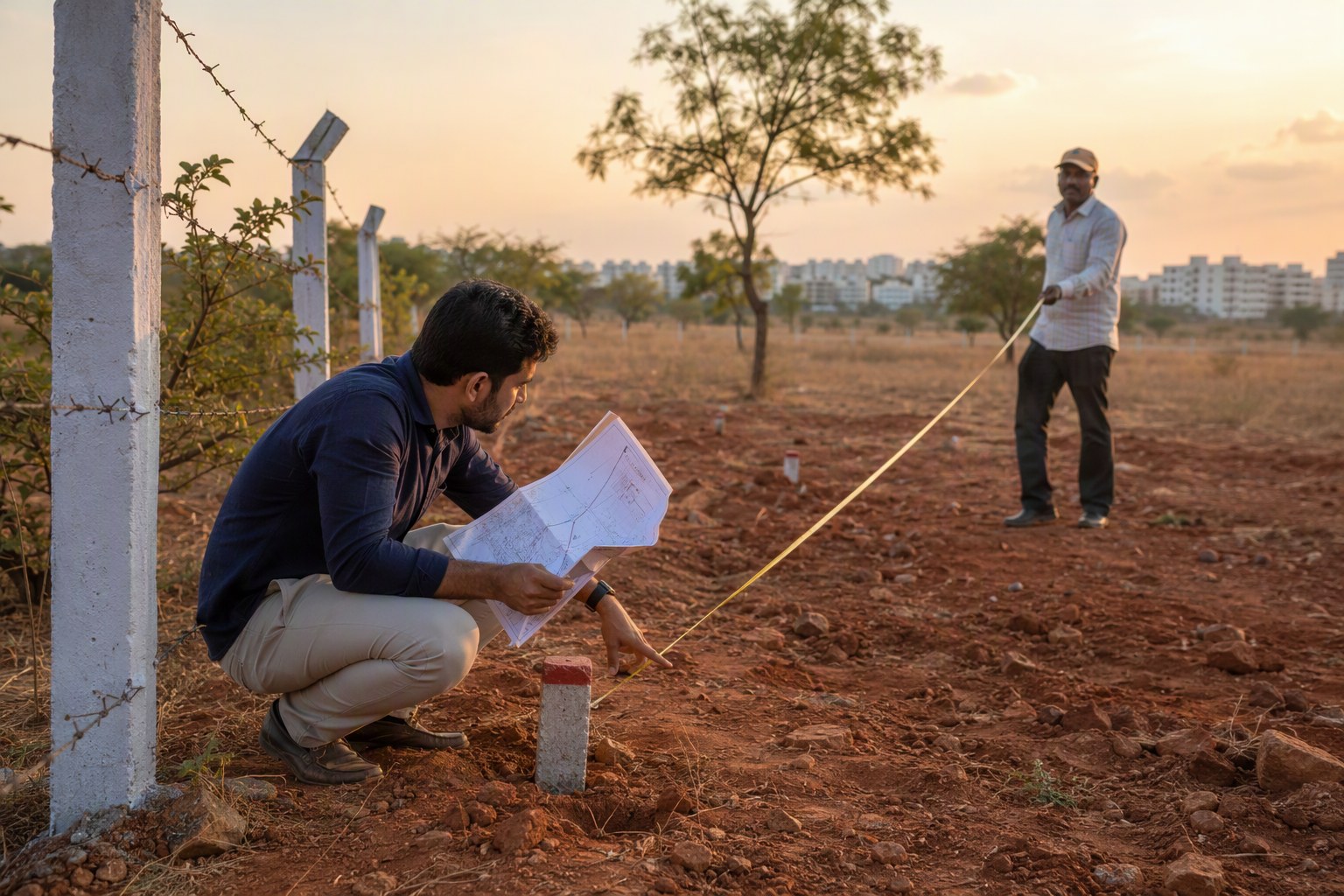
In this case, the buyer initially gave only the plot number and layout name. We asked for the parent survey number and village. Once that came in, the risk became visible. That is why buyers should not stop at “Plot No.” details. Ask for the parent survey number before visiting the site for the second time.
Why The Seller’s Good Faith Was Not Enough
To be fair, not every seller in a 22-A case is cheating. Some sellers themselves do not know the land is flagged. Some inherited or received gifted property and assumed past registration means future sale is safe. Some rely on local agents who say, “Registration ayipotundi, no problem.” We have heard that line too many times.
But good faith does not protect the buyer if registration fails after advance payment. It also does not protect the buyer if a bank later refuses loan processing, or if resale becomes difficult. The buyer has to think like the next buyer also. If you struggle to verify it today, your future purchaser may struggle even more.
Our opinion: when a survey number triggers 22-A risk, the seller should resolve or clarify it before expecting full market confidence. The buyer should not fund the seller’s uncertainty unless the agreement clearly protects the advance and sets document-based conditions.
What We Told The Buyer To Do Before Paying Advance
We recommended a conditional approach. The buyer was interested in the location, but interest is not a reason to ignore title risk. The next steps were practical:
- Get the exact prohibited entry details for the survey number and village.
- Ask the seller to provide written clarification or relevant proceedings showing the plot is not affected.
- Match the plotted portion with the parent survey number using layout records and survey references.
- Check the EC again with correct survey number and SRO details.
- Speak to the SRO side before fixing a registration date.
- Do not pay non-refundable token advance until the 22-A issue is answered.
- If signing an agreement, include a refund clause linked to 22-A clearance and registration refusal.
For buyers who want a structured first screen, Property Verification Tool can help organise the checks. It will not replace legal advice, but it reduces the chance of missing basic red flags.
Gift Deed Plot 22-A Check: The Table We Use Internally
| Check Point | What It Tells You | Why It Mattered In This Case |
|---|---|---|
| Gift deed | Whether family transfer was registered | Looked proper, but did not clear government restriction risk |
| EC | Registered transaction history | Did not show the full 22-A issue by itself |
| Survey number | Revenue identity of the land | Triggered the main concern |
| Village and mandal | Correct government location | Marketing location was not enough |
| SRO jurisdiction | Where registration would be processed | Needed confirmation before sale agreement |
| Prohibited property list | Whether registration can be blocked or questioned | Changed the buyer’s decision |
What Happened To The Deal?
The buyer did not proceed with a normal advance payment. He asked the seller to first produce satisfactory clarification on the 22-A entry. The seller was surprised because the family had already done a registered gift deed earlier. That reaction is common. Many owners believe that one successful registration means every future registration will also pass.
The buyer’s position was correct. If a property needs clarification, let the person selling it bring that clarity. A buyer can support the process, but should not take the full risk. In this case, the buyer kept the option open but did not lock his money without protection.
That is a mature decision. Missing a plot is painful for a few days. Getting stuck with a disputed or blocked property can disturb finances for years.
Lessons From This 22-A Check Case Study
The biggest lesson is that title verification cannot be document-only. It must be record-led. Telangana buyers must connect registration documents with revenue records, SRO jurisdiction, survey numbers, prohibited property lists, and ground reality.
Gift deeds are common in family property planning. They are not bad documents. In many cases, they are perfectly valid and useful. But when the underlying land has a restriction, a gift deed cannot wash it away. The buyer must separate “valid family transfer” from “marketable title”.
We have seen buyers spend days negotiating rate and hardly any time checking the parent survey number. That order should be reversed. First check whether the land can be safely registered and resold. Then discuss price, payment schedule, and registration date.
Also remember that ready reckoner or market value is only one part of the transaction. A property may have an accessible guideline value, but still face title or registration issues. Use Market Value / Guideline Value Search for valuation reference, but pair it with Section 22-A Prohibited Property Check before you celebrate the deal.
Final Advice For Hyderabad Plot Buyers
If you are buying a plot in and around Hyderabad, especially in expanding mandals, ask for the survey number early. Do not depend only on the plot number printed in a layout sketch. Verify the village, mandal, SRO, EC, link documents, and 22-A status before token advance.
For gift deed properties, be extra calm. Families may be genuine, but records may be complicated. If the seller says everything is clear, ask for documents that prove it. If the SRO or prohibited property search shows a concern, pause the deal until the concern is answered in writing.
In Telangana real estate, the safest buyer is not the one who negotiates the hardest. It is the one who checks the survey number before falling in love with the plot.
Frequently Asked Questions
Can a gift deed property still fail a 22-A check?
Yes. A gift deed may be valid between family members, but if the parent survey number is listed under a prohibited category, registration of a future sale can be blocked or questioned.
Is an Encumbrance Certificate enough for buying a plot in Telangana?
No. An EC shows registered transactions, but it does not by itself confirm that the land is free from Section 22-A restrictions, revenue issues, or classification problems.
What should I check first for a Hyderabad plot?
Start with the survey number, village, mandal, SRO jurisdiction, EC, link documents, and Section 22-A prohibited property status. Plot number alone is not enough.
Should I pay token advance before 22-A verification?
Preferably no. If you must sign an agreement, include a clear refund clause if registration is refused or if the 22-A issue is not resolved by the seller.
Who should resolve a 22-A issue, buyer or seller?
The seller should provide clarification or correction documents before expecting the buyer to proceed. The buyer can verify, but should not carry the seller’s title burden.