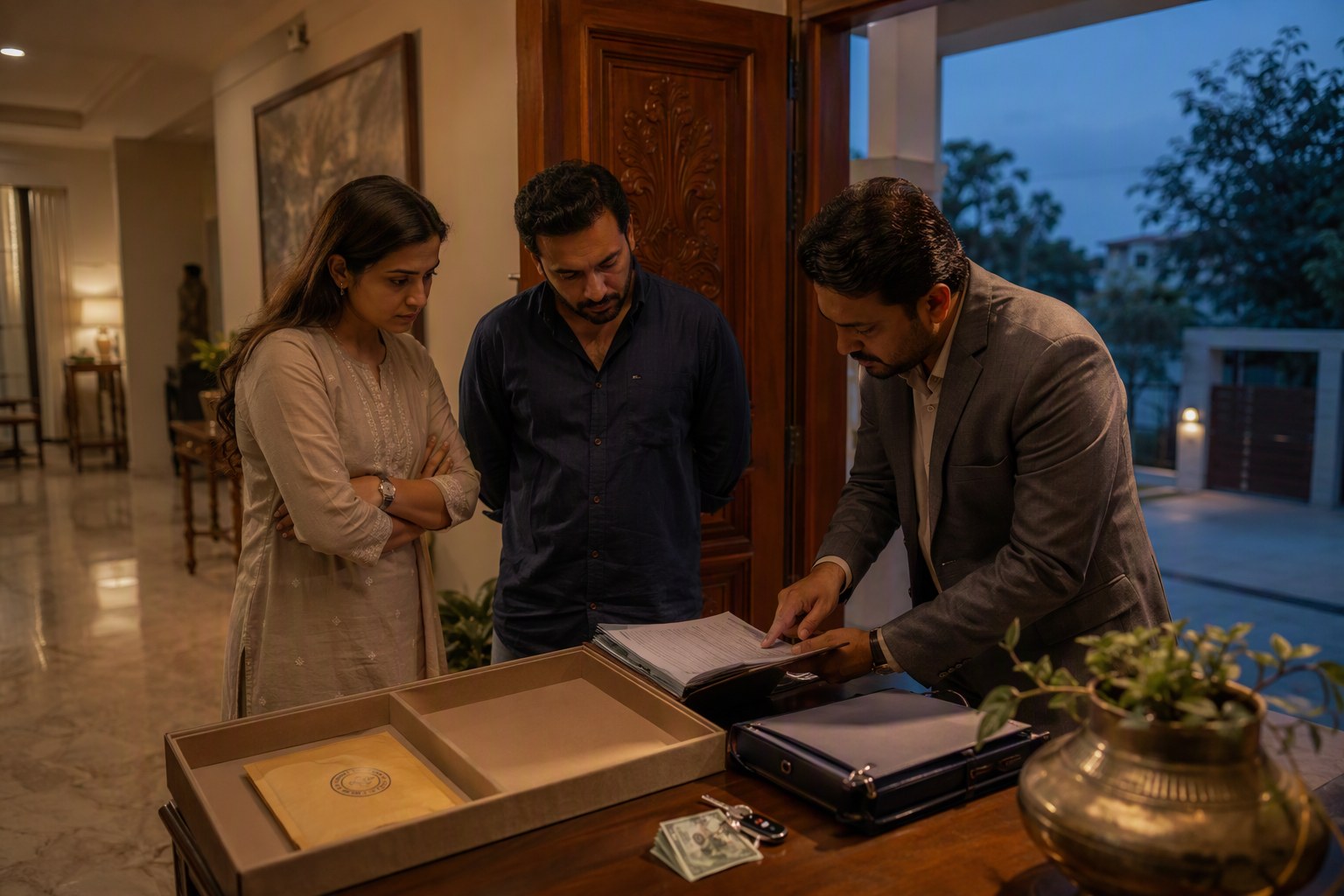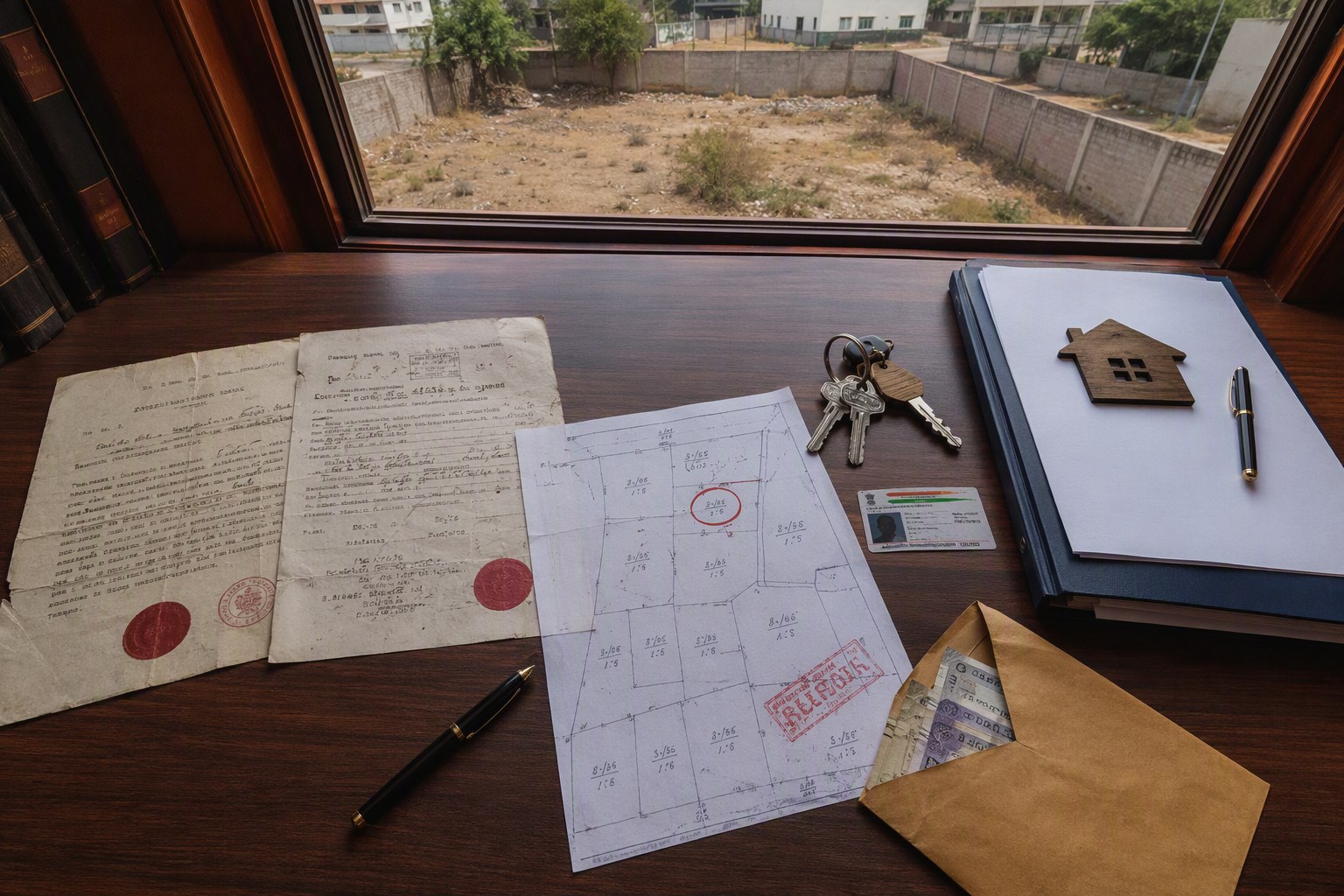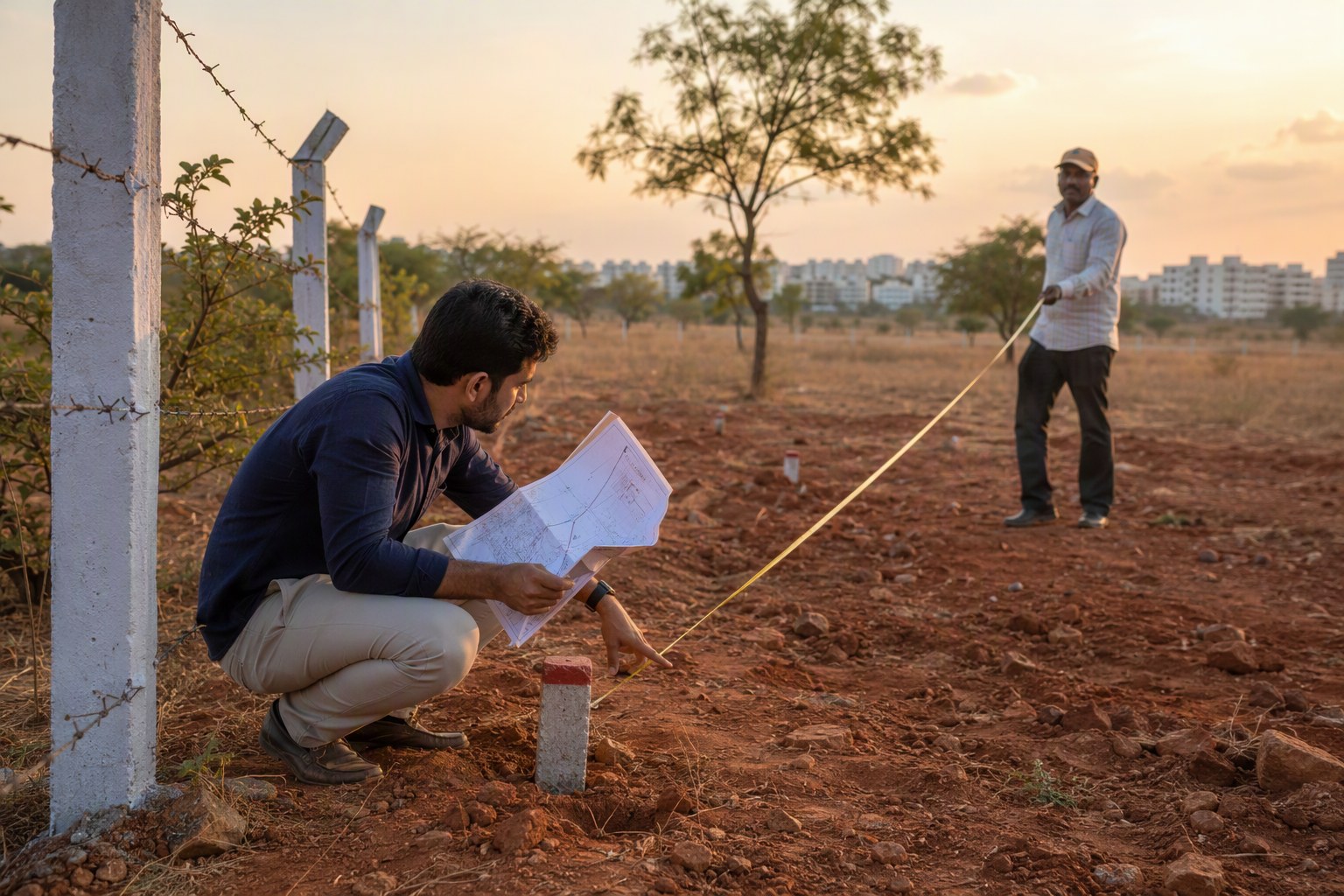
Can a buyer catch a plot boundary error before paying token? Yes. We have seen it happen when the buyer does not rush, compares the site fencing with the deed extent, checks the survey number records, and asks one uncomfortable question: “Is the land on ground exactly the same as the land in the document?”
This case came from the Mokila–Tangutur side of Shankarpally mandal, a belt where Hyderabad buyers often move fast because good plots do not remain on the table for long. The buyer liked the location, the approach road, and the neighbourhood. The seller wanted token immediately. But one small mismatch at the corner of the plot changed the whole deal.
Our view is simple: if the boundary is not clear before token, the deal is not ready for token.
Plot boundary error: what the buyer noticed at the site
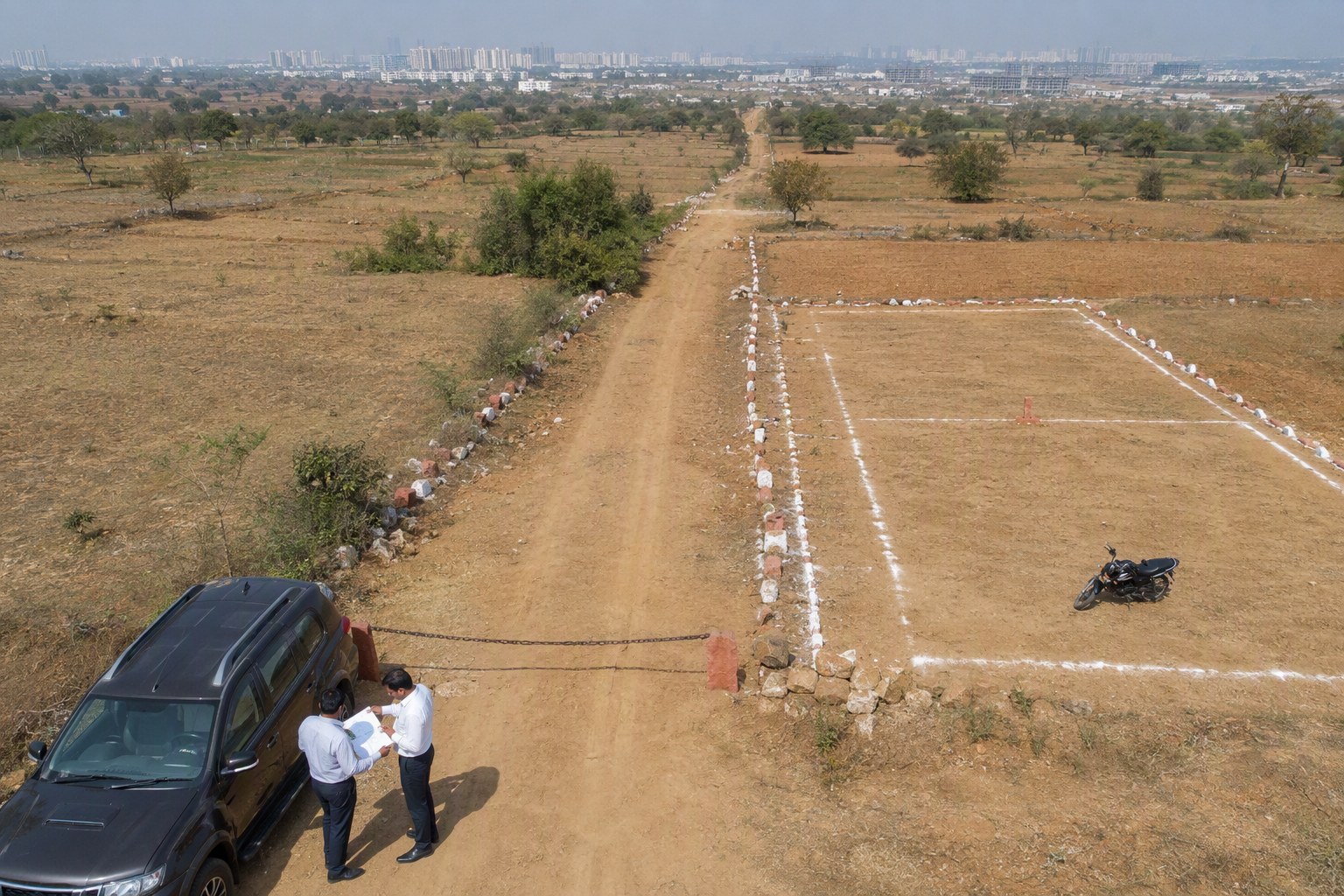
The plot looked normal at first glance. There was temporary fencing, a small gate, and stones placed at the corners. The seller’s representative said the fencing was old and “everyone in the layout knows the boundaries”. This is a common line in Hyderabad outskirts, especially in village layouts where formal demarcation is not always maintained after many resale transactions.
The buyer had carried the previous sale deed copy and layout copy. That was the first good decision. At the site, he compared three things:
- the boundary description in the sale deed, especially north, south, east and west sides;
- the physical fencing and corner stones on ground;
- the survey number and sub-division details shown in the available revenue papers.
One side did not sit correctly. The deed described a proper road-facing plot with a certain directional alignment. On ground, the fencing seemed to bend slightly near one corner. The front looked attractive, but the rear line did not match the shape that the document suggested. This was not a dramatic dispute with people fighting at the site. It was quieter than that. Just one suspicious corner, one slightly shifted fence, and one buyer who did not ignore it.
In our experience, this is how many plot issues begin. Not with a court notice. Not with a police complaint. It starts with a neighbour saying, “That stone was moved long back,” or a seller saying, “Sir, small adjustment only.” Small adjustment on land can become a big legal headache.
Plot boundary error found before token: the document check
Before paying token, the buyer asked for time to verify the property. That one decision saved him from entering a weak deal. We helped him organise the check in a practical way, not like a file kept for show.
First, the sale deed was read carefully. Many buyers look only at names, extent, and price. Boundary clauses are treated like routine text. That is a mistake. The boundary schedule tells you what lies on each side of the plot. If the deed says road on one side and the site shows another private plot, there is a problem. If the deed says open land but the site has a compound wall belonging to another owner, that needs explanation.
Second, the survey number was checked against land records. For Telangana plots outside dense municipal areas, survey number clarity is non-negotiable. Pahani, Dharani entries, old link documents, layout plan, and FMB or village map references should speak the same language. If one paper says one survey number and another paper refers to a neighbouring survey number, do not brush it aside.
Third, the buyer checked whether the property had any legal restriction risk. As per latest IGRS data available to us, the prohibited properties database under Section 22-A contains 3,076,153 entries. That number itself is a reminder: buyers cannot assume that every open plot is freely transferable. A quick Section 22-A Prohibited Property Check is basic due diligence before token, not something to be done after draft sale agreement.
The buyer also used the Survey Number Finder to organise the survey reference, the Encumbrance Certificate Search to review transaction history, and the Find Your SRO Office tool to confirm the correct registration office context. For market value cross-checking, the Market Value / Guideline Value Search is useful because ready reckoner values are tied to official registration data, not roadside talk.
How fencing, deed extent and survey details gave different signals
Here is the practical comparison that exposed the issue. I am not naming the parties or giving private plot identifiers, but the pattern is common enough across Mokila, Nandigama, Kollur, Tellapur fringes, Maheshwaram, Adibatla, Tukkuguda and other fast-moving Hyderabad outskirts.
| Item checked | What the paper suggested | What the site showed | Why it mattered |
|---|---|---|---|
| Sale deed boundary schedule | A regular plot with road access on the stated side | Road access was visible, but the corner alignment looked shifted | Boundary text and ground shape did not comfortably match |
| Physical fencing | Seller claimed it marked the actual plot | Fence line bent near one rear corner | Old fencing is not proof of title or measurement |
| Survey reference | Survey number and sub-division had to match revenue records | Neighbouring land appeared too close to one side | Possible overlap or shortfall needed surveyor confirmation |
| Neighbour input | No dispute was disclosed by seller | Local enquiry raised doubt about an old boundary adjustment | Silent local history can affect peaceful possession |
The seller’s side did not immediately accept that there was a mistake. That is also normal. Many sellers feel a buyer is “overchecking” when token is delayed. But a genuine seller should not fear boundary verification. If the land is correct, a proper demarcation only strengthens the deal.
The buyer then asked for a joint site visit with a local surveyor and the neighbouring owner or representative. This is where the matter became clear. The fencing did not fully match the deed understanding. One portion appeared to follow convenience, not the actual legal boundary. The seller may not have created the issue knowingly; the plot had changed hands earlier. Still, the risk would have passed to the new buyer if he paid token and later signed papers without correction.
Why a plot boundary error is dangerous in Hyderabad outskirts
Hyderabad’s outer residential belts have many genuine opportunities. I like these markets when documents are clean and access is proper. Shankarpally mandal, Patancheru side, Maheshwaram mandal, Ibrahimpatnam side and Medchal villages have all seen strong buyer interest over the years. But the same speed creates pressure. Buyers are told, “Pay token now, verify later.” That order is wrong.
A plot boundary error can create several practical problems:
- Short delivery of land: You may pay for the deed extent but receive less usable land on ground.
- Neighbour dispute: The next-door owner may object when you start compound wall work.
- Bank loan trouble: Technical verification may flag mismatch in boundaries or access.
- Registration risk: The document may register, but registration alone does not fix a wrong boundary.
- Construction delay: Building permission, road width, setbacks and approach can get affected.
For a villa plot buyer, even a small boundary shift can disturb compound wall alignment, parking, entry gate position and setback planning. Before planning construction, buyers should check road and development parameters through tools like Road Width Check, Land Use Zone Finder and FSI/FAR Calculator. These do not replace a surveyor, but they help the buyer ask sharper questions.
The token decision: what the buyer did right
The buyer did not accuse the seller. He simply made token conditional on boundary clarity. That is the mature way to handle such situations. He asked for the seller to either establish the correct boundary with supporting records or correct the transaction terms before any advance payment.
This is where many buyers fail. They pay token because the amount feels small compared to the total deal. Later, when the issue comes out, the seller says token is non-refundable or adjusts blame on the buyer for delay. A token receipt with vague wording is a weak shield. If you must pay token, mention the property identity, survey number, extent, boundaries, documents pending, refund condition, and time allowed for legal verification. Better still, verify first and pay later.
In this case, the buyer walked away from immediate token payment. The seller later agreed that a fresh measurement was needed. That saved the buyer from buying uncertainty. Whether he buys the same plot later after correction is a separate call. The real win was this: he did not become the owner of someone else’s old boundary confusion.
How to check a plot boundary error before token
If you are buying in Mokila, Kollur, Bachupally, Dundigal, Adibatla, Tukkuguda, Ghatkesar, Shamirpet, Kandukur, Kadthal or any other expanding Hyderabad belt, use this sequence before token.
1. Read the boundary schedule slowly
Do not treat north, south, east and west descriptions as formality. Check whether the neighbouring names, roads, open plots or survey references match what exists today. Older deeds may mention previous owners, so ask for updated link context.
2. Match the deed extent with ground possession
Extent on paper and possession on ground must align. If the seller says “fencing is approximate”, pause. Approximate fencing is fine for discussion, not for token.
3. Check survey number and sub-division
Survey number errors are common in village lands and converted layouts. Use revenue records, Dharani details where applicable, layout proceedings and survey sketches. A Property Verification Tool check can help organise the early warning points before you meet an advocate or surveyor.
4. Look at EC, link documents and SRO trail
The encumbrance certificate will not prove physical boundaries, but it can show whether the title flow is clean. Use EC along with link deeds, not as a standalone certificate. If you are unsure which office handles the village, use the SRO directory tools before running around between offices.
5. Speak to neighbours without drama
Local enquiry is still powerful in Telangana land buying. Ask politely. Do not create panic. A neighbour may tell you if the fence was shifted, if a pathway is under dispute, or if a nala or cart track existed earlier.
6. Bring a surveyor before payment
For open plots, a licensed surveyor’s demarcation is worth the time. Ask the seller to be present. If possible, have neighbouring owners acknowledge the stones. Do not rely only on broker confidence.
What this case teaches about plot boundary error risk
The main lesson is not “avoid outskirts”. That would be a lazy conclusion. Many clean and valuable plots exist across Greater Hyderabad’s growth corridors. The lesson is to separate market excitement from land verification. A good locality does not automatically make a good title. A nice road does not confirm correct boundaries. A ready buyer should still be a careful buyer.
We have seen buyers spend time negotiating small price differences but ignore the boundary clause. That is backwards. Rate matters, but identity of land matters first. Government ready reckoner or guideline value can be checked, market quotes can be compared, and stamp duty can be estimated using the Stamp Duty Calculator. But if the plot itself is not clearly identified on ground, all rate discussion is premature.
My opinion is firm on this point: token should be the reward for clarity, not the price of entering confusion. If a seller refuses reasonable boundary verification, the buyer has received an answer. Maybe not the answer he wanted, but a useful answer.
For Telangana buyers, especially first-time plot buyers, remember these local realities. Pahani entries, Dharani status, layout approval, SRO records, EC, survey sketch, link documents and physical possession must be read together. One clean paper cannot cure all other defects. One old fence cannot override proper measurement. One confident broker cannot replace a boundary check.
This case ended well because the buyer asked the right question before paying token. That is the safest stage to catch a plot boundary error. After token, ego enters. After agreement, pressure enters. After registration, litigation may enter. Before token, you still have choice.
Frequently Asked Questions
Can a plot boundary error be found before paying token?
Yes. Compare the sale deed boundary schedule, physical fencing, survey number records, layout plan and neighbour inputs before paying token. If anything does not match, ask for demarcation by a surveyor.
Is existing fencing enough proof of plot boundary?
No. Fencing shows possession or convenience, not always legal boundary. The correct boundary must match the deed, survey details, layout approval and ground measurement.
Which documents should I check for a Telangana open plot?
Check sale deed, link documents, EC, survey number, pahani or revenue record context, Dharani status where applicable, layout approval, SRO details and Section 22-A prohibited property status.
Should token be refundable if boundary verification fails?
Yes, if token is paid before full verification, the receipt should clearly say that the amount is refundable if title, boundary, survey or legal checks fail. Avoid vague cash tokens.
Who should measure the plot before purchase?
Use a competent local surveyor and conduct measurement in the presence of the seller. For disputed edges, neighbour presence or written acknowledgement can prevent later arguments.