

Case Study: The Farm Plot Road Inside a 22-A Block
Telangana has 30,3,076,153 prohibited properties recorded under Section 22-A as per latest IGRS data. That number is not a small warning label; it is a daily registration risk for buyers checking land around Hyderabad’s growth corridors. This case study on the farm plot road inside a 22-A block shows a common trap: the plot looked clean on paper, but the access road passing through a prohibited survey portion made the asset difficult to register, finance and resell.
We’ve seen this pattern around Shankarpally, Mokila, Chevella, Moinabad, Kandukur, Yacharam, Shamirpet and Maheshwaram mandals. A buyer checks the plot number, sees no obvious issue, speaks to the seller, gets a neat layout sketch, and assumes the deal is safe. But land does not exist only as a rectangle on paper. It needs lawful access. If the approach road is inside a 22-A blocked survey number, your so-called clean plot may become practically unusable.
In Hyderabad fringe land deals, the road is not a side detail. The road is part of the value, part of the title comfort, and often the first place where a hidden defect appears.
Why the Farm Plot Road Inside a 22-A Block Matters
Section 22-A blocks certain properties from registration. These may include government lands, assigned lands, endowment lands, wakf-related lands, protected lands and other categories recorded by government departments. The buyer’s problem starts when the sale plot is not directly listed as prohibited, but the access path runs through a survey number that is blocked.
In simple Hyderabad buyer language: your plot may be in Survey No. A, but your car, borewell vehicle, construction material and future buyer must pass through Survey No. B. If Survey No. B is in the 22-A list, the sub-registrar may not treat the total transaction lightly, especially where the access is shown as part of the sale understanding or layout plan.
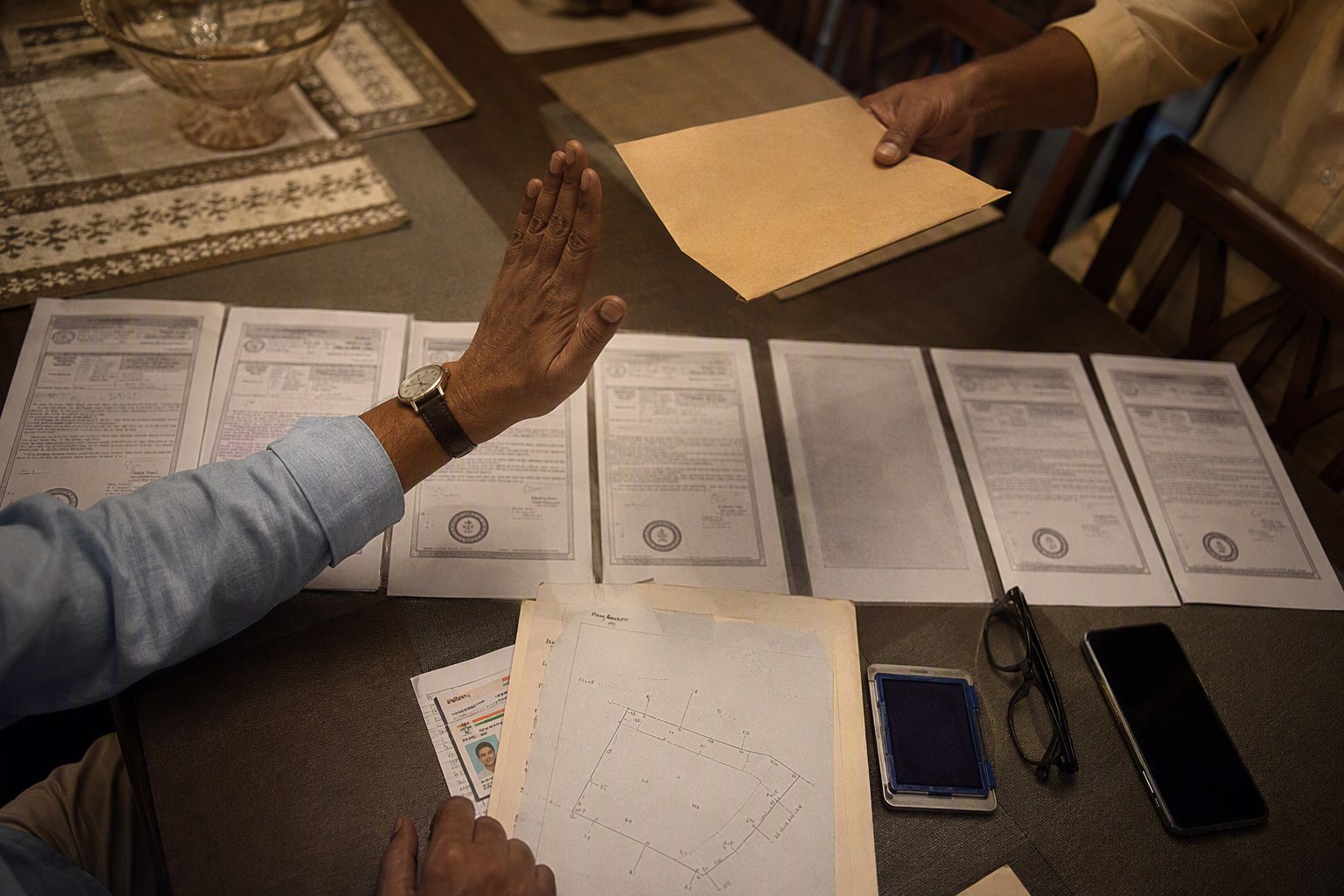
This is why we always advise checking more than the sale deed schedule. Check the village map, pahani, Dharani entries, old link documents, layout sketch, road alignment and neighbouring survey numbers. Use Section 22-A Prohibited Property Check early, not after token advance.
The Case: Clean Farm Plot, Risky Approach Road
This case is based on a typical transaction pattern we have reviewed in the Hyderabad outskirts. We are masking the exact survey numbers and party names because the lesson is more useful than the gossip.
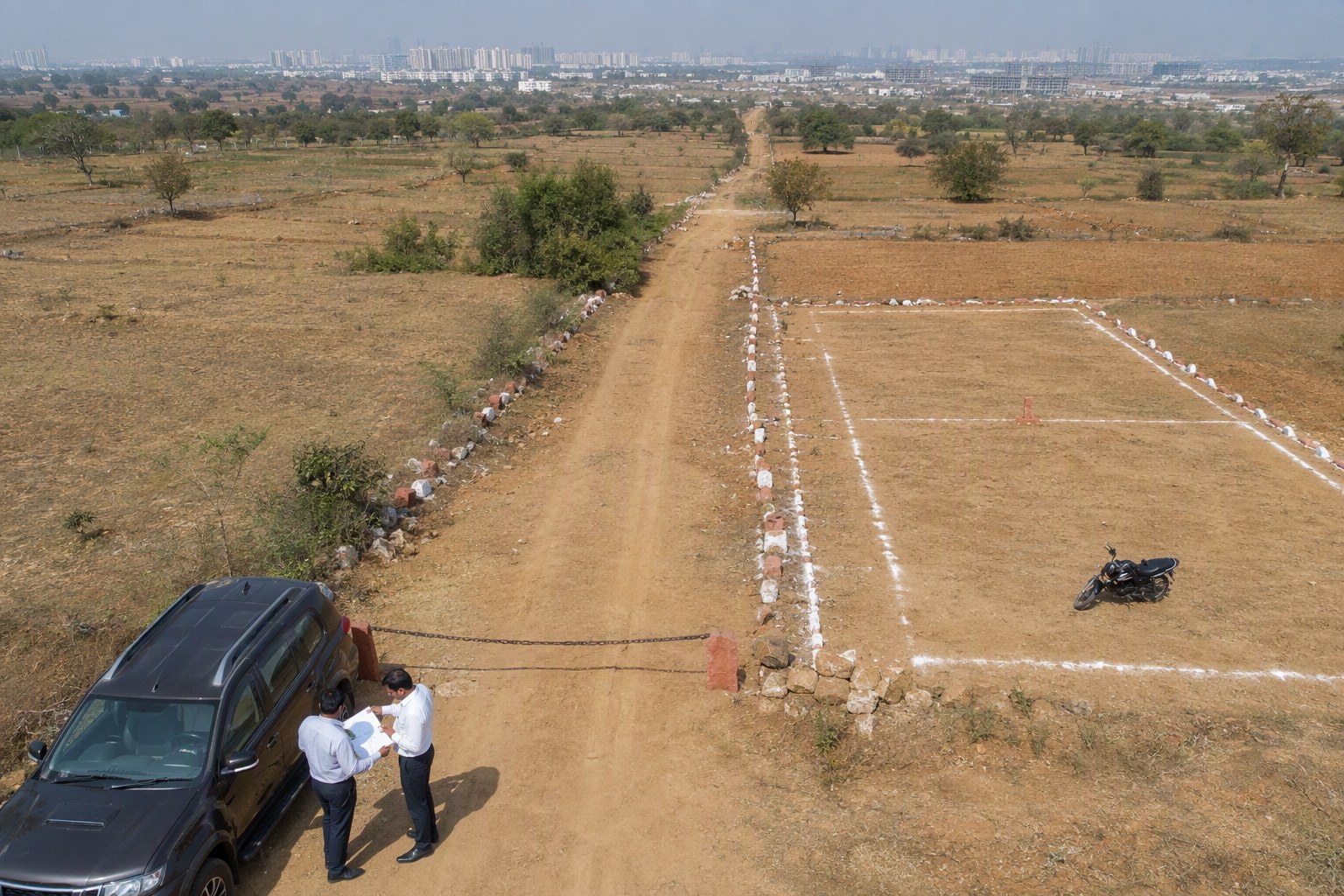
A buyer from Hyderabad wanted a weekend farm plot near the western corridor, in a village belt influenced by demand from Mokila, Shankarpally and Chevella side. The seller showed a farm plot with clear boundaries, a fencing line, a bore point nearby and a mud road from the village approach. The land parcel itself was not appearing as a prohibited property in the basic search shared by the seller.
The buyer’s first impression was positive. The soil was good for a small farmhouse plan. The location was not too far from the ORR side access. The seller said, “Registration ayipothadi sir, no issue.” This sentence is very common in Telangana land deals. It should never be accepted as due diligence.
When the buyer asked for verification, the first checks looked normal:
- The sale plot survey number did not immediately show as blocked in the seller’s shared screenshot.
- The land was reflected as private patta land in the documents produced.
- The link document chain looked better than many village land files we see.
- The EC did not show a recent mortgage or suspicious sale activity.
- The seller was ready to come to the SRO for registration.
But one small point created doubt. The layout sketch showed a road strip connecting the farm plot to the main village road. That strip was not part of the plot’s survey number. It crossed an adjoining survey field.
Once we checked the adjoining survey number, the problem came out: the access road portion was falling inside a 22-A blocked survey number as per latest IGRS data. The plot was not the villain. The road was.
How the Farm Plot Road Inside a 22-A Block Was Detected
The detection did not happen through one magic document. It came from matching four things: the survey number, the village map, the approach road path and the prohibited property record.
First, we identified the exact village and mandal. This matters because many Hyderabad buyers casually say “Shankarpally land” or “Moinabad land”, while the actual village may fall under a different revenue village boundary or SRO jurisdiction. For that, SRO Village Directory and Find Your SRO Office are useful starting points.
Second, we checked the plot survey number and neighbouring survey numbers. In Telangana, buyers must stop treating survey numbers like a formality. One digit wrong, one sub-division missed, and the entire reading changes. A tool like Survey Number Finder can help organise the first level of search before deeper legal review.
Third, the village map and the field situation were compared. The mud road used by the seller did not match a clearly dedicated public road in the way a buyer would expect. It looked like a usage path across land. Such roads may work socially for years, until a registration, loan, fencing dispute or resale brings the defect to the surface.
Fourth, we checked the prohibited property status. That is where the adjoining survey number showed the 22-A block. This was not a small clerical discomfort. It directly affected access.
Farm Plot Road Inside a 22-A Block: The Registration Risk
Many buyers ask, “If my plot is clean, why should the SRO bother about the road?” Fair question. The answer depends on how the transaction is drafted, how access is described, whether the road is part of the conveyed rights, and how the SRO reads the record.
If the sale deed simply sells the plot but quietly depends on a road through a prohibited survey number, the buyer may still face future issues. If the sale deed mentions access rights through the blocked survey number, the registration desk may raise questions. If the sketch attached to the deed shows the road inside a 22-A survey number, the risk becomes more visible.
Registration risk does not always mean the document will be rejected on the spot. Sometimes registration may happen, but the title remains commercially weak. A future buyer, banker or legal team can ask: “Where is lawful access?” That question can reduce confidence, delay resale or lead to renegotiation.
In our experience, the resale market punishes ambiguity faster than the registration system does. A buyer may tolerate a narrow road. A buyer may tolerate a kacha road. But a buyer with proper legal advice will hesitate when the approach itself is through land recorded under 22-A.
Why EC Alone Did Not Catch the Farm Plot Road Inside a 22-A Block
An Encumbrance Certificate is useful, but it is not a full land health report. It mainly records registered transactions over a property for the selected period. It may not tell you that your access road is passing through a prohibited survey number. That is why relying only on EC is risky in farm plot purchases.
Use Encumbrance Certificate Search to check registered history. Then go one level deeper with EC Analyzer to read transaction patterns. But after that, still check Dharani, pahani, village map, 22-A status and ground access.
For this buyer, the EC of the sale plot looked acceptable. The defect was outside the sale plot. That is the exact reason the problem was missed in the first round.
Documents We Checked in This 22-A Road Case
| Document / Check | What We Looked For | What It Revealed |
|---|---|---|
| Sale deed schedule | Plot boundaries and survey reference | Plot survey looked clean at first glance |
| Link documents | Ownership chain and past transfers | No immediate red flag on the main plot |
| EC | Registered transactions and charges | No obvious recent encumbrance on the plot |
| Pahani / revenue record | Land classification and names | Needed cross-check with neighbouring land |
| Village map | Access road alignment | Road path crossed another survey number |
| 22-A prohibited property check | Blocked survey numbers | Approach road survey was under 22-A block |
| Site visit | Actual road usage and fencing | Ground access did not prove lawful access |
This is the difference between document collection and due diligence. A broker can collect papers. A serious buyer must connect the papers.
The Ready Reckoner Rate Did Not Solve the Road Problem
Some buyers feel comforted when the market value or ready reckoner rate is available for the village. Yes, guideline value is necessary for stamp duty calculation and price benchmarking. But it does not certify that your access road is clean.
For the transaction value side, a buyer can use Market Value / Guideline Value Search and Stamp Duty Calculator. These help you understand the government value and likely registration cost. But they do not replace a 22-A check or road verification.
In this case, even if the ready reckoner value for the sale plot was available according to government records, the access defect remained. A lower price cannot cure a bad road title. A discount may look attractive today, but your resale buyer may ask for a much bigger discount later.
Locality Pattern: Where Buyers Should Be Extra Careful
This issue is not limited to one village. We have seen similar risk patterns in farm plot belts around Hyderabad where agricultural lands are divided informally, marketed as weekend plots, or sold with internal mud roads that are not properly carved out.
Be careful in and around:
- Shankarpally mandal: Popular for farm plots due to western Hyderabad demand. Check village boundaries carefully.
- Mokila and nearby village belts: Premium buyer interest makes clean access even more valuable.
- Chevella mandal: Large land parcels and older revenue histories need patient verification.
- Moinabad mandal: Weekend farmhouse demand is strong, but access and land-use checks are crucial.
- Kandukur and Maheshwaram side: Growth expectations are high; do not skip 22-A and land-use checks.
- Yacharam and Ibrahimpatnam belts: Survey-level checking is necessary before paying advance.
- Shamirpet and Medchal side villages: Do not assume a used road is a legally dedicated road.
Actual market and guideline values vary by village, classification, road frontage and date of registration. We are not quoting a rupee rate here because the verified data supplied for this case contains the 22-A count, not village-wise current values. Pull the live value from the official record or use the guideline value tool before negotiation.
What the Buyer Did After Finding the 22-A Road Block
The buyer had three choices.
Option one: proceed, hoping the issue would not matter. This was the riskiest option. We advised against it.
Option two: ask the seller to provide a different lawful access route, supported by documents. This is possible in some cases, but only if there is another road through clean private land or a recognised public road.
Option three: pause the purchase until the access issue is clarified by competent legal and revenue verification. This was the sensible path.
The buyer finally held back the balance payment and asked for proof of lawful access. The seller could not provide clean documentation. That itself answered the question.
A farm plot without clean access is not a peaceful weekend investment. It is a future argument waiting near the gate.
How to Check Road Risk Before Buying a Farm Plot
Here is the practical workflow we use for buyers looking at land around Hyderabad:
- Identify the exact revenue village: Do not rely only on marketing locality names like “near Mokila” or “Shankarpally side”.
- Check the sale survey number: Confirm the survey number, sub-division and extent.
- Check neighbouring survey numbers: Especially the numbers through which the road passes.
- Run a 22-A check: Use Section 22-A Prohibited Property Check for the plot and road-related survey numbers.
- Verify EC: Use Encumbrance Certificate Search, but do not stop there.
- Inspect the road on ground: Measure approximate width, usage, fencing, obstruction and continuity.
- Check road width comfort: Use Road Width Check for planning-level clarity.
- Check land use: Use Land Use Zone Finder if you are planning a farmhouse or future construction.
- Track future changes: Use Property Change Tracker for ongoing monitoring where available.
Red Flags in Farm Plot Road Documents
Watch for these signs before paying token advance:
- The seller says the road is “common understanding” but has no deed or recorded proof.
- The layout sketch is private and not supported by approval records.
- The road is shown across neighbouring land without that owner being part of the transaction.
- The road width changes suddenly on ground.
- There is fencing, stones or a bund partially blocking the road.
- The road survey number is different from the plot survey number, but nobody has checked it.
- The seller avoids sharing village map or pahani details.
- The broker says, “All people are using this road, so no problem.” Usage is not the same as title.
One more point: do not confuse a cart track with a registered right of way. In many Telangana villages, old access paths exist due to custom or neighbourly adjustment. That may not be enough for a clean sale, bank comfort or future development.
How This Affects Resale and Loan Eligibility
Banks and serious resale buyers prefer clarity. If the plot has no clean road access, the next buyer’s advocate will raise objections. Even if a bank does not finance many farm plot purchases, the same logic applies to private resale: the buyer wants certainty.
Access defects affect:
- Resale confidence: Buyers fear future disputes and SRO objections.
- Valuation: A plot with doubtful access is not equal to a similar plot with a clear public road.
- Construction plans: Material movement, water tankers, labour access and emergency access depend on the road.
- Family use: A weekend farm plot becomes stressful if neighbours block the path.
- Legal cost: Fixing access after purchase is usually harder than verifying it before purchase.
In our opinion, Hyderabad buyers over-focus on distance from ORR, price per acre or price per gaj, and under-focus on access title. The road is where many land deals show their true quality.
What Sellers Should Do if the Road Falls in a 22-A Block
If you are a genuine seller, do not hide the problem. It will come out during proper verification. Instead, collect documents and clarify the access route before marketing the land.
A seller should:
- Confirm whether there is an alternate clean access.
- Get survey-level mapping done by a competent professional.
- Check whether the road is part of a legally recognised public pathway.
- Take legal opinion on any claimed right of way.
- Avoid promising registration if the access depends on a blocked survey number.
- Disclose the issue honestly to buyers.
A transparent seller may still find a buyer if the risk is manageable. A seller who hides the road issue usually loses credibility once the buyer’s legal team finds it.
Final View on the Farm Plot Road Inside a 22-A Block
The lesson from the farm plot road inside a 22-A block is simple: checking only the plot is not enough. In Telangana land buying, especially around Hyderabad’s farm plot belts, the approach road must be verified with the same seriousness as the sale survey number.
The IGRS figure of 30,3,076,153 prohibited properties shows the scale of 22-A sensitivity across the state. For a buyer, that number becomes real when one blocked survey number sits between your land and the public road.
Before you pay advance, run the basic checks, read the EC, verify the survey numbers, check the road, speak to the SRO-side documentation expert and take legal opinion. A good farm plot should give you peace, not a lifelong road dispute.
Frequently Asked Questions
Can my farm plot be registered if only the approach road is under 22-A?
It depends on how the access is documented and how the SRO reads the file. Even if the plot itself is not blocked, a road through a 22-A survey number can create registration, resale and usage risk. Get legal verification before paying advance.
Is an EC enough to confirm that a farm plot road is safe?
No. EC mainly shows registered transactions for the selected property and period. It may not reveal whether the approach road crosses a prohibited survey number. Check village map, pahani, Dharani details, neighbouring survey numbers and 22-A status.
What should I check before buying a farm plot near Shankarpally or Moinabad?
Check the exact revenue village, survey number, sub-division, EC, pahani, 22-A status, land use, road width and lawful access. Do not rely only on broker sketches or oral statements about common roads.
Does guideline value prove that the land title is clean?
No. Guideline value or ready reckoner rate helps with valuation and stamp duty calculation. It does not certify title, access rights or 22-A clearance. Treat valuation and legal verification as separate checks.
What is the safest first step before paying token advance?
Check the plot and all access-road survey numbers for 22-A status. Then verify EC, village map and revenue records. If the seller refuses to share survey details, treat it as a serious warning sign.