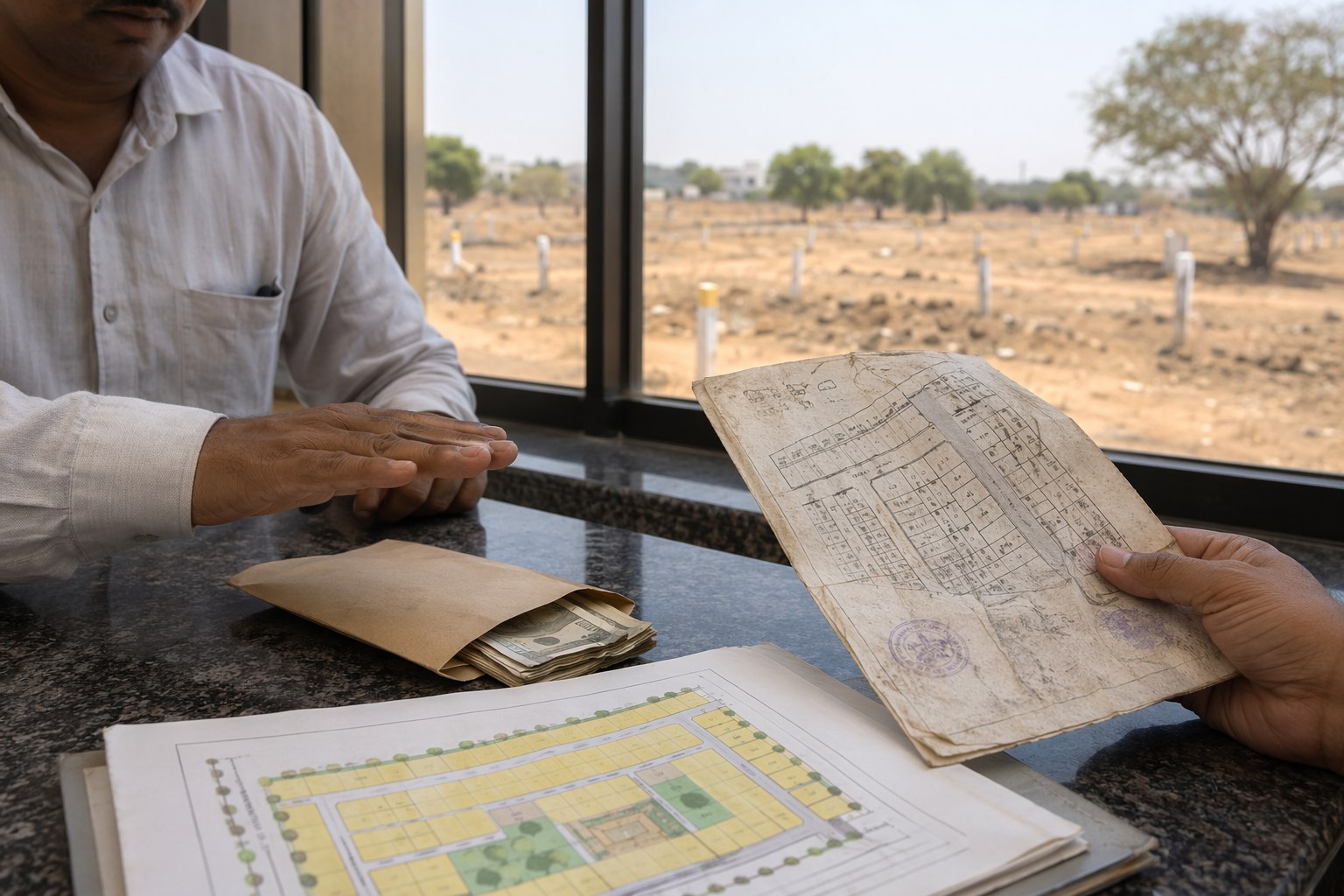


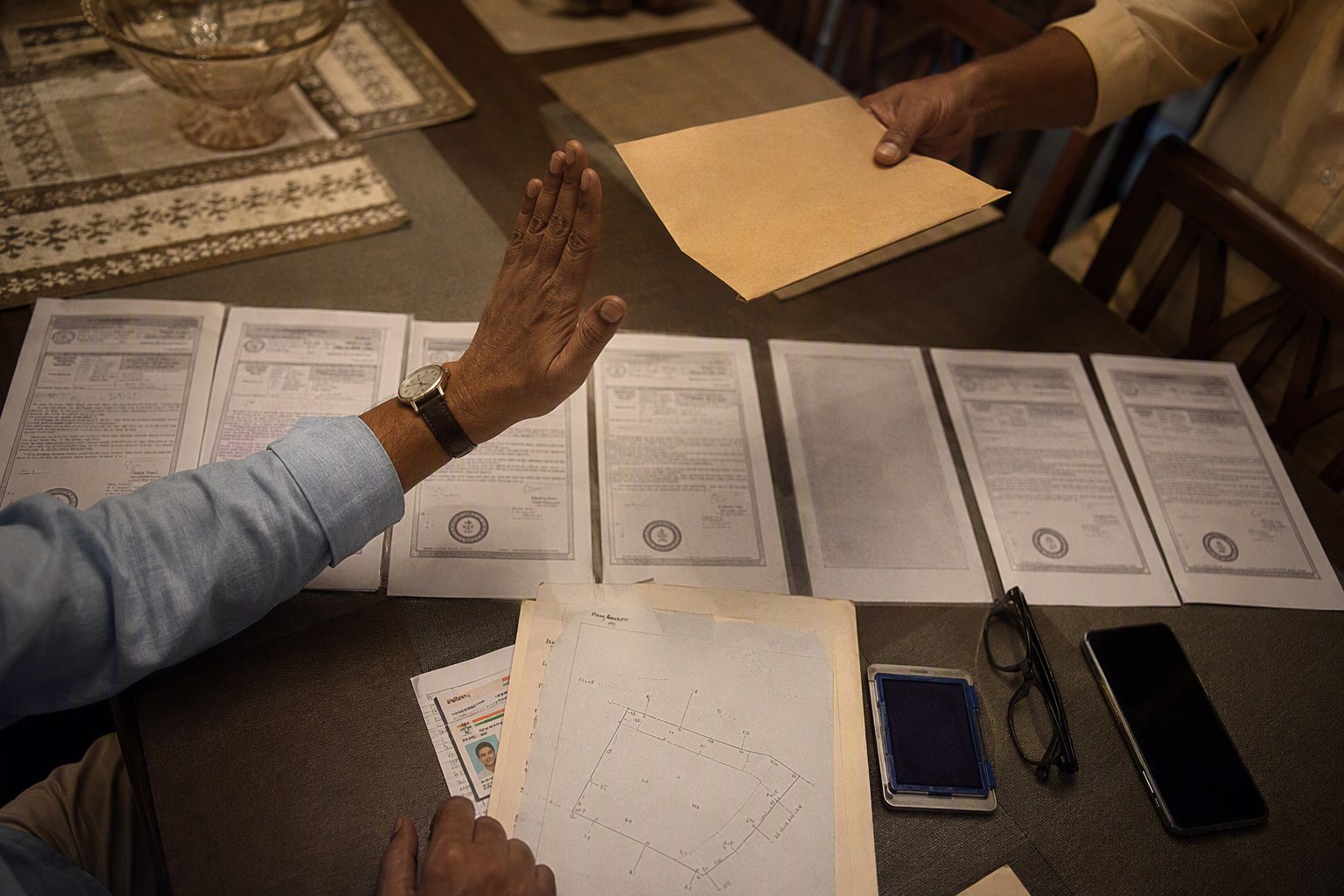
Case Study: Missing EC Page That Changed a Plot Deal
As per latest IGRS data available to us, Telangana has 30,76,153 prohibited property entries under Section 22-A. That single figure is enough reason to stop treating plot paperwork like a routine formality. In this case study, a missing EC page did not automatically kill the transaction, but it changed the buyer’s risk view completely. The plot was in the Hyderabad growth belt, the seller sounded genuine, the pahani looked clean at first glance, and the guideline value check matched the village records. Still, one absent page in the Encumbrance Certificate made us slow down.
In our experience, most plot disputes do not begin with dramatic fraud. They begin with a small gap: a missing page, an unclear survey boundary, a vague link document, an unverified dharani mutation, or a seller saying, “Sir, this is normal only.” Sometimes it is normal. Sometimes it is the only warning you will get before paying an advance.
Verified.RealEstate view: A clean-looking sale deed is not enough. For open plots in Telangana, the EC, pahani, dharani status, Section 22-A check, SRO records, and physical boundary inspection must speak the same language.
Missing EC Page: Why This Small Gap Became a Big Plot Risk
The buyer in this case was considering an open plot in the western Hyderabad belt, around the Mokila–Shankarpally side. This belt attracts buyers from Gachibowli, Kondapur, Tellapur, Nallagandla, and the Financial District because land parcels still feel more accessible than core Hyderabad apartments. But the same belt also has mixed land histories: agricultural land converted into plotted layouts, family partitions, old pattadar passbooks, unregistered agreements, and survey number changes after road widening or layout approvals.
The seller had shared the latest sale deed, pattadar details, pahani copy, and EC printout. On paper, the plot looked saleable. The buyer had already checked the broad market value through official channels and wanted to proceed with token advance after a lawyer review. The issue came up when the EC printout was arranged in order. One page was missing between two continuous entries.
Now, a missing EC page can happen for innocent reasons. The print may be incomplete. The scanning may be poor. The person downloading it may have skipped a page. In SRO practice, old records may be indexed differently. But for a buyer, the question is simple: what was on that missing page?
That question changed the tone of the deal. Until then, everyone was discussing price, road approach, future resale, and registration convenience. After the missing page was noticed, the discussion moved to title risk.
Missing EC Page in Telangana Plot Due Diligence: What We Checked First
We started with the basic rule we follow for plots in Shankarpally mandal, Gandipet mandal, Ramachandrapuram mandal, Maheshwaram mandal, and Ibrahimpatnam mandal: never read one document alone. A sale deed may say one thing, dharani may show another, and the EC may quietly carry the real history of mortgages, attachments, releases, and prior transfers.
The first step was to pull the EC again, not depend on the seller’s PDF. Buyers can do an initial review using the Encumbrance Certificate Search. For a deeper reading, especially when entries are old or unclear, the EC Analyzer helps organise the sequence and identify gaps that a casual reader may miss.
We then checked whether the land or survey number had any Section 22-A risk. This is not optional in Telangana. With 30,76,153 prohibited property entries in the government records as per latest IGRS data available to us, a buyer must verify whether the property is hit by government land classification, assigned land restriction, endowment issue, wakf entry, court order, or other prohibition. A quick first-level check can be done through the Section 22-A Prohibited Property Check.
For this case, the missing EC page became more serious because the plot belonged to a larger survey number that had seen multiple subdivisions. In places like Mokila, Kollur, Tellapur, Narsingi, Adibatla, and Tukkuguda, this is very common. The marketing brochure will show a neat plot number, but the legal trail still sits inside an old survey number. If the old survey number has any defect, the individual plot can also get dragged into the problem.
The Local Context: Hyderabad Growth Corridors Are Not All the Same
A buyer may hear “West Hyderabad” and assume all land is equally safe. That is a dangerous shortcut. Mokila in Shankarpally mandal is not the same as Tellapur in Ramachandrapuram mandal. Kollur has its own approvals and access patterns. Narsingi and Kokapet fall into a different pricing and planning zone. Adibatla and Kongara Kalan on the eastern side have another type of demand, driven by employment clusters and large land parcels. Maheshwaram mandal has strong airport-side interest, but land history must be checked carefully.
We are not quoting a broker rate here because that would be irresponsible without the exact village, survey number, road width, layout approval, and market value extract. The only rate we treated as reliable in this file was the official market value, commonly called guideline value or ready reckoner value, checked against the relevant village and SRO records. Buyers can do their own first check through the Market Value / Guideline Value Search before discussing stamp duty and registration cost through the Stamp Duty Calculator.
This distinction matters. Market talk may be loud. Government record is quieter, but it is the record that matters at registration.
What the Missing EC Page Finally Showed
After requesting a fresh certified copy and cross-checking the SRO index, the missing page was traced. It did not show an outright ban on sale. It showed an earlier financial charge and later release. On the face of it, that can be acceptable if the release is proper and the bank or lender’s interest is fully closed. But here is why the risk view changed: the seller had not disclosed it voluntarily.
When a seller says, “There is no loan history,” and the EC later shows a charge and release, the buyer must ask why. Maybe the seller forgot. Maybe a family member handled the old loan. Maybe the current seller was not fully aware because the property came through partition. Or maybe the seller was hoping the buyer would not read the EC properly.
We did not accuse anyone. We changed the process. The buyer was advised to seek original release documents, bank closure proof where available, link documents, and a written declaration in the agreement of sale. The draft agreement was also revised to include a title indemnity clause. The deal could still proceed, but not on blind trust.
How We Read the File: Document by Document
For Telangana plot buyers, especially in peri-urban Hyderabad, the safest method is to build a document chain. One missing page should push you to check the whole chain, not just that page.
| Document or check | What we looked for | Why it mattered in this case |
|---|---|---|
| Encumbrance Certificate | Continuity of entries, missing pages, mortgage, release, attachment, sale history | The missing EC page showed a prior charge and release |
| Sale deed and link deeds | Clear transfer of title from previous owners | The seller’s title depended on older documents, not only the latest deed |
| Pahani and dharani status | Name match, land classification, extent, survey number | The plot came from a larger survey number, so revenue records mattered |
| Section 22-A check | Prohibited property risk | With 30,76,153 entries in records, this was treated as a mandatory check |
| SRO verification | Certified copies and indexing | The fresh certified EC resolved the missing page issue |
| Physical inspection | Road access, boundaries, neighbouring possession | Paper title and ground reality had to match |
We also suggested checking the survey number independently through the Survey Number Finder and confirming the correct registration office through the Find Your SRO Office. Many buyers depend on the layout developer or broker for SRO details. That is not enough when a defect has already surfaced.
Why Section 22-A Cannot Be Ignored in Plot Deals
Section 22-A is the legal wall many buyers discover too late. If a property is listed as prohibited, the SRO may refuse registration or the buyer may face a long correction process. In Telangana, the scale of records is not small. The available IGRS data shows 30,76,153 prohibited property entries. This does not mean every plot is unsafe. It means every buyer should verify before paying money.
In Hyderabad’s expanding edges, land classification can be confusing. A plot may be marketed as residential, but the parent survey number may have had older revenue remarks. Assigned land, government land, endowment land, wakf land, ceiling surplus issues, and court attachments can all create registration trouble. Some issues are genuine defects. Some are old entries that need correction. Either way, the buyer should know before signing.
In this case, the Section 22-A check did not become the final blocker, but doing it early helped the buyer negotiate from a stronger position. The seller realised the buyer was not depending only on glossy layout maps.
The Role of Dharani, Pahani, and SRO Records
Dharani is useful, but it is not a substitute for legal reading. Pahani shows revenue details such as pattadar, nature of land, and survey extent. SRO records show registered transactions. EC shows encumbrance history based on registration records. A good due diligence exercise compares all of them.
For example, if the pahani shows one name, the sale deed shows another, and the EC has a mortgage entry in a third name, that is not a small clerical issue. It may still be explainable through inheritance, partition, GPA, or release deed. But it must be explained with documents, not WhatsApp assurances.
We’ve seen this pattern in land around Shankarpally, Chevella, Moinabad, Maheshwaram, and Ibrahimpatnam. Buyers get excited because the plot is close to a growing road or upcoming development zone. Then they rush the advance. The seller says registration can happen quickly. The buyer thinks legal verification can happen later. That order is wrong. Verification must come before advance, or at least before any non-refundable payment.
How the Buyer’s Negotiation Changed After the EC Gap
Before the missing page was found, the buyer was negotiating like a normal purchaser. After the certified EC revealed the earlier charge and release, the buyer asked for stronger safeguards. The seller had to provide original link documents for inspection. The agreement of sale had to include clear statements about title, possession, loans, disputes, family claims, and prior encumbrances. The buyer also insisted that any registration would happen only after the lawyer cleared the revised file.
This is how due diligence should work. It is not meant to frighten buyers away from every plot. It is meant to price the risk properly. A clean file moves faster. A file with gaps needs conditions. A file with unexplained defects should be avoided.
For buyers comparing a plot with a constructed property, tools like the Composite Value Calculator and Building Value Calculator can help separate land value from construction value. For open plots, land use and approach road checks also matter. We often ask buyers to use the Land Use Zone Finder and Road Width Check before getting emotionally attached to a location.
What Buyers Should Learn from This Missing EC Page
The biggest lesson is simple: an incomplete EC is not a formality defect. It is a due diligence trigger. Do not accept “server issue” or “print problem” as the final answer. Ask for a fresh certified copy. Compare it with link deeds. Check the SRO index. Look at dharani and pahani. Confirm Section 22-A status. If the plot is part of a layout, check layout approval, road widths, open space, and whether the plot number actually corresponds to the survey extent.
In our opinion, the most dangerous buyer is not the careless buyer. It is the half-informed buyer. He checks one website, sees one clean entry, and assumes the title is clear. Telangana land records require cross-reading. Even lawyers ask for multiple documents because no single record tells the full story.
- Do not rely on seller-shared EC only. Pull your own EC or ask for a certified copy.
- Do not ignore missing pages. A page gap can hide a charge, release, attachment, or prior transaction.
- Check Section 22-A before advance. The prohibited property list is too large to ignore.
- Match survey number, plot number, and village. Many Hyderabad outskirts plots come from larger survey numbers.
- Use SRO and dharani together. Registration and revenue records must be read side by side.
- Put disclosures in writing. Oral assurances are weak when a title defect appears later.
Our Final View on the Plot Deal
The missing EC page did not automatically mean the plot was bad. That is an important distinction. A prior loan, if properly released, may not stop a sale. But non-disclosure changes trust. In a land transaction, trust is not built by polite conversation. It is built by documents matching each other.
The buyer in this case got a better understanding of the risk before committing serious money. The seller had to produce more records. The agreement became tighter. The lawyer had a clearer set of questions. That is a good outcome. A missed page became a warning light, not a disaster.
For Telangana plot buyers, especially around Hyderabad’s active mandals, this case is a reminder: paperwork is not boring back-office work. It is the deal itself. If one page is missing, pause. The land will still be there tomorrow. Your money should not move faster than the records.
Frequently Asked Questions
Can a missing EC page make a plot unsafe to buy?
Not always. A missing EC page may be a scanning or printing issue. But it must be resolved before payment. Ask for a fresh certified EC and compare it with SRO records, link deeds, pahani, and dharani details.
What if the missing EC page shows an old loan that was released?
An old loan with a proper release may be acceptable, but the buyer should verify the release deed, closure proof where available, and the continuity of title. The agreement of sale should include clear seller declarations and indemnity.
Why is Section 22-A check needed for Telangana plots?
Section 22-A covers prohibited property entries. As per latest IGRS data available to us, Telangana has 30,76,153 such entries. A buyer should check this before paying advance, especially for plots in larger survey numbers.
Is dharani enough to confirm plot ownership?
No. Dharani is useful for revenue status, but buyers should also check EC, SRO records, link deeds, pahani, survey number details, land classification, and physical possession. One record alone is not enough.
Which tools can help before buying a plot in Hyderabad outskirts?
Start with EC search, Section 22-A prohibited property check, guideline value search, survey number finder, and SRO office lookup. These checks help you ask better questions before signing the agreement.