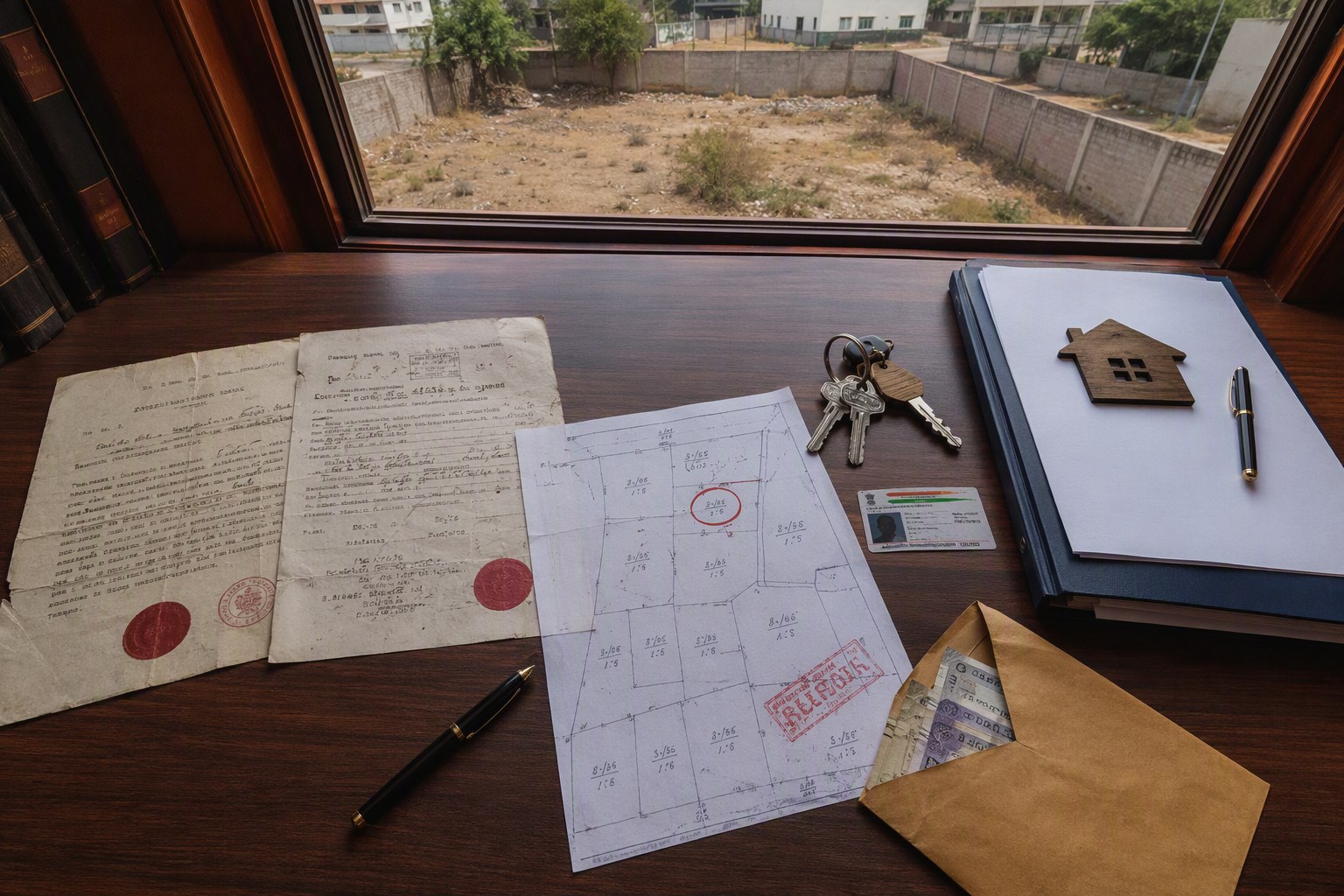
UDS mismatch case study: two resale flats, same city, very different buyer confidence
UDS mismatch can change the mood of a Hyderabad resale flat transaction within one meeting. We recently compared two similar resale flats in the western corridor. Both were in established apartment projects, both had regular families as sellers, both were being checked by serious buyers with bank loan plans. One file moved smoothly because the undivided share of land matched across documents. The other slowed down because the UDS wording and land share did not tally cleanly between the earlier deed, current sale deed draft, society papers and project records.
This is the type of issue many buyers notice only after paying a token. In our experience, that is too late. UDS is not decorative wording in a sale deed. It is the buyer's share in the underlying land. When the flat is old, mortgaged, inherited, gifted, or sold more than once, that small schedule entry becomes a serious legal and lending checkpoint.
| Checkpoint | Flat A: UDS records matched | Flat B: UDS mismatch found |
|---|---|---|
| Location profile | Established western Hyderabad resale market, with clear SRO trail | Similar western Hyderabad resale market, but land schedule needed deeper reading |
| Sale deed schedule | Flat number, parking reference, super built-up description and UDS were consistent with prior deed | UDS wording in seller's deed did not sit comfortably with older project papers |
| EC chain | Encumbrance entries followed the same property description | EC did not by itself explain the difference in UDS description |
| Bank view | Lender's legal team had fewer queries | Lender asked for clarification and supporting documents |
| Buyer sentiment | Negotiation remained about price and handover | Negotiation shifted to legal risk, indemnity and whether to proceed |
The lesson is simple: two flats can look equally good during a site visit, but the document file can tell two different stories. A neat lobby, functioning lift and nice view will not save a buyer if the title schedule is messy.
What exactly is UDS mismatch in a resale flat?
UDS means undivided share of land. In an apartment, you own the constructed flat and a proportionate share in the land on which the building stands. That land share is usually written in the schedule of the registered sale deed. It may also appear in the agreement of sale, allotment letter, construction agreement, society records, builder handover papers, mortgage papers and sometimes RERA disclosures for newer projects.
A UDS mismatch happens when these records do not agree, or when the description is so unclear that a buyer, lawyer or lender cannot confidently connect the flat to the right land share. It can be a genuine clerical issue. It can also point to a deeper problem such as wrong schedule copying, revised layout, land extent discrepancy, unregistered correction, or poor documentation by the builder.
In Hyderabad and surrounding markets like Kondapur, Miyapur, Nallagandla, Puppalaguda, Narsingi, Kokapet, Bachupally and Manikonda, buyers often focus on carpet feel, amenities and rent potential. Fair enough. But at resale stage, the legal value of a flat depends heavily on whether the registered chain is clean. The Sub-Registrar Office record is the backbone. Society NOC is useful, but it does not replace registered title.
Our rule is blunt: if the UDS in the current seller's deed does not reconcile with the mother deed chain, do not treat it as a small typo until the seller proves it through registered or legally acceptable supporting documents.
UDS mismatch case study: why Flat A passed and Flat B got stuck
Flat A had the boring file that every resale buyer should secretly love. The seller had the original registered sale deed. The prior EC entries matched the flat description. The apartment association records reflected the same unit. The land reference in the schedule could be traced to the project land documents. The buyer still checked SRO jurisdiction, EC and valuation, but there was no drama.
For this type of file, the work is not zero. You still verify whether any mortgage is pending, whether the property falls under the right SRO, whether the land is affected by any notified restriction, and whether the market value adopted for registration is in line with government ready reckoner values. But the checks are confirmatory. They do not become rescue work.
Flat B looked equally saleable during inspection. The building was occupied, maintenance was being collected, and the seller had possession. The problem appeared when the buyer's lawyer compared the seller's registered deed with older project documents and the proposed resale draft. The UDS reference did not match comfortably. The seller first called it a drafting mistake. The lender did not accept that answer on face value.
This is where many Hyderabad resale transactions become emotional. Seller says, “We bought it through bank loan only, so why are you asking now?” Buyer says, “If your bank cleared it, my bank should also clear it.” But legal teams are not identical. A past loan does not guarantee future approval. Bank empanelled advocates change. Internal policies change. A missed issue in an earlier loan can still become a live problem in the next resale.
How lenders read a UDS mismatch before sanction
A home loan sanction is not only about salary and CIBIL. For resale flats, the bank's legal check is often where weak files struggle. If the UDS differs across papers, a lender may ask for the builder's clarification, association letter, link documents, approved plan references, correction deed, rectification deed, or indemnity. In some cases, the lender may ask the buyer to choose another property.
From the bank's angle, the worry is practical. If enforcement is ever needed, the security must be identifiable. The flat, parking, land share and title chain must be clear enough for mortgage creation. If the property description is uncertain, the mortgage security becomes weaker. That is why even a small UDS variation can trigger multiple queries.
Buyers should check the Encumbrance Certificate Search early. EC will not solve every UDS issue, but it helps you see how the property has moved through registered transactions. Use the EC Analyzer to read the chain more carefully instead of depending only on a broker's summary. If there is an existing loan, also run a CERSAI Charge Check so you know whether any registered security interest is visible.
UDS mismatch and Telangana land records: why survey number checks matter
Apartment buyers sometimes assume survey number checks are only for open plots and agricultural land. That is a mistake. Every apartment project sits on land. That land came from one or more survey numbers, often in a specific village and mandal. In parts of Serilingampally mandal, Gandipet mandal, Rajendranagar mandal, Quthbullapur mandal and Medchal side, project land histories can involve old pahanis, conversion records, layout approvals, amalgamations and multiple link deeds.
If the flat's UDS is not matching, you should go one level below the flat document and inspect the land trail. Which survey numbers formed the project land? Was the land converted? Are the link documents coherent? Does the project land extent in the builder documents match what is being conveyed proportionately? A buyer may not personally read every pahani, but the legal adviser should.
For a starting point, use the Survey Number Finder and SRO Village Directory. These tools help buyers speak the correct language with document writers, lawyers and SRO staff. If the village, mandal or SRO is wrong in your understanding, your verification can go in the wrong direction.
Section 22-A risk: don't ignore prohibited property checks
UDS mismatch is one risk. Prohibited property status is another. Telangana government records include 3,076,153 prohibited property entries under Section 22-A related datasets. That does not mean every apartment buyer is in danger. It means a buyer should not assume that a flat is safe only because people are living in the building.
Section 22-A issues usually attach to land parcels, not to your sofa or kitchen tiles. If the project land or part of the underlying survey number has a restriction, registration or financing can become difficult. Sometimes the issue is historical. Sometimes it is a classification or notification problem. Either way, do the check before token advance, not after your loan file is opened.
Use the Section 22-A Prohibited Property Check along with the Property Verification Tool. For apartment resale, ask the seller for the land schedule from the parent documents, not just the flat number and door number. Without the underlying land reference, a prohibited property check becomes weak.
What Flat A did right before resale registration
Flat A's buyer did not rely on one document. The buyer compared the seller's deed, prior deed, EC, tax receipts, association dues status and loan closure papers. The buyer also checked the SRO and government market value before planning registration. This reduced last-minute surprises at document drafting stage.
For value-related checks, use the Market Value / Guideline Value Search and Stamp Duty Calculator. I prefer buyers to run these before negotiation hardens. If the buyer and seller are working with different assumptions about ready reckoner value, stamp duty and registration cost, the final week becomes noisy.
If the project is RERA-registered, a RERA Project Lookup can help cross-check promoter, project and approval information. In older apartment blocks, RERA may not be relevant, but approved plan, occupancy-related papers and association records still matter. Don't force one checklist on every building. Kondapur resale, Himayatnagar resale and Narsingi gated community resale will not have identical document histories.
What Flat B should have done after the UDS mismatch appeared
Once the mismatch appeared, the seller needed to stop giving oral assurances and start producing documents. A buyer should ask for written clarification from the builder or association only as supporting material. If the original registered deed is wrong, a proper rectification route may be needed. A casual letter cannot rewrite a registered instrument.
Here is the practical sequence I would follow:
- Compare all schedules: seller's deed, previous deed, builder agreement, construction agreement, allotment letter and draft resale deed.
- Check EC wording: see whether the property description remained consistent across transfers and mortgages.
- Trace land documents: identify survey numbers, village, mandal and SRO jurisdiction.
- Ask for builder clarification: useful when the mismatch is due to project-level drafting, but not enough if deed correction is legally required.
- Speak to lender early: send the document set to the bank legal team before paying a large advance.
- Consider rectification deed: if a registered correction is needed, complete it before resale registration wherever possible.
- Use indemnity carefully: indemnity is not a magic cure. It is only one layer of protection.
In our experience, buyers lose bargaining power when they discover title issues after paying a non-refundable token. Sellers also suffer because one failed buyer creates doubt for the next buyer. Clean it once, properly, and the flat becomes easier to sell.
UDS mismatch in Hyderabad resale: red flags buyers should not brush aside
Some warning signs deserve immediate attention. If the seller says the builder has all papers but cannot share them, pause. If the UDS in the draft deed is copied from a different flat, pause. If the flat number changed after approval or after handover, pause. If the parking slot is being sold as if it is separately registered land, pause. If the EC shows a different description from the sale deed, pause.
Another common issue is area terminology. Super built-up area, plinth area, carpet area and undivided land share are not the same. A buyer may use the Area Unit Converter for measurement clarity, but legal comparison needs document reading. If someone tries to explain UDS mismatch by casually mixing built-up area and land share, ask for a lawyer's written view.
For redevelopment-prone older buildings in localities like Ameerpet, Begumpet, Chikkadpally, Himayatnagar and parts of Secunderabad, UDS becomes even more sensitive. When a building is redeveloped, the land share influences negotiation strength. A flat with unclear UDS may face more questions when owners discuss redevelopment, compensation, new flat allocation or corpus.
How a buyer should compare two similar flats before choosing one
When two resale flats are similar in price band, location and amenities, I would choose the cleaner title over the prettier balcony. That may sound conservative, but Hyderabad buyers have learned this lesson many times. A document defect can delay registration, loan disbursal and future resale. Interior work can be changed. Title defects are harder.
Make a simple comparison sheet before paying advance. Put Flat A and Flat B side by side. Check sale deed schedule, UDS, EC, link documents, property tax, maintenance dues, loan closure, CERSAI, SRO, Section 22-A, litigation disclosure and possession status. If one file is clean and the other needs explanations, price should reflect that risk. Sometimes the better decision is to walk away politely.
Use the Find Your SRO Office before registration planning. Wrong SRO assumptions create avoidable running around. If valuation is confusing, the Composite Value Calculator can help buyers think through land and building value more clearly, especially where the document splits construction and land components.
My view: UDS mismatch is not always fatal, but it is never casual
A UDS mismatch does not automatically mean fraud. Hyderabad has many old apartment files where drafting quality was poor. Some issues can be corrected. Some can be explained through link documents. Some may be acceptable to a particular lender after legal review. But a buyer should not self-certify it as harmless.
Flat A moved because the records spoke in one voice. Flat B struggled because every stakeholder heard a slightly different story from the documents. That is the real difference. In resale, confidence comes from consistency. If the UDS, survey references, EC chain and seller documents agree, the buyer can focus on price, repairs and handover. If they don't, the transaction becomes a legal negotiation first and a property purchase later.
Before you finalise any resale flat in Hyderabad, especially in high-demand corridors like Kondapur, Nallagandla, Miyapur, Puppalaguda, Kokapet, Narsingi, Manikonda and Bachupally, do the dull checks. They are cheaper than regret. Ask for the full document set. Read the schedule. Verify the land trail. Speak to your lender before paying a large advance. A clean UDS record may not look exciting, but it is one of the strongest comforts a resale buyer can have.
Frequently Asked Questions
What is UDS mismatch in a resale flat?
UDS mismatch means the undivided share of land shown for a flat does not match across documents such as the sale deed, prior deed, builder papers, EC chain or society records. It can be a clerical error or a sign that deeper title verification is needed.
Can a bank reject a home loan because of UDS mismatch?
Yes, a lender can raise legal queries, ask for clarification, request a rectification deed, or decline the property if the security is not clearly identifiable. A past loan on the same flat does not guarantee fresh approval.
Is a builder letter enough to fix wrong UDS in a registered deed?
Usually, a builder letter is only supporting evidence. If the registered sale deed itself contains an error, a proper legal route such as a rectification deed may be required. Take advice from a property lawyer before relying on informal letters.
Should apartment buyers check survey numbers and Section 22-A?
Yes. An apartment stands on land, and that land has survey numbers, village and mandal references. Buyers should check the land trail and prohibited property status before paying a major advance.
When should I verify UDS in a Hyderabad resale flat?
Verify it before token advance or at least before signing any binding agreement. Compare the seller's deed, EC, prior deeds, builder papers and draft resale deed. Early checking gives you better negotiation power and fewer loan surprises.