Case Study: The Inherited Plot Split That Hit a 22-A Wall
Section 22-A is not a small footnote in Telangana property due diligence. As per latest IGRS data, Telangana has 30,76,153 Section 22-A prohibited property entries. That number matters because one wrong survey number, one old government classification, or one unresolved entry can stop registration even when the family settlement looks perfectly clean.
This case study follows an inherited plot split where the documents looked workable at first glance. The family had a registered parent deed, an old layout reference, tax receipts, and a proposed partition understanding between siblings. On paper, it felt like a routine family division. At the registration-risk stage, the file hit a 22-A wall.
Names and exact identifiers are withheld, but the situation is very familiar to anyone dealing with inherited land around Hyderabad’s growth corridors: one family, one plot, multiple legal heirs, and a survey number that carried more history than the family expected.
Why Section 22-A matters in an inherited plot split
In Telangana, Section 22-A entries broadly refer to properties prohibited from registration. These may include government lands, assigned lands, endowment lands, wakf-related entries, ceiling surplus lands, certain disputed classifications, and other categories flagged by the registering department or revenue records.
For buyers, it is a red signal. For families dividing inherited property, it is even more painful because the issue may not appear during casual document checking. It usually appears when someone tries to register a sale deed, gift deed, partition deed, release deed, or development agreement.
Our view is simple: a family partition is not registration-safe just because all siblings agree. The land record must also agree.
In this case, the family had treated the inherited plot as private patta land for years. They were paying local dues. Neighbours had built houses. Brokers were quoting market interest. One sibling wanted to sell his share, another wanted to retain, and a third wanted a formal registered partition before applying for building permission.
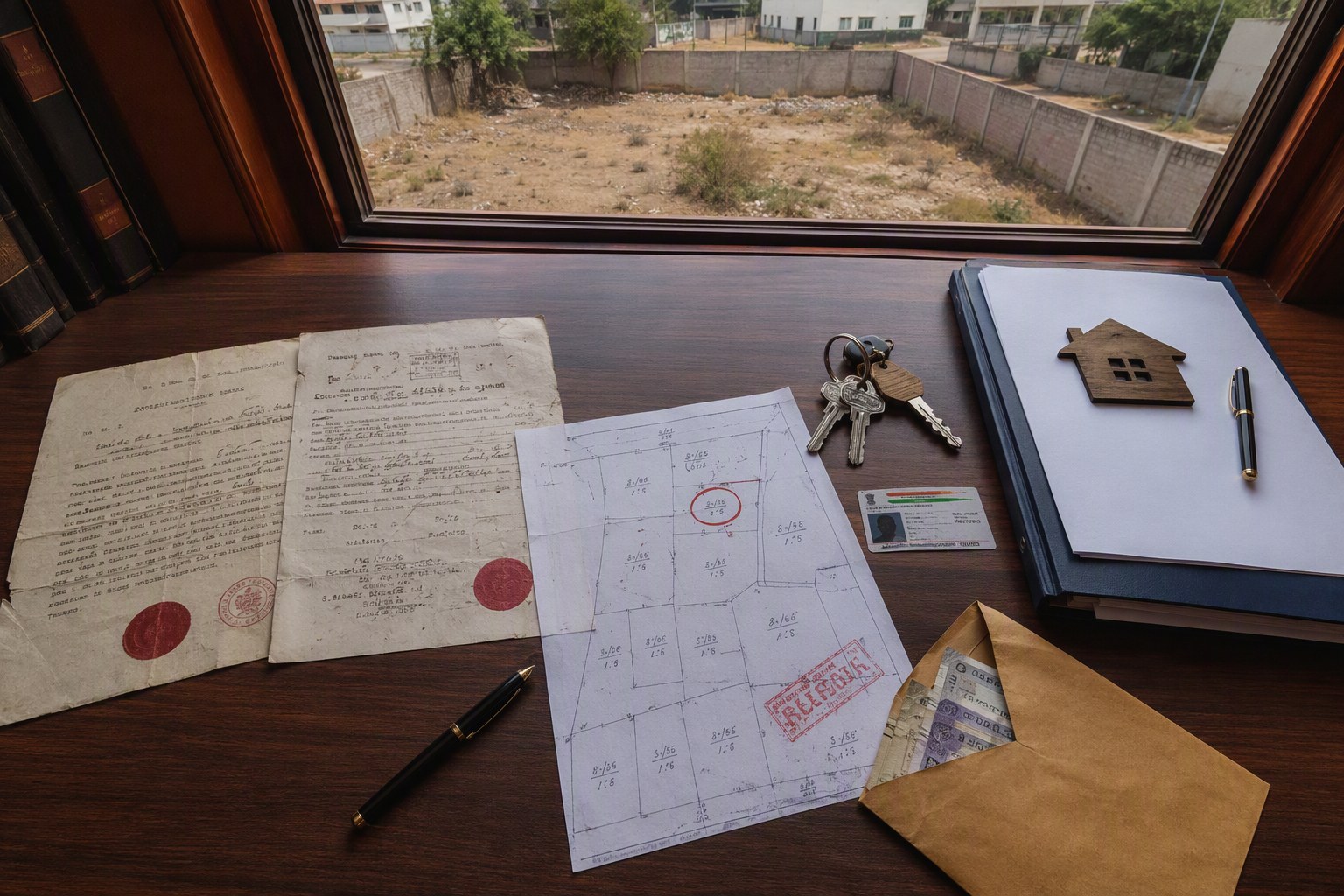
The problem came from the survey number. A portion of the larger survey had a prohibited property marker. The family plot sat inside that survey extent as per the old layout sketch. That was enough to trigger registration risk.
The inherited plot split: what looked clean initially
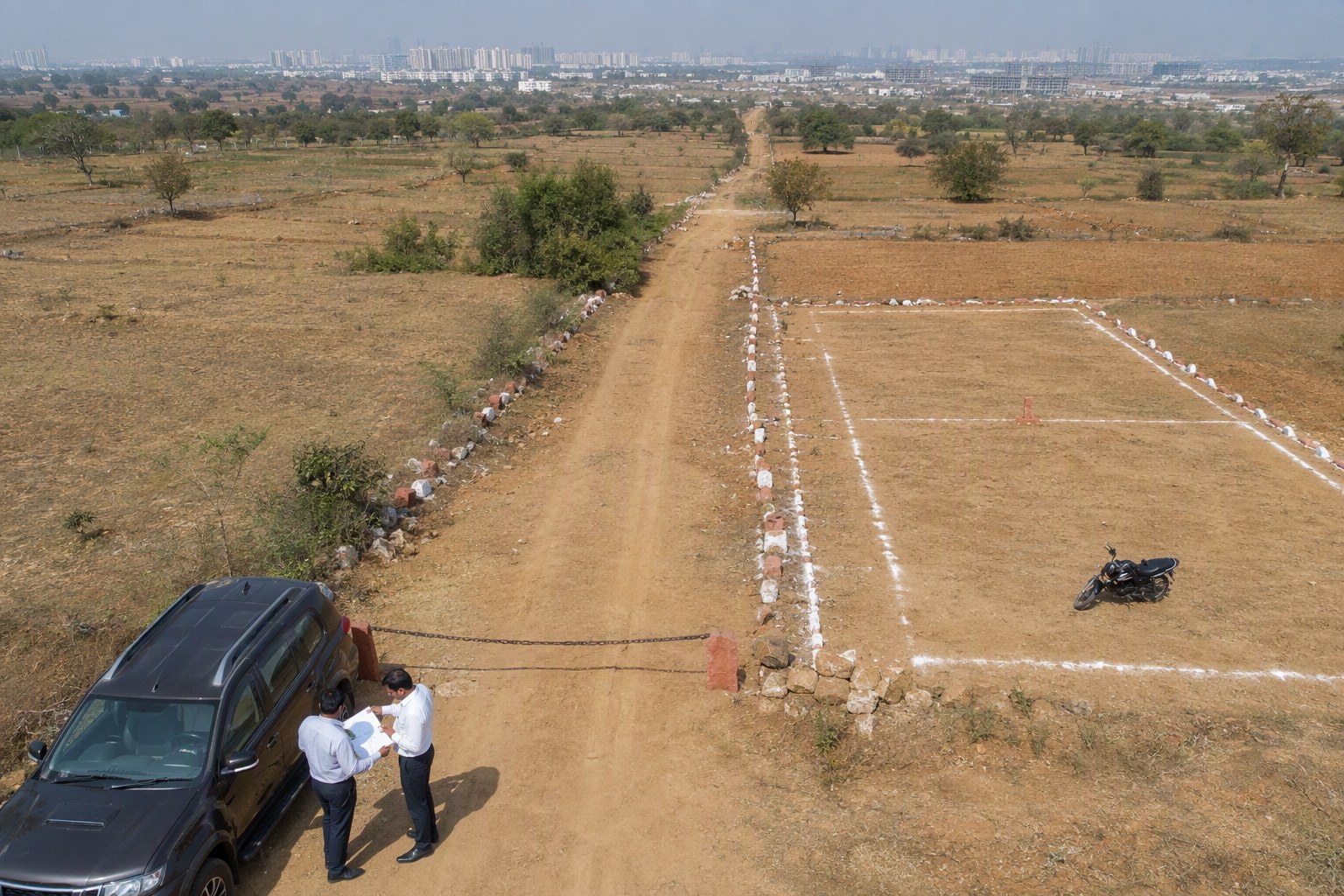
The plot was in a Hyderabad-side peri-urban belt where village records, gram panchayat layouts, HMDA influence, and later municipal expansion often overlap. We see this pattern in areas around Medchal, Shamirpet, Ghatkesar, Hayathnagar, Maheshwaram, Gandipet, Shamshabad, and parts of Patancheru. The exact mandal in this file is not being named, but the record behaviour was typical of these transition zones.
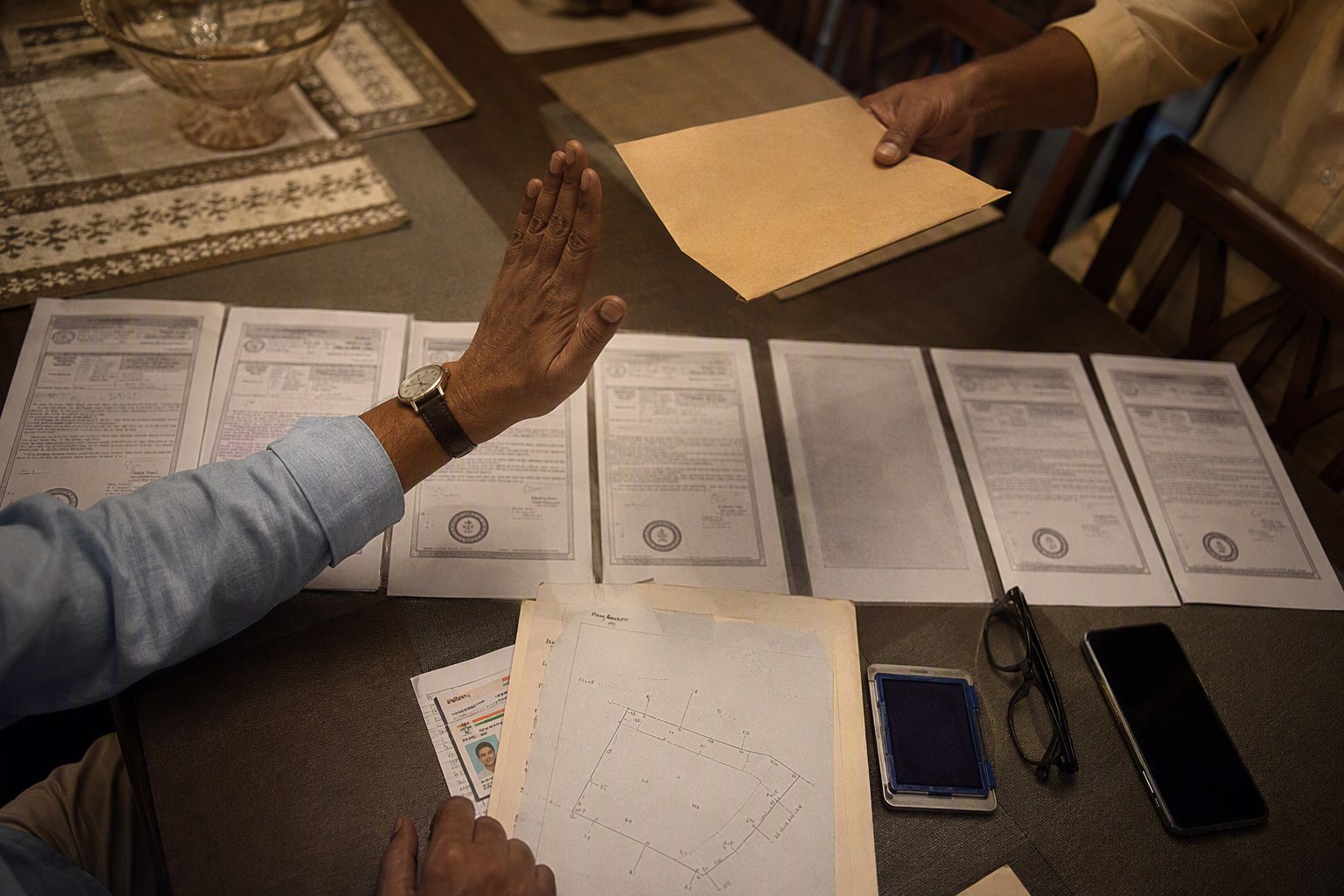
The family brought the following papers for review:
- Old registered sale deed in the father’s name.
- Death certificate and basic legal heir documents.
- Municipal or local body tax payment references.
- Photocopy of an old layout plan.
- Neighbouring plot sale deeds as market comfort.
- Draft family partition terms.
- Recent EC printout covering the visible chain.
At this stage, many families feel the matter is solved. The old deed exists, legal heirs are traceable, and no obvious mortgage appears in the EC. But Hyderabad land files are not checked only by deed chain. You must also check survey number status, revenue classification, Dharani visibility where applicable, SRO practice, and 22-A risk.
For any inherited plot split, our first working checklist is usually this: identify the exact survey number, confirm the village and mandal, verify the SRO, check EC, check prohibited property status, compare market value or ready reckoner data, and then decide whether the family document is registerable.
Useful starting points are the Survey Number Finder, Find Your SRO Office, and Encumbrance Certificate Search. These do not replace legal due diligence, but they reduce blind spots before the family spends money on drafts, stamp papers, and buyer negotiations.
Where the inherited plot split failed: the 22-A check
The turning point came when the survey reference was screened for prohibited property risk. The family had checked only the plot document and EC. The EC showed the registered transactions available in the SRO record. It did not give full comfort on the revenue-side prohibition.
When the survey number was checked against 22-A risk, the larger land parcel had an entry. The family was surprised because neighbouring properties had changed hands earlier. That is not unusual. Sometimes old registrations happened before stricter digitisation. Sometimes nearby plots fall in different sub-divisions. Sometimes one portion is affected and another is not. Sometimes the document description itself is weak, so mapping the plot to the survey extent becomes the real fight.
This is why we keep telling readers: do not stop at EC. Use the Section 22-A Prohibited Property Check before deciding that an inherited plot is safe for sale or partition registration.
In this case, the proposed split required a registered document. One sibling planned to release rights in favour of another. Another wanted to sell after partition. The Sub-Registrar Office risk was clear: if the property description linked to a prohibited survey entry, registration could be refused or kept pending subject to clarification.
How 30,76,153 prohibited entries change buyer behaviour
The figure of 30,76,153 Section 22-A prohibited property entries is not just an administrative number. It changes how buyers, banks, developers, and family members behave.
A buyer may say, “Sir, deed is there, no?” But once a 22-A concern appears, the same buyer will ask for revenue clarification, NOC, sub-division proof, town planning approvals, and sometimes a legal opinion from a panel advocate. Banks tend to be stricter because they have to create a clean mortgage. Developers are even more careful if they are considering a joint development or plotted layout aggregation.
We’ve seen families lose serious buyer interest because they disclosed the issue late. In this case, that was avoided because the file was checked before accepting a token advance. That saved the family from a bigger mess: refund pressure, allegations of suppression, and a broken sale negotiation.
Document chain versus land classification
This case shows a common Hyderabad mistake. Families assume a registered deed is the final word. It is not. A registered deed proves that a document was registered; it does not automatically cure all defects in title, land classification, zoning, or government prohibition.
Think of it in two layers:
| Layer | What it tells you | What it may not tell you |
|---|---|---|
| Registered document chain | Past sale, gift, partition, mortgage or release documents recorded at the SRO | Whether the survey number is now prohibited under Section 22-A |
| EC | Visible encumbrances and registered transactions for the searched period | Revenue classification, assignment history, boundary accuracy, land use mismatch |
| Revenue record or Dharani-related check | Nature of land, pattadar linkage where available, survey-level information | Validity of old layouts, physical possession disputes, municipal approval gaps |
| Town planning check | Road width, land use, layout or building permission feasibility | Clear title or family succession disputes |
For urban and peri-urban plots, the safest approach is to read all layers together. A single clean-looking document is not enough.
The family’s first reaction: “But neighbours registered”
This is the most common line we hear. In many localities around Hyderabad, neighbours become the first legal advisors. Someone will say, “My plot was registered last year.” Another will say, “Bank loan came for that house.” A broker may say, “Only online issue, sir, it will clear.”
Maybe. Maybe not.
Neighbouring registration does not automatically prove your plot is clear. Even within one old layout, plots may fall under different survey numbers or sub-divisions. Boundaries may have shifted. The old vendor may have sold more land than he had. A part of the survey may be patta and another part may have government classification. The SRO may also apply current checks more strictly than before.
In this inherited plot split, the neighbour argument was tempting but unsafe. The family needed a survey-level and SRO-level review, not street-level confidence.
What we checked after the 22-A hit
Once the 22-A risk appeared, the review moved from “prepare partition deed” to “prove registerability”. The family had to gather better evidence before deciding the next step.
The practical checks included:
- Confirming the exact village, mandal, survey number and plot mapping.
- Comparing the old deed schedule with the layout sketch and physical boundaries.
- Checking whether the plot was part of the affected survey extent or outside it.
- Reviewing old link documents to see how the vendor derived title.
- Checking EC through the relevant period and matching names carefully.
- Looking at SRO jurisdiction because wrong assumptions about SRO can delay the file.
- Checking whether the family document should be partition, release, gift, or sale between heirs.
- Estimating registration cost only after registerability looked possible.
For valuation and duty planning, the family could use the Market Value / Guideline Value Search and Stamp Duty Calculator. But we advised them not to treat duty calculation as the first step. If the property itself is blocked, stamp duty planning is secondary.
Why an inherited plot split needs a different risk lens
A normal resale file has one seller and one buyer. An inherited plot split has multiple human and legal moving parts. There may be daughters married long back, one brother abroad, one heir deceased, minor grandchildren, unregistered family arrangements, oral possession, and old tax receipts in only one person’s name.
In Telangana, families often say “intlo settlement ayindi” — settlement is done within the house. That may be socially true. But the SRO needs a legally valid document. Buyers and banks need a clear chain. If a 22-A entry sits in the background, even a peaceful family arrangement can fail at the last stage.
This is why we prefer a staged approach:
- Stage one: Identify the property correctly.
- Stage two: Check title chain and EC.
- Stage three: Check 22-A and revenue classification.
- Stage four: Decide the correct family document.
- Stage five: Calculate duty, registration cost, and tax impact.
- Stage six: Register only after the risk is documented.
If the family is planning a later sale, they should also check tax exposure using the Capital Gains Tax Calculator. For development potential, road width and zoning can be screened using Road Width Check and Land Use Zone Finder.
The registration-risk stage: where emotion meets procedure
By the time a family reaches registration planning, emotions are usually high. Someone has already spoken to a buyer. Someone needs funds. Someone feels the property has been unused for too long. In this case also, the pressure was not legal alone; it was personal.
One sibling felt the 22-A check was overcautious. Another became worried that the entire inheritance was worthless. Both reactions were extreme.
A 22-A hit does not always mean the family has no rights. It means registration risk exists and must be resolved or explained. Sometimes the entry may relate to a larger survey but not the particular plot. Sometimes rectification or clarification may be needed. Sometimes the land is genuinely not registerable. The answer depends on the record, not on optimism.
Our practical advice to the family was to pause the partition registration attempt until the survey mapping and revenue classification were reviewed. Filing a document and facing refusal without preparation can create a paper trail that weakens future negotiations.
What buyers should learn from this case
If you are buying from legal heirs, be extra careful. A family selling inherited land may be honest and still unaware of hidden record problems. Do not assume fraud. But do not skip checks either.
Before paying a token advance for an inherited plot in places like Ghatkesar, Keesara, Shamshabad, Maheshwaram, Moinabad, Shankarpally, Patancheru, Medchal, or Hayathnagar, ask for:
- Parent deed and link documents.
- Death certificate and legal heir proof.
- Family settlement, partition, release, or succession documents, if any.
- Latest EC review, preferably analysed beyond name matching.
- Survey number and village details.
- 22-A prohibited property status.
- Market value or ready reckoner check for registration planning.
- Physical possession and boundary confirmation.
The Property Verification Tool and EC Analyzer are useful for early screening. If a seller refuses to share survey details, that itself is a warning sign.
What the family should have done earlier
In our experience, inherited property should be cleaned up before the sale discussion starts. The best time to fix family documentation is when everyone is calm, not when a buyer is waiting at the SRO.
For this family, the smarter sequence would have been:
- First, identify the exact plot with survey mapping.
- Then check EC and 22-A status.
- Then decide whether all heirs must join a partition or release deed.
- Then check guideline value and stamp duty.
- Then approach buyers with a clean disclosure note.
Instead, they started with buyer interest and came to due diligence later. That is common, but risky.
Can a 22-A issue be fixed?
Sometimes yes, sometimes no. It depends on why the property is listed and whether the entry applies to the specific plot. A mistaken or overbroad entry needs a different response from a genuine government land classification. Assigned land has a different treatment from a private patta land mapping error. Endowment or wakf-related entries need specialist review.
No journalist or broker should casually promise clearance. The proper path is document review, revenue record review, and official clarification through the right channel. The family may need help from a local revenue practitioner, advocate, licensed survey support, and sometimes representation before authorities.
For the family in this case, the immediate result was not a quick registration. The result was better clarity. They understood that the split could not be treated as a simple deed-drafting exercise. That may sound disappointing, but it prevented a rushed transaction from becoming a bigger dispute.
Our editorial take on inherited plot split due diligence
Hyderabad’s land market is mature in pricing but still uneven in records. That gap creates most disputes. Buyers talk in market rates. Families talk in emotional shares. SROs talk in document formats. Revenue records talk in survey numbers. Unless all four languages match, registration risk remains.
The biggest lesson from this inherited plot split is not that Section 22-A is scary. The lesson is that title checking must move from document comfort to record certainty. With 30,76,153 prohibited property entries in Telangana records, nobody should treat 22-A screening as optional.
If you are dividing family property, do not wait until the buyer asks. Check it yourself. If you are buying from heirs, do not rely only on the parent deed. If you are advising a family, do not draft first and verify later.
A clean inherited plot split is possible. But in Telangana, clean means more than signatures from all heirs. It means the survey number, SRO record, EC, revenue classification, and registration pathway all support the transaction.
Frequently Asked Questions
What is the main risk in an inherited plot split in Telangana?
The main risk is assuming that family consent and an old registered deed are enough. You must also check EC, survey number, SRO jurisdiction, revenue classification, and Section 22-A prohibited property status.
Does a clean EC mean the plot is free from Section 22-A issues?
No. An EC shows registered transactions and encumbrances for the searched period. It may not show whether the survey number is flagged as prohibited under Section 22-A.
Can a family register a partition deed if the survey number is in 22-A?
Registration may be refused or delayed if the property description links to a prohibited entry. The family should first verify whether the entry applies to their exact plot and seek proper legal and revenue guidance.
Which tools should I use before buying inherited land in Hyderabad?
Start with survey number identification, EC search, SRO check, guideline value search, and Section 22-A prohibited property check. These early checks help you avoid paying an advance on a risky file.
Is every 22-A hit a final rejection of title?
Not always. Some entries may need clarification or mapping review, while others may indicate a serious bar on registration. The exact reason for the entry decides the next step.