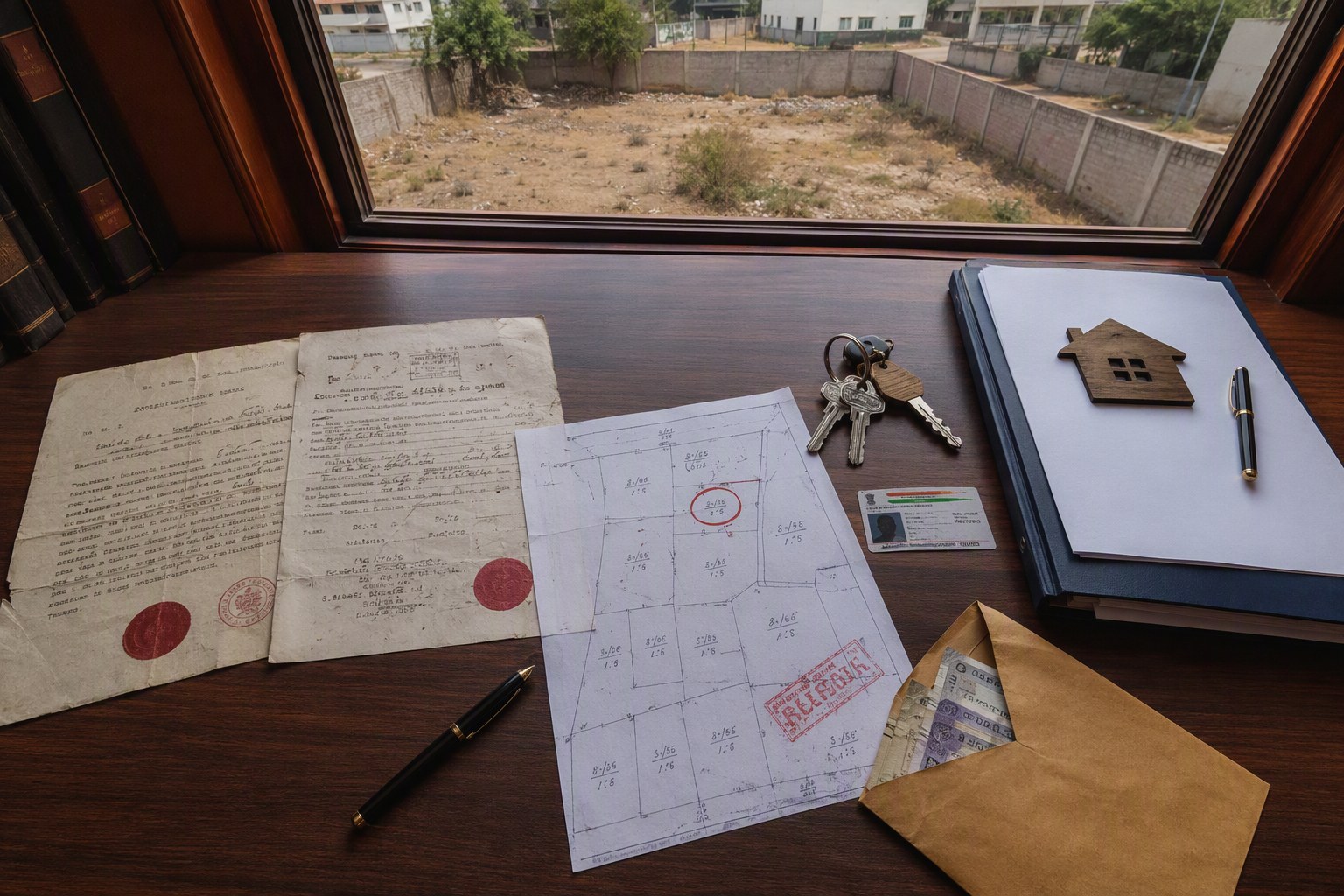
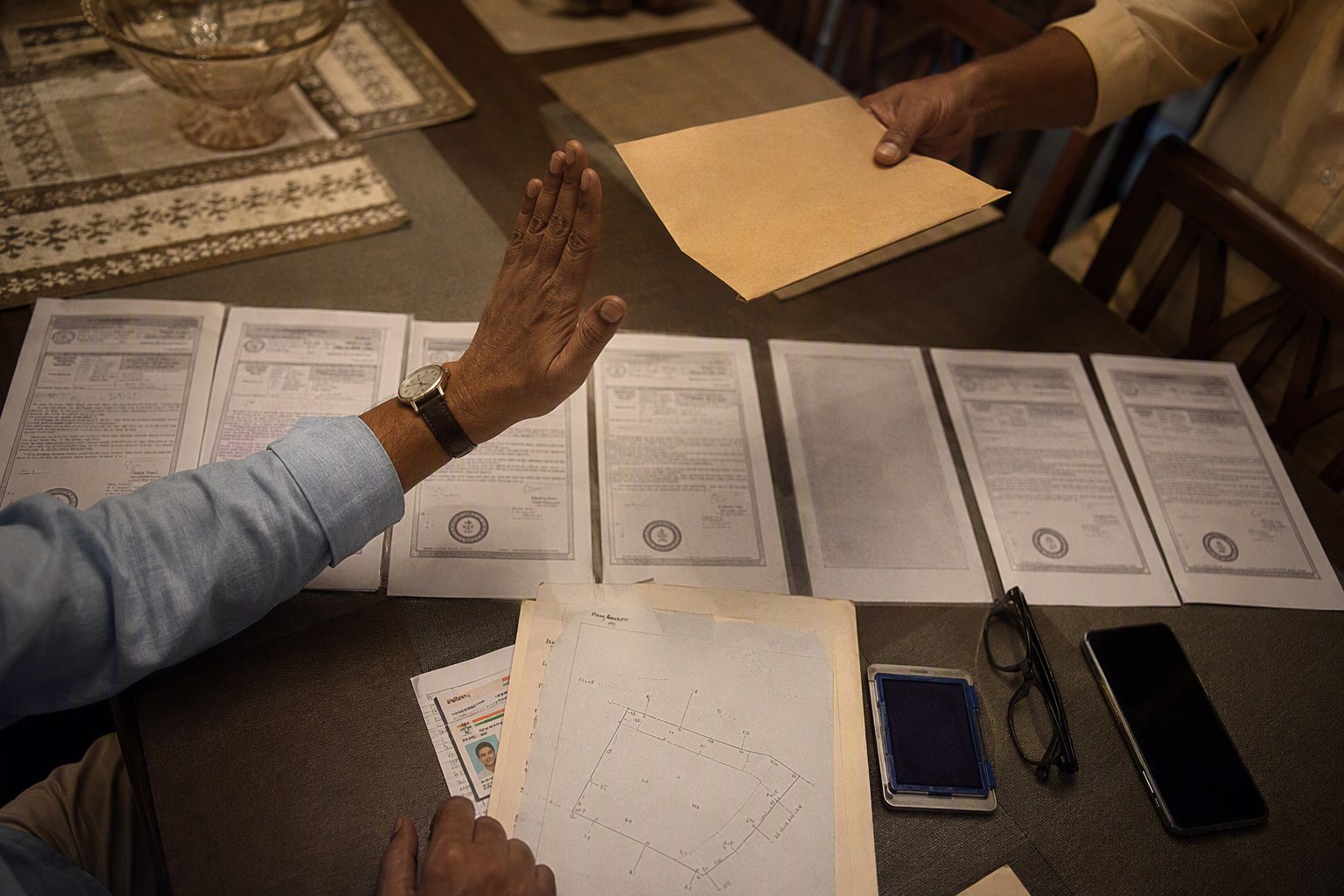
Case Study: GPA Sale vs Registered Deed in a Resale Deal — the short answer is simple: the GPA route looked faster, but the registered deed route gave stronger ownership, clearer bankability, and fewer surprises at the SRO. In Hyderabad resale property, speed is useful only if the title can survive EC, CERSAI, Section 22-A, family claims, and mutation checks.
We see this confusion often in Kondapur, Narsingi, Manikonda, Miyapur, Tellapur, Bachupally and Ameenpur resale deals. A seller says, “Sir, GPA is enough, registration later.” A buyer thinks he is saving time. Then the file reaches the bank legal team or SRO, and the real story starts.
| Point | GPA-based resale path | Registered sale deed path |
|---|---|---|
| Ownership strength | Weak if used as substitute for sale deed | Strong when title chain is clean and deed is registered |
| Bank loan comfort | Often questioned by legal teams | Usually easier if EC, link documents and approvals match |
| SRO record | Power document may exist, but sale transfer is not complete merely by GPA | Buyer’s purchase is recorded through registered conveyance |
| Risk of seller/family dispute | Higher, especially in old family layouts and inherited properties | Lower when all owners execute the deed properly |
| Speed | Looks quick at the start | Slower because verification is done before payment |
| Best use | Limited authority situations, not a shortcut for ownership | Normal resale purchase route |
Case Study: GPA Sale vs Registered Deed in a Resale Deal — the Hyderabad resale background
This case is anonymised, but the pattern is very familiar. The property was a resale flat in the western Hyderabad belt, not very different from what buyers see around Kondapur in Serilingampally mandal, Nallagandla, Manikonda in Gandipet mandal, or Tellapur in Ramachandrapuram mandal. The buyer wanted quick possession. The seller’s side suggested a GPA-based arrangement first, with a registered deed to be done later.
On paper, it sounded convenient. The seller had an old agreement, some previous link documents, society letters, tax receipts and a GPA from an earlier owner. The buyer was told that many people had purchased like this in the same apartment block. That sentence itself is a warning sign. In our experience, “others also did it” is not title verification.
The second option was slower. It required the seller to produce the full link document chain, latest EC, tax receipts, occupancy-related papers where applicable, identity and family consent documents, loan closure proof if any, and clear registration through the correct SRO. This was less exciting, but legally cleaner.
Before paying a large advance, the buyer checked the property on Encumbrance Certificate Search, checked whether the survey or door-linked land had any restrictions through Section 22-A Prohibited Property Check, and verified SRO jurisdiction using Find Your SRO Office. That changed the tone of the negotiation.
Case Study: GPA Sale vs Registered Deed in a Resale Deal — why the GPA route looked attractive
The GPA side had one selling point: speed. The seller’s representative said possession could be handed over quickly, and registration could be handled after “small pending formalities”. Many resale buyers in Hyderabad get tempted at this stage, especially when the flat is in a good location near Financial District, Gachibowli, Kokapet, Miyapur Metro side, Uppal, or Kompally.
But a General Power of Attorney is an authority document. It authorises one person to act for another person within the terms written in that document. It is not the same as a registered sale deed conveying ownership. If the GPA holder signs documents beyond his authority, or if the principal has died, revoked the power, or never had clean title, the buyer inherits the fight.
There is another local issue. In many Hyderabad resale deals, buyers don’t read the Telugu descriptions carefully. Village name, mandal name, survey number, flat number, undivided share, boundaries and schedule can look boring, but one mismatch can disturb the chain. A GPA may mention an old gram panchayat layout. The current sale may be inside a municipal corporation limit. The property tax record may show a different door number. The EC may carry spelling differences. None of these should be ignored.
My rule is blunt: if a seller is asking for sale consideration, the buyer should ask for a registered sale deed. GPA is not a magic substitute for conveyance.
Where GPA may still appear in genuine transactions
Not every GPA is suspicious. NRIs use GPA to authorise a family member to sign documents. Elderly owners may give GPA to a son or daughter. A developer may give limited authority to execute certain documents. The problem starts when GPA is used as the main “sale document” in place of a registered deed.
In this case, the GPA was not merely an execution support document. It was being presented as the practical basis for purchase. That is where the buyer had to slow down.
The registered deed route: slower, but the file became stronger
The registered deed route forced everyone to put documents on the table. The buyer asked for parent documents, previous sale deeds, EC, approved plan papers where relevant, property tax receipts, maintenance dues confirmation, identity proofs, PAN details, and loan closure records. The seller initially resisted. That is normal. Many sellers are comfortable talking about location, view, woodwork and rent potential, but become impatient when asked about title.
The buyer then used Market Value / Guideline Value Search to understand the government value basis for registration and Stamp Duty Calculator to estimate statutory cost. I prefer this approach because it separates market negotiation from registration compliance. Market price is between buyer and seller. Ready reckoner or guideline value is a government reference for registration. Both matter, but they are not the same thing.
The buyer also ran a charge check through CERSAI Charge Check. This is a practical step many resale buyers skip. If the seller had taken a secured loan and the bank’s charge was not properly closed, the buyer could face trouble later. EC is necessary, but for financed properties, CERSAI review adds another layer of comfort.
Once the seller realised the buyer was serious, the missing documents started coming. The registered route exposed small issues early: an old address mismatch, a pending society dues letter, and a previous bank loan closure document that had to be collected. None of these were impossible to fix. But if the buyer had gone ahead on GPA comfort, these issues would have remained hidden until resale, loan, or mutation time.
Section 22-A check: one database number every Telangana buyer should respect
Telangana buyers must take prohibited property checks seriously. As per the Verified database context, there are 3,076,153 prohibited properties under Section 22-A records. That number should make every buyer pause before saying, “Registration office will anyway tell us.”
Section 22-A restrictions can relate to government lands, assigned lands, endowment lands, Wakf-related entries, court issues and other prohibited categories recorded by government systems. In a Hyderabad resale flat, the buyer may think, “This is an apartment, why should I check land?” That thinking is risky. Every apartment stands on land. If the underlying land record has a problem, the flat buyer may not immediately feel it, but the title quality is affected.
In western Hyderabad, many projects and standalone buildings have passed through village-to-urban transitions. Serilingampally, Gandipet, Ramachandrapuram, Bachupally and Ameenpur areas have seen rapid conversion of agricultural land, layouts, apartments and mixed-use development. Old pahanis, Dharani entries, HMDA permissions, gram panchayat permissions and municipal records can all appear in the title story. The names and survey numbers must line up.
For land or villa resale, use Survey Number Finder and Property Verification Tool before relying on seller statements. For apartment resale, still ask for the land schedule and project-level documents where possible.
GPA sale vs registered deed: what changed in the buyer’s decision
The buyer first liked the GPA path because it promised quick possession. After verification, the buyer changed his position. He agreed to proceed only through a registered sale deed executed by the rightful owner or properly authorised attorney, with authority verified and all title documents reviewed.
This did not make the deal collapse. It made the deal cleaner. The seller had to regularise pending paperwork. The buyer reduced risk. The bank legal team had fewer objections. The SRO process became more predictable because the document was structured as a conveyance, not an informal handover.
There is a common myth that careful documentation kills deals. I disagree. Careless documentation kills future resale. A buyer may manage to enter a property today, but when he sells later in Narsingi, Kokapet, Miyapur, Uppal or Bachupally, the next buyer’s lawyer will ask the same questions. If the chain is weak, discount pressure starts. Some buyers walk away. Banks may refuse funding. That is the real cost.
What the GPA route failed to answer
- Was the GPA still valid and not revoked?
- Did the person who gave GPA have clean and marketable title?
- Were all legal heirs and co-owners covered?
- Was the GPA allowed to sell, receive consideration and execute registration?
- Did the EC show a clean chain without unexplained gaps?
- Was there any mortgage, CERSAI charge or unclosed loan?
- Was the property linked to any Section 22-A restriction?
What the registered deed route forced the parties to clarify
- Correct seller identity and authority
- Full schedule of property with flat number, undivided share and boundaries
- Registration through the correct SRO
- Stamp duty and registration cost planning
- Loan closure and original document handover
- Society or association dues position
- Possession handover terms and timelines written clearly
Document strength matters more than speed in Hyderabad resale
Hyderabad buyers are becoming sharper, but resale documentation is still uneven. In old apartments at Ameerpet, Himayatnagar, Tarnaka and Mehdipatnam, you may see older title chains and manual records. In newer belts like Kokapet, Tellapur, Nallagandla and Financial District surroundings, you may see multiple development agreements, landowner shares, builder share sales, mortgage releases and RERA references. Each property type has its own document smell test.
For RERA-registered projects, a buyer can check basic project details through RERA Project Lookup. For flat valuation structure, Composite Value Calculator can help separate land and building components for better understanding. For ongoing monitoring after shortlisting, Property Change Tracker is useful because title and status are not frozen forever.
In this case, the buyer did not reject the property merely because GPA appeared. He rejected the idea of treating GPA as ownership. That distinction is sensible. If an owner living abroad gives a properly drafted and registered GPA to a brother to execute a sale deed, and the buyer verifies the principal, authority, life status, documents and consideration flow, the transaction may still be workable. But if someone says, “Take GPA and possession, deed later,” I would treat it as a red flag.
Practical checklist before accepting any GPA in a resale deal
If a GPA is part of your resale purchase, ask for these checks before paying serious advance:
- Read the GPA wording: It must specifically authorise sale, registration, receipt of consideration and execution of documents, if those acts are expected.
- Confirm the principal: The person giving power must be alive, competent and still willing. A revoked or stale power can damage the transaction.
- Check title of the principal: GPA cannot give better title than the person who issued it.
- Match property schedule: Survey number, plot number, flat number, boundaries, UDS and village/mandal details must match link documents.
- Take latest EC: Use EC to compare past transactions and look for mortgages, attachments or gaps.
- Check Section 22-A: Do not assume apartments are immune from land-level restrictions.
- Check CERSAI: Especially where bank loans are involved.
- Insist on registered sale deed: The final ownership transfer should be by registered conveyance.
Also keep payment discipline. Avoid cash-heavy arrangements. Mention consideration, possession, original document handover, dues, fixtures and default consequences in writing. If the seller says these are unnecessary formalities, that is another signal to slow down.
Our view on GPA sale vs registered deed in Telangana resale deals
For Telangana resale buyers, a registered sale deed is the safer route. GPA can support execution in genuine cases, but it should not replace conveyance. The SRO record, EC chain, Dharani or land background, Section 22-A status, CERSAI charge, family consent and property schedule matter more than verbal urgency.
We’ve seen buyers lose good deals by being too casual, and we’ve also seen buyers avoid bad deals by asking basic questions. The best resale transaction is not the fastest one. It is the one you can defend when you sell, when your bank checks, when your heirs inherit, and when government records are reviewed later.
If you are comparing a GPA-based shortcut with a registered deed route, choose the route that gives you documentary ownership, not just possession keys. In Hyderabad real estate, keys open the door; documents protect the asset.
Frequently Asked Questions
Is a GPA sale valid for buying resale property in Telangana?
A GPA by itself should not be treated as a substitute for a registered sale deed. It may authorise someone to act, but ownership transfer in a resale purchase should be through a properly registered conveyance after title checks.
Can an NRI sell Hyderabad property through GPA?
Yes, an NRI can authorise a trusted person through a valid GPA, but buyers must verify the authority, identity, life status of the principal, title chain, EC, CERSAI status and SRO requirements before registration.
Why should I check Section 22-A for an apartment resale?
An apartment stands on underlying land. If that land has a government restriction or prohibited entry, the flat title can be affected. Telangana records show 3,076,153 prohibited properties under Section 22-A, so this check is not optional.
What is safer: quick possession through GPA or registered deed?
Registered deed is safer. Quick possession may feel attractive, but resale value, bank funding and legal ownership depend on clear registered documents, clean EC, correct SRO registration and verified title chain.