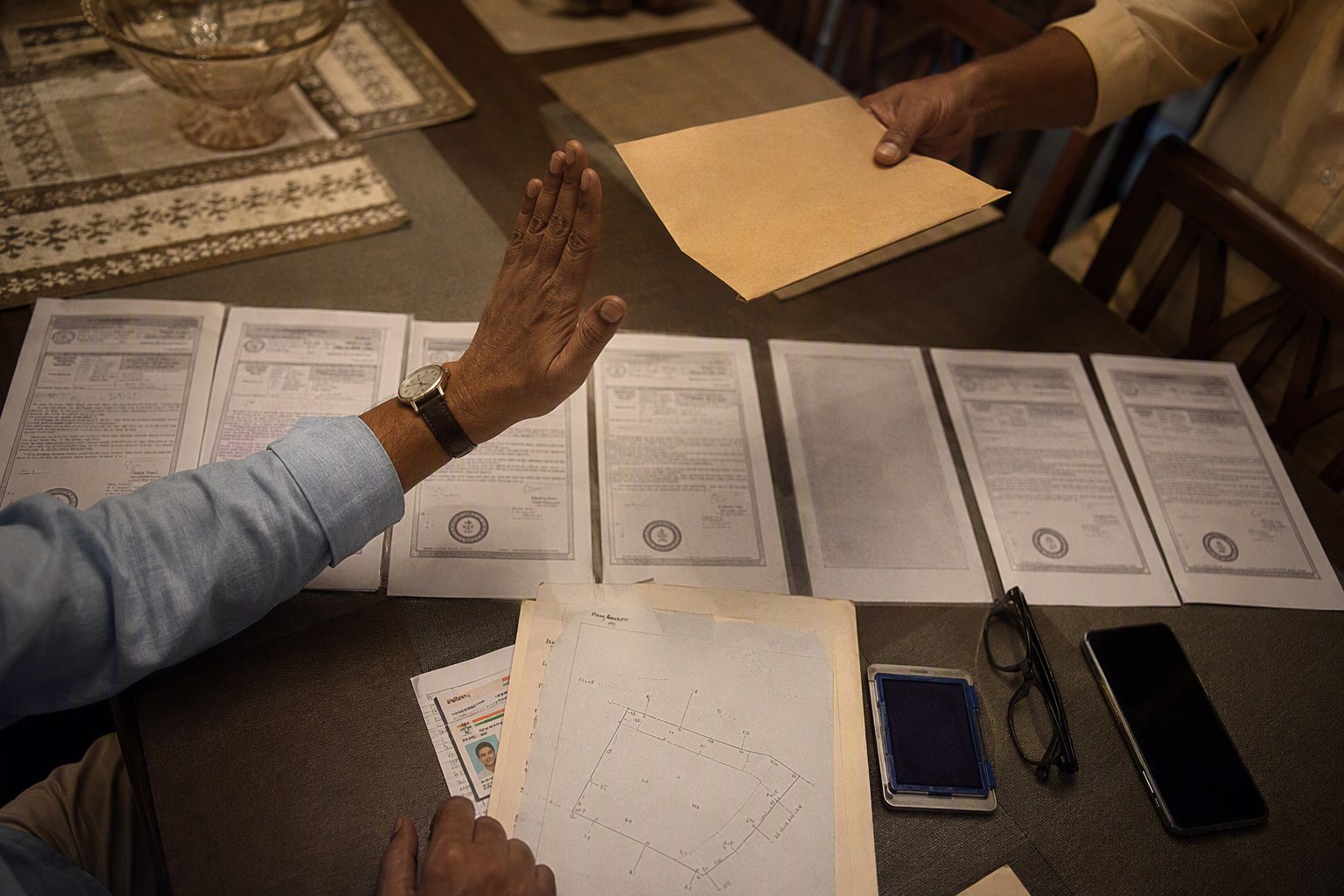



Why did a clean family gift deed pause a Telangana resale? Because the registered gift deed was only one part of the ownership story. In this Telangana resale case, the document looked fine at first glance, but mutation was not updated in revenue records, the pahani trail had missing links, and an older parent document was not available for verification. The buyer was ready, the seller was confident, and the broker thought it was a simple family transfer. Then the due diligence file slowed everything down.
We see this often in Hyderabad and surrounding districts, especially in resale plots and houses that moved within a family through gift deed. A father gifts to son. Mother gifts her share to daughter. Siblings execute release deeds or gift deeds. On paper, it feels clean because there is no sale dispute. But when the same property comes for resale, the buyer’s lawyer, bank panel advocate, or verification team will ask a different question: Can we trace title, possession, revenue mutation, EC, and survey identity without a break?
This case study is based on the kind of verification issues we handle regularly at Verified.RealEstate. We are not naming the family, buyer, survey number, or transaction value. The point is to explain the risk pattern, not expose anyone’s private matter.
Gift Deed Gap That Paused a Telangana Resale: What Was the Main Issue?
The main issue was simple but serious: the registered gift deed existed, but the mutation and link-document trail did not support it cleanly.
The property was in the Hyderabad growth belt, in a mandal where agricultural land records, layout conversion papers, and SRO registration documents often need to be read together. The seller had received the property through a family gift deed. The gift deed was registered at the SRO. Stamp duty and registration were not the problem. The EC showed the gift deed entry. At first glance, everyone felt the file was ready.
But resale verification is not only about whether one document is registered. It is about whether the document fits into the full chain. In this case, three gaps came up:
- The donee’s name was not reflected consistently in mutation records.
- The pahani and revenue extracts did not clearly carry forward the ownership change.
- One older link document before the donor’s ownership was missing from the seller’s file.
For a cash buyer with high risk appetite, this may look like a small delay. For a buyer taking a home loan, or buying land for construction, it becomes a real blocker. Banks do not like unclear mutation. Lawyers do not like missing parent documents. Buyers do not like last-minute surprises.
Gift Deed Gap That Paused a Telangana Resale: The Property Background
The property was a resale asset in the wider Hyderabad market, not a fresh builder sale. The parties were dealing with land records, SRO documents, and family transfer documents. Localities like Narsingi, Kollur, Tellapur, Mokila, Shankarpally, Adibatla, Ghatkesar, Bachupally, Kompally, and Shamshabad see many such files because land has moved from older family holdings into plotted development, villas, or independent houses.
In our experience, resale files around Rajendranagar mandal, Gandipet mandal, Shankarpally mandal, Serilingampally mandal, Hayathnagar mandal, Maheshwaram mandal, and Medchal side need special attention. A property may be physically within a fast-growing real estate pocket, but its title history may still sit inside older revenue terminology: survey number, extent, khata, pattadar name, possessor column, pahani, and mutation proceedings.
The seller’s position was understandable. He said, “The gift deed is registered. What else is needed?” That is a common reaction. A registered gift deed is strong evidence of transfer. But it does not automatically answer every title question. If the donor’s own title is not traced properly, the donee’s title inherits that weakness. If mutation is not completed, revenue records may still show the earlier person or may show inconsistent entries. If the survey number is part of a larger land parcel, identity issues can also come up.
Our practical rule is this: a gift deed transfers rights only if the donor had clear transferable rights. The resale buyer must verify both the gift deed and the donor’s title chain.
How the File Looked Clean at First
The first-level document set looked decent. The seller had the registered gift deed. The EC reflected the family gift transaction. The parties had ID proofs, property tax-related papers where applicable, and physical possession was with the seller. The broker had already circulated the file to the buyer’s side as a “clear family gift deed property”.
That description is tempting, but it is not enough. A gift deed between close relatives often creates comfort because there is usually no sale consideration dispute. Still, family documents can hide other issues. Sometimes one legal heir is not part of the arrangement. Sometimes the gifted property came from ancestral land, not self-acquired property. Sometimes the gift deed describes the property using an old survey number, while the current marketable identity uses plot number, municipal number, or layout reference.
In this case, the EC was not adverse. That was good. But the EC alone could not close the file. We recommended a deeper check through the Encumbrance Certificate Search and then a document-wise reading, not only a transaction-list reading. An EC can show registered transactions, but it does not certify that revenue mutation is completed or that all link documents are available.
Where the Gift Deed Verification Started Failing
The gift deed verification started failing when the buyer’s advocate asked for the mutation trail after the gift deed. This is where many Telangana resale files become uncomfortable.
The family had assumed that registration itself was the final step. But in land and semi-urban property matters, mutation plays a major role. Mutation is not a title deed by itself, but it shows whether the government record has recognised the change for revenue purposes. If the seller wants to resell, the buyer will ask whether the name of the present owner appears in the relevant record set.
In this file, the post-gift mutation was either not done or not traceable in the file. There was no neat order showing that the donee’s name had been carried into the revenue record. The pahani entries were not matching the gift deed position clearly. This created a basic doubt: was the seller only holding a registered document, or was his name properly reflected in government records too?
For apartments inside GHMC or HMDA-approved projects, mutation may not be the central issue in the same way. For land, houses built on older plots, gram panchayat layouts, and converted parcels, mutation can become a deciding factor. Buyers in Mokila, Shankarpally, Kothur, Tukkuguda, Maheshwaram, and Ghatkesar should be especially careful because land identity and revenue records can carry old references.
The Missing Link Document Problem
The second issue was the missing link document. The donor had gifted the property, but the file did not contain a full, uninterrupted title chain showing how the donor originally got clear title. There was one gap before the donor’s acquisition. The seller’s family believed the document existed somewhere, but it was not immediately available.
This is a classic resale slowdown. The buyer is not only buying from the donee. The buyer is relying on the donor’s title also. If the donor bought the property through a sale deed, that sale deed must be reviewed. If the donor got it through partition, succession, court decree, assignment, or earlier gift, that path must be checked. The chain should not jump from “grandfather owned it” to “father gifted it” without documentary support.
Hyderabad resale buyers often ask for a 30-year link document chain. Some banks ask for a chain as per their internal policy. We are not quoting a universal rule because requirements vary by lender and property type. But as a market practice, missing parent deeds do delay files. If certified copies are available from the SRO, the delay can be managed. If the document was unregistered, lost, or described differently, the problem becomes bigger.
For any resale property, the starting checks should include the Find Your SRO Office tool and the Survey Number Finder. The SRO path helps trace registered documents. The survey number path helps connect the legal description with the land record identity.
Why Mutation Matters in a Telangana Gift Deed Resale
Mutation does not create ownership in the same way as a registered sale deed or gift deed. But in Telangana resale verification, mutation supports possession, revenue recognition, and continuity of records. If there is a gap, the buyer’s side may ask for correction before registration.
In rural and peri-urban Telangana, a buyer may see different records saying different things. One record may show the donor. Another may show the donee. A tax receipt may show an old name. A layout paper may show a developer. A pahani may carry older entries. The sale deed may mention a converted plot number. Unless these are reconciled, the file feels risky.
Dharani has changed how many agricultural land records are accessed and updated. But not every resale file is straightforward. Assigned lands, prohibited lands, ceiling issues, wakf/endowment claims, government land entries, and old survey disputes can still affect marketability. As per latest IGRS data available to us, Telangana’s Section 22-A prohibited properties data contains 3,076,153 entries. That number itself tells buyers why one should not skip a prohibited property check.
Before advancing token amount, buyers should use the Section 22-A Prohibited Property Check and the Property Verification Tool. These tools do not replace a lawyer, but they help buyers ask better questions before money moves.
How the Buyer Reacted
The buyer did what a sensible buyer should do: he paused. He did not cancel immediately. He asked for clarification, certified copies, mutation proof, and link documents. That pause saved both sides from a messy registration-day argument.
Many sellers feel offended when buyers ask for more papers. My view is blunt: a genuine seller should welcome serious verification. If a buyer is paying hard-earned money, he has every right to ask how title moved from one person to another. A resale is not a trust exercise. It is a document exercise.
The buyer’s advocate raised specific queries:
- Where is the mutation order after the gift deed?
- Does the donee’s name appear in the relevant pahani or revenue extract?
- Is the donor’s title supported by registered link documents?
- Are there any Section 22-A restrictions for the survey number?
- Does the EC cover all relevant names and property descriptions?
- Is the physical property matching the schedule in the gift deed?
These are not academic questions. We have seen transactions in Tellapur and Kokapet-side resale markets where the flat file is perfect but the undivided land history is weak. We have also seen villa plot files in Shankarpally and Mokila where the marketing brochure is glossy, but the old revenue trail needs repair.
What the Seller Had to Fix Before Resale
The seller had to collect and correct the file before pushing for registration. The first task was to obtain missing certified copies from the concerned SRO. If the older document was registered, the certified copy route was available. If not, the family had to produce supporting documents explaining the title flow.
The second task was mutation follow-up. Depending on the nature of the land and current classification, the family had to check the appropriate revenue or municipal record route. In some cases, parties need to approach the tahsildar office. In other cases, municipal mutation or property tax name transfer may also be relevant. The exact route depends on whether the property is agricultural land, converted land, gram panchayat layout plot, municipality area, GHMC property, or a registered apartment.
The third task was document consistency. The schedule in the gift deed had to be compared with the older sale deed, survey record, layout plan, tax records, and EC. Small differences in boundaries, extent, survey sub-division, or plot number can create large doubts. If the north boundary in one deed says road and another says private land, somebody must explain why.
For valuation-related clarity, the parties could check the Market Value / Guideline Value Search. For duty planning on the resale deed, the Stamp Duty Calculator is useful. We are not quoting any transaction amount here because the case is anonymised and rates vary by exact SRO village, property type, road access, and market conditions.
The Verification Checklist We Used
Here is the practical checklist we used in this gift deed resale review. This is not a decorative list. These are the checks that decide whether a resale file moves or stops.
| Check | What We Looked For | Why It Mattered |
|---|---|---|
| Gift deed | Registration details, donor and donee identity, property schedule, acceptance of gift | To confirm the transfer document itself was valid on its face |
| EC | Gift deed entry, prior transactions, mortgages, releases, unusual gaps | To see registered encumbrances and transaction flow |
| Mutation | Name change after gift deed in relevant records | To confirm revenue or municipal record continuity |
| Pahani or revenue extracts | Pattadar, possessor, survey number, extent, classification | To match possession and land identity |
| Link documents | Donor’s title source and earlier parent deeds | To prove the donor had transferable title |
| Section 22-A | Prohibited property risk | To avoid registration refusal or serious title risk |
| Physical identity | Boundaries, access road, plot or house location | To ensure the property on ground matches the papers |
We also suggested running the file through the EC Analyzer because many buyers read ECs casually. An EC may contain spelling variations, old document references, mortgage releases, and description changes. A quick skim is not enough.
What Finally Happened in the Telangana Resale Case
The resale did not collapse. It paused. That distinction matters. A pause is healthy when the file can be cured. A cancellation happens when the gap is too large, parties become defensive, or a serious legal defect is found.
In this case, the seller agreed to collect missing papers and clarify mutation status before insisting on full payment. The buyer agreed to keep the offer open for a limited period, subject to clean verification. That is the right approach. No shouting, no blind trust, no pressure registration.
From a journalist’s lens, the case reflects a bigger Hyderabad market pattern. Resale demand is strong in many corridors, but buyer awareness is also improving. People are no longer satisfied with only Xerox copies and broker assurances. They want EC, link deeds, pahani, dharani status, SRO checks, CERSAI where loans are possible, and clarity on prohibited lists.
For property with possible loan history, the CERSAI Charge Check can help identify registered security interest. For ongoing monitoring after shortlisting a property, the Property Change Tracker is useful, especially when there is a gap between token payment and final registration.
Lessons for Hyderabad Buyers Considering Gift Deed Properties
My opinion is clear: do not reject every gift deed property. Many gift deed properties are perfectly saleable. Parents gifting to children, spouses gifting shares, and family settlements are common in Telangana. The risk is not the gift deed itself. The risk is an incomplete file.
Before paying a large advance, ask for these papers:
- Registered gift deed copy with full schedule
- EC covering relevant period and names
- Donor’s title document and earlier link documents
- Mutation proof after gift deed
- Pahani, dharani extract, or relevant revenue record where applicable
- Property tax mutation or municipal records for urban properties
- Layout approval, building permission, or occupancy papers where relevant
- Section 22-A prohibited property check
- CERSAI check if bank loan or mortgage risk is suspected
If the seller says “all papers are in order”, ask for a document index. A genuine file should be organised document by document. In our experience, confusion starts when sellers keep saying “paper is there” but cannot say which paper, from which office, for which period.
Lessons for Sellers Who Received Property Through Gift Deed
If you received property through a gift deed in Telangana, do not wait until you find a buyer to clean the file. Do it now. Resale pressure creates bad negotiation. Buyers use document gaps to reduce confidence, delay payment, or walk away.
Sellers should check three things early. First, whether the gift deed is properly registered and available in clean copy. Second, whether mutation or name transfer has been completed in the correct records. Third, whether the donor’s own title chain is available. If any link is missing, apply for certified copies or obtain legal clarification before marketing the property.
Also check whether the schedule needs explanation. Old deeds may mention acres and guntas. Newer sale deeds may use square yards or square metres. Use the Area Unit Converter when comparing extents, but do not rely only on conversion. Boundaries, survey number, and physical possession must also match.
Red Flags in Gift Deed Resale Files
These red flags deserve quick attention:
- Gift deed exists, but donor’s title deed is missing.
- Gift deed schedule does not match older sale deed schedule.
- Mutation is pending for many years after the gift deed.
- Pahani shows a different pattadar or possessor name.
- Property is part of a larger survey number with no clear sub-division.
- Legal heirs are not clearly accounted for in family property.
- EC has gaps, spelling variations, or unexpected transactions.
- Seller refuses Section 22-A or SRO checks.
- Physical access road is different from document boundary.
One red flag does not always mean fraud. Sometimes it is only old paperwork. But a buyer should not ignore it. A seller should not hide it. Clean explanation is the difference between a delay and a dispute.
Final Takeaway on Gift Deed Gap That Paused a Telangana Resale
The real lesson from this gift deed gap that paused a Telangana resale is that registration is only the starting point. Mutation, pahani continuity, EC reading, link-document tracing, SRO verification, survey identity, and prohibited property checks all matter.
Hyderabad’s resale market is maturing. Buyers in premium areas like Kokapet, Narsingi, Tellapur, Kondapur, and Manikonda are asking sharper questions. Buyers in expanding corridors like Shankarpally, Mokila, Adibatla, Tukkuguda, Ghatkesar, and Kompally should be even more careful because land records can be older and more layered.
A family gift deed can be clean. But it must be supported by a clean chain. If there is a mutation gap or missing parent deed, pause the transaction, collect the documents, and then proceed. That pause may feel irritating for a week or two, but it can save years of litigation.
Frequently Asked Questions
Is a registered gift deed enough to sell property in Telangana?
A registered gift deed is essential, but resale verification also needs donor title, mutation records, EC, property schedule matching, and checks for restrictions such as Section 22-A.
Can mutation delay a resale after a family gift deed?
Yes. If the donee’s name is not reflected in relevant revenue or municipal records, buyers and banks may ask the seller to complete or clarify mutation before registration.
What is the biggest risk in buying a gift deed property?
The biggest risk is assuming the gift deed alone proves full title. The donor’s title chain must also be checked. If the donor had weak or unclear title, the donee’s resale title can also be questioned.
Should I check Section 22-A for a resale property?
Yes. Telangana’s Section 22-A prohibited properties data contains 3,076,153 entries as per latest IGRS data available to us. A prohibited property check is a basic step before paying token money.
Which documents should I ask for before buying a Telangana resale property received by gift deed?
Ask for the registered gift deed, EC, donor’s title documents, earlier link documents, mutation proof, pahani or relevant revenue records, tax records, layout or building approvals where applicable, and prohibited property checks.