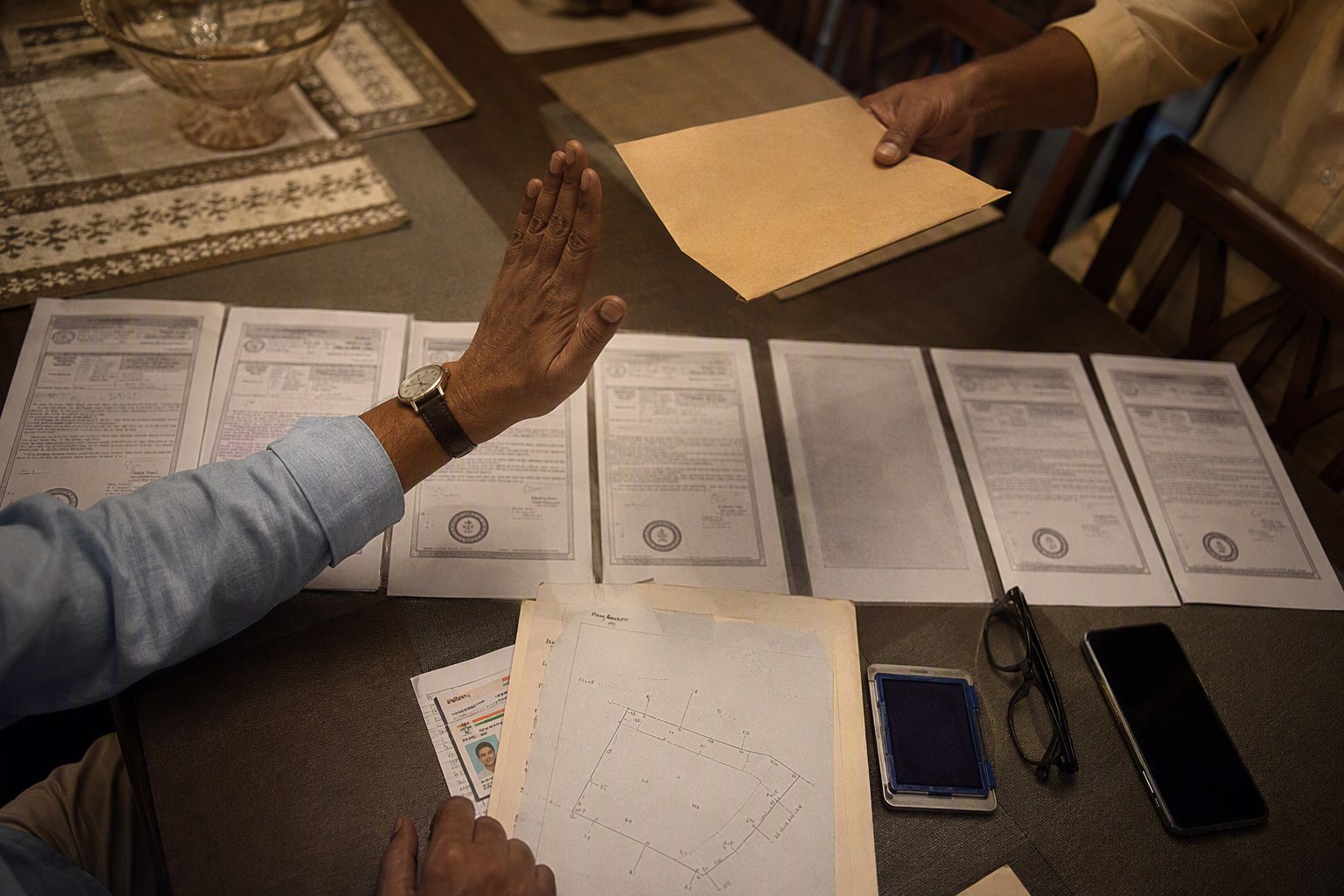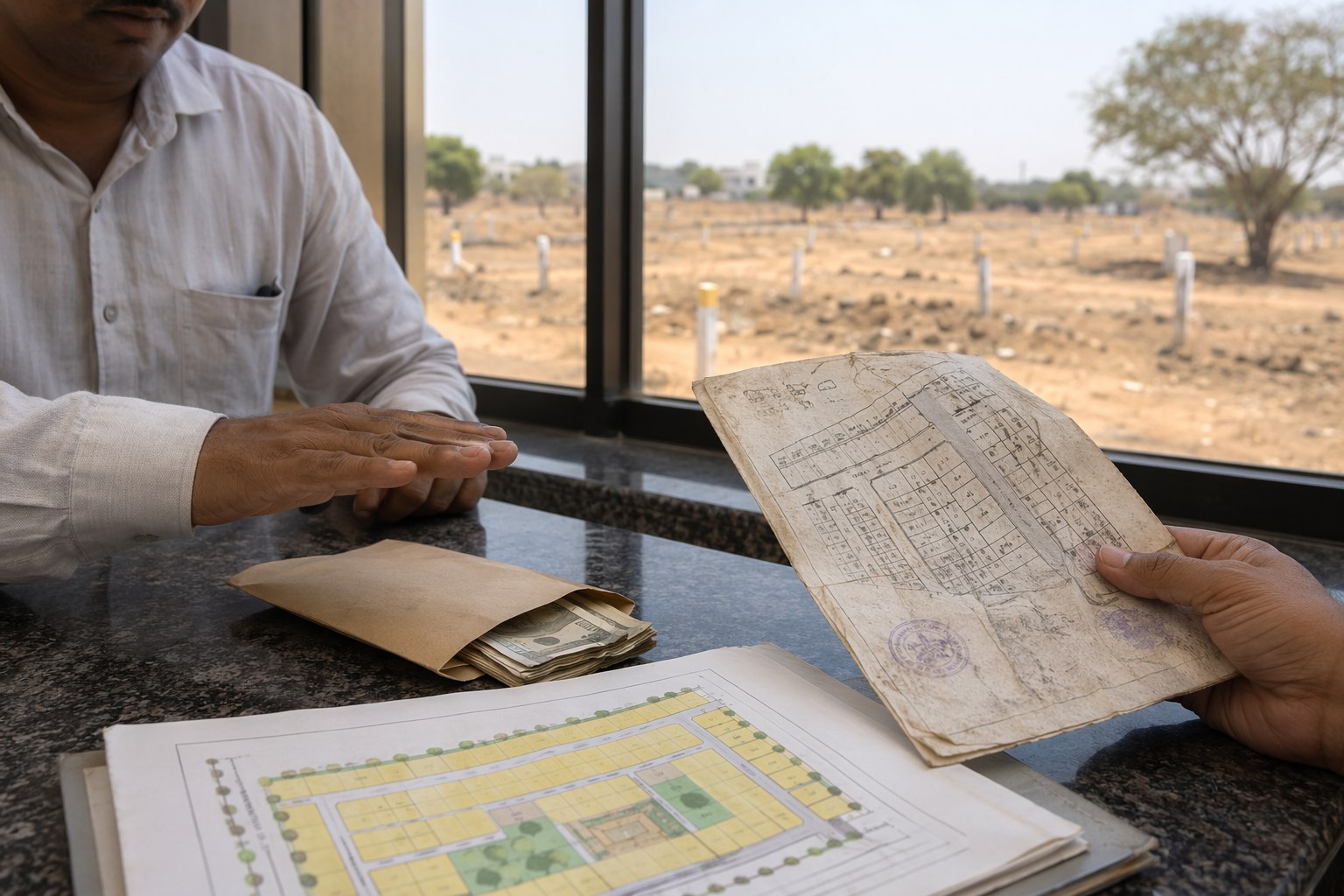



The Missing NALA Order looked like a small gap at first. The buyer had liked a villa near the Kollur-Mokila belt, the site visit went well, the approach road was decent, and the builder’s sales team was pressing for token payment. But one document was not available: the NALA land-conversion order. That missing paper changed the whole deal discussion.
This is an anonymised case from our Telangana property verification work. The location details are kept broad, but the pattern is very common around Hyderabad’s expanding villa corridors: Mokila, Kollur, Tellapur, Narsingi, Gandipet, Shankarpally mandal, Shamshabad mandal, Maheshwaram mandal and similar edges where old agricultural survey numbers have become plotted layouts and villa projects.
My view is simple. A villa can have a grand elevation, club house promise and nice brochure. Still, if the parent land conversion record is unclear, the buyer should not rush into token payment. In Telangana, a villa deal is not only about the building. It starts with the land.
Missing NALA Order in a Villa Sale: What Actually Happened
The buyer had shortlisted a villa in a gated community on Hyderabad’s western side. The project was not in the city core. It was on land that, according to the sale team, had earlier been agricultural and later converted for residential development. That is normal for many projects outside the older municipal limits. The issue was not that the land was once agricultural. The issue was that the conversion proof was not produced when asked.
The buyer first checked the brochure, site plan, Google location, road access and sample villa. Everything looked fine from a buyer’s eye. Then came the document round. We asked for the chain documents, pahani history, mutation entries, layout approval papers, building permission, latest encumbrance certificate, SRO details, market value reference and land conversion order.
The seller side shared some documents. There was a registered sale deed in the developer’s favour. There were layout-related papers. There were tax receipts. There was a draft agreement. But the NALA order was missing. The sales person said, “Sir, conversion is already done, file is with office, we will send later.” That line is where the buyer paused.
In our experience, “we will send later” is not a document. It is only a promise. For property due diligence, a missing document must be treated as missing until it is physically verified.
Before paying any token, the buyer used our Property Verification Tool to organise the basic checks. The survey number was cross-checked through Survey Number Finder, and the relevant registration office was identified using Find Your SRO Office. The point was not to reject the property blindly. The point was to make the seller prove the land status before money moved.
Why the Missing NALA Order Matters in Telangana
NALA generally refers to land conversion from agricultural use to non-agricultural use. In Telangana property transactions, buyers often hear this word only at the final stage. That is too late. If agricultural land has been converted into a residential villa layout, there should be proper evidence of conversion, usually linked to survey numbers, extent, applicant details and the competent authority’s order.
For a villa buyer, the NALA order helps answer a very basic question: was the land legally allowed to move from agriculture to residential or non-agricultural purpose? Without that clarity, the buyer is taking a risk on the land beneath the villa.
This becomes especially relevant in peri-urban Hyderabad. Around Shankarpally mandal, Chevella side, Mokila, Kondakal, Velimela, Kollur and Patancheru edges, many parcels have changed hands over the years. Some lands moved from family holdings to developers. Some were aggregated across multiple survey numbers. Some have old pahanis, old pattadar names, later mutations and then development agreements. One weak link in that chain can delay registration, bank loan, resale or occupancy comfort.
I do not say every missing NALA paper means fraud. Sometimes the order exists but is poorly filed. Sometimes the developer has conversion details under a parent parcel, while the sales team has not mapped them properly to the villa unit. Sometimes the land may fall inside a planning area where other permissions also need review. But the buyer should not assume. Property is not bought on assumption.
Missing NALA Order Before Token Payment: The Right Time to Ask
Many buyers ask for documents after paying token. That is the biggest practical mistake we see. Once token is paid, the buyer loses negotiating strength. The seller may push deadlines, say the amount is non-refundable, or ask the buyer to “adjust” small document gaps. In a hot locality, sales teams may also say another buyer is ready.
In this case, the buyer did the correct thing. He liked the villa but held back the token. He asked for the NALA order, parent document chain and latest EC before committing. The latest EC was checked using Encumbrance Certificate Search, and the EC entries were later reviewed along with the parent documents. For land-based deals, EC alone is not enough, but it is a useful starting point.
We also asked the buyer to check whether the land had any prohibited-property angle. Telangana’s Section 22-A prohibited property list is not a small side issue. As per our verified database context, there are 3,076,153 prohibited properties recorded under Section 22-A. That number itself tells buyers why government record checks cannot be treated casually. The buyer used Section 22-A Prohibited Property Check to screen the survey references.
For market value and registration planning, the buyer also referred to Market Value / Guideline Value Search and Stamp Duty Calculator. We did not depend on brochure pricing for legal comfort. Ready reckoner values, SRO jurisdiction and document history all have their own role.
What We Checked After the Missing NALA Order Was Flagged
Once the missing NALA order became the main issue, we did not stop at one question. A land-conversion gap can be connected to several other records. The checklist became sharper.
| Document or Check | Why It Was Asked | What Buyer Should Look For |
|---|---|---|
| NALA / land conversion order | To confirm non-agricultural use permission | Survey number, extent, authority, order details and match with parent land |
| Pahani and mutation records | To understand agricultural ownership history | Pattadar names, nature of land, survey continuity and later changes |
| Parent sale deeds | To trace how developer obtained rights | Clear chain from earlier owners to developer or land aggregator |
| Encumbrance certificate | To check registered transactions and charges | Sale deeds, mortgages, releases, agreements and gaps in entries |
| Section 22-A check | To see whether registration may be restricted | Survey number match, village match and SRO-level caution |
| Planning and layout permissions | To confirm development legality | Approval authority, land use, road widths, open spaces and conditions |
We asked for land-use confirmation too. Buyers can use Land Use Zone Finder to understand the planning context. If the project is part of a layout or gated villa development, road width and open space requirements should also be looked at. Tools like Road Width Check and OSR Calculator help buyers ask better questions before a site office visit turns into a token-payment trap.
In this case, the seller side first sent a general approval file. It had project references but did not clearly tie the conversion order to the specific survey numbers. That was not enough. We asked for the complete order copy and the survey-number mapping. A buyer does not need to become a revenue officer, but he should insist that the seller’s documents talk to each other.
How a Missing NALA Order Can Affect a Villa Buyer
The risk is not always dramatic on day one. The villa may be standing. Roads may be laid. Neighbours may already be living there. That is why buyers become relaxed. But land documentation issues often surface later, at bank processing, registration, resale, mutation or when a government record gets updated.
Here are the practical issues we discussed with the buyer:
Bank loan delay: Legal teams of banks usually ask for land-conversion records when agricultural land history is visible. If the file is incomplete, loan sanction can slow down or get conditional.
Registration doubts: If the SRO or document writer notices land-status mismatch, extra clarification may be asked. SRO practice can vary by location, so the buyer should not leave it to the final registration day.
Future resale questions: Today’s buyer becomes tomorrow’s seller. A sharp buyer in the future will ask the same NALA question. If you cannot answer then, your resale discussion becomes weaker.
Planning permission mismatch: Land conversion, layout approval and building permission must be read together. One document cannot automatically cure a gap in another document.
Dispute exposure: If survey numbers, extents or parent ownership are unclear, a later objection can become expensive even if the buyer acted in good faith.
My opinion after seeing many such files is clear: if the developer or seller becomes irritated when you ask for NALA and land records, that itself is a signal. A clean file is usually shared with confidence. A messy file is explained with stories.
The Hyderabad Locality Angle: Why Villa Belts Need Extra Care
Hyderabad’s villa demand has moved strongly beyond the old apartment-heavy zones. Buyers now compare Tellapur, Kollur, Mokila, Nallagandla side, Osman Nagar, Shankarpally road, Gandipet belt, Adibatla, Tukkuguda and Maheshwaram side depending on budget, office commute and school access. Many of these areas have mixed land histories.
In core areas like Banjara Hills, Jubilee Hills or parts of Hitec City, land records have their own complications, but the nature of due diligence is different. In villa belts, the parent land may have been agricultural not too long ago. Survey-number identity matters. Village name matters. Mandal jurisdiction matters. SRO mapping matters. Pahani entries matter. Dharani records may show a story, while registered documents may show another timeline. A proper file should reconcile these.
Buyers also get distracted by “near Financial District” or “close to ORR” language. Those phrases help in marketing, but they do not prove land title. A villa in a preferred corridor still needs the same document discipline as any other land-backed purchase.
What the Buyer Did Next After the Missing NALA Order
The buyer did not cancel immediately. That is an important lesson. Good due diligence is not about creating panic. It is about slowing the transaction until facts are clear.
He sent a written document request to the seller side. The request asked for the land-conversion order, parent title chain, approval copies, latest EC, link documents and SRO details. He also made it clear that token payment would be considered only after review.
That changed the tone of the transaction. The seller side stopped pushing for same-day token and escalated the file internally. After some follow-up, they shared more papers. Some were useful. Some still needed clarification. The buyer then took a commercial call based on risk appetite, bank comfort and whether the missing NALA order gap could be properly closed.
The main win was this: the buyer did not become financially trapped before seeing the file. Even if a deal is later dropped, that is better than paying first and fighting later. We have seen buyers spend weeks chasing refunds because they trusted verbal assurances at the site office.
Practical Checklist Before Buying a Villa on Converted Land
If you are evaluating a villa in Telangana, especially in Hyderabad’s outer growth corridors, use this checklist before token payment:
Ask for complete parent documents, not only the villa agreement draft.
Ask whether the land was agricultural earlier. If yes, request the NALA or land-conversion order.
Match the order with survey numbers, village, mandal and extent.
Check pahani and mutation trail where agricultural history exists.
Check latest EC through Encumbrance Certificate Search and review registered entries.
Check Section 22-A risk using Section 22-A Prohibited Property Check.
Identify the correct SRO through Find Your SRO Office.
Check guideline value through Market Value / Guideline Value Search before stamp duty planning.
If the project claims RERA registration, verify it using RERA Project Lookup.
Put all pending-document conditions in writing before paying any token.
Do not accept only WhatsApp photos of partial pages. Ask for readable copies. If one order covers multiple survey numbers, ask for the mapping statement. If the seller says the document is with the bank, ask for a bank-certified copy or legal opinion reference. If the seller says “all other buyers have bought,” remember that other buyers’ risk appetite is not your legal protection.
Missing NALA Order: My Take for Hyderabad Villa Buyers
A missing NALA order is not a small clerical issue when the land has agricultural history. It goes to the base of the property. In a villa purchase, the buyer is not just buying walls, tiles and a parking slot. The buyer is taking a share in land, layout obligations, access rights and long-term title comfort.
We’ve seen Hyderabad buyers negotiate hard on interiors but stay casual on parent documents. That is the wrong priority. Interiors can be changed. Land record defects are harder to repair. Before token payment, the buyer must see the file, not the brochure alone.
The better approach is calm and firm. Tell the seller: “I like the villa. I am ready to proceed after document verification. Please share the NALA order and connected land records.” A genuine seller may take time, but will understand. A seller who refuses basic documents before token is asking you to buy blind.
For Telangana property, document checking is not a formality. It is the purchase itself. The site visit tells you whether you like the home. The records tell you whether you should buy it.
Frequently Asked Questions
What is a NALA order in Telangana property deals?
A NALA order is generally the land-conversion approval showing that agricultural land has been permitted for non-agricultural use. For villa projects built on former agricultural land, buyers should ask for this order and match it with survey numbers, village, mandal and extent.
Should I pay token if the seller says the NALA order will be shared later?
In my view, no. Ask for the NALA order and key land records before token payment. Once money is paid, your negotiation strength reduces and refund discussions can become painful.
Is an Encumbrance Certificate enough to prove the land is safe?
No. An EC shows registered transactions and charges, but it does not by itself prove land conversion, planning approval or absence of every title issue. Use EC along with pahani records, parent documents, NALA order, Section 22-A check and approval papers.
Why is Section 22-A checking needed for villa land?
Section 22-A relates to prohibited properties where registration may be restricted. As per our verified database context, Telangana has 3,076,153 prohibited properties recorded under Section 22-A, so buyers should screen the survey number and village before proceeding.
Which records should I ask for before buying a villa near Hyderabad?
Ask for parent sale deeds, latest EC, pahani and mutation records, NALA or land-conversion order, layout approval, building permission, RERA details where applicable, SRO details, guideline value reference and Section 22-A status.