

Case Study: The Old Layout Approval That Saved a Plot Buyer
The old layout approval looked like a boring photocopy at first. One faded plan, one proceedings page, a few survey numbers, and a rubber stamp that had almost disappeared. But for a Hyderabad plot buyer, that old layout approval became the difference between a clean purchase and a risky token advance on the wrong plot.
This case is from the western Hyderabad belt, on the Mokila-Shankarpally side of Rangareddy district. The buyer’s name is changed here, but the pattern is very familiar. We’ve seen similar files in Shankarpally mandal, Gandipet mandal, Moinabad, Maheshwaram, Abdullapurmet, Ghatkesar and Medchal. The locality changes. The mistake is usually the same: people check the sale deed and EC, but ignore the original layout approval.
In our experience, a plot deal is not safe just because the seller has a sale deed. The plot must also match the approved layout, survey number, village record, SRO history and current restrictions.
Old Layout Approval: The Small Document That Changed the Deal
The buyer, whom we’ll call Ravi, was looking for a residential plot near the Mokila-Shankarpally growth corridor. Like many IT employees from Gachibowli and Financial District, he wanted a plot that was not too far from ORR access, not too deep inside agricultural roads, and preferably in a layout that already had road markings.
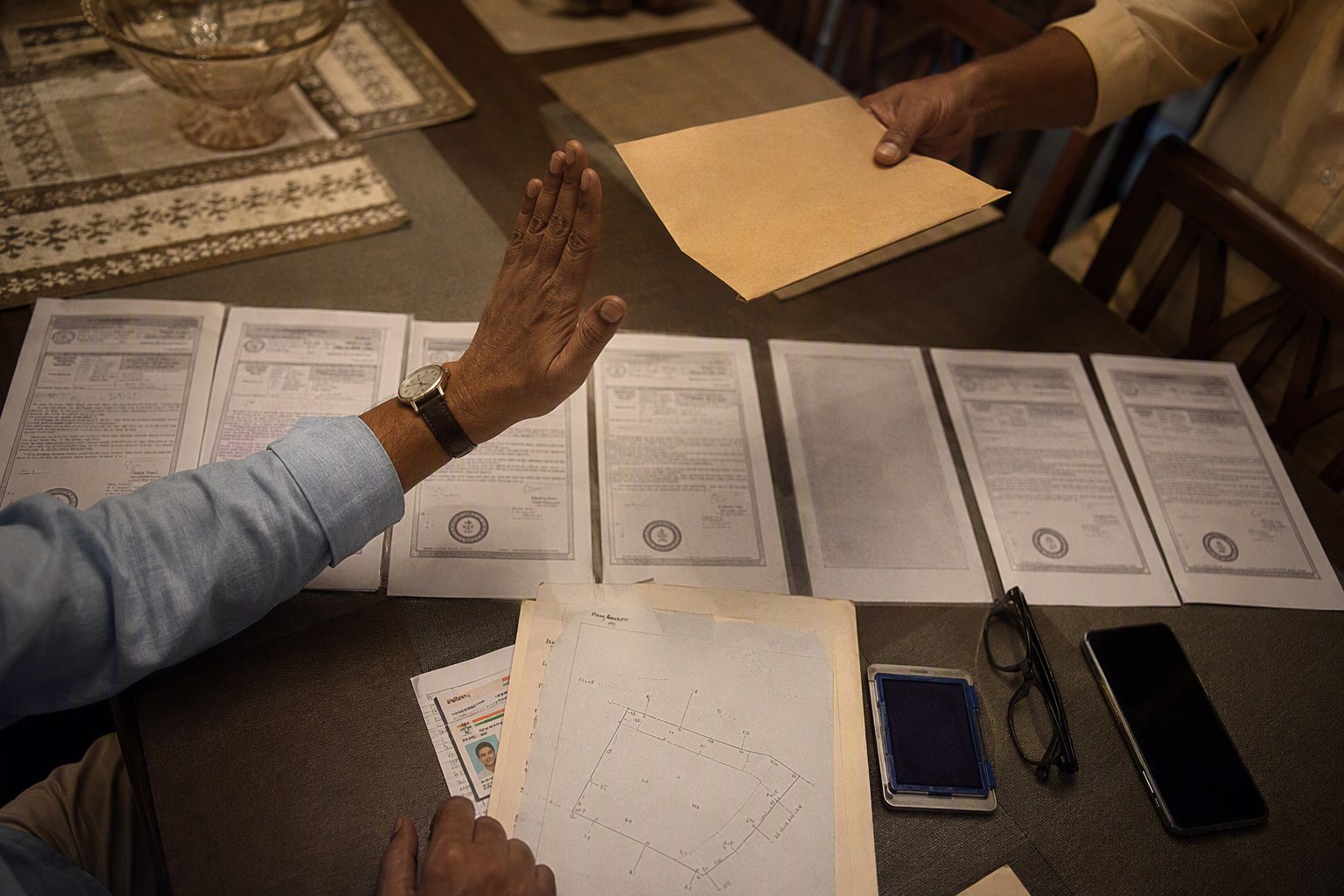
The seller showed a set of documents: registered sale deed, link deed copies, an EC printout, pattadar passbook copy from an earlier owner, tax receipts, and a layout plan photocopy. On WhatsApp, the plot looked simple. On ground, it looked even better. There were stone markings, a mud road, a few neighbouring compound walls, and one house under construction two lanes away.
The seller was pushing for token money that same evening. His line was also common: “Sir, another party is ready. If you want, block it today.” Ravi almost agreed.
Then he called us for a quick review. The first thing we asked was not the price. We asked for the layout approval copy, the proceedings number, the approved plan, village name, survey numbers, and plot number as per the sanctioned plan.
That is where the deal started changing.
Why Old Layout Approval Matters in Hyderabad Plot Deals
An old layout approval is not just a historical paper. It tells you whether the land was legally divided into plots, whether roads and open spaces were part of the sanctioned plan, and whether your plot number actually exists in the approved drawing.
In Telangana, especially around Hyderabad’s outer growth belts, many layouts were created years ago under gram panchayat, DTCP or other local authority permissions depending on the period and jurisdiction. Later, jurisdictional changes, municipal mergers, HMDA influence zones and new planning norms created confusion for buyers. A seller may say “old approved layout” very casually. But the file must prove it.
For Ravi’s file, the first warning sign was this: the sale deed mentioned a plot number, but the layout plan copy had a slightly different internal numbering pattern. The seller said it was “only old numbering and new numbering”. That can happen. But it must be supported by documents, not oral explanation.
We asked Ravi to pause the token and run three checks before committing:
- Match the plot number with the sanctioned layout plan.
- Match the layout survey numbers with the sale deed and link documents.
- Check whether the land had any registration restriction, government claim or Section 22-A issue.
For a first-level check, tools like Property Verification Tool, Encumbrance Certificate Search, Section 22-A Prohibited Property Check and Survey Number Finder can help a buyer organise the file before visiting the SRO or speaking to a document writer.
Old Layout Approval Check: What We Found in Ravi’s File
The layout plan was not fake. That was the surprising part. Many buyers think verification means either “genuine” or “fraud”. Real property files are rarely that clean. In this case, the old layout approval existed, and the proceedings appeared to relate to the same village area.
But the specific plot Ravi was being asked to buy was not comfortably matching the sanctioned layout sheet.
The approved plan showed a block of plotted land within certain survey numbers. Roads were shown with fixed widths. Open space was marked separately. The plot numbers followed one sequence. Ravi’s sale deed chain, however, referred to a plot number that appeared in a later sketch attached to one link document, not in the old approved plan itself.
That difference is not a small spelling error. It can mean many things:
- The plot may be part of an unapproved extension beside an approved layout.
- The plot may have been carved out after approval without revised permission.
- The approved road pattern may have been changed on ground.
- The same plot number may have been reused in a private sketch.
- The seller may genuinely not know the difference because he also purchased based on old papers.
We have seen this around Kollur, Tellapur, Osman Nagar, Moinabad, Kandukur, Adibatla, Tukkuguda and Ghatkesar also. One part of a venture may be properly approved, while the backside extension or corner strip may be outside the approved boundary. On ground, both look like one layout. On paper, they are not the same.
The Section 22-A Angle Buyers Often Ignore
Old layout approval alone is not enough. A plot can be in an approved plan and still face registration trouble if the underlying survey number is affected by a government restriction, endowment issue, assigned land entry, ceiling issue, court order or other objection.
Telangana’s prohibited properties list under Section 22-A is not a small background database. The database context we track contains 3,076,153 prohibited property entries. That number itself should make buyers careful before paying token money on any plot, especially in fast-moving outskirts.
Ravi’s plot was checked against the prohibited property angle. We also advised him to verify at the concerned SRO, because online checks are a starting point, not the final legal opinion. The SRO jurisdiction matters. A plot near one mandal boundary may be assumed to fall under one office, but the registration history may point elsewhere. Buyers can use Find Your SRO Office and SRO Village Directory to avoid going to the wrong office with half information.
Where the Deal Became Risky
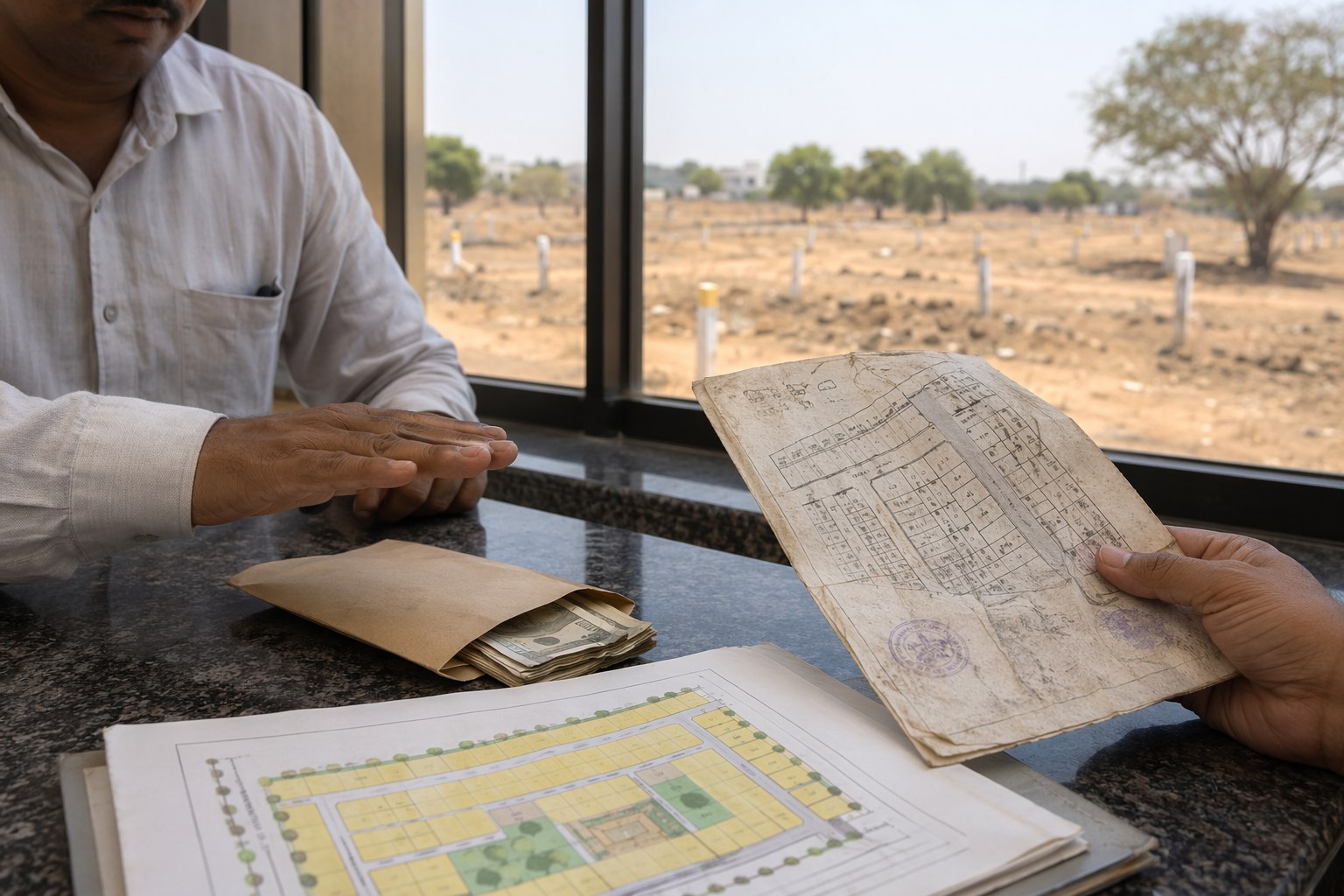
The turning point came when we compared three items side by side: old approved layout plan, sale deed schedule, and ground sketch shared by the broker.
| Document Checked | What It Should Confirm | What We Saw |
|---|---|---|
| Old layout approval plan | Approved plot number, roads, open space and survey numbers | Approval existed, but Ravi’s plot number was not clearly traceable in the approved sheet |
| Sale deed schedule | Same plot number and boundaries as approved plan | Schedule matched the seller’s private sketch, not the original approved plan neatly |
| EC and link deeds | Clean ownership chain without unexplained jumps | Ownership trail needed deeper review because later documents used altered layout references |
| Ground position | Plot should physically sit inside the approved boundary | On-ground marking appeared to be at the edge of the approved layout area |
| Section 22-A check | No registration prohibition affecting the survey number | No instant comfort was taken; SRO-level confirmation was still advised |
This is the exact stage where many buyers make a bad decision. They say, “Registration happened before, so what is the problem?” But old registrations do not automatically cure layout irregularities. If the plot itself is outside the sanctioned layout, future resale, building permission, bank loan, road access, drainage approval and municipal permissions can become painful.
Old Layout Approval vs LRS vs Registered Sale Deed
One of the biggest confusions in Telangana plot buying is mixing up three different things: layout approval, LRS and registered ownership.
A registered sale deed proves that a transaction was registered. It does not by itself prove that the layout was planned and approved correctly.
LRS, where applicable and valid, is a regularisation route for certain unapproved layouts or plots. But a mere application, receipt or old discussion about LRS should not be treated as final approval.
An old layout approval, when genuine and applicable to the exact plot, is stronger evidence that the land was divided with planned roads and open spaces. But even then, the approved plan must match your plot.
For buyers comparing plot options, the basic workflow should include EC, guideline value, SRO, road width, land use and prohibited property checks. Useful starting points are Market Value / Guideline Value Search, Road Width Check, Land Use Zone Finder and Stamp Duty Calculator.
How the Old Layout Approval Saved Ravi’s Token Money
After the mismatch was flagged, Ravi asked the seller for one simple thing: a certified copy or clearer authority record proving that the offered plot number was part of the approved layout. He also asked for a written clarification on the changed numbering and boundary position.
The seller became uncomfortable. The broker first said the documents were “standard”. Then he said the old file was with another family member. Then he suggested that Ravi pay token first and verify later.
That was enough.
Ravi did not pay token money. He stepped back from that plot. A few weeks later, he shortlisted another plot in the same broad belt, but this time the approved plan, plot number, survey number and sale deed schedule matched properly. The price discussion was slower, but the file was cleaner. That is how property buying should work. First verify, then negotiate hard, then pay.
In Hyderabad outskirts, buyers often behave as if a good plot will vanish in one day. Good plots do move fast in areas like Mokila, Shankarpally, Kollur, Tellapur, Tukkuguda, Adibatla and Ghatkesar. Still, a risky file does not become safe because there is urgency. Urgency is exactly why verification must happen before token.
What Buyers Should Ask When Someone Shows an Old Layout Approval
If a seller says “old approved layout”, don’t reject it blindly. Some old approvals are perfectly valid and valuable. But ask proper questions.
1. Who approved the layout?
Was it gram panchayat, DTCP, HMDA or another competent authority for that time and place? The answer depends on the year, village, mandal and jurisdiction. Do not accept only a broker’s statement.
2. Is there a proceedings number?
A layout plan without proceedings or sanction reference is weak. You need the approval reference, date, authority and the plan sheet that carries the relevant seal or signature.
3. Do the survey numbers match?
Survey number mismatch is a major red flag. The sale deed, link deeds, pahani history, layout approval and ground location must speak the same language. If sub-division numbers are involved, check them carefully.
4. Is your plot number visible in the approved plan?
Not “nearby”. Not “same venture”. Your exact plot number should be identifiable. If renumbering happened, ask for documentary support.
5. Are roads and open spaces intact?
Some old layouts lose their original road pattern on ground. A road shown in approval may be narrower on site. Open space may be encroached. For future building permission, access and resale, this can matter a lot.
6. Is the land hit by Section 22-A or other restriction?
Before token, run a prohibited property check and take SRO-level confirmation where needed. With 3,076,153 prohibited property entries in the current database context, this is not a formality.
Our Practical Opinion on Old Layout Approval Files
Old layout approval is not a problem by itself. In fact, a genuine old approved layout in a good Hyderabad belt can be a strong purchase, especially where the roads are formed, houses exist, and the document chain is clean.
The problem starts when sellers use one genuine old approval to sell plots that are not actually inside that approval. This is more common at layout edges, extension portions, corner lands, leftover agricultural strips and areas where private sketches were made after the original sanction.
We tell buyers to avoid emotional decisions on plots. Villas and flats have glossy brochures. Plots have dusty files. The file is the product. Read it like one.
If the file has old Telugu revenue terms, use Telugu-English Property Terms Dictionary. If the area is mentioned in guntas, square yards or acres across different documents, use Area Unit Converter. If you are planning construction later, tools like FSI/FAR Calculator and OSR Calculator can help you understand planning constraints at a basic level.
Old Layout Approval Checklist Before Paying Token
Before you transfer even a small token amount, keep this checklist ready:
- Get the complete sale deed chain, not only the latest deed.
- Collect the old layout approval proceedings and approved plan.
- Match plot number, survey number, village and mandal across all papers.
- Check EC for the relevant period and review unexplained transactions.
- Verify whether the survey number appears in any prohibited property list.
- Check the concerned SRO and village jurisdiction.
- Confirm land use and road access before assuming future construction is easy.
- Do not rely only on WhatsApp photos of documents.
- Do not pay token if the seller refuses basic file clarification.
For Ravi, this checklist saved him from a doubtful plot. For another buyer, the same checklist may confirm that the plot is genuine and worth negotiating. Verification is not meant to kill every deal. It is meant to separate a buyable file from a risky one.
Final Takeaway: Old Layout Approval Can Protect You, If You Read It Properly
The old layout approval saved Ravi because it forced the deal to answer one hard question: is this exact plot part of the sanctioned layout or not?
That question should be asked in every Hyderabad outskirts plot deal, whether it is in Shankarpally, Mokila, Moinabad, Maheshwaram, Adibatla, Tukkuguda, Ghatkesar, Medchal or any fast-growing mandal. A registered deed, a friendly broker and a neat site visit are not enough. The plot must stand up on paper.
Our advice is simple: before token, verify the old approval, EC, SRO jurisdiction, survey number, land use and Section 22-A status. If the seller is genuine, he will cooperate. If he creates pressure, that pressure itself is information.
Frequently Asked Questions
What is old layout approval in Telangana plot buying?
Old layout approval is a past sanction given by the competent authority for dividing land into plots with roads, open space and plot numbers. Buyers must verify whether their exact plot appears in that approved plan.
Is a registered sale deed enough for buying a plot near Hyderabad?
No. A registered sale deed proves registration of a transaction, but it does not automatically prove that the layout is approved, the plot is inside the sanctioned boundary, or the land is free from restrictions.
How do I check if my plot is part of an approved old layout?
Compare the approved layout plan, proceedings number, survey numbers, plot number, sale deed schedule and ground location. If there is renumbering or boundary confusion, ask for certified records or legal verification before paying token.
Why is Section 22-A check needed for an approved layout plot?
Even if a layout approval exists, the underlying survey number may still face registration restrictions in some cases. Telangana prohibited property records contain 3,076,153 entries in the current database context, so checking before token is sensible.
Should I pay token money before document verification?
In our opinion, no. Pay token only after checking the sale deed chain, EC, layout approval, survey number, SRO jurisdiction, land use and prohibited property status. Pressure to pay first and verify later is a warning sign.