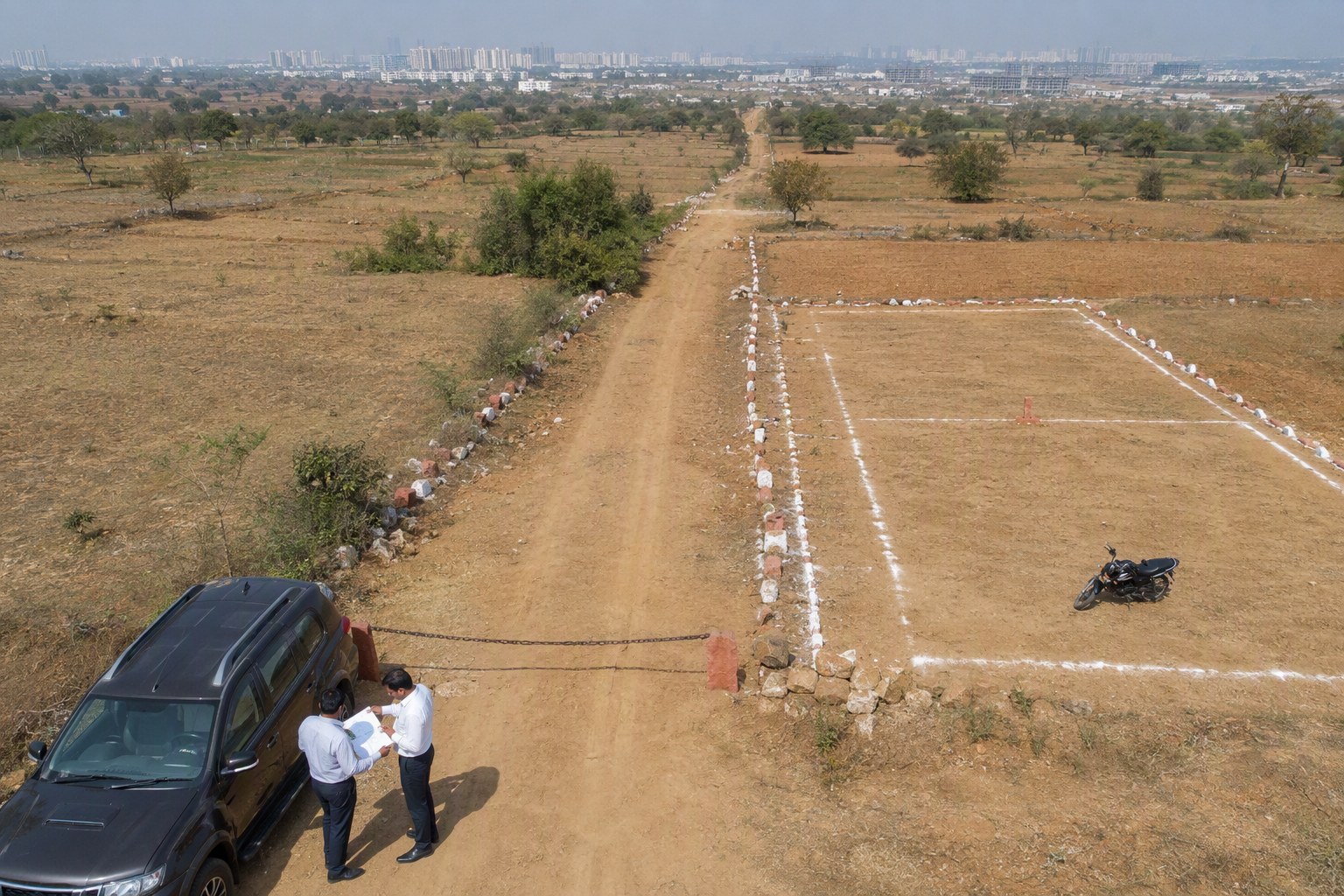
Case Study: Can a Passbook Gap Delay Your Plot Resale?
Can a passbook gap delay your plot resale? Yes, it can. In many Hyderabad and peri-urban Telangana plot transactions, a missing or mismatched pattadar passbook entry may not kill the deal outright, but it can slow down token advance, agreement drafting, loan processing, and registration planning. The buyer will usually ask for the Encumbrance Certificate, Dharani record, pahani history, Section 22-A check, SRO trail, and sometimes even old revenue mutation papers before releasing serious money.
We have seen this pattern in Kollur, Mokila, Shankarpally, Adibatla, Tukkuguda, Shamirpet, Ghatkesar and Maheshwaram side transactions. The plot may be physically clean. The layout may be known locally. The seller may have an old registered sale deed. Still, if the passbook chain has a gap, the buyer’s advocate will pause. That pause is not always a rejection. It is a verification stage.
My view is simple: a passbook gap is not the same as defective title. But in Telangana, it is enough to trigger deeper checks before token money moves.
What is a passbook gap in plot resale?
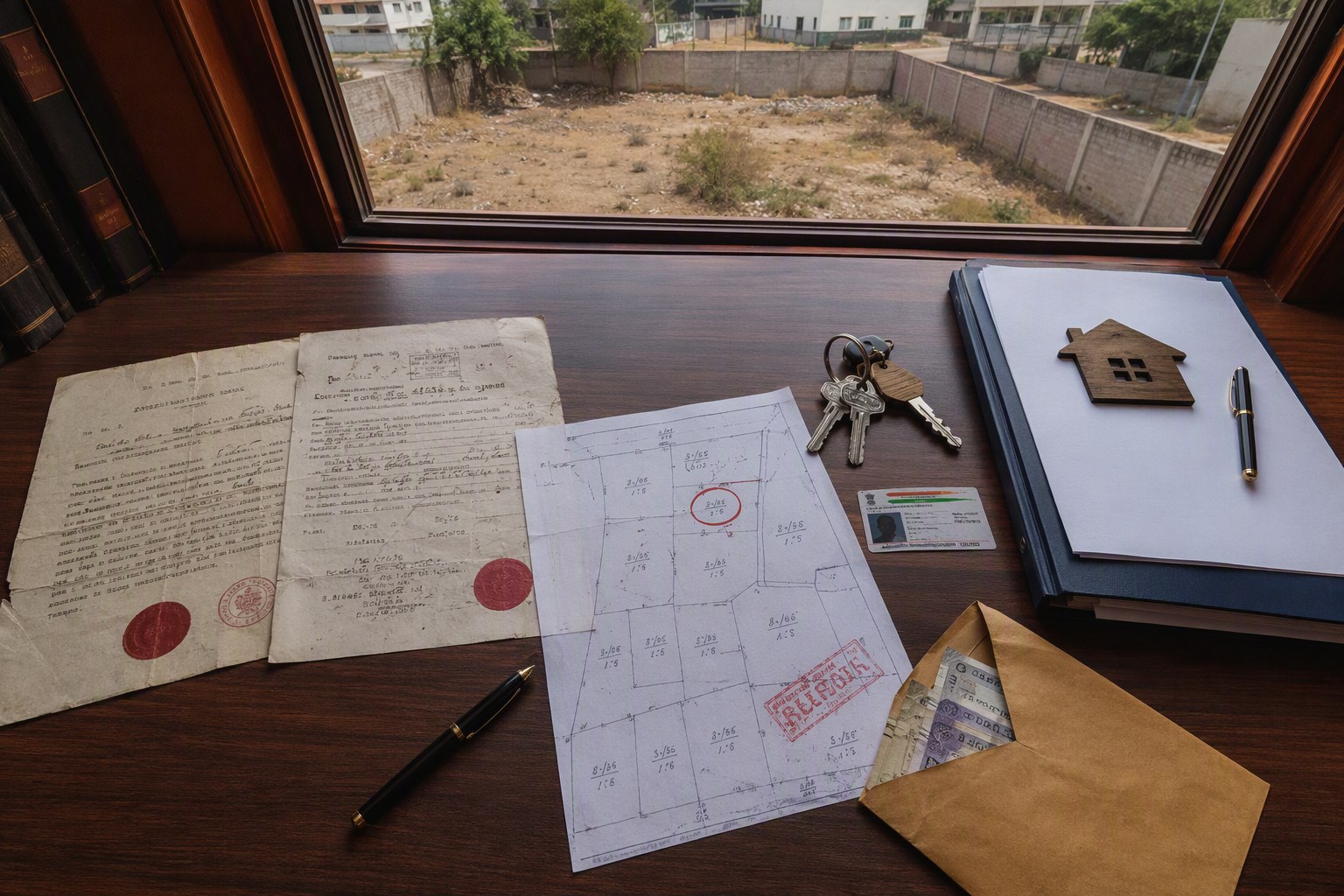
A passbook gap usually means the seller’s revenue record does not fully match the registered document chain. In Telangana, buyers commonly compare three things: registered sale deeds from the SRO, Dharani pattadar passbook details, and village revenue records such as pahani or old mutation references. If one of these is missing, delayed, wrongly updated, or showing an older owner, people call it a passbook gap.
For agricultural land converted into plots, this is more common than many buyers expect. Before layout development, the land may have passed through family partition, gift deed, sale deed, GPA-linked transaction, mutation, conversion, and layout approval stages. If the passbook was not updated at one step, the current seller may hold a registered document but may not have a clean matching revenue trail.
In practical Hyderabad market language, a buyer asks: “Sir, deed is there, but passbook lo name enduku ledhu?” That one question can delay the token.
Case study: passbook gap delay in a west Hyderabad plot resale
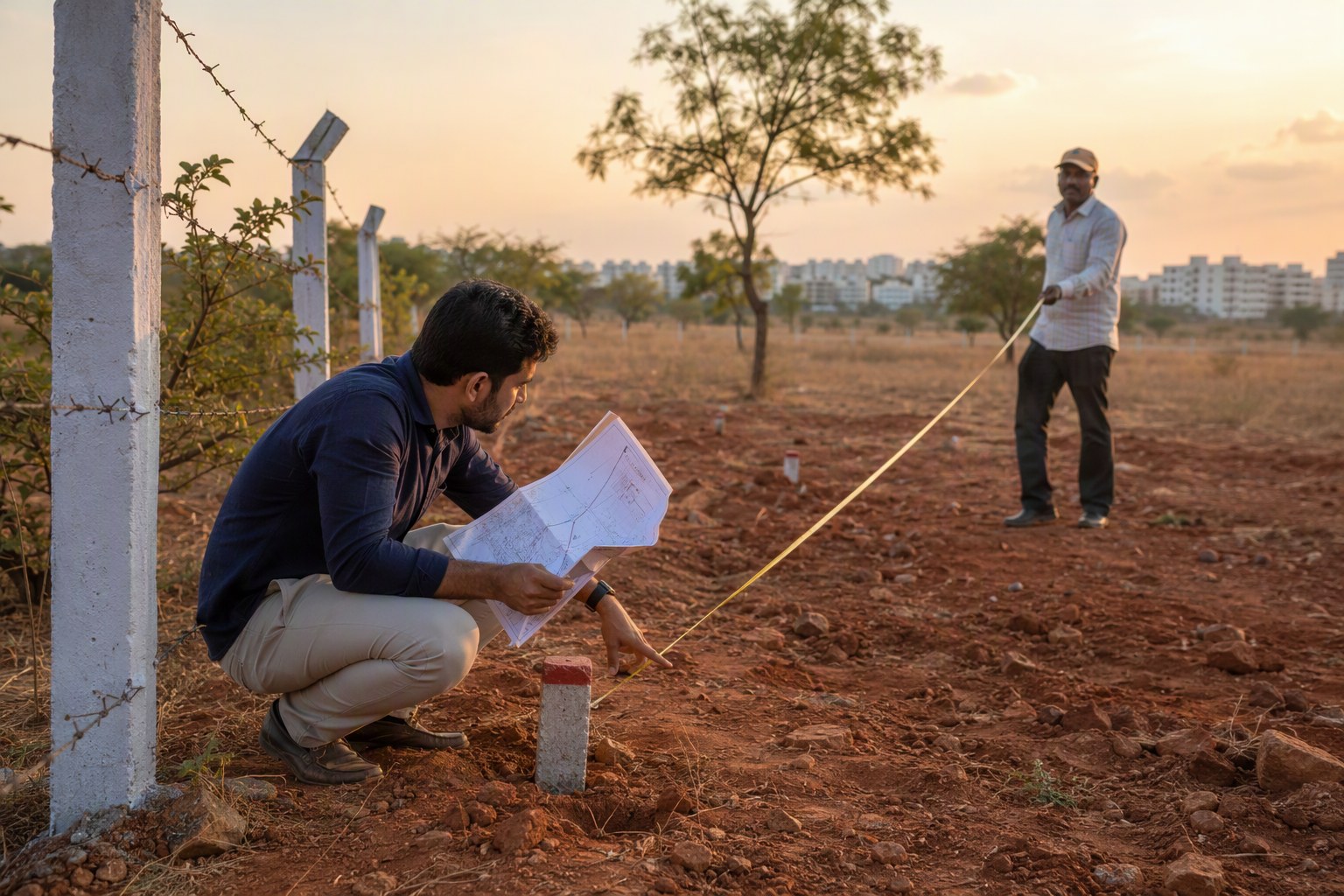
Let us take a real-world style case based on the type of files we review regularly. The plot was near the Mokila-Shankarpally belt, an area where many families bought land early and are now reselling plots after surrounding development improved. The seller had a registered sale deed. The plot boundaries matched the old layout sketch. Local enquiries were also positive.
But when the buyer’s side checked revenue records, the passbook did not reflect the seller’s name cleanly. The old pattadar name appeared in one revenue reference, while the seller’s registered sale deed showed a later purchase. The buyer was ready with token money but did not release it immediately. Instead, he asked for:
- Latest Encumbrance Certificate from the relevant SRO period
- Dharani ownership snapshot, where applicable
- Old pahani or mutation trail
- Section 22-A prohibited property check
- Layout approval copy and plot schedule matching
- Seller identity and link document verification
This is exactly where sellers get irritated. They feel the buyer is over-checking. In our experience, a serious buyer is not wasting time here. He is protecting his money. Once token is paid, backing out becomes messy. If the passbook gap later connects to government land, assigned land, ceiling land, disputed inheritance, or wrong survey number, the buyer may get stuck.
Why buyers check EC when there is a passbook gap
The Encumbrance Certificate, or EC, is usually the first formal check after a passbook mismatch. It shows registered transactions in the SRO records for the property description searched. A clean EC does not solve every revenue issue, but it gives the buyer confidence that the document chain has not been silently burdened by sale, mortgage, attachment, or other registered entries.
For Hyderabad outskirts, EC search must be done carefully. The survey number, plot number, village, mandal, SRO and document numbers should be aligned. A mistake in village name or SRO selection can produce a weak EC. For example, a buyer looking at a plot near Adibatla should not casually assume the same process as a flat in Gachibowli. Village-level land identification matters much more in plot files.
You can start with our Encumbrance Certificate Search and then use the EC Analyzer to read the transaction trail more sensibly. I still suggest human legal review for high-value resale plots, especially where the passbook chain is not clean.
Passbook gap and Section 22-A: why this check cannot be skipped
Section 22-A is one of the biggest fear points in Telangana land transactions. Properties notified under prohibited categories may face registration restrictions. According to government records in our database, Telangana has 3,076,153 prohibited property records under Section 22-A. That number alone explains why careful buyers are not willing to depend only on verbal assurances.
A passbook gap can make buyers ask a simple question: is this land missing from the passbook because of a normal mutation delay, or because it has some restriction? The answer needs record checking, not guesswork.
Use the Section 22-A Prohibited Property Check before taking or giving token. If the property is clear, good. If a matching or similar survey entry appears, do not panic immediately. Verify survey number, extent, village, mandal, nature of prohibition and whether the plotted area is actually affected. Many issues need document-level reading.
Can a passbook gap delay your plot resale even when the EC is clean?
Yes. A clean EC and a passbook gap can exist together. EC is based on registered transactions. Passbook and pahani records belong to revenue administration. Both systems talk about property, but they do not always update at the same speed or in the same language.
Suppose the seller bought the land through a registered deed years ago, but mutation was not completed. The EC may show the sale deed. The passbook may still show an earlier pattadar. In that case, the title may still be explainable, but the buyer will ask for supporting papers.
Now take another situation. A family partition happened, but the plot sale deed was later executed by only one family member. The passbook may show a broader family name or old ancestor reference. Here the buyer will want legal heir documents, partition deed, consent deeds or release deeds. The issue is no longer just clerical.
That is why we tell sellers: do not argue emotionally. Build the file logically.
Documents buyers usually ask before paying token money
When a passbook gap appears, the buyer’s advocate normally widens the checklist. The exact list changes from file to file, but these are common:
| Document or check | Why it matters |
|---|---|
| Registered sale deed | Shows how the seller acquired rights in the property |
| Link documents | Helps trace title from previous owners |
| EC from SRO records | Checks registered transactions and encumbrances |
| Dharani or passbook record | Shows revenue ownership status where applicable |
| Pahani or old revenue entries | Useful for agricultural land history and survey continuity |
| Section 22-A check | Identifies prohibited property risk |
| Layout approval copy | Confirms whether plotted development has formal backing |
| Survey number confirmation | Prevents wrong-land and boundary mistakes |
| SRO jurisdiction check | Ensures documents are searched in the right registration office |
For survey-related confusion, use the Survey Number Finder. For registration-office mapping, check Find Your SRO Office. If you want a broader first-pass review, use our Property Verification Tool.
How the buyer thinks when a passbook gap appears
Most sellers assume buyers only look at price. That is not true, particularly for plots. Buyers look at three risks: title risk, registration risk and resale risk. If there is a passbook gap today, the buyer asks whether he will face the same question when he resells five or ten years later.
In localities like Narsingi, Kokapet, Tellapur and Gachibowli, apartment buyers often depend on RERA, builder approvals and bank legal checks. Plot buyers in Shankarpally, Kandukur, Ibrahimpatnam, Shamirpet, Medchal and Chevella mandals behave differently. They want land-level clarity. They may ask neighbours, village-level contacts, revenue consultants, document writers and advocates before taking a call.
Token money gets delayed because the buyer does not want to negotiate first and verify later. That is a sensible approach. Once a seller accepts token, both parties start behaving as if the deal is fixed. If a defect comes out later, tempers rise.
How sellers can handle a passbook gap before listing the plot
If you are planning to sell a plot and already know there is a passbook mismatch, do not wait for the buyer to find it. Prepare an explanation file. A calm seller with papers gets more respect than a loud seller with excuses.
- Take latest EC for the correct property description.
- Collect all link documents in chronological order.
- Check Section 22-A status before marketing the plot.
- Confirm survey number, village and mandal spelling across records.
- Keep old passbook, pahani, mutation or Dharani references ready if available.
- Show layout approval, LRS/BRS-related papers or regularisation references where relevant.
- Do not hide disputes, family claims or pending revenue applications.
If the plot is in a developed layout, also compare plot number, boundaries and extent with the approved plan. A passbook gap plus layout mismatch is a red flag. A passbook gap with a clean registered chain and clear survey mapping is usually more manageable.
Market value, stamp duty and resale planning during a passbook gap
When resale discussions restart after document checks, buyers and sellers also look at government market value, stamp duty and registration planning. I prefer using official value checks early, because unrealistic expectations create unnecessary fights later. You can use the Market Value / Guideline Value Search and Stamp Duty Calculator for initial planning.
I am not quoting locality-wise rupee rates here because rates change street by street, survey by survey and approval type by approval type. A plotted venture near a wide road in Mokila cannot be treated the same as an interior agricultural conversion parcel in another village. Ready reckoner value, market asking price and bank comfort can all differ.
For sellers, the lesson is this: a passbook gap can affect timing more than pricing. The buyer may still agree to your expected price if the title explanation is strong. But he may not pay token until his advocate signs off.
When a passbook gap becomes serious
Not every passbook gap is dangerous. Some are old mutation delays. Some are spelling differences. Some are caused by village reorganisation, survey subdivision or old manual record issues. But a few situations need caution.
- The seller cannot produce link documents.
- The EC does not show the claimed acquisition deed.
- The survey number appears in Section 22-A records.
- The land extent in sale deed and revenue records is inconsistent without explanation.
- There are family members claiming share but not signing.
- The plot is carved from land without proper layout support.
- The seller asks for large cash token before giving documents.
In these cases, do not treat the passbook gap as a small clerical issue. Pause the transaction. Ask for written clarification. If the seller is genuine, he will usually cooperate. If he becomes aggressive when you ask for EC, 22-A and link documents, that itself tells you something.
Can a passbook gap delay your plot resale in HMDA and DTCP layouts?
Yes, but the nature of the delay changes. In an approved layout, buyers may feel more comfortable because the plotting process has already passed through some scrutiny. Still, approval is not a magic shield against every title issue. If the underlying land title had a gap, the buyer may still ask for parent documents and revenue history.
For HMDA and DTCP layout plots, check whether the plot schedule in your sale deed matches the layout plan. Verify open spaces, road width and land use if there is any doubt. Tools like Road Width Check and Land Use Zone Finder are useful for early screening, especially near growth corridors where land use changes are common.
If the property is part of a RERA-registered plotted development, use RERA Project Lookup. RERA does not replace title due diligence, but it gives another layer of project-level information.
Practical answer: will the resale fail?
A passbook gap alone does not automatically fail a plot resale. The deal usually depends on the explanation. If the seller has a registered deed, clean EC, proper link documents, no Section 22-A issue, correct survey identity and a reasonable revenue-record explanation, many buyers proceed. They may ask for an indemnity clause or extra document support in the agreement.
But if the passbook gap exposes a deeper problem, the resale can fail. No sensible buyer wants to inherit a revenue dispute. Banks also may hesitate if land identity is unclear. Even cash buyers are now more cautious because future resale and registration restrictions matter.
My advice to sellers is straightforward: solve what you can before marketing. My advice to buyers is equally clear: do not pay token first and verify later. In Telangana plot transactions, token discipline saves lakhs of rupees and months of stress.
Verified.RealEstate view on passbook gap delay
Hyderabad’s plot market has matured. Buyers in Kondapur or Manikonda may talk carpet area and UDS. Buyers in Shankarpally, Maheshwaram, Yacharam, Keesara or Medchal still ask about survey number, pahani, passbook and SRO history. That is not old-fashioned. That is land due diligence.
A passbook gap is a yellow signal, not always a red signal. Slow down, verify, and then move. If records support the seller’s title, the transaction can go through. If the records are weak, walking away is also a good business decision.
Frequently Asked Questions
Can a passbook gap delay your plot resale in Telangana?
Yes. It can delay token payment, agreement drafting and registration planning because buyers usually ask for EC, Section 22-A, Dharani, pahani and link-document checks before proceeding.
Does a passbook gap mean the title is defective?
Not always. It may be a mutation delay, spelling issue or old revenue-record mismatch. But it must be explained with registered documents and supporting revenue records.
Should I pay token money before checking Section 22-A?
No. Check Section 22-A status before paying token, especially for plots linked to survey numbers in Hyderabad outskirts and Telangana growth corridors.
Is a clean EC enough to ignore a passbook gap?
No. EC shows registered transactions, while passbook and pahani records relate to revenue entries. Both need to be read together for land and plot transactions.
What should a seller do before listing a plot with a passbook mismatch?
Prepare the EC, link documents, Dharani or passbook references, pahani records, layout papers, survey confirmation and Section 22-A check before showing the file to buyers.