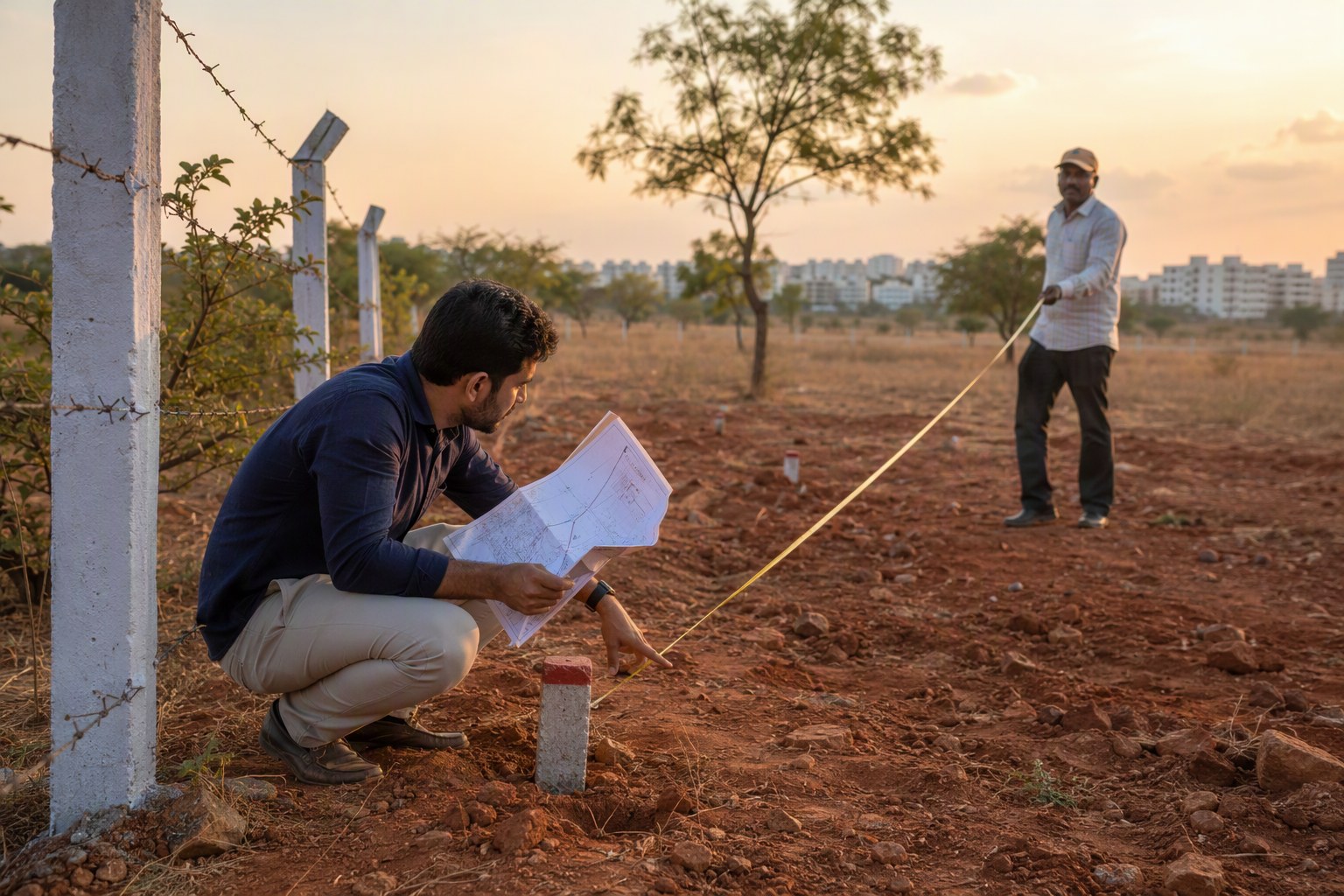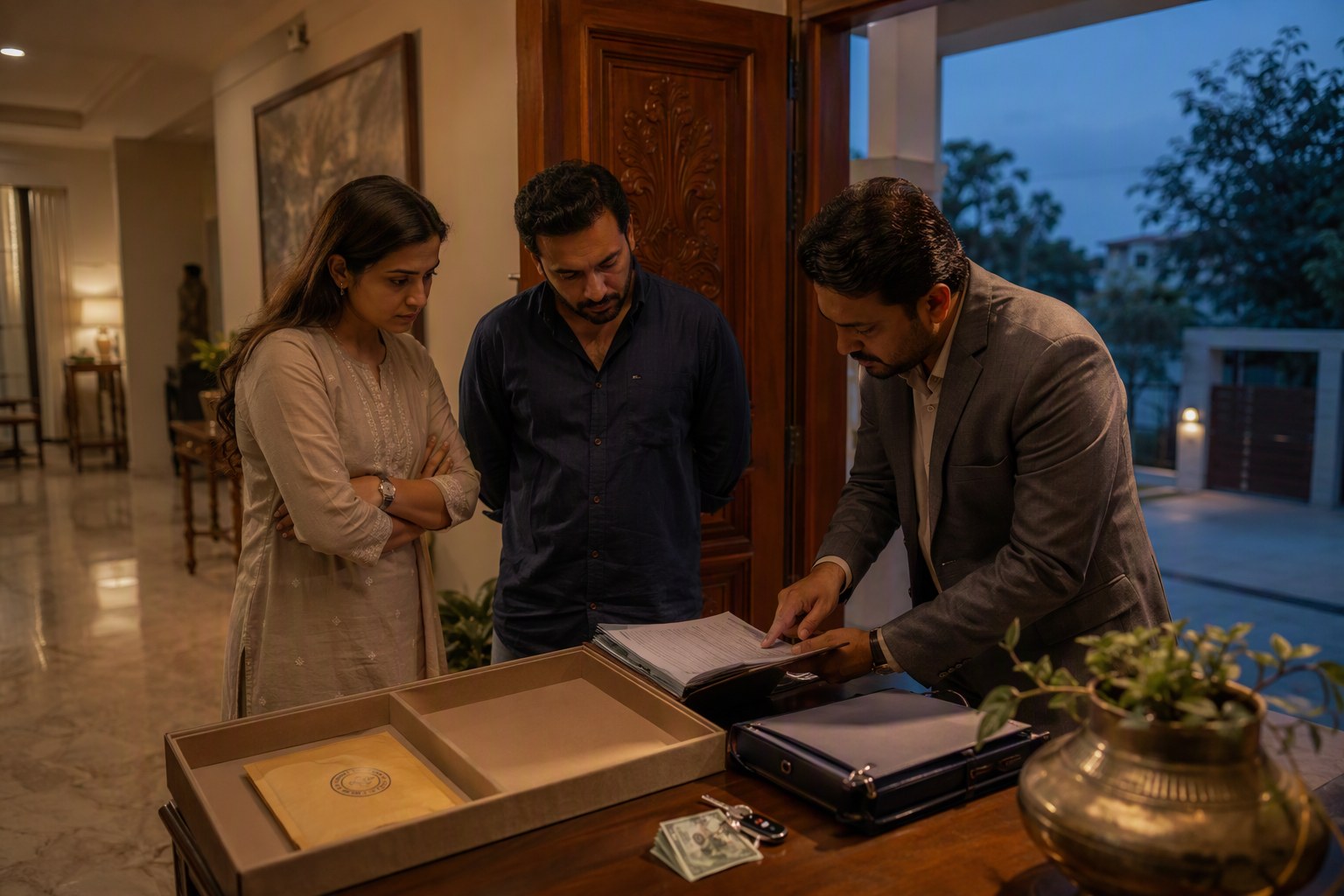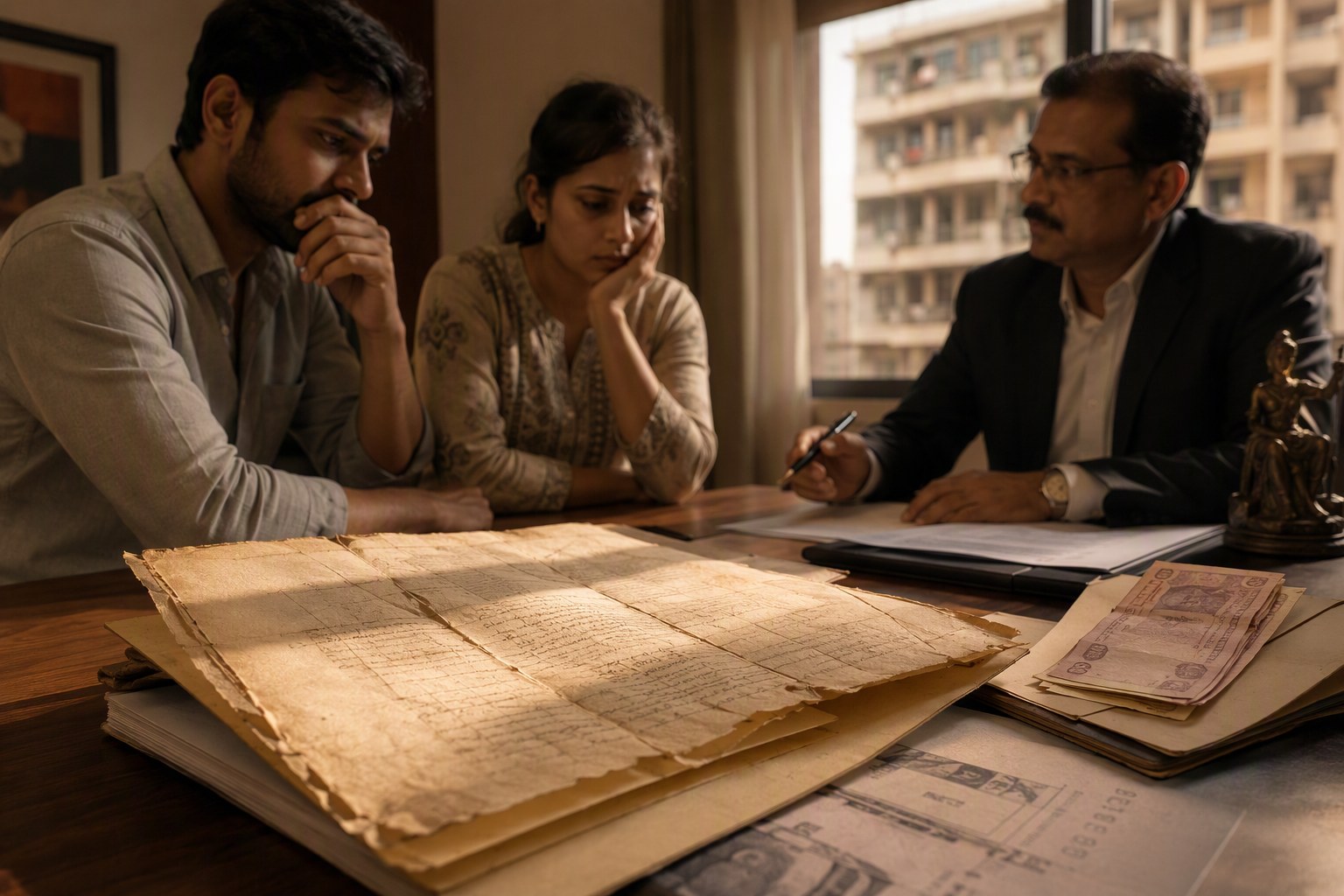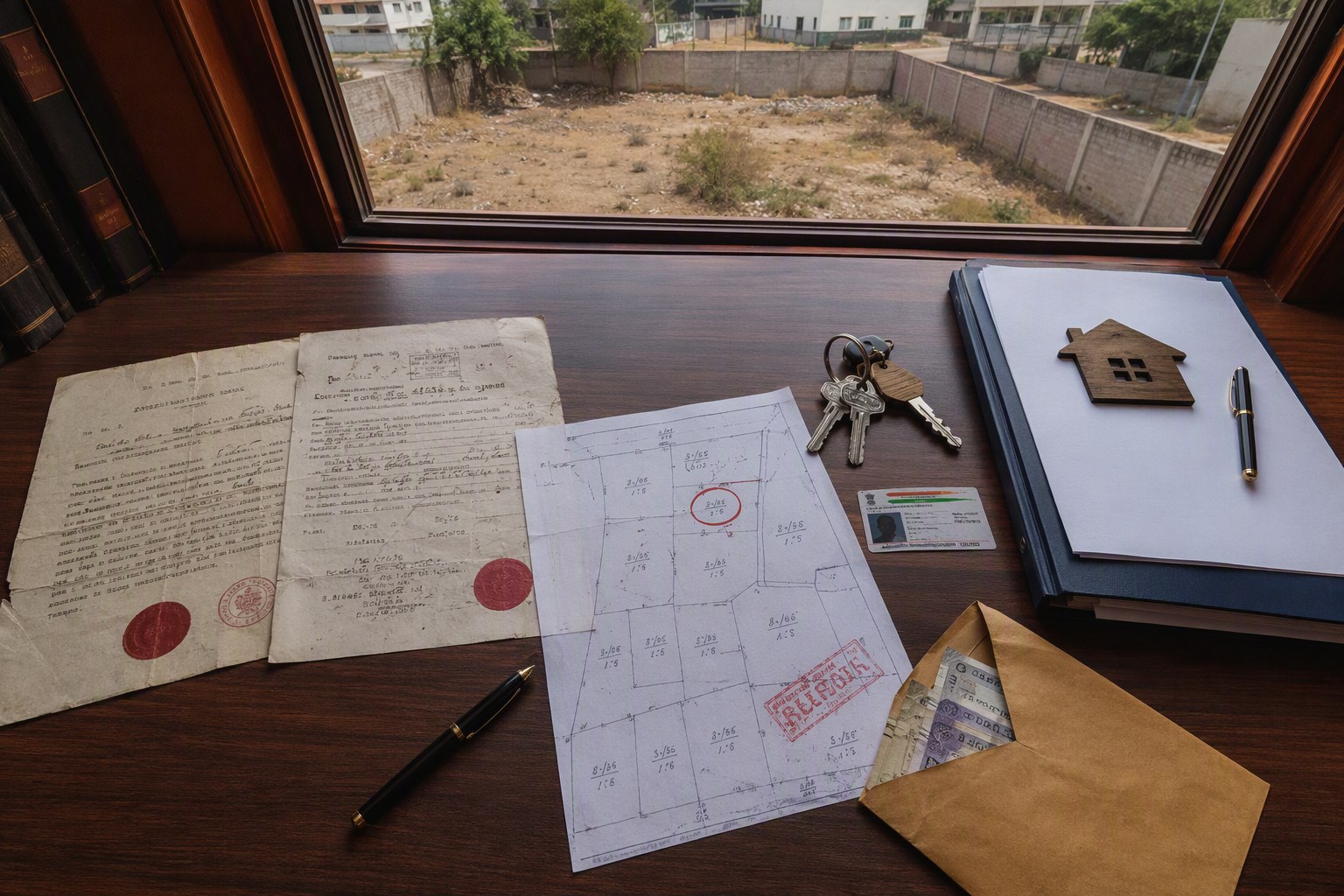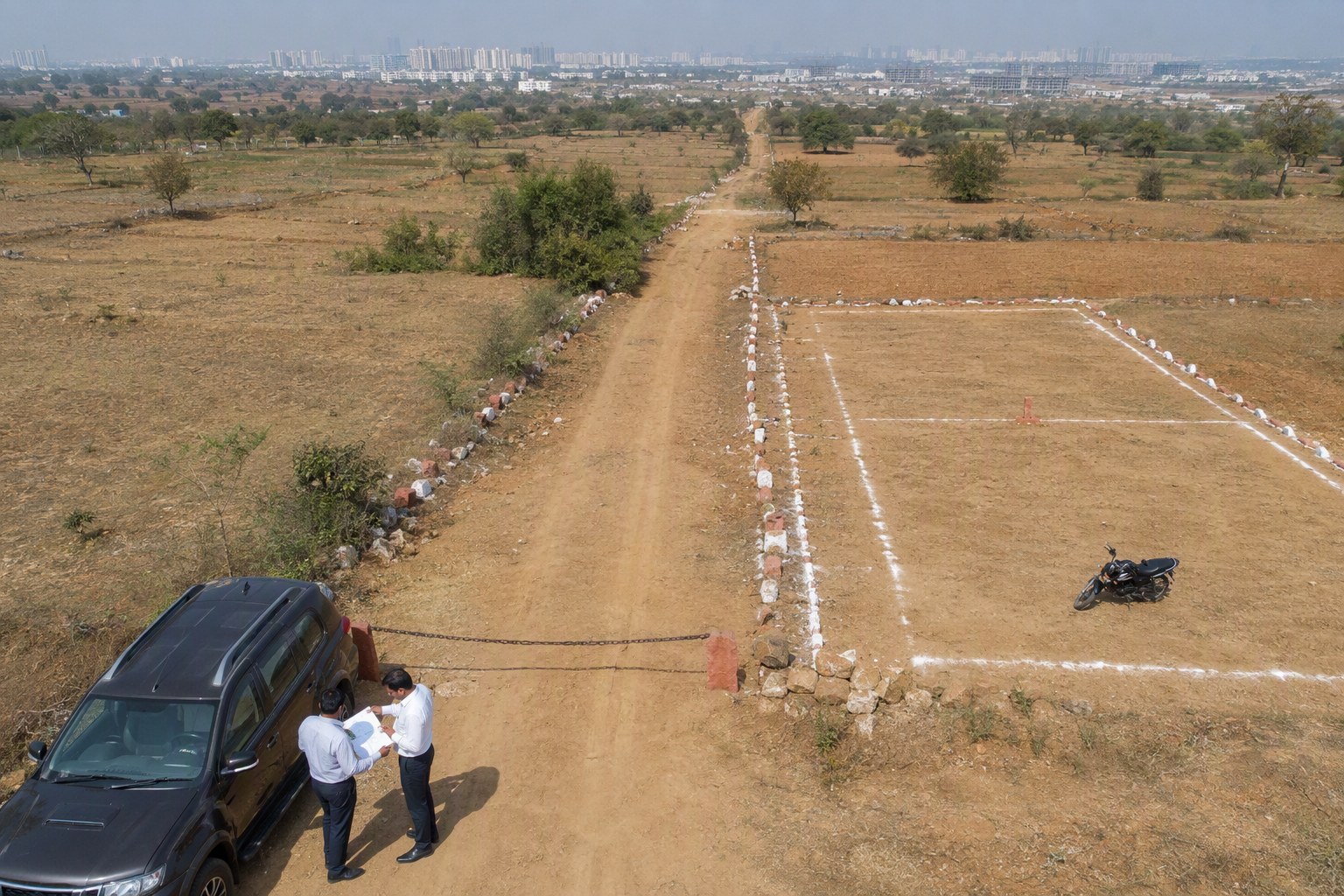
Same Survey Number does not always mean same risk. In Telangana land buying, two buyers can look at the same survey number in the same village and still end up with completely different outcomes. One buyer may see a pahani, Aadhaar-linked seller, old sale deed copies and a plotted layout sketch, then pay token. Another buyer may pause, check the Encumbrance Certificate, match the survey number with Dharani entries, check the SRO trail, and search the Section 22-A prohibited properties list before giving even one rupee.
We have seen this gap many times around Hyderabad growth corridors like Mokila in Shankarpally mandal, Tellapur near Ramachandrapuram, Patancheru, Maheshwaram, Shamirpet and the Adibatla belt. The land may look clean on paper at first glance. The real problem usually starts when the buyer treats a survey number as a simple address, not as a title-history container.
In Telangana, a survey number is not just a location marker. It is where title, sub-division, extent, classification, pattadar history, court disputes, government restrictions and registration eligibility can all meet.
Same Survey Number: Buyer A vs Buyer B in a Hyderabad Land Deal
Let us take an anonymised comparison from the type of land checks we regularly see in the Hyderabad outskirts. Both buyers are looking at land linked to the same survey number in a revenue village near the western corridor. The exact village name is not the point here; similar issues come up in Mokila, Kollur, Velimela, Nandigama, Kandukur, Shamirpet and Maheshwaram side also.
The seller’s broker says the land is clear. He shares a sale deed copy, pattadar passbook extract, a recent pahani screenshot and a location pin. The price is attractive compared with nearby ventures. The broker says another party is ready, so token must be paid quickly. This is where the two buyers take different routes.
| Check Point | Buyer A: Basic Paper Reliance | Buyer B: Verification Before Token |
|---|---|---|
| Survey number | Accepts the survey number written in the old deed and broker note | Cross-checks survey number, sub-division and extent using Survey Number Finder |
| EC | Does not pull fresh EC before token | Uses Encumbrance Certificate Search and reviews transaction trail |
| Section 22-A | Assumes registration is possible because nearby plots were sold | Runs Section 22-A Prohibited Property Check |
| SRO jurisdiction | Depends on broker’s statement | Confirms correct registration office through Find Your SRO Office |
| Token payment | Pays first, verifies later | Verifies first, negotiates later |
Buyer A is not careless in the usual sense. He asks for documents, calls a known deed writer and sees the land physically. Many Hyderabad buyers do exactly this. But in our experience, the risk is not in the visible land. The risk is in what is missing from the set of documents shown before token.
Buyer B behaves differently. He treats the token as a legal and emotional trap. Once money is paid, pressure starts from both sides: seller asks for balance, family says do not lose the deal, broker says documents can be adjusted, and the buyer’s own ego says he has already committed. That is why Buyer B finishes the red-flag checks first.
Same Survey Number Can Have Different Title Layers
A single survey number can cover a large original land extent. Over time, it may be divided among family members, sold in pieces, converted into plots, affected by acquisition, assigned to weaker sections, classified as government land, marked as endowment land, or partly placed under a prohibited category. The land on the ground may still be open and fenced, but the official title story may be complicated.
This is very common in the old village belts around Hyderabad. A survey number in Shankarpally mandal may have old agricultural entries, later family partitions and recent plot sales. A survey number in Maheshwaram mandal may be close to industrial or airport-growth influence. A survey number near Patancheru may have both agricultural and plotted development pressure. The buyer must not assume that all extents inside the same survey number carry the same legal status.
There is another practical issue. Brokers often say, “Same survey number only, sir, nearby registration happened last month.” That statement is not enough. One part of the survey number may be registerable, while another sub-division or extent may have an objection. One family member’s share may be clean, while another share may be under dispute. A previous sale may have been registered, but that does not automatically make your proposed extent safe.
Same Survey Number and the EC: What Buyer B Found
Buyer B first pulled the Encumbrance Certificate. An EC is not a magic certificate, but it is a strong starting point. It shows registered transactions in the relevant SRO records for the selected property details and period. If the EC does not match the seller’s story, the buyer must slow down immediately.
In this case-type comparison, the EC check raised questions. The seller was showing a family link document and a later mutation-style record. But the EC history showed older transactions involving different extents within the same survey number. Some entries referred to boundaries that did not comfortably match the broker’s sketch. There was also a difference between the extent described orally and the extent visible across the chain documents.
This is where many land buyers get confused. They think an EC should either be “clear” or “not clear”. Real land verification is rarely that simple. You may get an EC with entries, but the question is whether the entries support your seller’s title. You may get a nil EC for a wrong survey input, but that does not prove the land has no past transactions. The quality of the search matters.
For a sharper reading, Buyer B used EC Analyzer to organise names, document references and transaction sequence. Then he compared the EC with the old deed, latest pahani, Dharani details and physical boundaries. This step exposed the core issue: same survey number, but not necessarily the same legally available parcel.
Same Survey Number and Section 22-A: The Check Buyer A Skipped
Section 22-A is one of the most ignored checks in Telangana land buying. It deals with prohibited properties where registration can be restricted for specified categories. The list may include government lands, assigned lands, endowment-related properties and other notified categories depending on the official record.
As per the Verified database context, Telangana Section 22-A prohibited property records stand at 3,076,153. That number alone should make any serious buyer pause before paying token on agricultural land, open plots or unapproved layouts.
Buyer A skipped this check because the seller had a passbook-style document and nearby owners were saying the area is “safe”. Buyer B searched before token. The result did not automatically mean the entire deal was dead, but it showed that the same survey number needed deeper verification with village, mandal, SRO and extent-level clarity.
This is the exact difference between a cautious buyer and a hopeful buyer. Hope is not a title document. A token receipt is not protection. A broker’s confidence is not a government clearance.
Why Basic Papers Are Not Enough for Same Survey Number Land
Basic papers are useful, but they are not the full verification. A seller can show a document set that looks neat and still miss crucial questions. Here is how we usually read such files:
- Sale deed: Check seller title, schedule, boundaries, link documents and whether the deed refers to the correct survey number and extent.
- Pahani: Useful for cultivation and revenue entries, but it is not the final word on marketable title.
- Dharani entry: Helpful for pattadar and land classification checks, but it must be matched with older documents and ground realities.
- EC: Essential for registered transaction history, but search inputs must be accurate.
- Section 22-A check: Mandatory before token, especially in village lands around Hyderabad.
- SRO confirmation: Registration jurisdiction and document trail must match the village and survey details.
- Guideline value: Many people call it ready reckoner rate; in Telangana, check the government market value for stamp duty planning through Market Value / Guideline Value Search.
Buyer A had only a surface-level comfort. Buyer B had a risk map. That is the whole story.
The Token Payment Trap in Same Survey Number Deals
The token is usually small compared with the total deal value, but it changes the buyer’s behaviour. Before token, the buyer asks tough questions. After token, the buyer starts adjusting. We have seen educated buyers make poor decisions at this stage because they do not want to lose face in front of family or friends.
In Hyderabad outskirts, brokers often use urgency. “Another party is waiting.” “Registration slot is available.” “Owner will increase rate.” “Only this bit is left.” Some of these statements may be genuine. Many are pressure tactics. A clean seller will not object to reasonable verification before token, especially when survey number, SRO and prohibited property checks can be done quickly.
Buyer B’s approach was simple: no token until minimum verification. He checked the EC, Section 22-A status, SRO jurisdiction and land identity. He also kept a written checklist, so the discussion did not become emotional. If the seller answered well, he would proceed. If not, he would walk away.
What Happened to the Two Buyers?
Buyer A paid token based on basic papers. Later, when his lawyer asked for EC, link documents and Section 22-A clarity, the seller side became defensive. The broker said these checks are normal after agreement. The buyer then faced the classic problem: either fight for refund, accept risk, or spend time chasing documents that should have been checked earlier.
Buyer B did not pay token immediately. His EC and prohibited property checks raised enough questions to ask for a proper clarification from the seller. He requested updated documents, exact sub-division details and SRO-level confirmation. The seller could either provide clarity or lose a serious buyer. That is a better negotiating position.
Did Buyer B lose a “hot deal”? Maybe. But in Telangana land, the deal you avoid can be as valuable as the property you buy. Especially in areas where land values move on rumours of roads, layouts, IT expansion, pharma activity, regional ring road influence or future zoning changes.
Same Survey Number Checklist Before You Pay Token
If you are looking at land in Hyderabad outskirts, use this order. It is practical and saves arguments later.
1. Confirm the land identity
Do not depend only on the location pin. Match village name, mandal, survey number, sub-division, extent and boundaries. If the land is in a fast-growing belt like Kollur, Mokila, Narsingi side, Shamirpet, Kandukur or Adibatla, identity mistakes can be costly.
2. Pull the EC before token
Use Encumbrance Certificate Search. Check names, dates, document numbers, extents and boundaries. If you cannot understand the EC, get it reviewed before payment.
3. Check Section 22-A
Run Section 22-A Prohibited Property Check. If the survey number appears in a restricted context, do not panic, but do not pay. Ask for written clarification and official verification.
4. Verify SRO and village mapping
Use Find Your SRO Office and confirm where the property documents should be searched or registered. Wrong SRO assumptions create wrong EC comfort.
5. Check market value for stamp duty planning
Before agreement, check the guideline value using Market Value / Guideline Value Search. Then use Stamp Duty Calculator to understand registration cost based on the official value and transaction structure.
6. Use a full verification workflow
If the land is agricultural, inherited, converted, plotted or near a disputed village boundary, run a broader review through Property Verification Tool. For families tracking a property over time, Property Change Tracker is useful because land records can change after mutation, dispute entries or official corrections.
Our Opinion: Same Survey Number Comfort Is Dangerous
Hyderabad buyers are becoming smarter, but land sales are also becoming more packaged. A neat PDF folder, drone video, Google pin and confident broker can make a risky file look premium. My view is clear: if a seller wants token before EC and Section 22-A check, the buyer should slow down.
Good land can wait for verification. Bad land cannot tolerate questions.
The same survey number can produce two buyer outcomes because the buyers are not really buying the same thing. Buyer A is buying a story. Buyer B is buying after testing the story against government records, SRO history and restriction lists. That is the difference.
For Telangana, especially around Hyderabad expansion zones, land verification is not just lawyer work at the end. It is a pre-token discipline. Once you follow it, you start seeing land deals differently. The flashy site visit becomes less important. The document trail becomes the centre.
If you remember only one line from this case study, keep this: same survey number does not mean same title, same registration eligibility, or same risk.
Frequently Asked Questions
Can two plots in the same survey number have different legal status?
Yes. One part may have clean title while another part may have a dispute, government restriction, assignment issue, wrong extent, or unclear family share. Always verify the exact sub-division, extent and boundaries.
Should I check EC before paying token for land in Telangana?
Yes. Pull the EC before token payment. It helps you see registered transaction history and compare it with the seller’s documents. A token paid before EC check weakens your negotiating position.
What is Section 22-A prohibited property check?
It is a check for properties where registration may be restricted under Section 22-A categories. Telangana prohibited property records are large, so this check is essential for land buyers.
Is pahani enough to prove ownership?
No. Pahani is a revenue record and useful for land details, but it is not enough by itself. Match it with sale deeds, link documents, EC, Dharani data, SRO records and prohibited property status.
Which checks should I do first for Hyderabad outskirts land?
Start with survey number identity, EC, Section 22-A status, SRO jurisdiction, Dharani details and guideline value. Do these before token, not after agreement pressure starts.