


Case Study: Patta Passbook Mismatch Delayed a Sale
Can a patta passbook mismatch delay a sale even when the seller has a registered sale deed, EC, tax receipts, and a willing buyer? Yes. We have seen it happen in Telangana, especially around Hyderabad growth corridors like Shankarpally, Mokila, Nandigama, Maheshwaram, Adibatla, Moinabad, Kollur and Tellapur. The reason is simple: land records are not judged by one paper alone. If the patta passbook details do not match pahani, Dharani, survey extent, seller name, nature of land, or the schedule in earlier registered deeds, the buyer, bank, document writer, and sometimes the SRO will pause the transaction.
Answer first: In this case, the plot sale got delayed because the patta passbook showed one version of ownership and extent, while supporting land records showed another. Nothing looked fraudulent at first glance. But the mismatch created enough doubt for the buyer’s lawyer and the bank to ask for rectification before registration.
This is not a rare Hyderabad-side problem. It is a very Telangana problem. Many families have old agricultural land converted into layouts, family partition arrangements, regularisation papers, pahanis with spelling variations, and survey sub-divisions that were never properly aligned across records. When the market is active, everyone wants quick token, quick agreement, quick registration. But land records do not move at WhatsApp speed.
Patta Passbook Mismatch Delayed a Sale: What exactly went wrong?
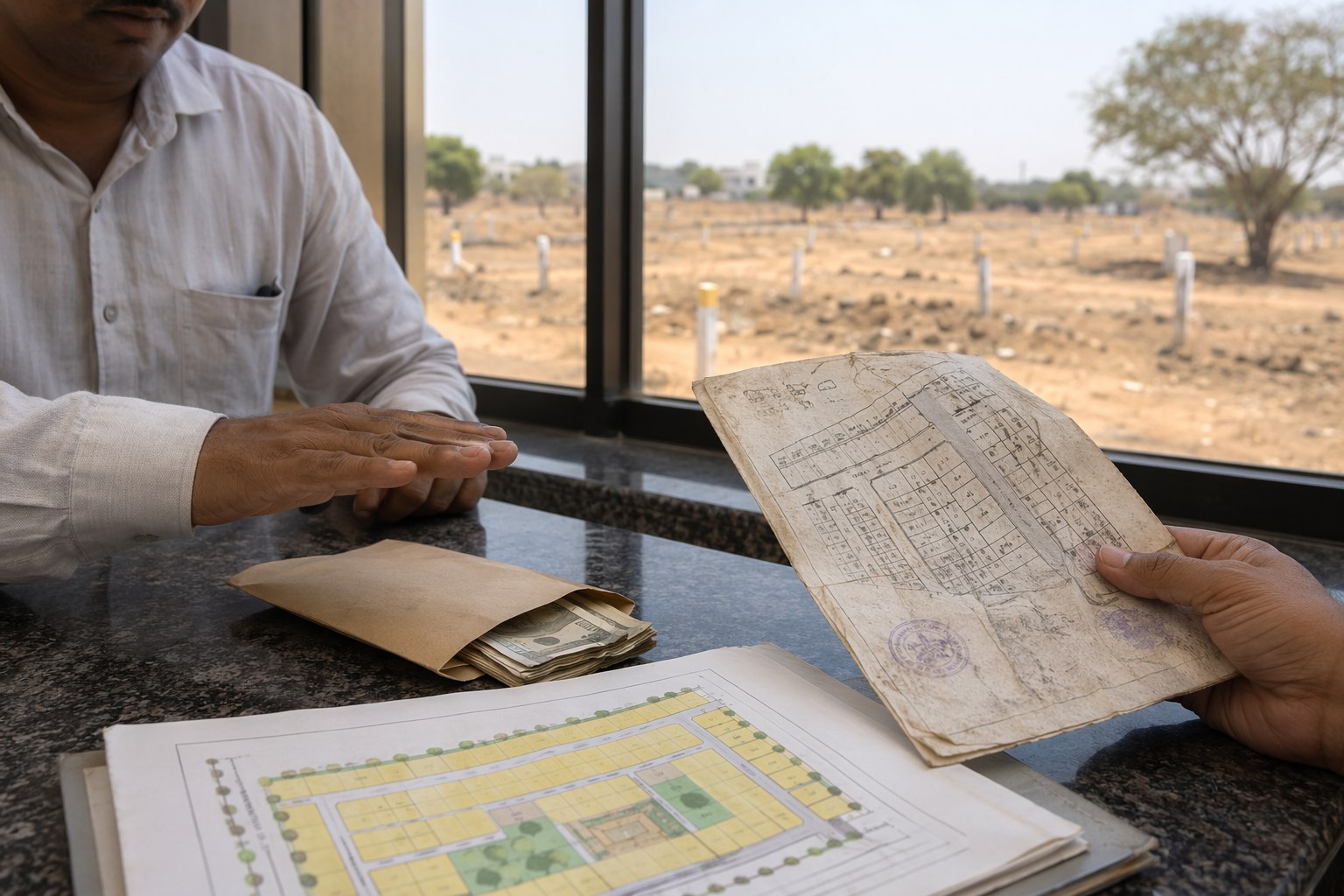
The seller had a plot near a fast-developing western Hyderabad belt. The locality was the kind buyers like: access to ORR-side employment zones, reasonable road connectivity, and demand from families who cannot stretch to prime Tellapur or Gachibowli pricing. The seller’s file looked decent at the first meeting.
- Registered sale deed was available.
- Past link document copies were available.
- EC did not show an obvious mortgage or recent dispute entry.
- Property tax-style local receipts and layout-related papers were in the file.
- The seller had a patta passbook for the parent land.
The buyer paid a small token after a basic document review. The plan was to close the sale quickly. In our experience, this is where many Telangana land deals start becoming risky. The early file may look clean, but the deeper check begins only when you compare every record against the same survey number, village, mandal, extent and owner identity.
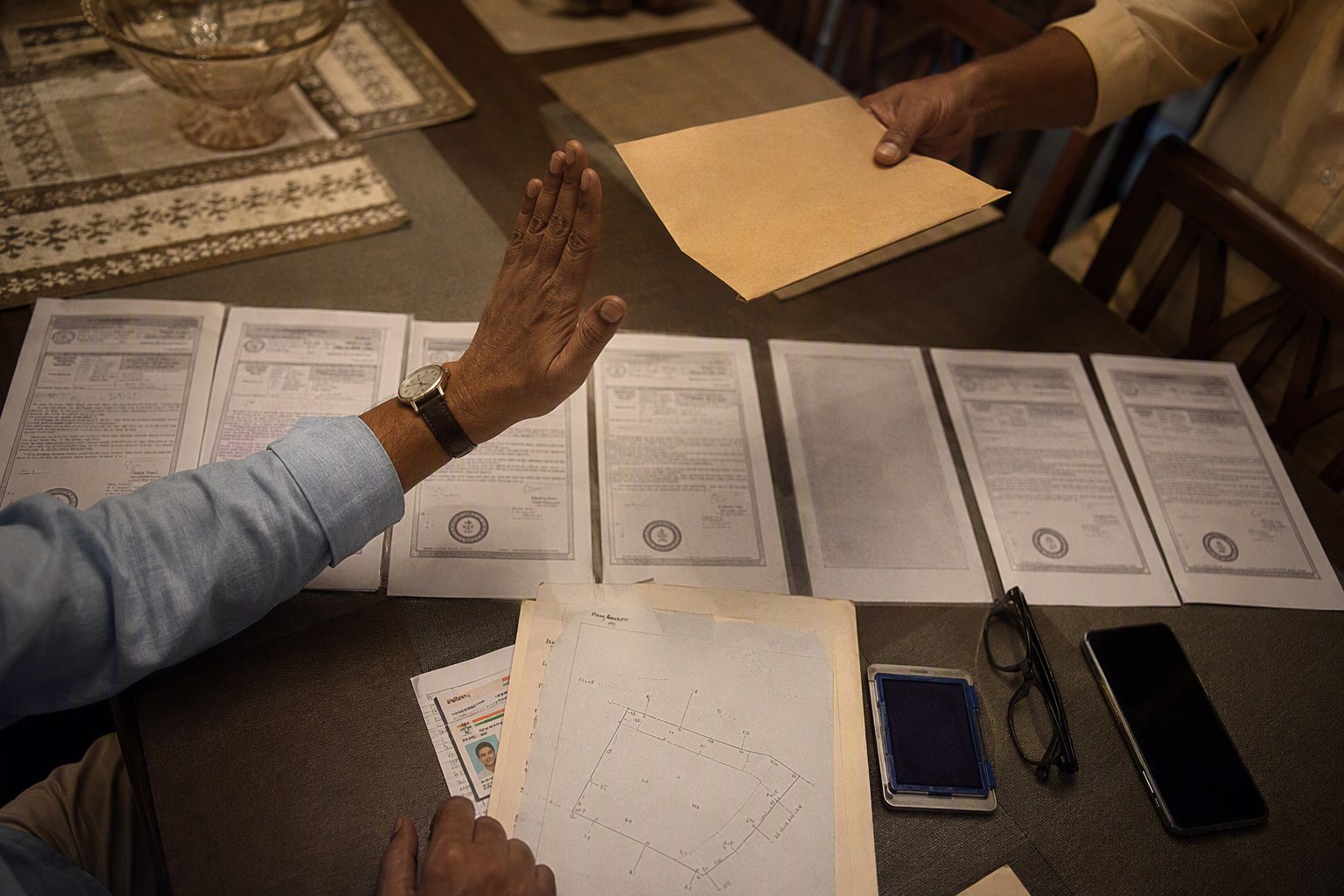
The first red flag came when the buyer’s advocate compared the patta passbook with pahani and Dharani details. The seller’s name appeared, but not in the exact way it appeared in the earlier registered deed. The extent also did not reconcile neatly with the extent mentioned in the layout schedule and the plot schedule. The survey number had a sub-division reference in one record, while another record still reflected a broader parent survey description.
To a lay buyer, this may sound like clerical headache. To a bank legal team, it is a title risk. To an SRO-side document checker, it can become a query. To the buyer, it becomes sleepless nights.
Why a patta passbook mismatch matters in Telangana
A patta passbook is not just a decorative document kept in a plastic folder. It is a revenue record reflecting pattadar details, land extent and related entries. In agricultural land transactions, it carries weight. In plotted land cases, especially where the plot traces its title to a parent agricultural survey number, the passbook can still influence the buyer’s confidence and legal opinion.
But a passbook alone does not prove clean title for a plotted sale. Hyderabad investors often make this mistake. They see a passbook and assume the matter is settled. It is not. The passbook must speak the same language as other records.
Here is what usually has to match:
| Record | What must be checked | Why it matters |
|---|---|---|
| Patta passbook | Pattadar name, survey number, extent, village and mandal | Shows revenue-side ownership record |
| Pahani / Adangal | Cultivation and land possession entries, nature of land, extent | Helps verify whether revenue entries support the claimed title |
| Dharani record | Current pattadar, survey details, land classification | Used widely for Telangana agricultural land verification |
| Registered sale deed | Vendor, purchaser, schedule, boundaries, plot number, survey reference | Primary legal transfer document |
| EC | Registered transactions, mortgages, court attachments if reflected | Shows registration history for the selected period |
| Layout papers | Approval, plot mapping, roads, open space and parent survey linkage | Connects the individual plot to the parent land |
When these records do not align, the buyer’s side will ask: Which record is correct? Was there a mutation pending? Was there a family settlement not registered properly? Was the layout carved out from land where revenue entries were not updated? Is the seller selling more than his actual share? These are uncomfortable questions, but they are better asked before registration than after paying full consideration.
The mismatch was small on paper, big in impact
In this case study, the mismatch was not a dramatic ownership dispute. No stranger came and claimed the property. No court stay was produced. The issue was more ordinary, and that is exactly why it is dangerous.
The patta passbook and related revenue records did not perfectly match the registered title trail. There were differences in name spelling, extent treatment and survey sub-division reference. The seller argued that these were old clerical issues. He was probably not lying. Many land records around peri-urban Hyderabad carry exactly these issues due to older manual entries, family transfers, mutation delays and later digitisation.
But the buyer’s advocate gave a practical opinion: do not proceed until the mismatch is corrected or at least officially explained. The bank took the same line. The sale was delayed.
We have seen similar trouble in mandals where agricultural land has moved into plotted development demand. Shankarpally mandal, Moinabad mandal, Maheshwaram mandal and Nandigama mandal see buyers coming from IT corridors, NRIs, small builders and long-term investors. The land file may pass casual scrutiny, but when a loan-backed buyer enters, documentation has to be tighter.
Patta passbook mismatch delayed a sale even though EC looked clean
A clean EC is useful, but it is not a magic shield. The Encumbrance Certificate reflects registered transactions available in the registration system for the chosen period. It may not solve revenue record mismatches. It may not explain wrong survey mapping. It may not show every ground-level possession issue. It may not prove that a plot carved out of a parent land has been properly reconciled with revenue records.
That is why we usually tell buyers to run EC review along with revenue record review. Start with Encumbrance Certificate Search, but do not stop there. If the land is survey-number based, use Survey Number Finder. If there is any doubt on government restrictions, check Section 22-A Prohibited Property Check. If you are not sure which registration office handles the village, use Find Your SRO Office.
Telangana has a large prohibited property data environment. The Verified database context records 3,076,153 prohibited property entries under Section 22-A. That number should make any serious buyer slow down and verify. It does not mean every property is risky. It means the state has a substantial set of records where registration restrictions can matter, and you should not rely on verbal assurances.
What the buyer’s lawyer asked before clearing the deal
The buyer’s lawyer did not reject the property outright. This is an important distinction. A mismatch is not always a deal-breaker. Sometimes it is a correctable record issue. Sometimes it is a warning sign. The job is to separate one from the other.
In this case, the lawyer asked for a record reconciliation pack:
- Latest Dharani extract for the relevant survey number and village.
- Latest pahani/adangal entries showing pattadar and extent.
- Copy of patta passbook and any mutation proceedings.
- Link documents from the parent land owner to the current seller chain.
- Layout approval and plot-wise schedule connecting the plot to the parent survey number.
- Clarification on name spelling difference through identity documents and supporting affidavits, where legally acceptable.
- Revenue office clarification or correction where the extent mismatch needed official treatment.
- Fresh EC for a suitable period, taken close to the registration date.
The seller was irritated. That is also common. Sellers often say, “Sir, same documents were accepted when I bought.” But resale due diligence is not based only on what happened earlier. A buyer today may have a bank loan, a stricter advocate, a more cautious family, or a future plan to build. If there is a weak record now, it can create a bigger problem during the next resale.
How the sale delay played out
The buyer did not cancel immediately. The agreement period had to be extended. The seller approached the relevant revenue side for correction and clarification. The document writer reworked the schedule to ensure survey references, plot boundaries and link details were consistent. The buyer’s lawyer asked for updated copies before giving a final go-ahead.
The bank also waited. Banks do not like ambiguity in land title, especially in plotted property where the security value depends on clear ownership and marketability. Even if the plot has good road access and strong buyer demand, a title mismatch can weaken loan processing.
From a journalist’s point of view, this case shows the gap between market confidence and document confidence. In Hyderabad, many buyers are willing to pay premium rates for western and southern growth corridors because they believe the long-term story is strong. But a strong location cannot cure a weak file.
Before fixing a deal price, buyers should check government guideline value using Market Value / Guideline Value Search and estimate registration cost with Stamp Duty Calculator. These tools do not replace legal due diligence, but they help you avoid another common mistake: agreeing on commercial terms before knowing the registration and valuation basics.
Where Hyderabad buyers commonly miss this risk
Patta passbook mismatch risk is more visible in land and plotted development than in a completed apartment. A flat in a RERA-registered project has its own checks, though buyers must still verify approvals and title. For projects, use RERA Project Lookup. For independent plots, the work is more ground-level and record-heavy.
We often see mistakes in these situations:
- HMDA or gram panchayat layout resales: The buyer checks plot number but not the parent survey number linkage.
- Family-owned land converted into plots: Partition details are casually explained but not properly documented.
- Old agricultural land near new roads: Revenue entries lag behind actual market transactions.
- Village name confusion: Similar locality names around Hyderabad create wrong SRO or wrong village checks.
- Spelling variations: Telugu-to-English name entries differ across passbook, pahani, Aadhaar, PAN and sale deed.
- Extent conversion confusion: Acres, guntas, square yards and square metres are mixed without careful conversion. Use Area Unit Converter before comparing figures.
In our experience, the most dangerous phrase in a land deal is “small correction only”. Sometimes it really is small. Sometimes it hides a share dispute, excess sale, wrong survey mapping, assigned land issue, ceiling land concern, or Section 22-A problem. Verification is the only way to know.
What sellers should do before putting a plot on the market
Sellers lose time and bargaining power when buyers discover mismatches after token payment. If you are planning to sell a plot in places like Mokila, Kollur, Kardanur, Adibatla, Tukkuguda, Kandukur side, Shadnagar belt or Moinabad belt, prepare the file before you invite buyers.
Here is my practical seller checklist:
- Match the seller name across sale deed, passbook, pahani, Dharani and ID proofs.
- Check whether the survey number in the sale deed matches the revenue record.
- Confirm whether the extent sold in the layout matches the available parent land extent.
- Collect link documents in chronological order.
- Take a fresh EC close to the sale discussion.
- Check if the land appears in any prohibited property context.
- Keep layout approval, proceedings and plan copy ready.
- If there was inheritance, gift, partition or GPA history, keep registered proof ready.
A seller who gives a clean, indexed file earns trust. A seller who says “everything is there, you only check” usually invites longer questioning. In Hyderabad’s competitive plot market, clean documentation can be as valuable as road width or facing.
What buyers should insist on before paying token
Tokens are emotional. Once paid, both sides start behaving as if the deal is almost done. But if the patta passbook mismatch appears later, refund conversations become unpleasant. So do basic checks before token, not after.
My buyer-side checklist is simple:
- Ask for the exact village, mandal, survey number and plot number.
- Verify the SRO jurisdiction using SRO Village Directory.
- Pull EC and compare every transaction with the link document chain.
- Check Section 22-A risk through Section 22-A Prohibited Property Check.
- Compare patta passbook with pahani and Dharani details.
- Check whether the layout approval actually covers the plot being sold.
- Review road access, land use and building feasibility if you plan construction.
- Use Property Verification Tool when you want a structured verification workflow.
If the seller refuses to share basic land identifiers before token, be careful. Genuine sellers may hide price expectations, but they should not hide survey number and village details from a serious buyer.
What finally resolved the case?
The sale moved only after the seller produced updated supporting records and corrected the unclear parts of the file. The buyer’s side accepted that the mismatch was explainable, not a hidden title defect. The bank was then able to proceed with its internal review.
The delay still hurt both sides. The seller’s next purchase plan was pushed. The buyer had to extend loan processing. The document writer had to revise drafts. Family pressure increased. All this came from a mismatch that could have been spotted before the property was marketed.
My opinion is blunt: in Telangana plotted land, a patta passbook mismatch should never be brushed aside casually. It may be harmless, but it deserves verification. If the seller is right, official records can support him. If the seller is wrong, the buyer should know before money moves.
Final takeaway: clear papers must agree with each other
This case is a reminder that “clear papers” is not a single document claim. It is a consistency test. Sale deed, passbook, pahani, Dharani, EC, layout approval, SRO jurisdiction and ground possession should all point to the same property story.
Hyderabad’s land market rewards speed, but safe registration rewards patience. Before you buy a plot in any mandal around Hyderabad, check the records like a banker and negotiate like a local. That combination saves money, time and stress.
Frequently Asked Questions
Can a patta passbook mismatch stop registration in Telangana?
It can delay or complicate registration, especially if the mismatch relates to owner name, survey number, extent, land classification or prohibited property status. The SRO, buyer’s lawyer or bank may ask for clarification or correction before proceeding.
Is a clean EC enough to buy a plot near Hyderabad?
No. EC is only one part of due diligence. For plots, you should also verify patta passbook, pahani, Dharani details, layout approval, survey number linkage, SRO jurisdiction and Section 22-A risk.
What should I check first if the passbook and sale deed do not match?
Start with the exact survey number, village and mandal. Compare the passbook with pahani, Dharani record, link documents and layout plan. If the mismatch is in extent or ownership, ask for official correction or written clarification before paying major money.
Does a spelling difference in seller name create a title problem?
A small spelling variation may be explainable, but it should be supported by ID proof, link documents and legal drafting. If the variation appears across revenue records and registered deeds without clarity, treat it as a verification issue.
Which Verified.RealEstate tools help in plot verification?
Useful tools include EC Search, Survey Number Finder, Section 22-A Prohibited Property Check, Find Your SRO Office, Market Value / Guideline Value Search and Property Verification Tool.