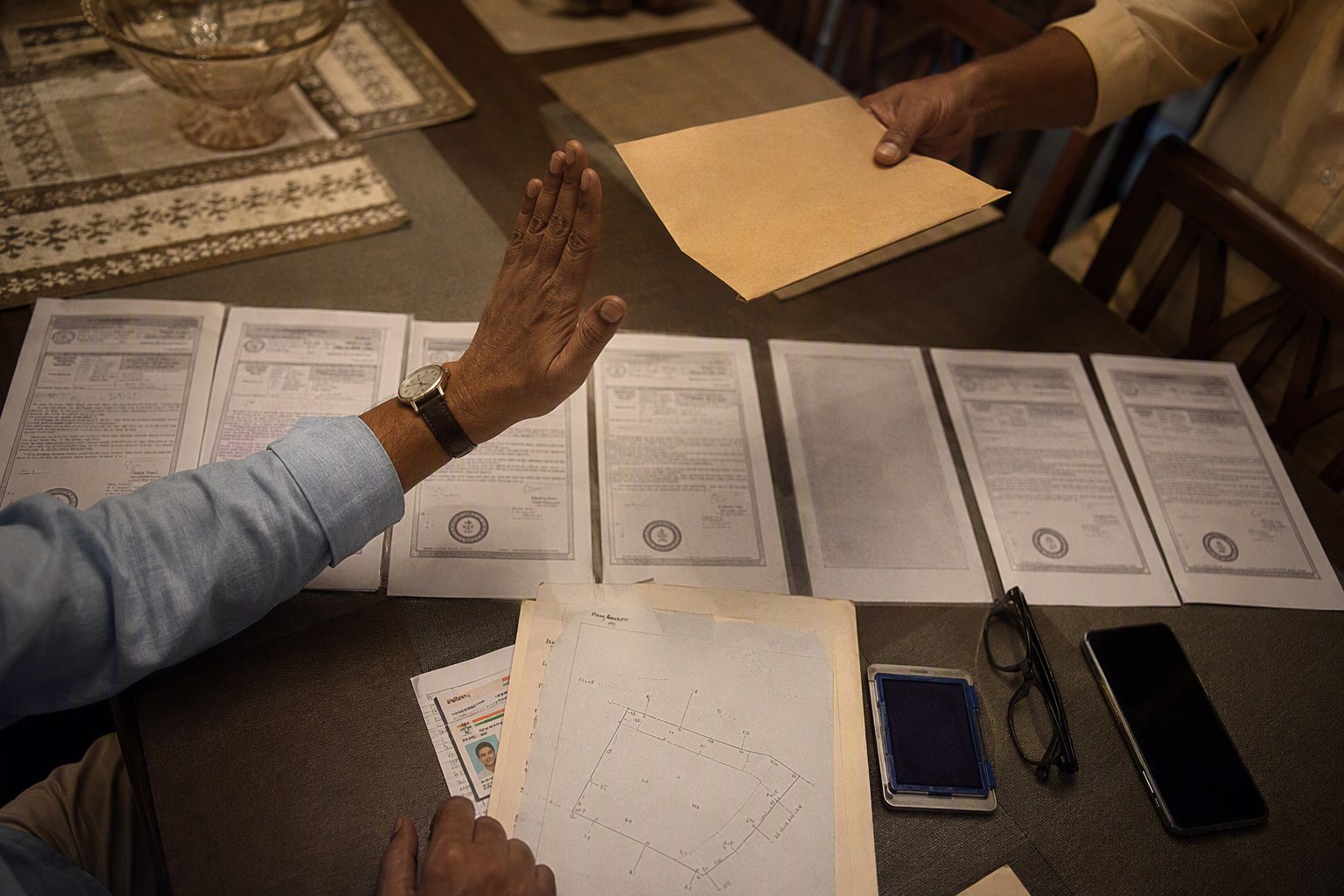



OC Copy vs Possession Letter is not a small paperwork difference in a Hyderabad flat deal. One document says the building has been cleared for occupation by the competent authority. The other usually says the builder is handing over possession to the buyer. In our experience, confusing the two can affect bank loan processing, resale comfort, municipal services, and the buyer’s bargaining power before paying token advance.
For this case study, I am comparing two flat buyers from the same price-sensitive mindset, both looking at ready-to-move flats in the Hyderabad market. One buyer relied on a possession letter and paid token advance quickly. The other asked for the OC copy first, checked project and title trails, and only then moved ahead. The difference was not legal English. It was practical risk control.
OC Copy vs Possession Letter: the quick side-by-side view
| Point | Buyer A: relied on possession letter | Buyer B: verified OC copy before token |
|---|---|---|
| First document checked | Possession letter from builder/seller | Occupancy Certificate copy from authority |
| Main assumption | Flat is handed over, so it must be ready legally | Flat may be physically ready, but statutory clearance must be checked |
| Token advance timing | Paid early to “block the flat” | Paid only after document review |
| Bank loan comfort | Faced extra queries on building completion and approvals | Had cleaner discussion with lender and legal team |
| Resale confidence | Future buyer may ask the same OC question again | OC copy becomes part of resale file |
| Negotiation strength | Weak after paying token | Stronger before paying token |
The Hyderabad flat market has many micro-markets: Kukatpally, Miyapur, Nallagandla, Kondapur, Gachibowli, Manikonda, Tellapur, Uppal, LB Nagar, Bachupally, Kompally, Attapur and Pocharam all behave differently. But one rule remains common. If the building is completed and people are staying there, buyers should still ask for the OC copy, sanctioned plan references, RERA status where applicable, EC, link documents and mutation/tax-related papers.
My working rule is simple: possession proves handing over; OC supports lawful occupation. They are not substitutes.
OC Copy vs Possession Letter in Hyderabad flat buying
Let us call the two buyers Ravi and Sravani. Names are changed, but the pattern is very common in Hyderabad resale and near-ready project conversations.
Ravi saw a flat in a well-connected pocket near Miyapur and Hafeezpet belt. The seller showed him a possession letter, maintenance receipts, electricity bill, and society WhatsApp group messages. The flat looked neat. Lift was working. Families were already living in the block. The seller said, “OC is there only, we will give later. First give token, otherwise another party is ready.” Ravi paid the token.
Sravani inspected a flat around Narsingi-Manikonda side. She also liked the flat. The seller pushed for token advance. But she asked for the OC copy, sale deed chain, EC, property tax details, and whether the project name matched the RERA records. She checked the RERA details through RERA Project Lookup, pulled an EC trail using Encumbrance Certificate Search, and checked SRO mapping through Find Your SRO Office. She did not treat token advance as a formality.
Both buyers were serious. Both were not lawyers. The difference was timing. Ravi did document checks after emotional commitment and token payment. Sravani did document checks before financial commitment.
What an OC copy actually tells you
An Occupancy Certificate is issued after the competent authority is satisfied that the building is fit for occupation as per applicable rules and approvals. Depending on the location and approval route, the authority may be GHMC, HMDA, DTCP, municipality or other competent body. In Telangana flat deals, the OC copy gives comfort on whether the completed building has crossed a key statutory stage.
OC does not mean every title issue is solved. It does not replace EC, link documents, land ownership verification, RERA review, mortgage check, or Section 22-A prohibited property screening. But without OC in a completed apartment, buyers should slow down.
We’ve seen buyers in Kokapet, Puppalaguda, Nallagandla and Bachupally assume that branded construction or good elevation automatically means complete documentation. That is not always safe. A polished clubhouse cannot answer a legal query from a bank panel advocate.
What to look for in an OC copy
- Project or building name and block details should match the flat being sold.
- Survey number, plot number or approval reference should not be vague.
- The issuing authority should be relevant to that location.
- The date of issue should align with possession and sale timeline.
- If it is a partial OC, confirm whether your specific tower/block/floor is covered.
- Compare OC details with sanctioned plan, sale deed schedule and RERA project details where applicable.
If the seller only says “OC applied” or “OC is under process,” treat it as a different risk category. It may still be a workable purchase in some cases, but the pricing, bankability and conditions in the agreement should reflect that risk.
What a possession letter actually proves
A possession letter is usually issued by the builder to the allottee/buyer confirming that possession of the flat is being handed over. In resale, an earlier possession letter may be shown as part of the file. It may mention flat number, area, date, dues status and handover conditions.
Possession letter is useful. It helps establish when the first buyer took handover. It may support maintenance onboarding, electricity connection processing, and society records. But it is not the same as statutory occupancy clearance.
Ravi’s mistake was not accepting the possession letter. His mistake was accepting only that letter as enough comfort before paying token. In Hyderabad, especially in fast-moving localities, token advance creates pressure. Once money is paid, the buyer starts adjusting expectations. “OC will come later” becomes acceptable. “Minor deviation only” starts sounding normal. That is where risk enters quietly.
OC Copy vs Possession Letter: why banks and future buyers care
Bank legal teams usually ask questions that ordinary buyers do not ask at the site visit. They may ask for approved plan, completion/occupancy proof, title flow, EC, NOC where applicable, and project approvals. Some banks may process cases based on their internal policy and property category, but a missing OC can still trigger conditions or rejection depending on the file.
Future resale is another practical issue. Suppose Ravi wants to sell the flat after a few years. His buyer’s advocate may ask for OC. If Ravi never collected it, he has to chase the builder, society or authority records at that stage. That is a poor position to be in when a resale buyer is ready with loan sanction but waiting for legal clearance.
Sravani, on the other hand, built her resale file from day one. OC copy, EC, registered sale deed, tax records, RERA search, loan closure documents if any, and SRO details went into one folder. That is how serious buyers behave in mature markets like Gachibowli and Kondapur, and Hyderabad buyers are learning this quickly.
The Telangana angle: title checks cannot stop with apartment papers
Apartment buyers often focus only on flat-level papers. But the land underneath matters. Telangana has a large government-recorded prohibited property universe under Section 22-A. As per the database context available to us, prohibited properties under Section 22-A stand at 3,076,153. That number alone should make buyers careful before assuming that every attractive property is clean.
A flat buyer may ask, “Why should I check prohibited property status when I am buying only an apartment?” Fair question. Because the project land history, survey number trail, and registration restrictions can affect the comfort of the transaction. In some cases, the flat sale may look normal at the surface, but the underlying survey number history deserves attention.
Before paying token, use Section 22-A Prohibited Property Check and Survey Number Finder wherever survey details are available. For a broader first-pass review, use Property Verification Tool. These tools do not replace a lawyer’s opinion, but they help you ask better questions before money moves.
How Ravi’s deal became uncomfortable
After paying token, Ravi asked for OC. The seller first said the society has it. Society said the builder has it. Builder’s office said they would check old files. The bank legal team asked for more documents. The seller started getting irritated because he believed possession and regular maintenance were enough proof.
This is a common Hyderabad resale problem. Many sellers are genuine, but they themselves purchased years ago without collecting a proper document set. When they sell, the buyer inherits their paperwork gap. Ravi then had three choices: wait, renegotiate, or exit and fight for token refund. None of these options felt pleasant because the token was already paid.
His agreement draft also did not clearly say that token would be refundable if OC or approval documents were not produced. That one missing clause reduced his bargaining power.
How Sravani controlled the same risk
Sravani asked for documents before token. The seller sent the OC copy, but she did not stop there. She compared the flat number and block details. She checked whether the project was visible in RERA using RERA Project Lookup. She reviewed EC through EC Analyzer after downloading records. She checked the market value angle using Market Value / Guideline Value Search and estimated registration cost through Stamp Duty Calculator.
Only after this first round did she give token. Her token receipt mentioned that the amount was subject to satisfactory legal verification, bank legal clearance, OC verification, EC review, and seller’s ability to provide original/title-related documents. This is not over-cautious. This is common sense in a city where flats are often sold under time pressure.
Token advance clause: the most ignored part of flat buying
Most buyers spend time negotiating sale price, car parking and interiors. Very few negotiate the token receipt wording. That is a mistake. Token advance is where the buyer’s exit rights must be written.
For a ready-to-move flat, the token receipt or advance agreement should ideally mention:
- Seller must provide OC copy, sanctioned plan and approval references where applicable.
- Transaction is subject to buyer’s legal verification and bank approval.
- Token is refundable if material documents are not provided or if legal defects are found.
- Seller must disclose existing loans, mortgages, litigation, pending dues and society issues.
- Final sale deed will happen only after originals are verified and encumbrances are cleared.
- Car parking rights and undivided share details should be clear.
If you are drafting a simple token receipt or sale agreement condition, you can use Legal Document Generator as a starting point. Still, for high-value transactions, take a local property lawyer’s review. Hyderabad property files often carry small local details that templates cannot catch.
OC Copy vs Possession Letter: document checklist before paying token
Here is the practical checklist I suggest for Hyderabad and surrounding Telangana flat buyers:
Building and project documents
- OC copy or completion/occupancy-related approval as applicable.
- Sanctioned building plan and approval proceedings.
- RERA registration details where the project falls under RERA requirement.
- Fire NOC or other approvals where applicable to the building type.
- Society handover papers, if association is formed.
Flat and title documents
- Registered sale deed of current seller.
- Link documents showing how title moved from landowner/developer to present owner.
- Latest EC from the concerned SRO.
- Loan closure letter and release deed, if seller had a loan.
- CERSAI check for loan/security interest using CERSAI Charge Check.
- Property tax, electricity and maintenance dues status.
Land and local record checks
- Survey number and village/mandal details where available.
- Section 22-A prohibited property screening.
- Dharani/pahani-related history for land-origin clarity where relevant.
- SRO jurisdiction check before registration planning.
In older city areas like Himayatnagar, Barkatpura, Mehdipatnam or Secunderabad pockets, the paper trail may look different from newer gated communities in Tellapur or Kokapet. Do not force one standard format on every property. But do insist on legal comfort.
When can a possession letter still be useful?
A possession letter is not useless. It is part of the transaction file. It helps show when possession moved from builder to allottee. It may help track maintenance start date and handover obligations. In disputes about delay or amenities, it can become relevant.
But a possession letter should sit along with OC, not in place of OC. If the seller says possession letter is enough, ask a direct question: “Can you give the OC copy covering this block and flat?” The answer will tell you how much digging is needed.
Red flags I would not ignore
- Seller refuses to share OC before token.
- Builder says OC is “coming soon” but cannot give written status.
- Flat is ready, occupied, and many years old, but no one has OC copy.
- OC is for another block or phase, not your tower.
- RERA project name, sale deed schedule and building documents do not match cleanly.
- EC shows mortgage or transaction entries not explained by seller.
- Survey number falls into a restriction concern under government records.
- Seller pushes for cash token without written conditions.
Hyderabad buyers are smart, but the market is emotional. A good view, metro access, ORR connectivity or school proximity can make people rush. That is exactly when document discipline matters.
Final view from this case study
Between OC copy and possession letter, the safer buyer is the one who understands their separate roles. Ravi was not wrong to like the flat. He was wrong to pay first and verify later. Sravani did not kill the deal by asking documents. She protected the deal from future arguments.
My opinion is clear: for a completed flat, ask for the OC copy before token advance. If OC is unavailable, do not automatically reject the property, but change your approach. Put conditions in writing, get legal review, check whether your lender is comfortable, and price the risk properly. A flat deal should not depend on verbal assurances at the site office or parking cellar.
Use the tools, speak to the SRO if needed, check RERA where applicable, and read the EC properly. The best time to ask hard questions is before the seller has your money.
Frequently Asked Questions
Is an OC copy mandatory before buying a flat in Hyderabad?
For a completed building, you should ask for the OC copy before paying token advance. It gives comfort that the building has received occupancy-related clearance from the competent authority. Still verify title, EC, RERA status and loan/mortgage records separately.
Can a possession letter replace an Occupancy Certificate?
No. A possession letter generally confirms handover of the flat by the builder or seller. It does not replace statutory occupancy clearance. Treat it as a supporting document, not as proof of legal occupation approval.
What should I write in the token advance receipt?
Mention that the token is subject to satisfactory legal verification, OC review, EC check, bank legal clearance and production of required originals. Also write whether the token is refundable if material document defects are found.
Should I check Section 22-A for an apartment?
Yes, where survey number and land details are available. Apartment ownership is linked to the underlying land. Telangana records show 3,076,153 prohibited properties under Section 22-A, so buyers should not ignore land-level checks.
Which documents should I check along with OC?
Check the registered sale deed, link documents, EC, sanctioned plan, RERA details where applicable, loan closure papers, CERSAI record, property tax dues, maintenance dues and SRO jurisdiction before registration.