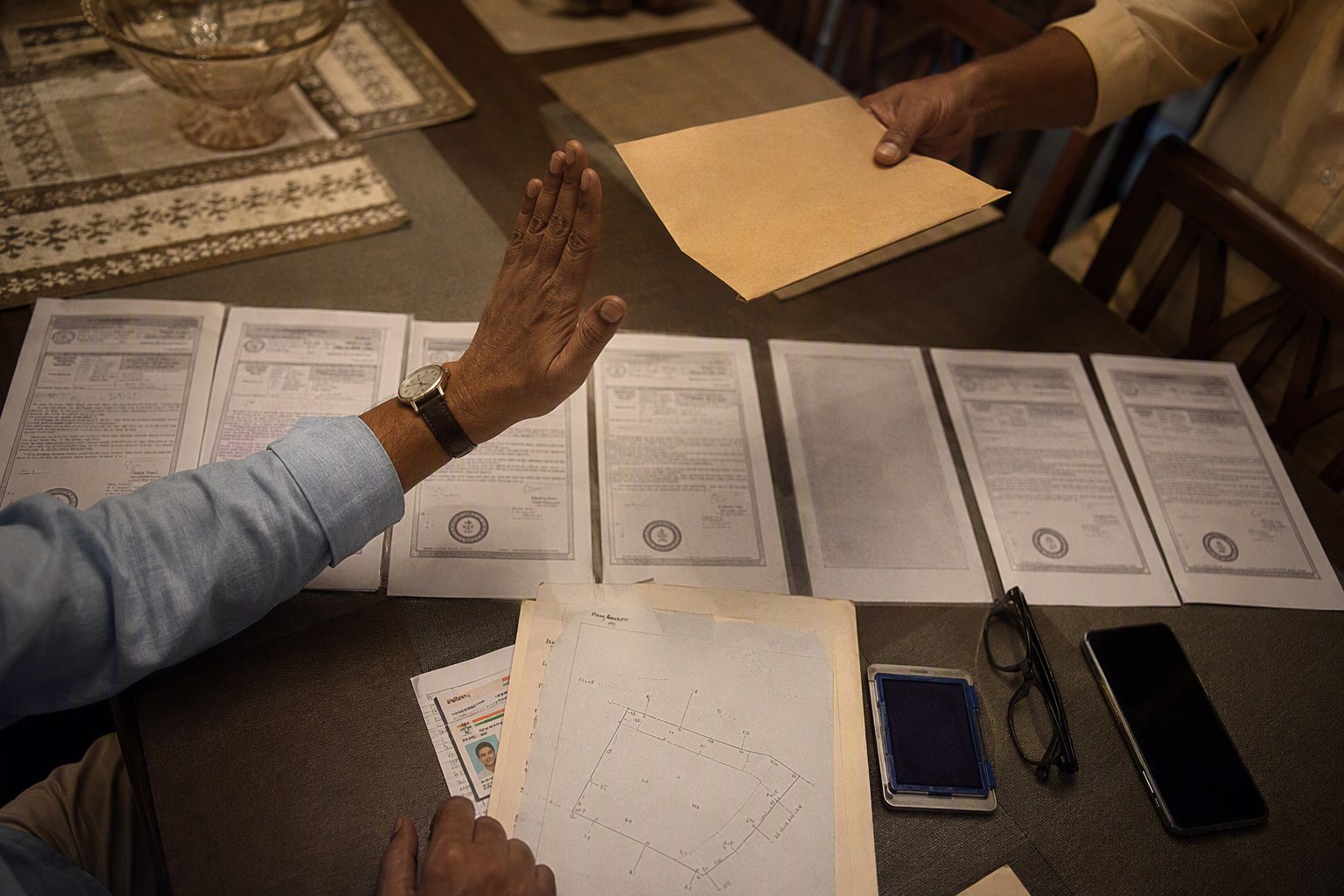



Telangana Case Study: Did a Minor’s Share Pause a Sale? Yes, it did — not because the property was fake, but because one legal heir was under 18 and had a share in the family property. In Hyderabad land deals, this one detail can slow registration, disturb bank loan processing, and make a large advance risky. We have seen buyers check EC, pahani, sale deed chain and even market value, yet miss a minor’s right hidden inside a family settlement or inheritance story.
This case is from the western Hyderabad belt, around Puppalaguda and Narsingi, where family-owned plots and old gram panchayat layouts now sit next to premium apartment towers. The buyer was ready to pay around ₹4.14 crore for a 300 sq yd house plot at ₹1.38 lakh per sq yd. In that micro-market, quotes of ₹1.20 lakh to ₹1.60 lakh per sq yd are not unusual for clean plots, while apartments in Narsingi, Manikonda and Kokapet often move in the ₹9,500 to ₹12,500 per sq ft band depending on brand, road access and stage of construction.
Our view is simple: a minor’s share is not a small technical point. It is a title risk. If the documentation is not handled properly, the same property can look saleable today and become disputable when the child turns major.
Telangana Case Study: Did a Minor’s Share Pause a Sale? The short answer
The buyer found the issue before paying a big token advance. The property belonged to a deceased father. His wife and three children were legal heirs. One child was still a minor. The sellers first said, “all family members are ready”, but the draft agreement showed only the mother and two major children as vendors. The minor’s share was being represented by the mother as natural guardian, without a court permission order.
That one missing document changed the deal timetable. The buyer’s advocate asked for a proper legal heir record, family member certificate, death certificate, previous title deeds, latest encumbrance certificate, municipal tax receipts, and a court order permitting sale of the minor’s undivided share. The seller felt this was excessive. The buyer did not. In our experience, this is exactly where a serious buyer must slow down.
In Telangana, the Sub-Registrar Office, or SRO, may accept several property documents if stamp duty and registration requirements are met. But acceptance of a document is not equal to perfect title. If a natural guardian sells a minor’s immovable property without required permission, the minor can challenge that sale after attaining majority. That is the real danger.
Where the property was and why the price pressure was high
The property in this case was near Puppalaguda, Gandipet mandal, close to the Narsingi-Manikonda growth belt. This is not a sleepy fringe anymore. Outer Ring Road access, Financial District offices, Kokapet launches, and strong rental demand have pushed landowners to quote aggressively.
For a 300 sq yd plot at ₹1.38 lakh per sq yd, the total consideration was ₹4.14 crore. The seller wanted a ₹25 lakh advance within two days. The buyer was planning part self-funding and part bank loan. Stamp duty and registration cost also had to be planned, so the buyer checked the government value through the Market Value / Guideline Value Search and estimated duty through the Stamp Duty Calculator.
Many Hyderabad buyers look only at market rate. That is a mistake. Ready reckoner value, SRO jurisdiction, property type, road width, survey number linkage and previous ownership all matter. In areas like Puppalaguda, Narsingi, Neknampur, Manikonda, Tellapur and Miyapur, old agricultural survey numbers often sit under new urban addresses. The apartment name or colony name alone is not enough.
How the buyer first spotted the minor’s share
The first clue came from the death certificate. The original owner had died around six years earlier. The sellers produced an old sale deed in the father’s name and a property tax receipt in the mother’s name. That is common in family properties. But a tax receipt does not prove full ownership.
The buyer’s document writer asked for the family member certificate. It listed the widow and three children. One child’s age was shown as 15. That meant the deceased owner’s share had passed to all Class I legal heirs, including the minor, assuming Hindu succession applied to this family. The mother could sign as natural guardian, but sale of the minor’s immovable property needed court permission for the buyer to feel safe.
The buyer then checked the encumbrance history through an Encumbrance Certificate Search. The EC showed no mortgage and no registered sale after the father’s purchase. That was good, but it did not remove the inheritance issue. EC can show registered transactions. It will not always explain whether all heirs have validly consented, whether a minor has a protected share, or whether an unregistered family arrangement is genuine.
Telangana Case Study: Did a Minor’s Share Pause a Sale? Documents that changed the decision
The deal did not collapse immediately. It paused. That pause saved the buyer from paying ₹25 lakh in a hurry. The buyer asked the sellers for a clean document pack before signing the agreement of sale.
| Document checked | What it showed | Why it mattered |
|---|---|---|
| Original sale deed | Property stood in the deceased father’s name | Confirmed root ownership but not current heirship |
| Death certificate | Original owner had passed away | Triggered succession verification |
| Family member certificate | Widow, two major children and one minor child | Confirmed the minor had a possible legal share |
| EC for 30 years | No later sale or mortgage found | Reduced encumbrance risk but did not fix minor’s title issue |
| Property tax receipt | Mutation in mother’s name | Useful for possession, not conclusive title |
| Survey number and layout papers | Linked plot to old survey number | Helped rule out mismatch in land identity |
| Court permission for minor’s share | Not available at first | Main reason the buyer paused payment |
The buyer also ran the land details through the Survey Number Finder because the plot had a colony address, while older documents mentioned survey numbers. This is a very Hyderabad problem. A property may be marketed as Narsingi or Puppalaguda, but the old record may refer to a village, mandal and survey number. If these do not match, registration day can become stressful.
Why a minor’s property share cannot be treated like a normal NOC
Some sellers say, “The child is small, mother will sign, no issue.” That is not how a careful buyer should treat it. A minor cannot personally execute a sale deed. A natural guardian can act, but sale of the minor’s immovable property is restricted. Generally, court permission is sought to show that the sale is for legal necessity or for the minor’s benefit.
Without that permission, the sale may be challenged later. The minor, after turning 18, can question the sale within the allowed limitation period. Imagine buying a plot, constructing a house, and then facing a title suit years later. Even if you eventually defend the case, the stress, legal cost and resale blockage are real.
In this case, the buyer’s bank also became cautious. Banks funding high-value Hyderabad properties usually scrutinise legal heirship, link documents, EC, municipal approvals and land classification. If a minor’s share is involved, many legal teams ask for a district court order. The bank was not being difficult; it was protecting its mortgage.
The Section 22-A check was also done — and why it matters
The minor’s share was the main issue, but the buyer also checked whether the land appeared in the prohibited properties list under Section 22-A. Telangana has a large volume of prohibited property entries. The database count stands at 147,934 prohibited properties under Section 22-A. That number alone should make buyers cautious, especially in peri-urban mandals where assigned land, endowment land, ceiling land or government land disputes can overlap with private claims.
The buyer used a Section 22-A Prohibited Property Check before going ahead. The property did not show as prohibited in the available check, which was a positive sign. Still, that did not solve the minor’s share. Different risks need different documents.
We often tell buyers this: a clean 22-A result does not mean clean title, and a clean EC does not mean all heirs have validly sold. Property verification is like checking a patient. Blood pressure normal does not mean the heart report can be ignored.
SRO, mandal and record matching: small errors that create big delays
The buyer initially thought the property would fall under one SRO based on the broker’s statement. But the older sale deed showed a different village reference. Before preparing challans and stamp papers, the buyer verified the correct office through the Find Your SRO Office tool.
This matters because Hyderabad’s growth has blurred locality names. A buyer may say Kokapet, the deed may say Gandipet mandal. A project may be sold as Tellapur, while the revenue village may be Osman Nagar or Kollur side. Manikonda listings can overlap with Puppalaguda, Neknampur and Shaikpet references. The SRO and mandal details must match the title chain.
The buyer also used a broader Property Verification Tool to create a checklist of missing documents. It flagged the same concern: succession records were incomplete and minor representation needed legal backing.
What happened after the sale paused?
After two rounds of discussion, the sellers accepted that the buyer’s objection was genuine. They approached a lawyer to file for permission to sell the minor’s share. The buyer refused to pay the ₹25 lakh advance until the petition copy, court process status and final permission order were available. A small refundable token was discussed, but the buyer wisely avoided a heavy non-refundable payment.
The final agreement of sale was also revised. It included conditions that the sellers must produce court permission, all legal heirs must join the final sale deed, and the buyer’s advance would be refundable if permission was refused or delayed beyond an agreed date. This is how a risky deal becomes a controlled deal.
Was the seller dishonest? Not necessarily. Many families genuinely do not understand that a minor child’s inheritance share has legal protection. But for a buyer paying crores in the Hyderabad market, ignorance on the seller’s side cannot become the buyer’s risk.
Practical checklist before paying advance in a family-owned Telangana property
- Ask who the current owners are: Do not stop with the person negotiating. Ask for full legal heir details if the original owner is deceased.
- Check age of every heir: If any heir is below 18, ask how that share will be legally conveyed.
- Take a 30-year EC: Use it to see registered sales, mortgages, gifts, partitions and releases.
- Match survey number and plot number: Colony names can confuse. Revenue identity is key.
- Check Section 22-A: Especially for plots, agricultural land and old layouts near city expansion zones.
- Verify SRO jurisdiction: Wrong SRO assumptions can delay registration planning.
- Do not rely only on mutation: Dharani, municipal mutation or property tax name is not the same as marketable title.
- Put conditions in the agreement: Refund clause, document delivery date and court permission requirement should be written clearly.
What buyers should learn from this Telangana minor’s share case
The biggest lesson is not that every inherited property is risky. Many family properties in Hyderabad, Rangareddy, Medchal-Malkajgiri and Sangareddy are perfectly saleable when documents are handled properly. The lesson is that succession must be checked before money moves.
In high-demand locations like Kokapet, Narsingi, Puppalaguda, Tellapur, Bachupally, Miyapur, Uppal and Kompally, buyers feel pressure because prices keep moving. Brokers may say another party is ready. Sellers may ask for instant token. We have seen that pressure many times. Still, if a minor’s share exists, a two-week delay is better than a ten-year dispute.
For apartments, buyers should also check project registration through the RERA Project Lookup. For plots and independent houses, title chain, survey identity, EC, SRO, 22-A and legal heirship are the core checks. If development potential is part of the price, tools like the FSI/FAR Calculator and Road Width Check can also help you understand whether the quoted rate is justified.
My opinion: the buyer in this case did the right thing. He did not accuse the seller. He did not run away blindly. He asked for the correct documents and made payment conditional. That is the mature way to buy property in Telangana.
Final take on the case
A minor’s share can pause a sale in Telangana, and in many cases it should. The pause is not a failure of the transaction. It is a safety break. When a family-owned property is being sold after the death of the original owner, every legal heir matters. A child’s share matters even more because the law gives special protection to minors.
If you are buying in Hyderabad or nearby mandals, treat the first document review seriously. Check EC, ready reckoner value, SRO, survey number, pahani or revenue trail where applicable, 22-A status and legal heirship. Pay a large advance only after the ownership story is supported by papers, not just family assurances.
Frequently Asked Questions
Can a mother sell a minor child’s share in Telangana property?
A mother can act as natural guardian in many cases, but sale of a minor’s immovable property generally needs court permission to make the buyer’s title safer. Buyers should insist on a proper legal opinion and court order where a minor’s share exists.
Is an Encumbrance Certificate enough to confirm clean title?
No. EC shows registered transactions like sale, mortgage or gift. It may not reveal whether all legal heirs have joined, whether a minor’s share was validly sold, or whether an unregistered family dispute exists.
Why did registration slow down in this case?
Registration slowed because one legal heir was a minor and the sellers did not initially have court permission to sell that minor’s share. The buyer and bank asked for the missing legal document before major payment.
Should I pay advance before checking legal heir documents?
A small refundable token may be manageable, but paying a large non-refundable advance before checking legal heirship is risky. In family-owned properties, verify death certificate, family member certificate, EC and title chain first.
Does a clean Section 22-A check mean the property is safe?
No. A clean Section 22-A result only reduces prohibited property risk. You still need to verify ownership, succession, survey number, SRO records, EC and any minor’s share issue.