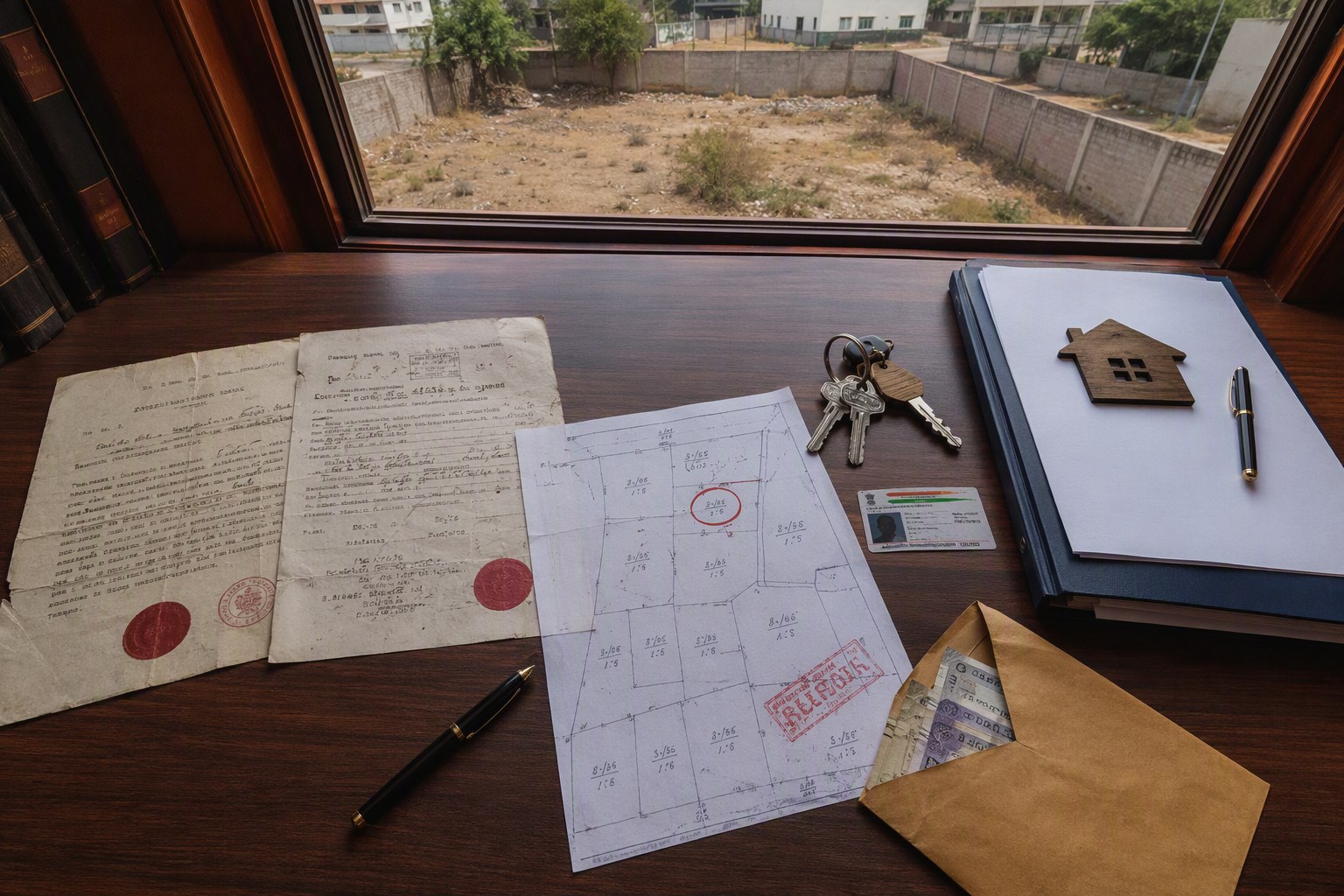
Telangana Case Study: Legal Heir Gap Delayed Hyderabad Sale is a reminder that a clean-looking resale file in Hyderabad can still get stuck at the last mile. In this case, a 3BHK resale near Kondapur-Hafeezpet had a willing buyer, a negotiated price, a token paid, and no obvious encumbrance in the first check. The delay came from a missing legal heir link in the ownership chain, not from pricing, loan eligibility, or buyer demand.
The apartment was in a well-occupied gated community, under Serilingampally mandal limits and linked to the local SRO serving the Hafeezpet-Miyapur belt. The agreed resale price was around ₹1.42 crore for a 1,865 sq ft flat, roughly ₹7,600 per sq ft, which was in line with active resale quotes in Kondapur, Hafeezpet, Nallagandla and Kothaguda during the same period. The buyer was ready to proceed because similar homes in the corridor were quoting between ₹7,200 and ₹9,200 per sq ft depending on tower age, floor, facing, amenities and maintenance.
But the property could not be registered on the planned date. The reason: the person shown as present seller was not the only legal successor of the earlier owner. One married daughter of the deceased original allottee had not signed any release deed, confirmation deed, or sale consent. The omission surfaced during bank legal scrutiny after the sale agreement was already drafted.
Our view: in Hyderabad resales, family title gaps are more common than forged papers. Many files fail not because someone is cheating, but because families assume mutation, possession and society records are enough. They are not.
Telangana Case Study: Legal Heir Gap Delayed Hyderabad Sale — what happened
The seller had acquired the flat through inheritance after his father’s death. The father was the first registered owner, having bought the apartment from the developer more than a decade earlier. After his death, the family got the apartment transferred in the society records and the municipal property tax name was also updated. The seller was paying maintenance, had possession, and had kept all utility bills current.
At the first glance, the file looked normal. The buyer’s broker saw the old registered sale deed, latest property tax receipt, electricity bill, maintenance no-dues letter and an Encumbrance Certificate showing no mortgage. The buyer also checked the indicative registration cost using the Stamp Duty Calculator and compared the declared value with the area’s government value through the Market Value / Guideline Value Search.
The buyer’s family was moving from a rented home in Gachibowli and wanted to close before the new school term. The seller wanted to use the proceeds for a villa booking near Tellapur. Both sides had a genuine reason to complete fast. The deal was not speculative. It was a typical Hyderabad upgrade-and-move transaction.
The problem entered when the buyer applied for a home loan. The bank’s advocate asked for the death certificate of the previous owner, legal heir proof, and documents showing how every legal heir had either joined the sale or released rights. The seller produced a family member certificate showing the widow and two sons. But the deceased owner also had a daughter, married and settled in Pune, whose name was not reflected in the sale draft.
That single missing link stopped the file.
Why the legal heir gap mattered in this Hyderabad sale
For immovable property, banks and careful buyers do not look only at who is living in the flat or who is collecting rent. They ask a tougher question: who has the legal right to sell? Under Hindu succession principles, Class I heirs generally include widow, sons, daughters and mother of the deceased. A married daughter is still a legal heir. Marriage does not erase her share.
In this case, the seller believed that because his sister had verbally agreed and had not claimed anything for years, the property could be sold by him and his mother. That is a common assumption in Telangana and Andhra families. We have seen the same issue in Ameerpet builder floors, Kukatpally resale flats, LB Nagar independent houses, and even agricultural land parcels around Shankarpally and Moinabad.
Verbal consent carries very little comfort for a buyer. If the omitted heir later disputes the sale, the buyer may face litigation, settlement pressure, or difficulty when reselling. Banks are even more conservative because their mortgage security must be enforceable.
The buyer’s lawyer recommended three conditions before registration:
- Obtain the deceased owner’s death certificate and match names across all records.
- Identify all legal heirs through family member certificate, affidavits and supporting ID documents.
- Get every heir to join the sale deed or execute a registered release or confirmation deed before the final sale.
The buyer also ran a fresh Encumbrance Certificate Search and a Section 22-A Prohibited Property Check. That was sensible. Verified.RealEstate’s risk database records 147,934 prohibited properties under Section 22-A in Telangana. Most apartment resales in established gated communities will not fall into that list, but a buyer should not assume. One wrong survey number or old government land linkage can create a registration shock at the SRO.
The deal numbers: pricing was not the dispute
What makes this case useful is that money was not the sticking point. The buyer and seller had already negotiated hard and settled close to the going resale band.
| Item | Case detail | Why it mattered |
|---|---|---|
| Location | Hafeezpet-Kondapur side, Serilingampally mandal | Strong end-user demand due to HITEC City, Gachibowli and Financial District access |
| Property type | 3BHK resale flat, 1,865 sq ft | Popular family size in the western Hyderabad market |
| Agreed value | About ₹1.42 crore | Worked out to roughly ₹7,600 per sq ft |
| Nearby resale band | ₹7,200 to ₹9,200 per sq ft | Comparable to Kondapur, Hafeezpet, Kothaguda and Nallagandla flats of similar age |
| Main delay | Missing consent of one legal heir | Bank legal team refused clearance until title chain was corrected |
Many buyers focus only on discount. That is understandable. In Hyderabad’s western corridor, a difference of ₹300 per sq ft on an 1,800 sq ft apartment is ₹5.4 lakh. But legal clarity can be more valuable than a small bargain. A cheaper flat with an unresolved heir issue may become costlier after legal fees, waiting time, loan re-sanction, and mental stress.
In this case, the buyer used the Composite Value Calculator to compare the flat’s built-up value with parking and undivided share components. He also checked the SRO jurisdiction using Find Your SRO Office, because a wrong SRO assumption can delay document preparation. These are small checks, but they reduce confusion during registration week.
How the legal heir issue was finally fixed
The solution was not dramatic. It was paperwork, signatures and patience. The seller contacted his sister in Pune and explained the bank objection. She did not want a share in the sale proceeds, but the buyer’s lawyer insisted that her position had to be recorded formally.
Two options were discussed. First, she could come to Hyderabad and sign the final sale deed as a consenting party. Second, she could execute a registered release deed in favour of her mother and brothers, or a properly drafted confirmation deed, depending on the lawyer’s title strategy. Because travel was difficult, the parties explored a power of attorney route. The bank did not accept a casual notarised authorisation. It wanted a properly executed and adjudicated document, with identity proof, photographs, and clear property description.
The process took about five weeks. The sale agreement had to be extended. The buyer’s loan sanction was revalidated. The seller had to give updated no-dues from the apartment association. A fresh EC was pulled because the bank wanted a document close to disbursement date.
The buyer stayed in the deal because the property was good and the price was fair. But he renegotiated the payment schedule. Instead of releasing a larger advance, he agreed to pay only after all heirs had signed or legally released rights. That was the correct move.
Telangana Case Study: Legal Heir Gap Delayed Hyderabad Sale — warning signs buyers missed
Looking back, there were early clues. None of them screamed risk, but together they deserved attention.
- The original registered owner was deceased, but the seller was presenting himself as sole decision-maker.
- Society transfer and tax mutation were treated as ownership proof.
- The family member certificate was not compared with the actual family structure known to neighbours and relatives.
- No registered release deed from other heirs was available.
- The sale agreement draft mentioned only the present seller and his mother, not all successors.
In our experience, apartment associations often update member names based on death certificate and an indemnity letter. That is useful for maintenance collection, car parking records and notices. It does not create marketable title by itself. GHMC tax mutation also helps, but it is not a substitute for a valid transfer of property rights.
Dharani entries, pahanis and mutation proceedings are even more misunderstood in land deals. For agricultural land in mandals such as Chevella, Shankarpally, Kandukur, Maheshwaram and Yacharam, people often say, ‘Name is in Dharani, so title is clear.’ That may be a good sign, but buyers still need to verify the parent documents, succession, court cases, survey number, boundaries, passbook history and prohibited status. A Survey Number Finder and Property Verification Tool can help structure that first review before spending on legal due diligence.
What sellers should do before listing an inherited Hyderabad property
If you are selling an inherited flat, house or plot in Telangana, do not wait for the buyer’s bank to find gaps. Clean the file before you list. A legally ready property sells faster and commands better trust.
Here is the practical checklist we recommend:
- Collect death certificates of all deceased owners in the chain.
- Prepare a legal heir chart with full names, age, relationship, address and ID proof.
- Check whether any heir has died after inheriting; if yes, their heirs may also need to be included.
- Get registered release deeds where some heirs do not want sale proceeds.
- Use consistent names across Aadhaar, PAN, passport, old sale deed, tax receipt and bank records.
- Pull the latest EC for at least 30 years where possible, not just a short period.
- Check Section 22-A status if land share, open plot or old layout history is involved.
- Keep society no-dues, property tax receipt, occupancy certificate copy and sanctioned plan ready for apartment sales.
For RERA-registered projects, buyers can also check project-level data through RERA Project Lookup. In older resale apartments, RERA may not answer every title question, but it can still help verify promoter details, approvals and project registration history where applicable.
How buyers can protect advance money
The biggest risk in such cases is not always losing the property. It is paying a large advance before title is verified. In Hyderabad, many resale agreements still take 10 percent as advance. On a ₹1.42 crore flat, that is ₹14.2 lakh. If the title gets stuck, recovering the amount can become a separate battle.
A safer structure is to split payments. Pay a small token for taking documents off the market. Release the main agreement advance only after lawyer review. Make the agreement conditional on all legal heirs joining the transaction, bank legal clearance, clean EC and successful registration. Mention refund timelines clearly if the seller cannot cure title defects.
Buyers selling another property to fund the purchase should also calculate tax impact early. The Capital Gains Tax Calculator can help estimate whether sale proceeds need to be reinvested within a deadline. A delayed registration can affect tax planning, especially when one property sale and another purchase are linked.
Our reporting takeaway from the case
This Hyderabad resale did not collapse. It got delayed, corrected and then moved ahead. That is the best possible outcome in a legal heir gap case. But the five-week delay had costs: loan revalidation, extended rent for the buyer, tension in the seller’s villa booking, fresh documentation, and a few hard conversations between relatives.
The broader lesson is simple. Title is not only the mother deed and EC. Title is also succession. In Telangana’s urban property market, many flats bought in the 2005-2015 boom are now changing hands after the first owner’s death. We will see more such cases in Madhapur, Manikonda, Miyapur, Nizampet, Uppal, Sainikpuri, Attapur and LB Nagar. Families must prepare for this reality.
If a seller says, ‘All family members are okay,’ ask for documents. If a broker says, ‘Registration will happen, no issue,’ still verify. If the SRO accepts a document, that does not mean future disputes are impossible. Registration is a formal act; legal title needs a clean chain.
For a buyer, the best deal is not merely the lowest rate per sq ft. It is a fair-priced property where ownership, possession, approvals and registration path are all clear. This case proves that a missing signature can be as powerful as a missing document.
Frequently Asked Questions
Can a married daughter claim a share in her father’s Hyderabad property?
Yes, in many Hindu succession situations, a daughter is a Class I legal heir along with sons and widow. Marriage does not remove her inheritance right. The exact answer can vary by personal law and facts, so buyers should get a property lawyer to review the family tree.
Is society transfer enough to sell an inherited flat in Telangana?
No. Society transfer helps with maintenance and internal records, but it is not the same as legal transfer of ownership. Buyers should ask for death certificate, legal heir proof, release deeds or consent from all heirs, and a clean title chain.
What should I check before paying advance for a Hyderabad resale flat?
Check parent deed, latest EC, property tax, society no-dues, legal heir documents if any owner is deceased, SRO jurisdiction, guideline value and Section 22-A status where relevant. Keep the advance conditional on legal clearance.
Can a legal heir sign later after the sale agreement is executed?
Yes, but it should be handled properly. The heir may join the sale deed, execute a registered release deed, or sign a legally valid confirmation document depending on the facts. The buyer should not complete registration until the lawyer and lender accept the cure.
Does a clean Encumbrance Certificate prove that there is no legal heir problem?
No. An EC shows registered transactions such as sale deeds, mortgages and releases for the searched period. It does not automatically confirm that all heirs of a deceased owner have joined the title. Succession must be checked separately.