Telangana Case Study: Why Did a Resale Villa Deal Pause? Short answer: because the buyer checked beyond the Encumbrance Certificate and found a survey-number level concern in Telangana Section 22-A prohibited property records before paying the token. The EC looked clean. The villa looked ready. The bank was broadly positive. But one cross-check on the land record changed the pace of the deal from fast negotiation to legal hold.
This is not a rare Hyderabad story. We have seen buyers in Tellapur, Osman Nagar, Kollur, Narsingi, Mokila, Kompally and Yapral assume that a registered sale deed plus EC means the property is safe. In resale villas, that assumption can become costly because the villa is not just a building. It is land, layout approval, survey number history, mutation, link documents, association handover, mortgage releases and SRO records all sitting together.
As per the available database fact, Telangana has 147,934 prohibited properties under Section 22-A. That is a serious number. Not every entry will affect a villa buyer. But if the survey number connected to your villa land is in or near a 22-A listing, you should slow down before token payment.
Telangana Case Study: Why Did a Resale Villa Deal Pause after a clean EC?
The case was from West Hyderabad, close to the Tellapur-Osman Nagar belt. The buyer was considering a resale villa in a gated community with a quoted price of around ₹7.8 crore. Built-up area was about 4,800 sq ft, plot extent was approximately 360 sq yd, and the villa was about four years old. For that micro-market, the quote was not shocking. In our experience, good villa communities around Tellapur, Osman Nagar and Kollur often see resale discussions in the broad range of ₹8,500 to ₹13,500 per sq ft depending on plot size, clubhouse, road access, builder name and occupancy.
The seller had a registered sale deed, mutation records, property tax receipts and an EC. The EC showed the builder sale to the first buyer and no obvious mortgage or sale after that. The buyer was happy because the location was strong: Outer Ring Road access, Financial District commute, schools nearby, and a villa community already occupied. It felt like a safe resale transaction.
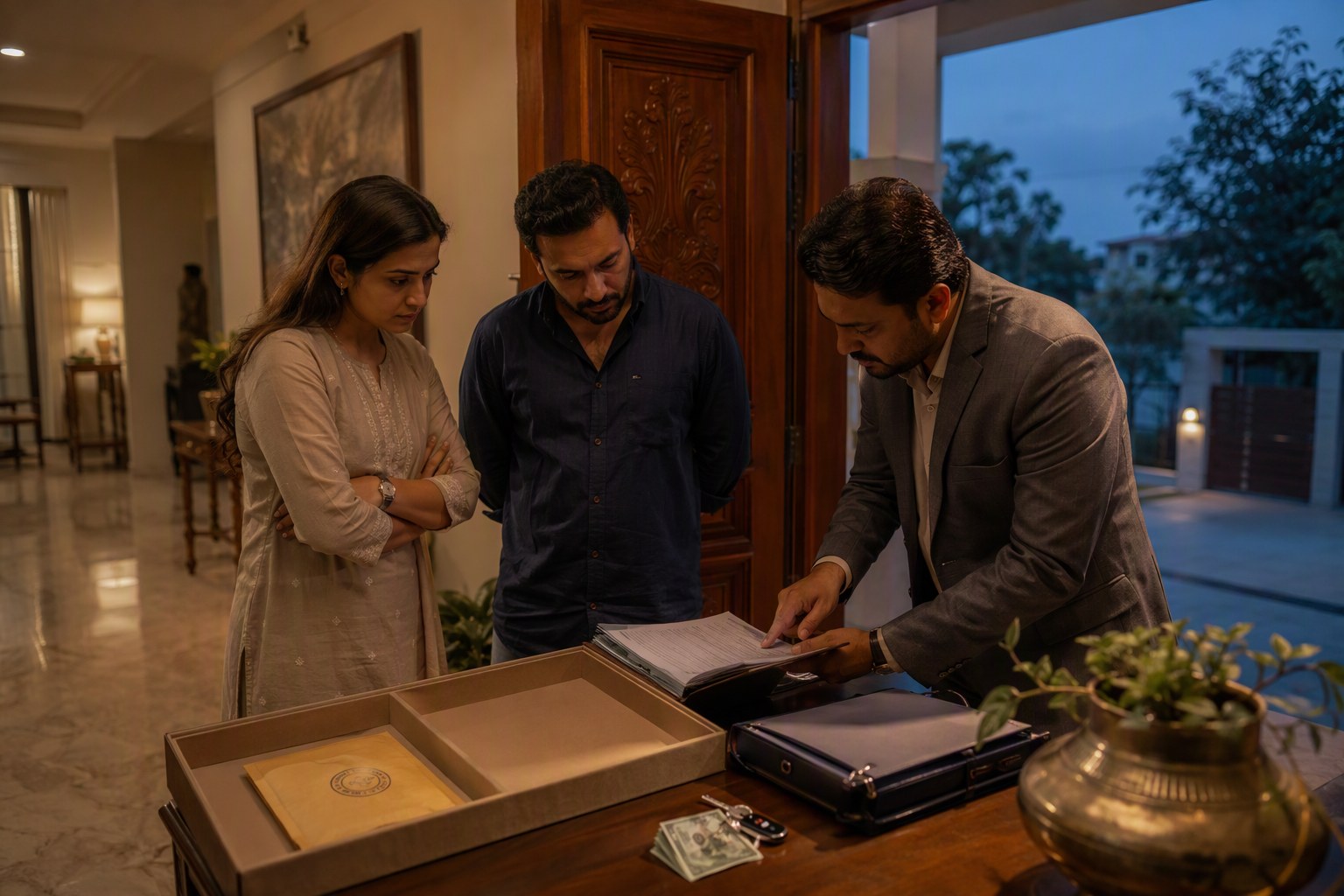
Then the buyer did one sensible thing. Before paying a ₹10 lakh token, he compared three items: the EC, the sale deed schedule and the survey number position in prohibited property records. That is where the file stopped.
The lesson is simple: EC tells you what has been registered. It does not, by itself, certify that the underlying survey number is free from every government restriction.
What exactly triggered the pause in this Telangana Case Study?
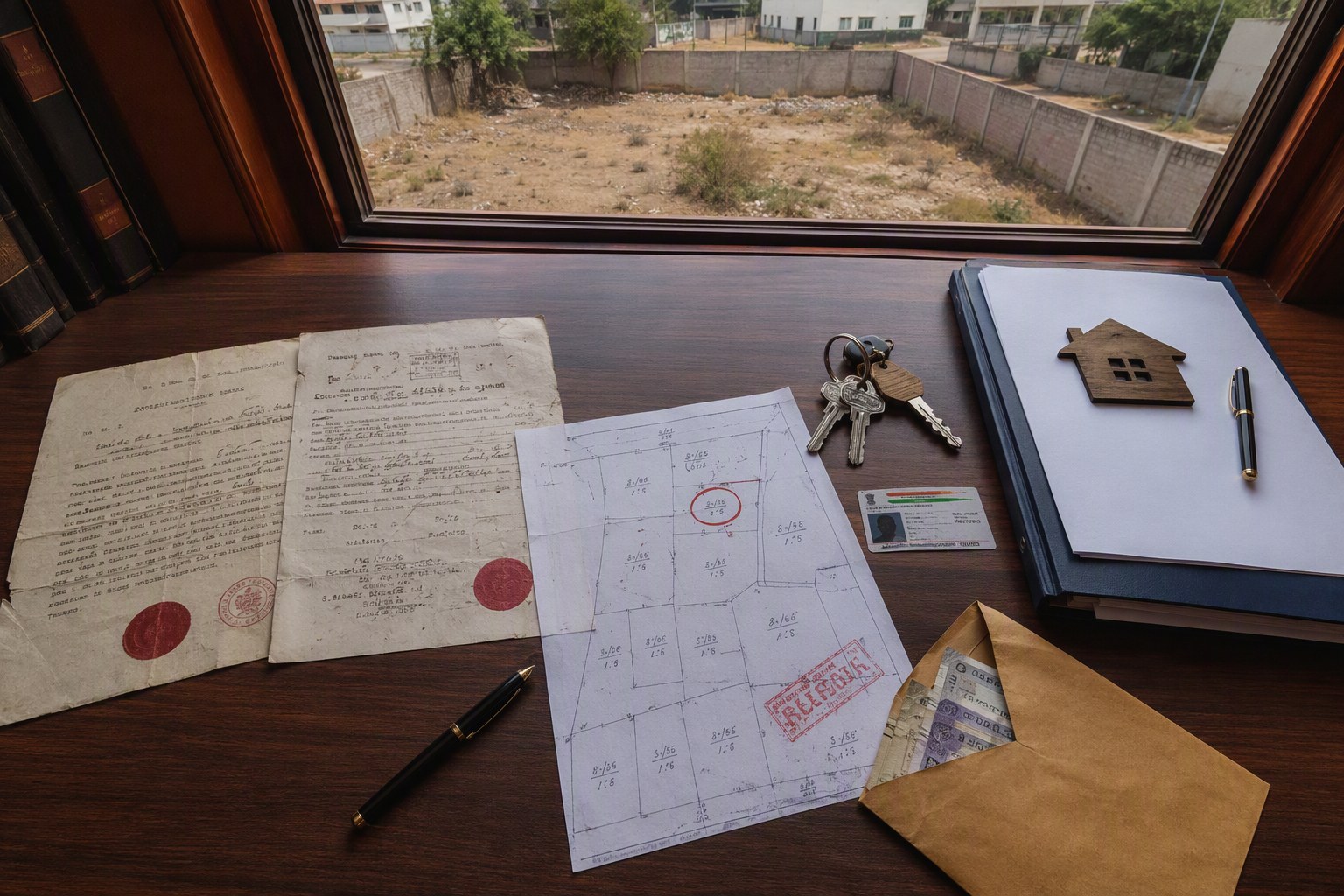
The EC was issued for the property and reflected registered transactions. But the sale deed schedule mentioned a parent land parcel spread across multiple survey numbers in the mandal. One survey number in the parent land chain had a similar number appearing in Section 22-A records. The villa plot itself was not clearly shown as prohibited in the seller documents, but the overlap was enough to ask questions.
This is the kind of small mismatch that buyers often ignore. In Hyderabad resale villas, especially where large agricultural lands were converted into plotted layouts or villa projects, parent survey numbers may have gone through several stages:
- Original pattadar holding as per pahani or revenue records
- Agreement of sale or GPA in old records
- Land conversion or layout approval stage
- Developer purchase or development agreement
- Plot-level allocation or villa sale deed
- Mutation and property tax entry in the buyer name
If any parent survey number appears in a restricted list, assigned land list, government land dispute, endowment land record, wakf-related record or court-restricted category, the buyer must not rush. Sometimes it is a clerical mismatch. Sometimes only a portion of a survey number is affected. Sometimes the project has already obtained clarification. But until that clarification is seen in writing, the risk remains.
Why a resale villa needs more checks than a flat
A flat buyer usually checks UDS, project approval, RERA if applicable, EC, sale deed and occupancy certificate. A villa buyer must go deeper because the land component is larger and more direct. In a villa, your enjoyment of the asset depends heavily on the title of the individual plot and the parent land.
For example, a villa in Narsingi or Kokapet may command ₹12 crore to ₹25 crore in a premium gated community. A villa in Tellapur or Osman Nagar may sit between ₹5.5 crore and ₹12 crore depending on plot size and brand. In Mokila, Shankarpally and Kollur side, pricing can vary widely, from around ₹3 crore for smaller or developing communities to much higher numbers for larger plots and established clubhouses. At these ticket sizes, a ₹5,000 document check is not enough. The land trail has to be read.
In this case, the buyer used an Encumbrance Certificate Search first. That was correct, but not sufficient. He then checked the survey number using a Survey Number Finder and compared it with the Section 22-A Prohibited Property Check. That combination raised the red flag.
EC versus 22-A: what each one actually tells you
Many buyers treat the EC as the final truth. It is a useful document, no doubt. But it has a limited job. It records registered transactions for the chosen property details and period. If a sale, mortgage, gift deed, release deed or other registered instrument exists, it may reflect there. But EC does not always explain revenue classification or government prohibition.
| Check | What it tells you | What it may not tell you |
|---|---|---|
| Encumbrance Certificate | Registered transactions, mortgages, sale deeds, releases for the searched period | Revenue dispute, assigned land status, partial 22-A restriction, layout compliance |
| Section 22-A check | Whether a property or survey number is listed as prohibited for registration | Whether the seller has a later clarification or court order removing the issue |
| Sale deed schedule | Plot extent, boundaries, survey numbers, link to parent land | Whether the stated survey number matches field reality |
| Dharani or revenue record | Pattadar, land nature, mutation and revenue details where applicable | Apartment-level or association-level private records |
| SRO verification | Registration jurisdiction and document trail | Physical possession and construction quality |
That is why a clean EC and a paused deal can both be true. The EC may be clean within its scope, while the survey-number history needs explanation.
The exact sequence followed before token payment
The buyer did not start with suspicion. He started with discipline. This is the sequence we recommend for resale villas in Telangana, whether the property is in Tellapur, Kollur, Mokila, Gandipet, Kompally, Yapral, Shamshabad or Adibatla.
1. Match the sale deed schedule with the physical villa
The buyer checked plot number, villa number, extent in sq yd, built-up area, boundaries and internal road details. In some resale communities, the marketing brochure and sale deed do not use the same numbering style. That is not automatically bad, but it must be reconciled.
2. Pull EC for a sensible period
For a four-year-old villa, checking only four years is weak. The parent land may have older transactions. The buyer searched the EC using available document numbers and property details. You can start with the Encumbrance Certificate Search, then ask your document writer or advocate to pull certified records from the SRO if needed.
3. Identify the correct SRO
West Hyderabad transactions can create confusion because buyers loosely say Hyderabad, while the registration may fall under Sangareddy, Ranga Reddy or Medchal-Malkajgiri jurisdiction depending on the exact village and mandal. For Tellapur and Osman Nagar, the buyer must be careful about village, mandal and SRO mapping. Use Find Your SRO Office before assuming jurisdiction.
4. Compare survey numbers with 22-A records
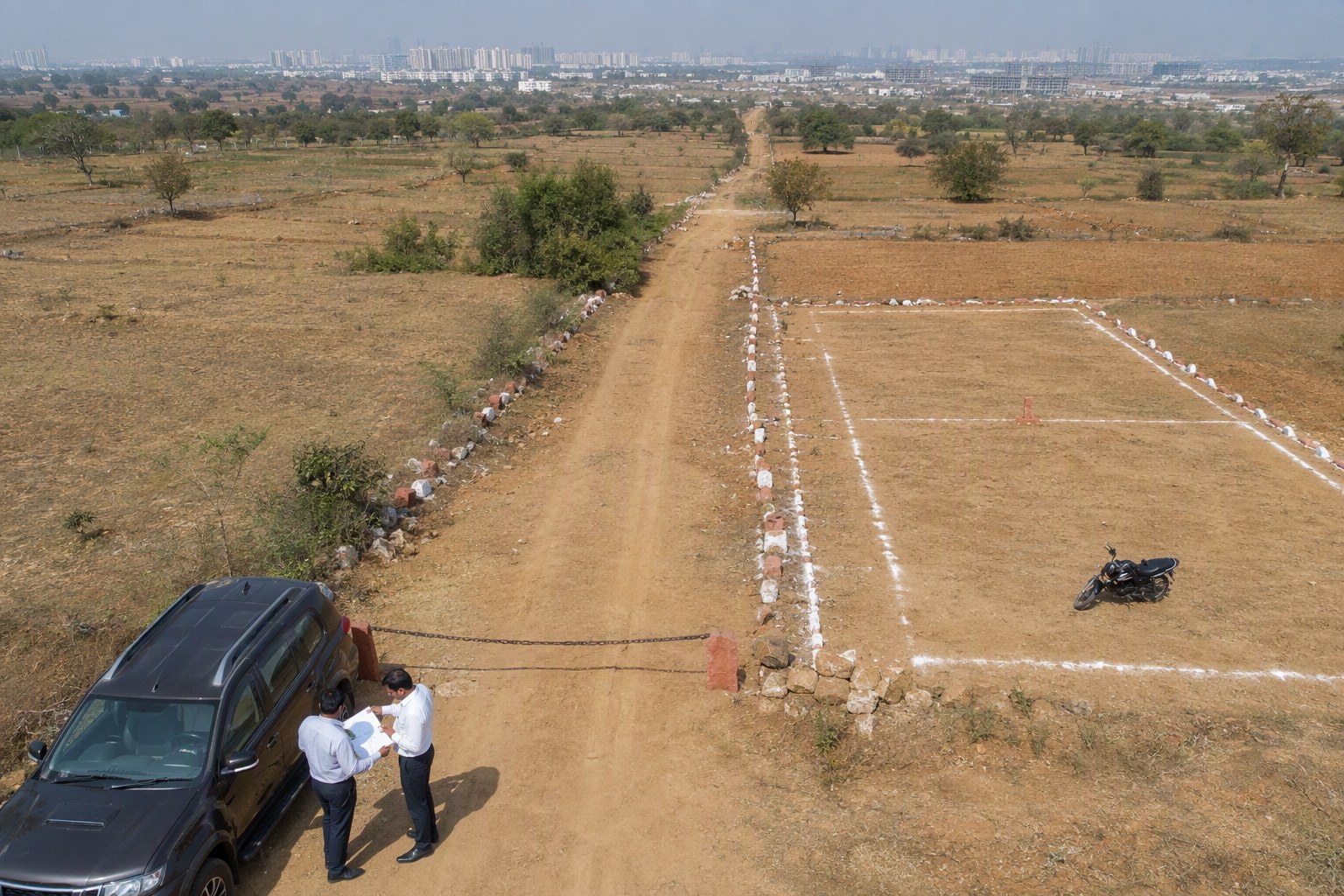
This was the turning point. The buyer found that one parent survey number required clarification. The correct response was not panic. The correct response was to pause token payment and ask the seller for a written explanation with supporting documents.
5. Check market value and stamp duty
For high-value villas, under-quoting in registration discussions can create later tax and loan discomfort. The buyer checked the ready reckoner direction through the Market Value / Guideline Value Search and estimated outgo using the Stamp Duty Calculator. The final registration value must align with legal advice, bank valuation and SRO practice.
6. Ask for builder and association papers
In a resale villa, the seller may have clear personal title, but common area handover may be weak. The buyer asked for layout approval, building permission, occupancy or completion evidence where available, mortgage NOC from builder project finance, association NOC, maintenance dues clearance and property tax payment.
What the seller said, and why it was not enough
The seller said the community had many registered villas and banks had funded several purchases. That may be true. But it does not answer a survey-specific question. In Telangana, I have seen banks approve loans based on panel legal reports that may not satisfy a cautious cash buyer, and I have seen cautious advocates raise issues that bank panels missed.
The seller then produced the original sale deed, link documents and tax receipts. Good documents, but the buyer asked for one more item: a clear note or certificate explaining why the parent survey number reference did not affect this villa plot. That could come through a revenue clarification, builder legal opinion backed by documents, or a fresh advocate opinion tracing the specific survey subdivision and extent.
This is where the deal paused. Not cancelled. Paused.
Why pausing was the right move
In Hyderabad, token payment has become casual. People transfer ₹5 lakh, ₹10 lakh or even ₹25 lakh after one site visit because they fear the villa will go to another buyer. In resale villas, this is risky. Once token is paid, the buyer loses negotiating control. The seller may say the amount is non-refundable. The agent may push both sides to sign a short agreement. The buyer then has to fight for documents after money has already moved.
In this case, the buyer had not paid token. So the conversation remained clean. He told the seller: clear the 22-A doubt, provide the supporting paper trail, then we proceed. That is how a mature buyer behaves.
We have seen similar pauses in Mokila where a survey number had old assigned land confusion, in Kompally where layout regularity needed more documents, and in Shamshabad side where agricultural-to-non-agricultural conversion papers were missing. Some deals later closed safely. Some were dropped. The pause is not the problem. Paying first and checking later is the problem.
How to read 22-A risk without overreacting
Section 22-A records are not always straightforward for lay buyers. A listing may refer to a full survey number, part extent, old village name, government classification or dispute category. In some cases, the property may have been wrongly tagged or the project land may be carved out from unaffected extent. That is why buyers should not simply search a number and declare the property bad.
But the opposite is also dangerous. Do not accept verbal explanations such as everyone has registered here or this issue is common in Telangana. If 147,934 prohibited properties exist in the database, the subject deserves respect. Ask for papers. Ask for an advocate opinion. Ask the SRO-side document writer to verify registration acceptability. Ask whether any recent transaction in the same project and same survey chain was registered without objection.
A practical way is to use Property Verification Tool to organise the checks and then give the file to a local property lawyer who understands Dharani, pahani, village maps and SRO practice. Online checks are excellent for early warning. Final comfort should be document-backed.
Red flags we saw in this file
- The EC was searched mainly on the villa document, not deeply on every parent land document.
- The sale deed schedule referred to multiple survey numbers, but the seller initially discussed only the villa number.
- One parent survey number had a possible overlap with prohibited property records.
- The builder handover file was incomplete in the seller folder.
- The seller wanted token first and clarification later.
None of these alone proves fraud. Together, they justify a pause. That is the difference between fear and due diligence.
What buyers should put in the token clause
If you must pay a token before full legal verification, at least protect yourself. The token receipt or memorandum should clearly say that the amount is refundable if title, EC, 22-A, approval, mortgage, tax, association or SRO verification is not satisfactory to the buyer or buyer bank. Mention a time period for document submission. Mention that seller must provide link documents, original title documents for inspection, loan closure papers if any, tax receipts, association NOC and approval copies.
For large villa deals, I prefer a small refundable booking amount rather than a large emotional token. A ₹7 crore or ₹10 crore villa purchase should not run on WhatsApp promises.
Final view on this resale villa case
The buyer did the right thing. A clean EC is a positive sign, but it is not the finish line. In Telangana resale villa purchases, the buyer must connect EC, sale deed schedule, survey number, 22-A status, Dharani or revenue trail, SRO jurisdiction, ready reckoner value and approval documents. If even one serious link is unclear, pause before token.
My opinion is simple: good properties survive due diligence. Weak files complain about it. If the seller has clean title, he should be able to support the claim with documents. If the project is genuinely free from 22-A risk, a proper explanation should be available. If nobody can explain the survey number properly, your money should stay in your account.
Hyderabad villa demand is strong, especially in Tellapur, Kollur, Narsingi, Mokila and Gandipet. But strong demand should not make buyers careless. The smartest purchase is not the fastest purchase. It is the one where your advocate, bank, SRO trail and land records all point in the same direction.
Frequently Asked Questions
Can a property have a clean EC but still have 22-A risk?
Yes. EC shows registered transactions for the searched property and period. Section 22-A records deal with prohibited registration status at property or survey-number level. Both must be checked separately.
Should I pay token for a resale villa before checking 22-A records?
Preferably no. If you pay, keep the token small and clearly refundable if EC, title, 22-A, SRO, approval or bank legal checks are not satisfactory.
Which documents are essential for a Hyderabad resale villa?
Sale deed, link documents, EC, survey number details, layout approval, building permission, tax receipts, association NOC, mortgage release if any, SRO details and 22-A check are essential.
Does a bank loan approval mean the villa title is safe?
Not fully. Bank legal checks help, but buyers should still run independent verification, especially for parent land, survey numbers and prohibited property records.
What should I do if the survey number appears in Section 22-A records?
Do not panic, but pause the deal. Ask for a written clarification, supporting revenue documents, advocate opinion and SRO-level confirmation before paying token or signing an agreement.