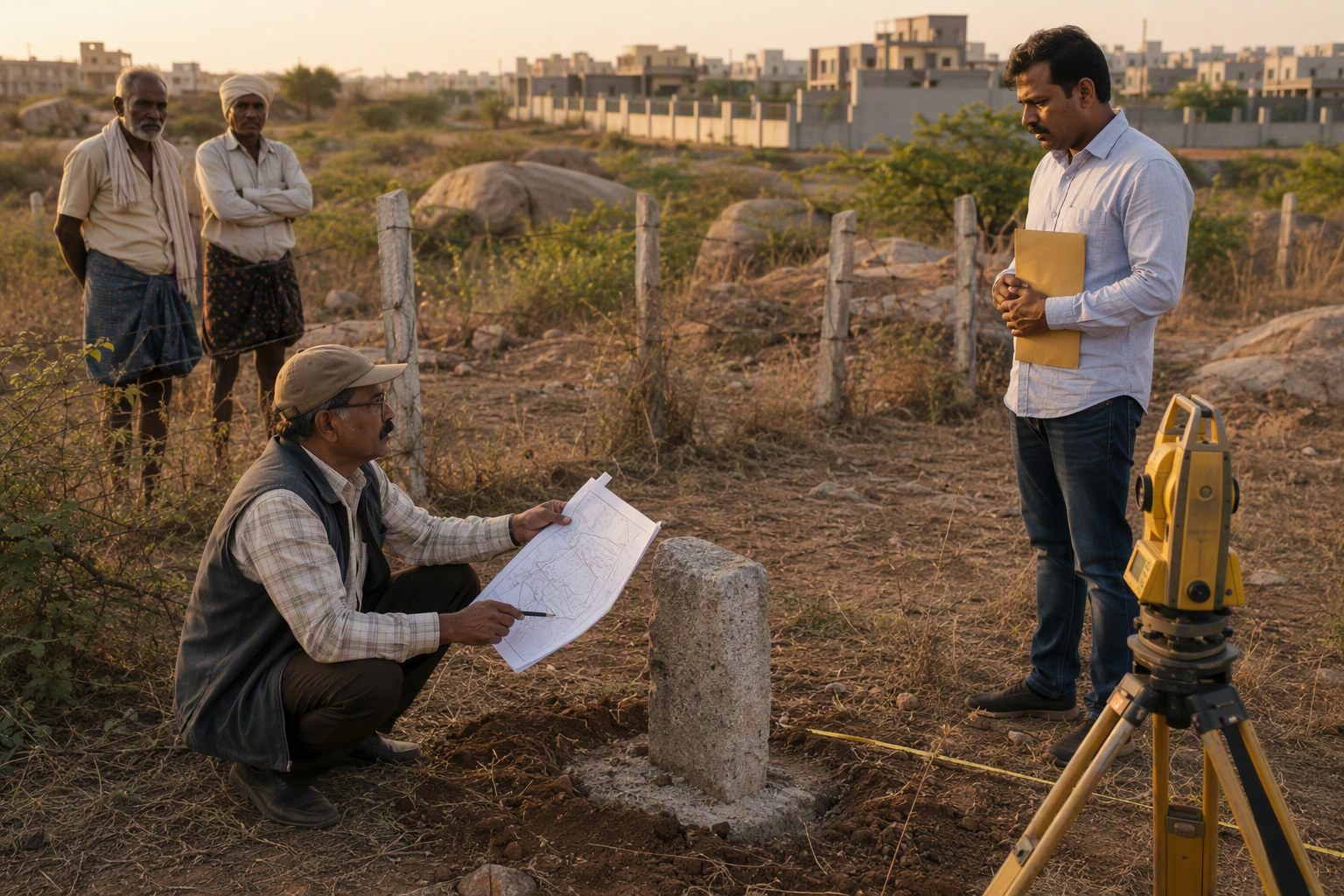



Can an old passbook beat a 22-A entry? Short answer: no, not by itself. An old pattadar passbook, pahani extract or revenue record can support a family’s possession history, but it does not automatically remove a land parcel from the prohibited properties list under Section 22-A. If a survey number is blocked in registration records, the Sub-Registrar Office will usually treat that entry seriously until a competent authority corrects it, clarifies it, or a court order deals with it.
This doubt comes up almost every week in Hyderabad’s growth belts. A seller in Kokapet says the land is ancestral. A broker in Shankarpally shows an old passbook. A family in Bachupally produces pahanis from earlier years. The buyer asks: if the passbook is old, does it prove the land is clean? In our experience, that is exactly where buyers get trapped. History is useful, but registration risk is a separate issue.
Verified database mapping of prohibited properties shows 3,076,153 Section 22-A entries. That is about 30.76 lakh prohibited property records. For a buyer, this number is not just a headline. It means one wrong survey number, one missed village name, or one assumption based on old papers can block a registration after token advance is already paid.
Can an Old Passbook Beat a 22-A Entry? Lawyer’s Direct Answer
An old passbook is evidence. A 22-A entry is a registration barrier. Evidence can help you challenge or clarify the barrier, but it does not erase the barrier on its own.
That is the practical lawyer view. A pattadar passbook shows that revenue records recognised a person as pattadar at a point in time. A pahani may show cultivation, possession, nature of land, survey number and names recorded in the revenue system. Dharani entries may show current mutation status. All these matter. But Section 22-A operates at the registration level. If the property is shown as prohibited, the SRO may refuse registration unless the entry is removed, corrected, or the buyer produces an acceptable legal basis.
For buyers, the mistake is treating one document as a master key. In Telangana land due diligence, no single paper is enough. Old passbook, latest Dharani status, pahani, EC, link documents, court cases, assigned land angle, government land angle, ceiling surplus angle, wakf/endowment angle, layout approval and SRO position have to be read together.
Before paying advance, run the survey number through Section 22-A Prohibited Property Check. Then match the village and mandal using Survey Number Finder and identify the correct registration jurisdiction through Find Your SRO Office. These are not cosmetic checks. They can save a buyer from paying lakhs in advance on land that cannot be registered in the normal course.
Why Can’t an Old Passbook Beat a 22-A Entry Automatically?
Because both records answer different questions.
| Document or record | What it usually shows | What it does not prove by itself |
|---|---|---|
| Old pattadar passbook | Revenue recognition of pattadar details at an earlier time | That the land is free from all prohibitory entries today |
| Pahani / adangal | Cultivation, possession, survey details and recorded names for that period | That title is marketable for sale registration |
| Dharani status | Current revenue mutation position for many agricultural lands | That there is no separate SRO-level objection |
| Encumbrance Certificate | Registered transactions and charges reflected in registration records | That unregistered claims, government objections or prohibited entries do not exist |
| 22-A prohibited property entry | Registration restriction or objection against property category or survey number | Final title decision in every dispute; it may need correction or legal challenge |
A lawyer will ask a simple question: what is the source of the 22-A entry? If the entry is because the land is recorded as government land, assigned land, endowment property, wakf property, ceiling surplus land, water body, road, burial ground, forest-related land, or another prohibited category, an old passbook cannot casually neutralise it.
There are cases where old revenue records help. For example, if a survey number was wrongly included due to clerical mapping, wrong village tagging, old sub-division confusion, or mismatch between old and new survey numbers, old passbooks and pahanis can support a correction request. But that is a process. It needs representation to the right authority, supporting documents, and in some matters, litigation. It is not a broker-level explanation to be accepted at the site.
Old Passbook Beat a 22-A Entry Claim: Common Hyderabad Buyer Scenarios
We’ve seen this argument in several Hyderabad-side markets where agricultural land, plotted ventures and urban expansion overlap.
Kokapet and Narsingi, Gandipet mandal
In the Kokapet-Narsingi belt, land values and buyer urgency are high. Sellers know buyers are nervous about missing out. If a seller shows an old passbook and says, ‘Registration problem will be cleared soon’, pause. In this belt, survey number accuracy is everything. A one-digit error, sub-division confusion or wrong village reference can change the whole reading. Check the current market value through Market Value / Guideline Value Search, but do not confuse ready reckoner value with title clearance.
Tellapur, Ramachandrapuram mandal
Tellapur has many layouts, apartments and land parcels with mixed document histories. A passbook may be relevant for an agricultural parent parcel, but if the buyer is purchasing a plot or share of land, the chain from agricultural land to layout approval and sale deeds must be tested. Use Encumbrance Certificate Search and then read the EC with the help of EC Analyzer. If the EC is clean but 22-A shows an objection, do not ignore the objection.
Bachupally, Bachupally mandal
In Bachupally, many buyers deal with old village land records, converted land parcels and apartment projects. A passbook shown for the parent land is not enough for a flat buyer. For projects, check approvals, land title flow and project registration status where applicable through RERA Project Lookup. The old passbook may explain the origin of title, but the flat buyer needs to know whether the developer had valid rights and whether any prohibited property issue touches the project land.
Adibatla, Ibrahimpatnam mandal
Adibatla attracts buyers looking at future growth, larger plots and farm-land-style purchases. Here, buyers must be careful with assigned land claims, old pahanis and village-level oral assurances. A seller saying ‘our family name is in old pahani’ is not the same as saying ‘the land is transferable and registrable today’. Both statements must be tested separately.
Can an Old Passbook Beat a 22-A Entry If the Entry Is Wrong?
Yes, an old passbook can help if the 22-A entry is wrong. But help is not the same as instant victory.
A wrong entry may happen due to old survey settlement issues, sub-division mismatch, wrong classification carried forward, clerical error, or a broad village-level entry applied too widely. In such cases, the seller’s legal team may collect old passbooks, pahanis, sethwar or village maps where available, link documents, previous registered sale deeds, mutation records and tax receipts. They may file a representation before the revenue authorities or seek a legal remedy.
From a buyer’s side, the safe position is this: let the seller clear it before sale. Do not accept a promise that the buyer can clear it later. Once you pay advance, your bargaining power drops. If the sale agreement is already signed, the agreement must clearly say what happens if the 22-A entry is not removed within the agreed time. The refund clause, time limit, document responsibility and dispute clause should be drafted properly. For draft support, buyers can use Legal Document Generator, but final wording should be reviewed by a property lawyer when the land is risky.
How Lawyers Read Old Passbook Beat a 22-A Entry Arguments
When a seller says the old passbook should override the 22-A entry, a lawyer will usually test the claim through these questions:
- Is the survey number exactly the same? Village, mandal and sub-division must match. Old and new survey references should not be casually mixed.
- Who is named in the old passbook? If the passbook is in the grandfather’s name, legal heirs, partitions, releases and later transfers must be checked.
- What is the land classification? Patta land, assigned land, government land and protected categories are not treated the same.
- Does the EC support the claimed title flow? Registered transactions must be consistent with the story told by the seller.
- What exactly does the 22-A entry say? Category, authority reference and property description matter.
- Has any authority already rejected removal? If yes, the risk is higher and the buyer needs stronger legal advice.
This is where local knowledge matters. A buyer sitting in Hitec City and buying land in Shankarpally mandal may not know old village boundaries. A family buying near Kompally may not know the SRO jurisdiction. A software professional booking land near Maheshwaram may rely only on a broker’s WhatsApp PDF. That is not due diligence. It is hope dressed up as paperwork.
Buyer Checklist Before Paying Advance on 22-A Risk Land
If there is even a hint of a 22-A issue, do this before paying token money.
- Check the exact survey number, village and mandal. Do not rely only on venture brochure names.
- Run a prohibited property check using Section 22-A Prohibited Property Check.
- Pull the EC using Encumbrance Certificate Search and compare it with link documents.
- Verify the correct SRO through Find Your SRO Office.
- Check ready reckoner value using Market Value / Guideline Value Search. This helps with stamp duty planning, but it does not clear title.
- Use Stamp Duty Calculator only after the title risk is under control. Stamp duty calculation should not be the first step.
- Ask the seller for the document that removes or clarifies the 22-A entry, not just old passbooks.
- Put every promise in the sale agreement. Oral assurance from broker, village elder or document writer is weak protection.
In our experience, serious sellers do not get offended by these checks. They may be slow, but they cooperate. Risky sellers rush the buyer, talk about another party waiting, and push for immediate advance. That behaviour itself is a signal.
What If the SRO Refuses Registration Despite Old Passbook?
If the SRO refuses registration due to a prohibited property entry, the buyer and seller must understand the reason in writing where possible. The next step depends on the nature of the entry. Some matters are corrected through revenue-side clarification. Some need higher authority involvement. Some need court proceedings. Some should simply be avoided by buyers because the legal cost and time risk are not suitable for a normal homebuyer or small investor.
A buyer should not assume that registration refusal is a small technical problem. In land deals, registration is the stage where many hidden issues become visible. If the property cannot be registered, possession and old papers may not give the buyer the marketable title they expected.
For apartment buyers, the same principle applies in a different way. If the project land has any prohibited property background, old parent documents alone are not enough. Check approvals, RERA status where applicable, EC, mortgage releases, sanctioned plan and land ownership chain. If the building is already constructed, tools like Composite Value Calculator and Building Value Calculator can help with value assessment, but legal title must come first.
Lawyer Opinion: Old Papers Are Not Waste, But They Are Not a Free Pass
I do not dismiss old passbooks. In many Telangana land matters, old passbooks and pahanis are valuable. They may show long possession, revenue recognition and family history. They may help correct a wrong entry. They may support a legal case. But buyers must stop treating them as a magic shield against Section 22-A.
The cleaner approach is simple. First, confirm whether a 22-A entry exists. Next, understand why it exists. Then ask whether the seller has already obtained a valid correction, deletion, clarification or court order. Only after that should price, stamp duty, advance and registration date be discussed seriously.
Hyderabad’s land market rewards speed, but it punishes careless speed. In hot belts like Kokapet, Tellapur, Bachupally, Shankarpally and Adibatla, documents must be read with village and mandal context. A passbook from an earlier decade may be a good starting point. It is not the finish line.
The buyer’s safest answer to the seller is polite but firm: ‘Clear the 22-A issue first, then I will proceed.’ That one sentence can save years of stress.
Frequently Asked Questions
Can an old passbook beat a 22-A entry in Telangana?
No. An old passbook can support title history or possession, but it cannot automatically override a Section 22-A prohibited property entry. The entry must be corrected, removed or legally dealt with by the proper authority.
Should I pay advance if the seller says the 22-A entry is wrong?
Avoid paying advance until the seller produces a valid correction, clarification or legal order. If you still proceed, the agreement must clearly cover refund, time limit and responsibility for clearing the entry.
Does a clean EC mean there is no 22-A problem?
Not always. An Encumbrance Certificate shows registered transactions and charges reflected in registration records. A prohibited property entry is a separate check and must be verified separately.
Which details should I match while checking 22-A status?
Match the exact survey number, sub-division, village, mandal and SRO jurisdiction. Many mistakes happen when buyers rely on locality names instead of revenue village details.
Can a wrong 22-A entry be removed?
Yes, if it is genuinely wrong and supported by records. Old passbooks, pahanis, link documents and authority records may help. But removal is a formal process, not an automatic result.