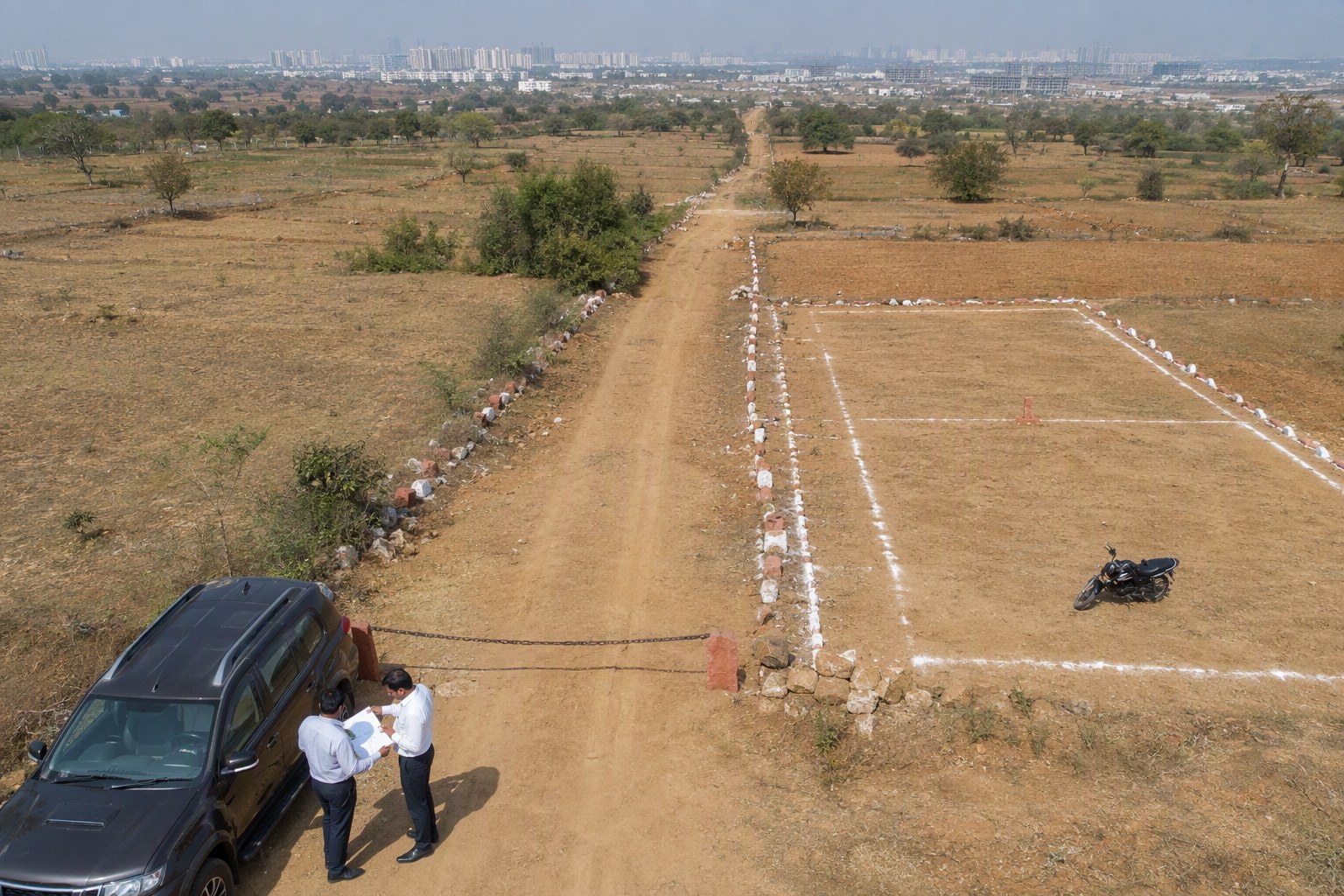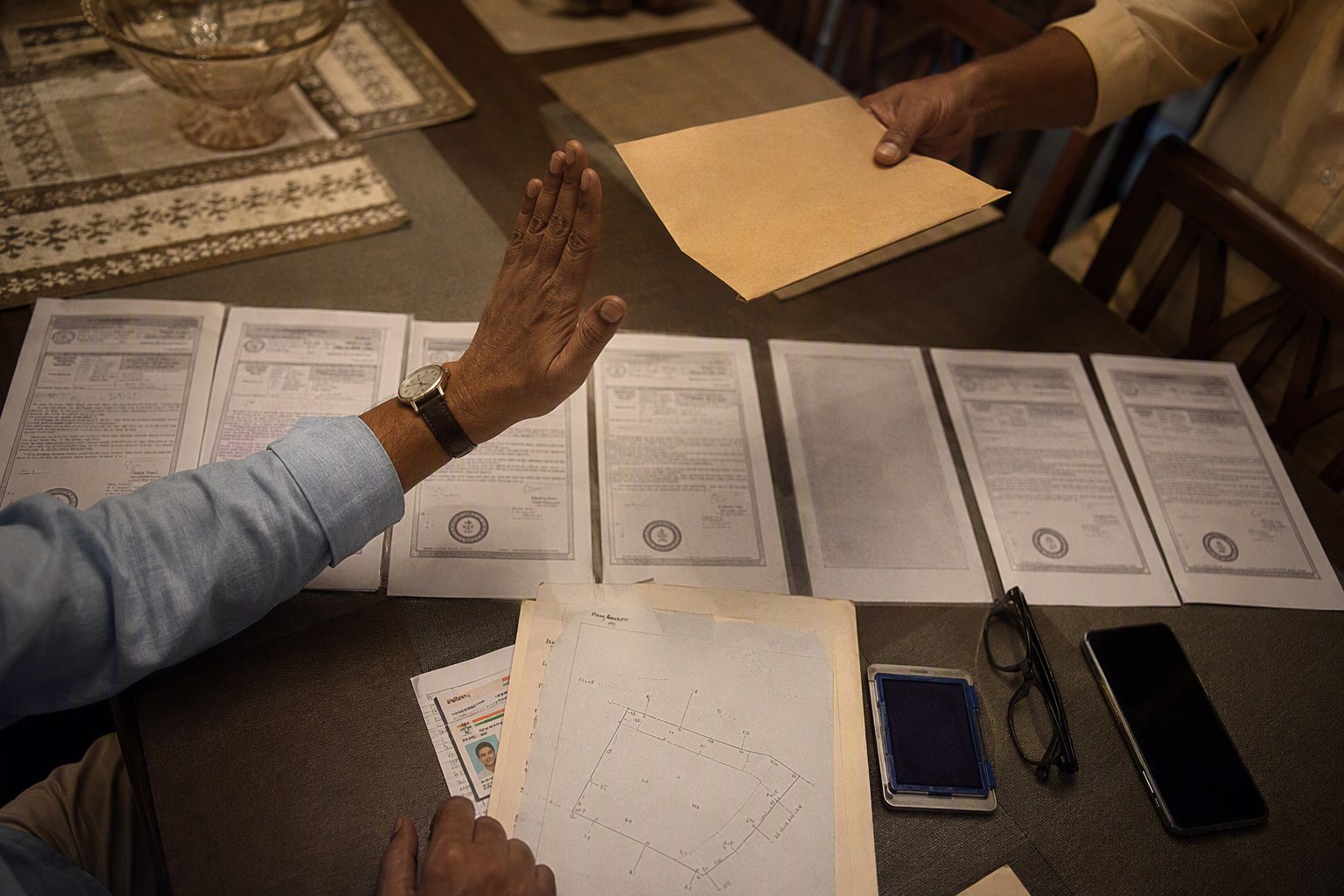



Hyderabad Case Study: A resale plot transaction in the Narsingi-Manikonda belt was paused last month after the main survey number looked clean, but the survey subdivision in one supporting record did not match the registered sale deed. The buyer was ready with token advance, the seller had an old link document, and the broker was pushing for a quick agreement. But one wrong subdivision number changed the tone of the deal.
The caution was not theoretical. Telangana has 1,47,934 prohibited property records under Section 22-A. In a market where one digit in a survey subdivision can decide whether the SRO accepts or refuses registration, the buyer’s lawyer advised a hold. In our experience, this is exactly where Hyderabad plot buyers make costly mistakes: they verify the main survey number and forget to verify the subdivision.
Our view is simple: a clean main survey number is not enough. In Telangana land checks, the subdivision, extent, village, mandal and SRO mapping must all sit together.
Hyderabad Case Study: What happened in the resale plot deal
The property was a resale open plot of about 267 square yards in a plotted layout close to the Narsingi, Manikonda and Puppalaguda corridor of Rangareddy district. The locality is popular with buyers working in Financial District, Gachibowli, Kokapet, Nanakramguda and HITEC City. Plots here do not stay in the market for long if the title is neat.
The quoted market rate in this specific negotiation was around ₹68,000 per square yard, putting the deal value at roughly ₹1.81 crore. The buyer also checked the government market value, commonly called ready reckoner or guideline value, through the Market Value / Guideline Value Search. The ready reckoner rate was lower than the resale quote, as usually happens in active western Hyderabad micro-markets.
The seller’s side produced a registered sale deed, old link documents, property tax references and a layout sketch. At first glance, the main survey number was consistent across most papers. The EC did not show any recent mortgage. The location matched the physical possession. The neighbours also confirmed that the seller had been holding the plot for years.
But during document verification, the buyer’s consultant noticed that one record carried the subdivision as Survey No. 112/AA, while the sale deed and earlier link document referred to Survey No. 112/A. The village name was the same. The mandal was the same. The main survey number was the same. Only the subdivision suffix was different.
Many buyers may ignore this as a typing mistake. We would not. In Telangana, that small suffix can point to a different land parcel, a land classification issue, or a record that has been altered during mutation, layout approval, road widening or government land reconciliation.
Hyderabad Case Study: Why the survey subdivision mismatch mattered
Survey numbers in Telangana are not casual labels. They are the spine of rural and peri-urban land records. Hyderabad’s expansion has pulled many former village lands into premium real estate markets. Narsingi, Kokapet, Puppalaguda, Tellapur, Osman Nagar, Kollur, Mokila, Bowrampet, Bachupally and Shankarpally have all seen this shift.
In such areas, the same main survey number may have several subdivisions. One part may be patta land. Another may have been acquired for road or public use. A third may fall under assigned land, ceiling surplus, endowment, waqf, government land or litigation. This is why Section 22-A checks are non-negotiable before paying serious money.
Section 22-A entries are especially sensitive because the SRO can refuse registration if the property falls under a prohibited category. Telangana’s database carrying 1,47,934 prohibited property records is a big red flag for buyers who still depend only on broker assurance.
For this case, the team ran the main number and the suspected subdivision through the Section 22-A Prohibited Property Check. The main survey number did not immediately raise an issue. But the alternate subdivision needed deeper confirmation, because the boundary description in the deed was not strong enough to close the doubt.
The key mismatch
| Document checked | Survey detail seen | Risk level |
|---|---|---|
| Registered sale deed | Main survey number with subdivision 112/A | Medium, because it needed cross-checking |
| Old link document | Same main survey number and 112/A | Lower risk |
| One supporting land record extract | Subdivision shown as 112/AA | High risk until clarified |
| EC search | No recent mortgage seen for the deed chain | Useful, but not final proof |
| Section 22-A check | Main number appeared clear, subdivision needed caution | Deal paused |
The buyer did the right thing: token was stopped before agreement
The buyer had planned to pay a token advance of ₹5 lakh and sign an agreement of sale within 48 hours. After the subdivision mismatch surfaced, the token was not paid. This single decision protected the buyer from a possible chain of stress: refund fights, legal notices, SRO refusal, loan delay and resale problems later.
We have seen buyers in Hyderabad proudly say, EC clean hai, problem kya hai? That is not enough for land. An Encumbrance Certificate mostly shows registered transactions at the SRO. It may not capture every government restriction, classification problem, court dispute, family claim, possession issue or wrong survey mapping. Still, EC is a must-have first layer. Use the Encumbrance Certificate Search, but never treat it as the only title check.
In this case, the buyer asked for three clarifications before moving ahead:
- A latest Dharani or revenue record extract showing the exact survey subdivision and extent.
- A written clarification from the seller explaining why 112/AA appeared in one record.
- Confirmation from the correct SRO and revenue side that the plot extent did not overlap with a prohibited or government-notified parcel.
That is a sensible approach. If the seller has clean title, these checks may take time but should not threaten the deal. If the seller starts avoiding questions, the buyer gets a signal without losing money.
How subdivision errors happen in Hyderabad land records
Not every mismatch means fraud. Some are genuine clerical mistakes. Some come from old handwritten pahani records, village maps, mutation entries, layout conversion, or digitisation differences between revenue and registration systems. But a buyer cannot assume innocence when the asset value is above ₹1 crore.
In Hyderabad’s western growth belt, we regularly see these patterns:
- Old village names versus current municipal identity: A plot may be marketed as Manikonda or Narsingi, but the revenue village may be Puppalaguda, Khanapur, Kokapet or another nearby village.
- Mandal changes: Properties around Gandipet mandal, Rajendranagar, Serilingampally and Shankarpally may have older documents referring to earlier administrative mapping.
- Subdivision suffix confusion: A, AA, E, EE, Paiki and part numbers are not interchangeable.
- Layout plotting after agriculture land: The original survey number may be large, but the buyer is purchasing one small plot carved from it.
- Boundary mismatch: North, south, east and west boundaries may not match the layout plan or physical site.
Our opinion: if the survey subdivision is wrong, do not rush just because the price is attractive. In areas like Mokila, Kollur and Tellapur, buyers sometimes accept weak papers because prices are moving fast. That is a bad habit. Land does not forgive casual verification.
Hyderabad Case Study: The exact verification trail we followed
The verification was not complicated, but it was disciplined. The buyer’s side did not depend only on a lawyer’s quick title opinion. They checked revenue, registration and market-value points together.
1. Survey number and village confirmation
The first step was to identify the exact revenue village, mandal and survey subdivision. For buyers, this is where the Survey Number Finder helps create a starting point. It is especially useful when the marketing name of the locality differs from the revenue village name.
2. Section 22-A prohibited property check
The second step was to check whether the survey number or subdivision had any match with prohibited property records. Since Telangana has 1,47,934 such records, this check is not optional. A property can look normal on the ground and still face registration issues.
3. EC and link document review
The EC was reviewed for the relevant period. The sale deed chain was compared with link documents. The mismatch did not appear in the registered deed chain, but it appeared in one supporting extract. That made the issue narrower, but not harmless.
4. SRO identification
The team checked whether the property fell under the correct Sub-Registrar Office jurisdiction. In fast-growing edges of Hyderabad, buyers sometimes approach the wrong SRO or assume jurisdiction based on the nearest main road. The Find Your SRO Office tool is a useful first check before document planning.
5. Guideline value and stamp duty estimate
The buyer compared market price with the ready reckoner value and estimated the registration outgo using the Stamp Duty Calculator. This helped separate price negotiation from title risk. A cheaper registration estimate cannot compensate for a risky subdivision.
6. Full property verification
Before signing, the buyer also queued the file for a wider check through the Property Verification Tool. In high-value resale plots, this step is worth the fee and time.
What the numbers said in this deal
The numbers were attractive, which is exactly why caution mattered. A 267 square yard plot at ₹68,000 per square yard in the Narsingi-Manikonda stretch is not an unusual conversation today. Depending on road width, layout status, approach road, HMDA approval, neighbouring development and distance from Outer Ring Road, resale rates can swing sharply.
| Item | Case figure | Buyer takeaway |
|---|---|---|
| Plot extent | 267 sq yd | Typical resale plot size for independent house buyers |
| Quoted rate | ₹68,000 per sq yd | Market-linked price in western Hyderabad belt |
| Approx deal value | ₹1.81 crore | High enough to justify deep verification |
| Proposed token | ₹5 lakh | Stopped before agreement |
| Statewide 22-A records | 1,47,934 | Subdivision check was necessary |
One practical point: buyers often spend days negotiating ₹1,000 per square yard but give only one evening to title verification. That is upside down. On a 267 square yard plot, ₹1,000 per square yard means ₹2.67 lakh. A bad title can freeze the full ₹1.81 crore.
What the seller should have done
The seller was not automatically wrong. But the seller’s response matters. A clean seller should be able to provide latest land records, old pahanis where available, mutation references, layout approval copies, link deeds, tax receipts and a proper explanation for any mismatch.
In this case, the seller first called it a typo. That may be true, but oral explanation is not enough. The buyer asked for documentary correction or confirmation. Until then, the sale stayed paused.
If the mismatch is genuinely clerical, the seller can usually support the file with certified copies, revenue clarification, updated extracts or a rectification route if required. If the mismatch points to a different parcel, the buyer must walk away or renegotiate only after legal clearance.
Lessons for Hyderabad resale plot buyers
Hyderabad plot buyers should treat survey subdivision as seriously as price, location and road width. This is even more true in Rangareddy, Medchal-Malkajgiri and Sangareddy growth corridors, where agricultural land, plotted layouts and municipal expansion overlap.
- Do not pay token before checking the exact survey subdivision.
- Match sale deed, link deed, pahani or Dharani extract, layout plan and EC.
- Check Section 22-A for the main survey number and the subdivision.
- Verify the correct revenue village and mandal, not just the marketing locality.
- Use ready reckoner value for stamp duty planning, not for title comfort.
- Take SRO jurisdiction seriously before preparing sale documents.
- If any record shows a different suffix, pause and get written clarification.
We've seen many Hyderabad deals survive after a mismatch is clarified. We have also seen buyers saved because they paused at the right time. This Narsingi-Manikonda case falls in the second category for now: not rejected, but not safe enough for payment.
Final word on this Hyderabad Case Study
The biggest lesson from this Hyderabad Case Study is that land verification is not about ticking one box. A main survey number can look clean while a subdivision creates risk. With Telangana carrying 1,47,934 prohibited property records, buyers cannot depend on casual checks, broker confidence or old photocopies.
For resale plots in Narsingi, Manikonda, Kokapet, Puppalaguda, Tellapur, Kollur, Mokila, Shankarpally and similar high-demand areas, the smart sequence is clear: identify the exact survey subdivision, check Section 22-A, review EC, confirm SRO, compare ready reckoner value, then discuss token. Not the other way round.
In this case, the sale was paused at the right stage. That pause may feel irritating during negotiation, but it is much cheaper than discovering the problem at the registration counter.
Frequently Asked Questions
Can a wrong survey subdivision stop property registration in Telangana?
Yes. If the subdivision points to a different land parcel or matches a prohibited property record, the SRO can raise objections or refuse registration. Buyers should verify the exact subdivision before paying token.
Is a clean Encumbrance Certificate enough for buying a Hyderabad plot?
No. EC is useful, but it mainly reflects registered transactions. For land, you must also check survey subdivision, pahani or Dharani records, Section 22-A status, layout approval and SRO jurisdiction.
What is Section 22-A in Telangana property checks?
Section 22-A relates to properties that are prohibited from registration, including certain government, assigned, endowment, waqf or disputed lands. Telangana has 1,47,934 prohibited property records, so buyers should check carefully.
Should I pay token if only the main survey number is clear?
Better not. The main survey number and subdivision must both match across sale deed, link documents, revenue records and layout papers. Pay token only after the mismatch is clarified in writing.
Which tools help verify a resale plot in Hyderabad?
Start with survey number identification, Section 22-A check, EC search, guideline value search, SRO lookup and stamp duty estimate. For high-value plots, a full property verification is safer.