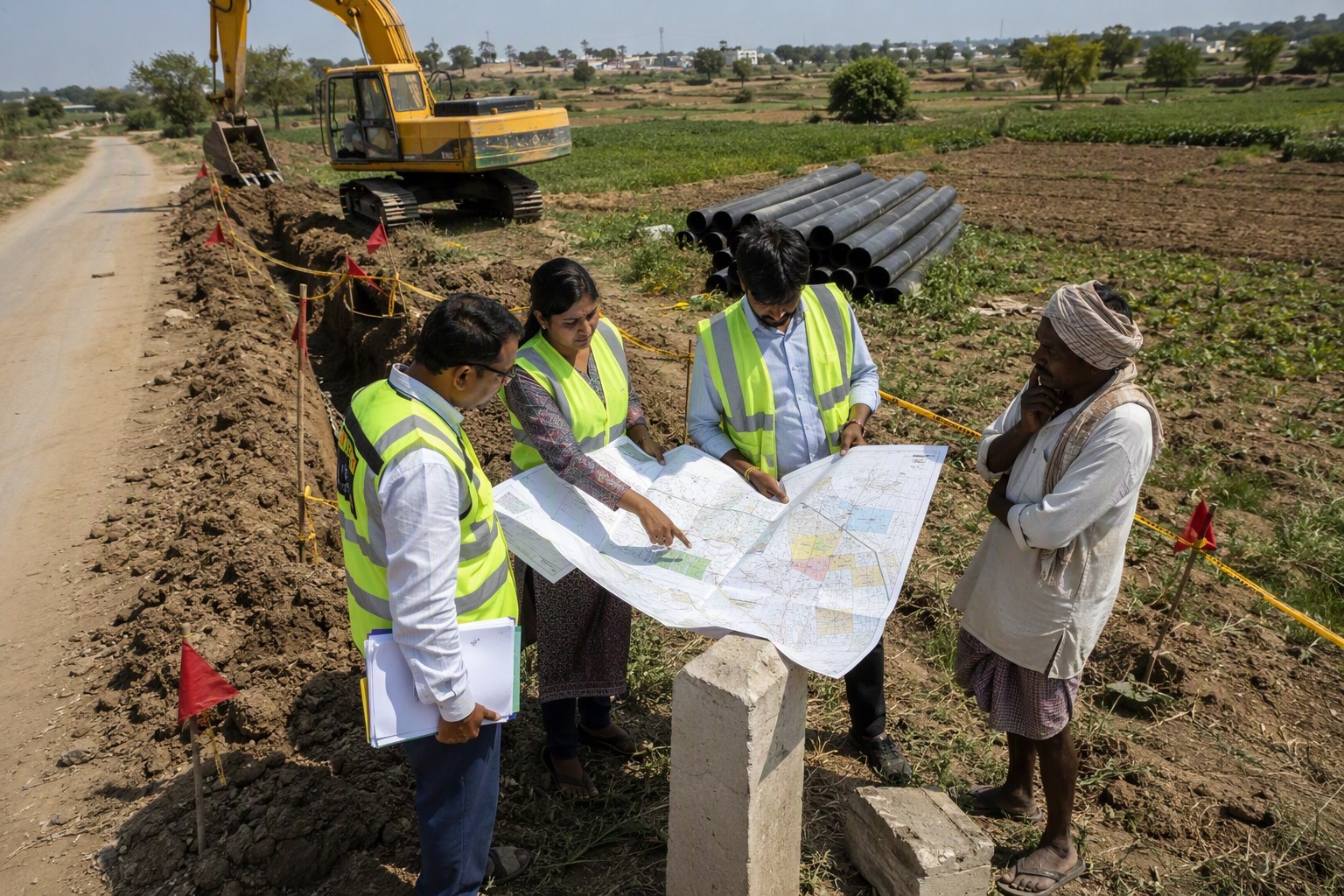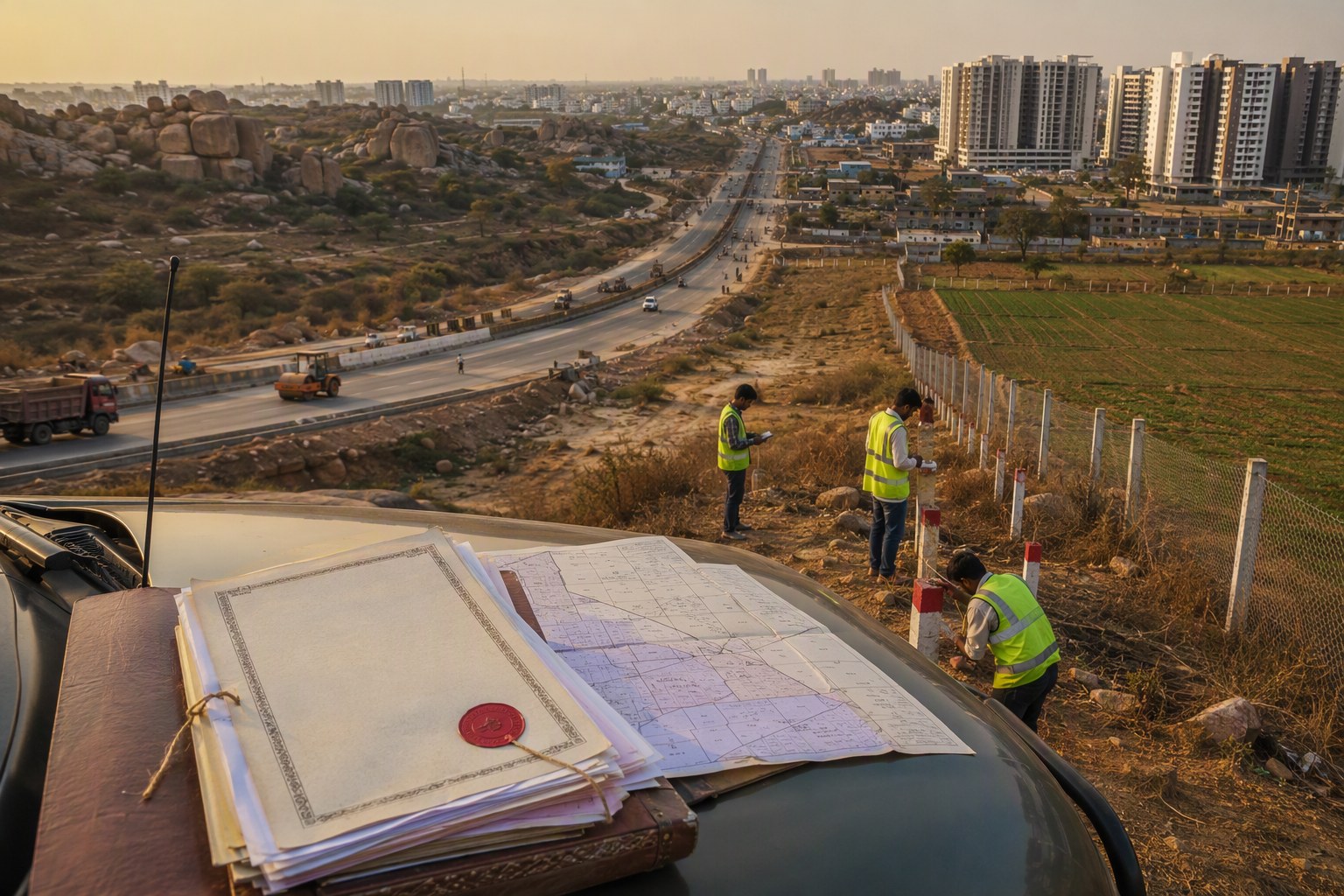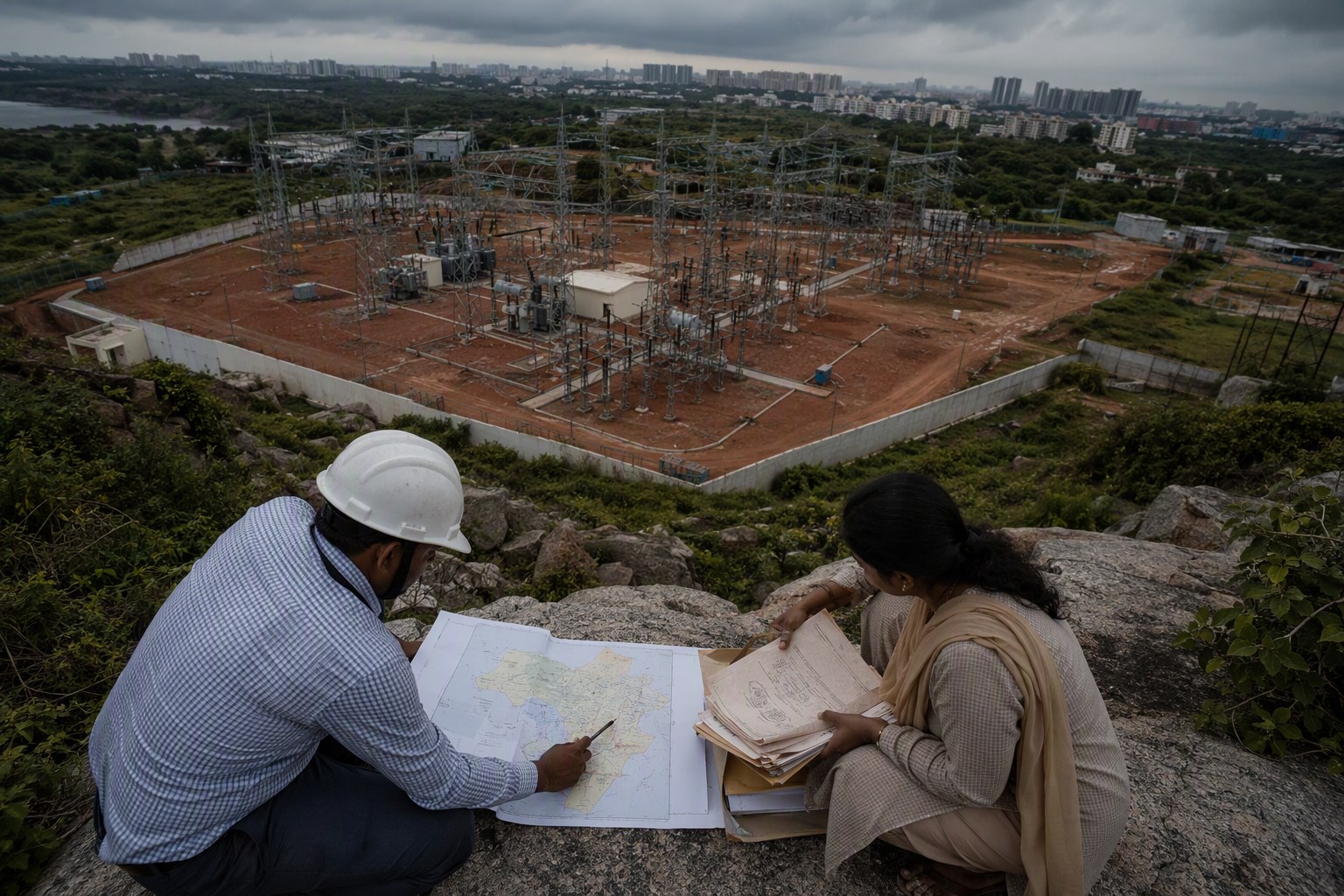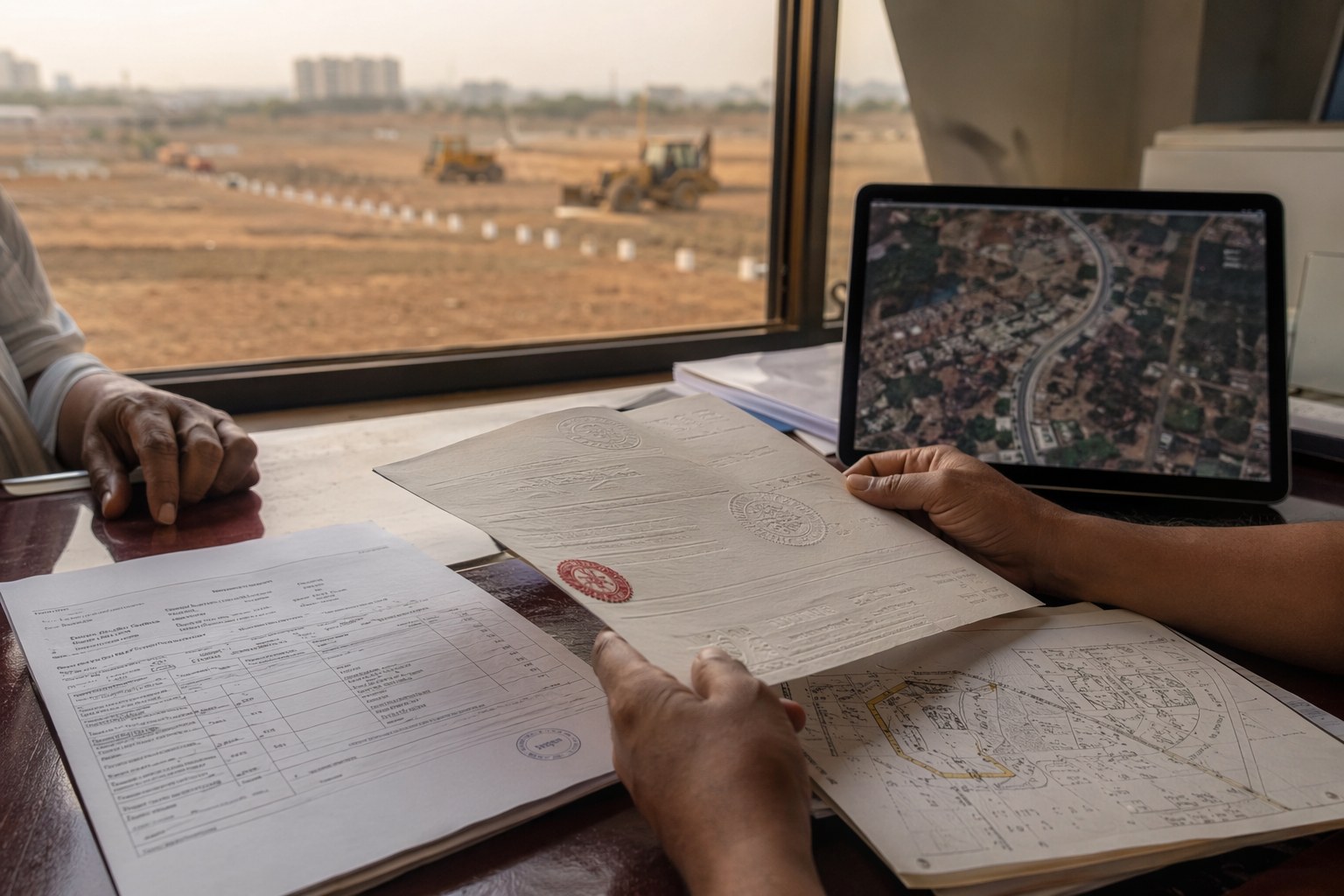
Hyderabad RRR land notices are changing the first question serious plot buyers should ask near the proposed Regional Ring Road influence areas: not “what is the rate?”, but “is the title clean, is the survey number affected, and is the land free from Section 22-A restrictions?”
Across mandals that buyers usually track for RRR-led appreciation — Shankarpally, Chevella, Moinabad, Kandukur, Yacharam, Ibrahimpatnam, Bhuvanagiri and Choutuppal — land enquiry has become more cautious. In our experience, the buyer who checks only location and road access is taking half a decision. The other half sits in EC entries, pahani records, Dharani details, SRO jurisdiction and the prohibited properties list.
The immediate trigger is the land notice environment around large infrastructure corridors. Once acquisition, alignment discussion, road widening, access control or compensation-related movement starts in a village, informal plot marketing also becomes louder. Some sellers present “RRR nearby” as if that alone clears all legal risk. It does not.
Hyderabad RRR land notices make EC the first document, not the last
Earlier, many Hyderabad and Rangareddy buyers used to ask for an Encumbrance Certificate only after finalising the plot and paying token advance. That approach is now risky near infrastructure corridors. An EC should be pulled before negotiation becomes serious, especially if the land is in a village where road, acquisition or survey activity is being discussed.
An EC shows registered transactions, mortgages, gift deeds, sale deeds, court attachments that reached registration records, and other recorded interests. It will not answer every revenue question, but it gives the first formal picture of ownership movement. For buyers checking land in Mokila side growth belts, Chevella villages, Moinabad farm layouts, Ibrahimpatnam outskirts or Bhuvanagiri-facing stretches, this is basic hygiene.
Use our Encumbrance Certificate Search before you pay any advance. If the EC has gaps, repeated transfers in a short period, unusual family settlement entries or old mortgage references, do not treat it as a small technical issue. Ask for the parent link documents and get the chain checked.
Our view is simple: RRR may improve access over time, but a future road cannot cure a defective title. A buyer should verify the land first and then discuss appreciation.
Hyderabad RRR land notices and the 22-A risk buyers cannot ignore
Section 22-A checks are becoming a front-desk requirement for plots near infrastructure corridors. As per latest IGRS data available in our database, Telangana has 3,076,153 prohibited property entries. That number alone should tell buyers why a casual “registration ayipotundi” assurance is not enough.
Section 22-A prohibited properties may include government lands, assigned lands, endowment lands, wakf-related entries, ceiling surplus lands, certain notified lands and other categories where registration can be restricted. The exact reason depends on the entry and the underlying record. Near villages seeing infrastructure attention, buyers must check whether the survey number, sub-division or adjoining land has any such marking.
Before shortlisting, run a Section 22-A Prohibited Property Check. If the land is clean there, still continue with EC, Dharani, pahani, layout and SRO checks. If it appears in the prohibited list, do not rely on verbal promises that “it will be removed soon”. Ask for the official removal order, mutation record and registration department clarity.
Why RRR corridor plot marketing needs stricter document reading
The Regional Ring Road story has created strong buyer interest beyond the Outer Ring Road. We have seen enquiries moving from established western localities like Kokapet, Narsingi, Kollur and Tellapur towards more land-heavy belts such as Shankarpally, Chevella and Moinabad. On the eastern and south-eastern side, buyers track Ibrahimpatnam, Yacharam and Kandukur. Towards the north-east, Bhuvanagiri and Choutuppal frequently come up in land discussions.
That does not mean every acre in these mandals is automatically safe or investment-worthy. Village boundaries matter. Survey number matters. Land use matters. Access from an existing road matters. So does whether the plot is part of an approved layout or only a private sub-division shown on paper.
A common problem is the “near RRR” claim. Near can mean different things: near a proposed road, near a village road that may connect later, near an acquisition-affected patch, or simply near in broker language. Buyers should ask for the exact village, mandal, survey number, SRO and land extent. Then check records. No serious land deal should proceed only on a location pin.
Document checklist for Hyderabad RRR land notices areas
For RRR-influenced villages, I would put the checklist in this order:
- Survey number confirmation: Match the survey number in sale deed, pahani, Dharani and village map. Use the Survey Number Finder if you are starting with incomplete details.
- Section 22-A check: Verify whether the survey number appears in the prohibited property list.
- EC search: Pull EC for the relevant period and compare names, extents and document numbers.
- SRO jurisdiction: Identify the correct Sub-Registrar Office using Find Your SRO Office. Wrong SRO assumptions create confusion during document collection.
- Guideline value: Check government market value through Market Value / Guideline Value Search. Do not confuse guideline value with actual selling price.
- Land use and layout status: Check whether the land is agricultural, residential, conservation, industrial or affected by planning controls. The Land Use Zone Finder is useful at this stage.
- Registration cost estimate: Before final budgeting, use the Stamp Duty Calculator.
What buyers should ask sellers before paying token
In Hyderabad land deals, token advance is often paid too early. Near RRR-influenced corridors, buyers should slow down. Ask these questions in writing, preferably over email or WhatsApp so there is a trail:
| Buyer question | Why it matters |
|---|---|
| What is the exact village, mandal and survey number? | All serious verification starts from these details. |
| Is the land in any acquisition notice, road widening plan or alignment discussion? | Compensation and ownership rights can become complicated. |
| Is the survey number free from Section 22-A restrictions? | Registration may be blocked if it is prohibited. |
| Can you share the latest EC and parent documents? | Title chain must match seller claims. |
| Is it part of an approved layout? | Unapproved plotting can create resale and building permission issues. |
| Which SRO handles registration? | SRO records help validate document history. |
EC, 22-A and Dharani should be read together
One mistake buyers make is treating a single clean document as full safety. A clean EC does not automatically mean clean revenue title. A Dharani entry alone does not prove there is no registered mortgage. A sale deed does not prove the land is outside prohibited categories. You need to read them together.
For example, a buyer looking at land around Chevella mandal should compare the seller name in Dharani, the pattadar passbook details, the latest pahani, EC transaction history and the 22-A list. If there is a mismatch in extent, spelling, father name, survey subdivision or classification, resolve it before agreement of sale.
Similarly, a buyer checking a plotted venture near Shankarpally or Ibrahimpatnam should ask whether the layout has required approvals and whether roads, open spaces and approach are properly recorded. If the land is marketed as a villa plot, check planning permissions, road width and land use. Tools like Road Width Check and Property Verification Tool can help organise the first round of checks.
How sellers and developers may respond
Good sellers will not object to document verification. In fact, serious landowners and developers near RRR corridors should keep EC, 22-A status, market value, pahani, layout approvals and SRO details ready. The market is becoming more record-driven. Buyers from Hyderabad, NRIs and salaried investors are no longer accepting only hand-drawn maps and oral route stories.
Developers may also need to explain whether the land is inside a planned layout, whether open space reservation applies, and whether the approach road is legally available. For plotted layouts, the buyer should review approval conditions carefully. Where RERA applies, use RERA Project Lookup to check project registration details.
Our take on Hyderabad RRR land notices for plot buyers
The RRR story is real as an infrastructure theme, but land buying should remain boring and document-heavy. That is where money is protected. If notices, alignments or acquisition-related activity are being discussed in a village, do not rush because a broker says rates will move. First confirm whether the land can be legally sold, registered and enjoyed without dispute.
For buyers, the safest sequence is: survey number, 22-A, EC, Dharani, SRO, land use, layout approval, road access, guideline value and only then price negotiation. We have seen enough Hyderabad land transactions to say this clearly: the best plot is not the one with the loudest future story. It is the one where the documents stand quietly without drama.
Frequently Asked Questions
Should I check EC before paying token for land near Hyderabad RRR areas?
Yes. EC should be checked before token advance, especially in RRR-influenced mandals like Shankarpally, Chevella, Moinabad, Ibrahimpatnam, Yacharam, Kandukur, Bhuvanagiri and Choutuppal. It helps identify registered transactions, mortgages and title movement.
What is Section 22-A in Telangana property registration?
Section 22-A refers to prohibited property categories where registration can be restricted. These may include government, assigned, endowment, wakf or other notified lands, depending on the record. Telangana prohibited property entries in our database stand at 3,076,153 as per latest IGRS data.
Does a clean EC mean the land is fully safe?
No. A clean EC is only one part of verification. Buyers should also check Dharani, pahani, Section 22-A status, SRO records, land use, layout approval and road access before buying.
Which details are needed to verify an RRR corridor plot?
You need the exact village, mandal, survey number, seller name, extent, SRO, parent documents, latest EC, Dharani or pahani details, layout approval and land use information.