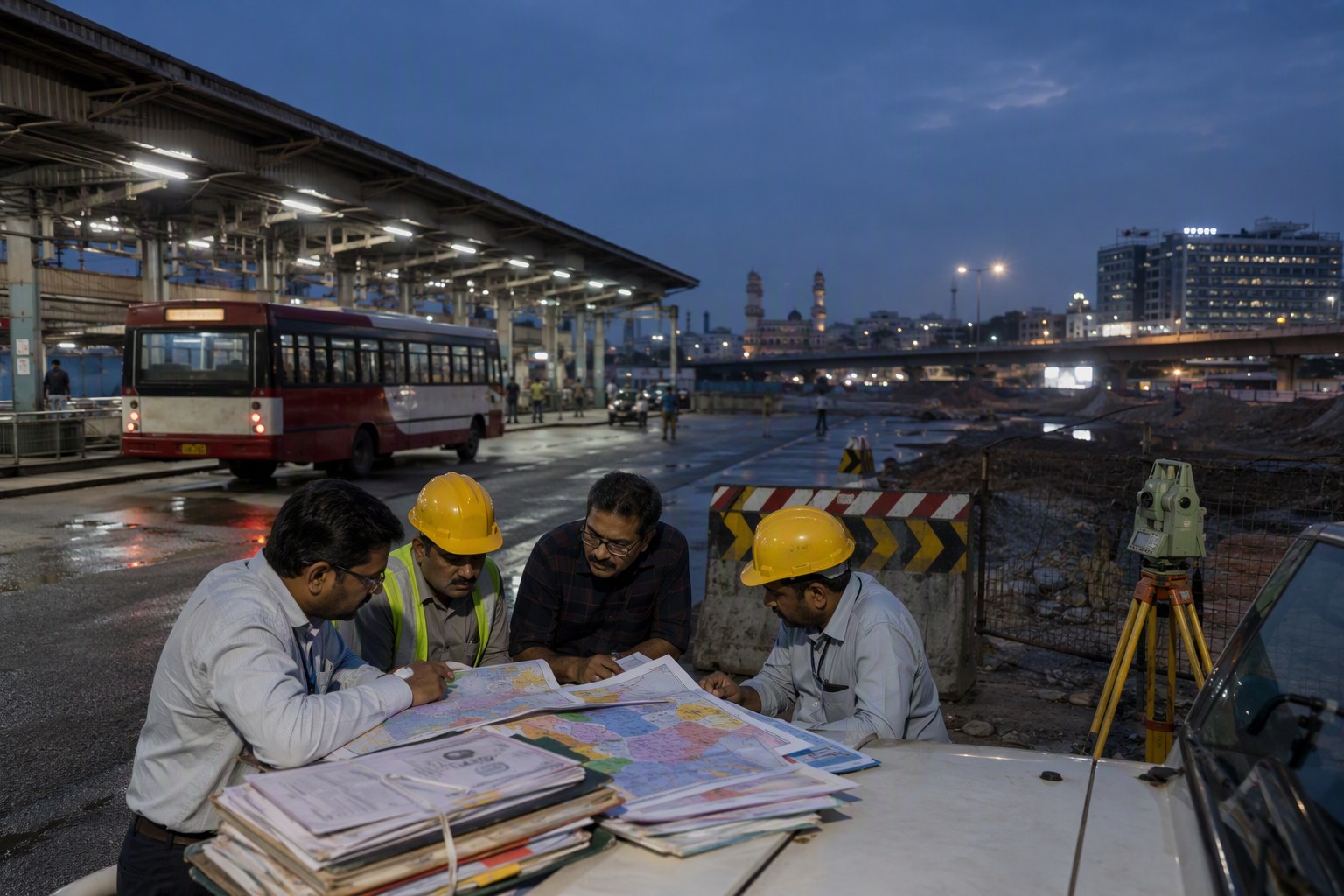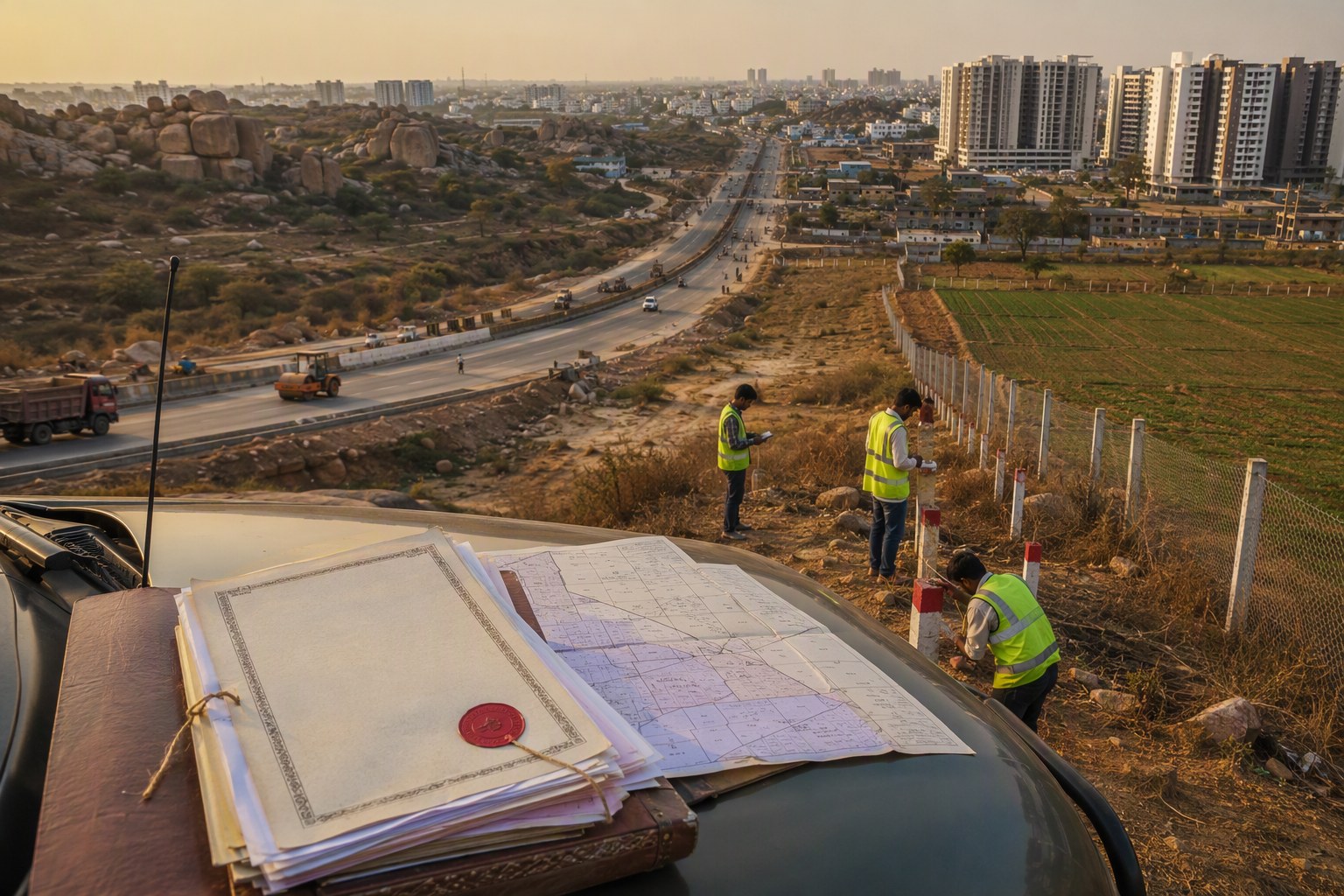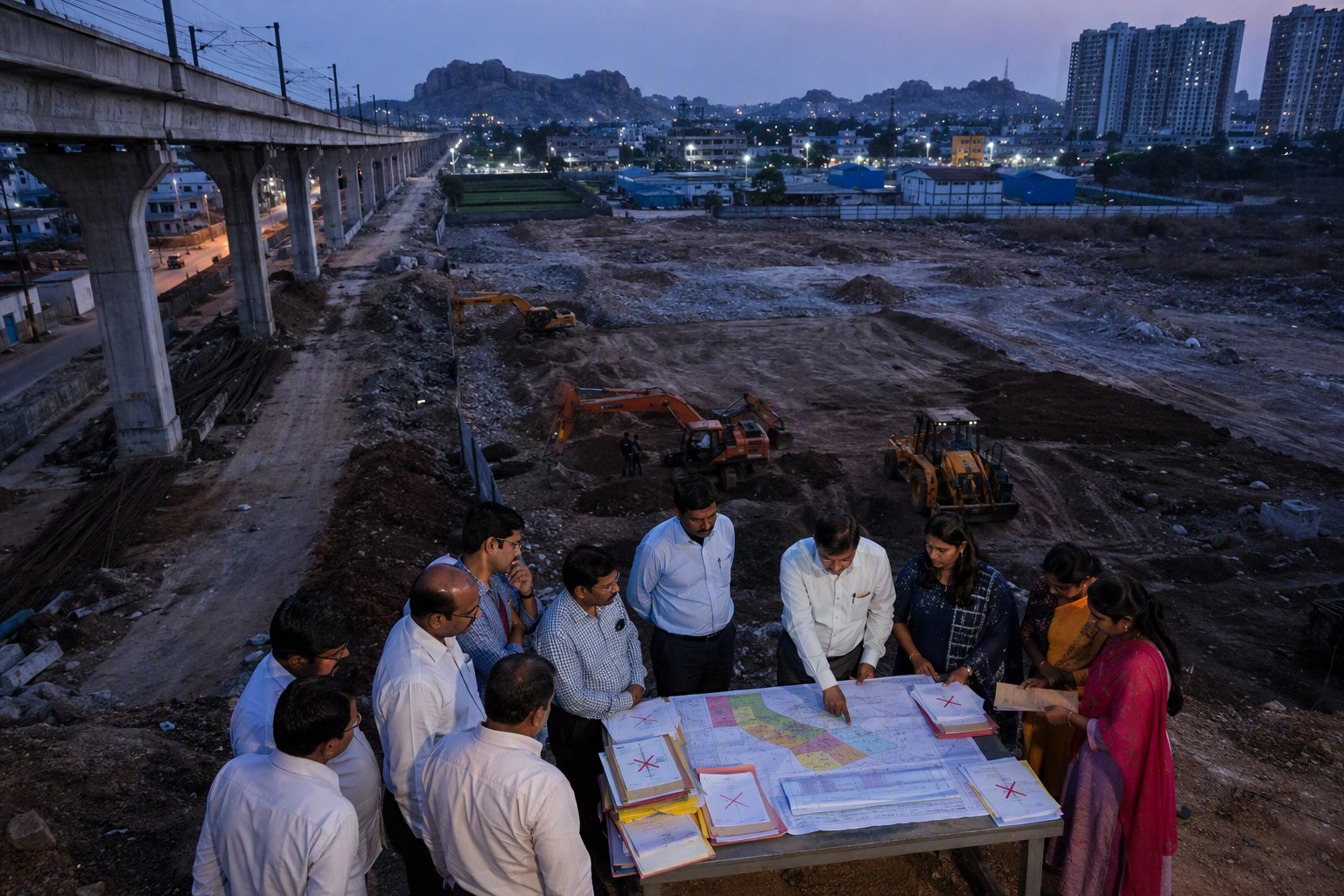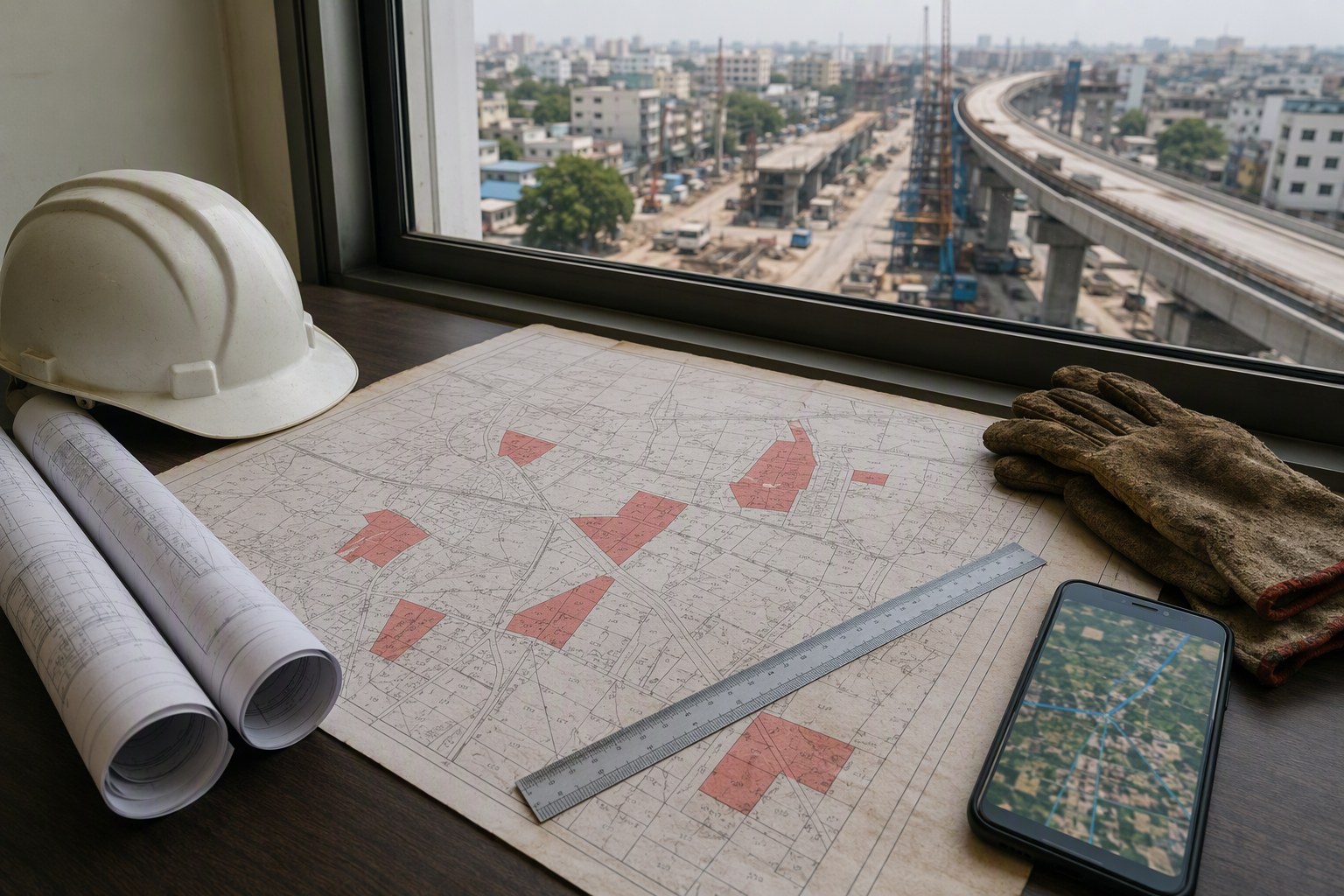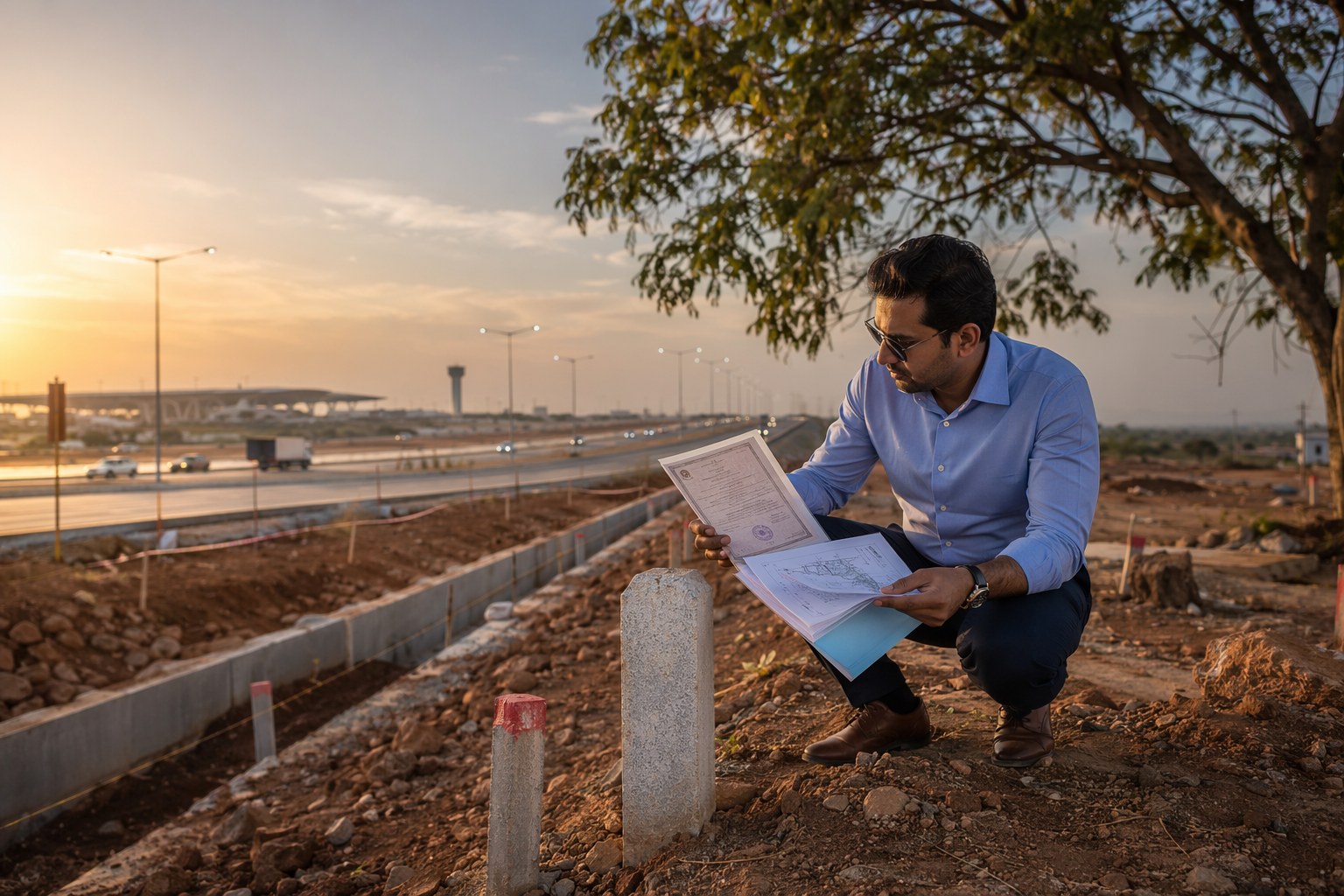
Hyderabad Airport Link Roads are again pushing plot buyers to ask a basic but often ignored question: can I legally and practically reach my land? In the airport-side belt — Shamshabad, Narkhuda, Mamidipally, Kothwalguda, Tukkuguda, Adibatla and parts of Maheshwaram — link road works and road-widening discussions are changing how buyers should read title papers, pahani entries, layout plans, access paths and setbacks before paying an advance.
The short answer is this: don’t buy only because a plot is “near airport road” or “next to proposed link road”. In our experience, airport-side land deals fail less because of distance from the main road and more because of unclear access, missing EC checks, 22-A restrictions, wrong survey boundaries, and road setbacks not understood at the time of agreement.
Hyderabad Airport Link Roads: why access proof is now the first document to check
Airport connectivity has always been a major selling point in south Hyderabad. Brokers speak of ORR access, Srisailam Highway, Bengaluru Highway, Shamshabad airport proximity, and upcoming road improvements. Fair enough. These corridors do matter for long-term usability.
But the ground reality is simple. A road on a map does not automatically give your plot a legal passage. Buyers must separate three things:
- Existing physical access — the road or cart track you can see on ground.
- Recorded legal access — road shown in layout, sale deed, village map, panchayat/HMDA records, or relevant revenue documents.
- Future road impact — widening, setback, acquisition, or alignment affecting part of the land.
We’ve seen buyers in Shamshabad mandal assume that a mud road beside a venture is public access. Later, when fencing comes up on neighbouring land, the same buyer has to negotiate passage or fight over boundaries. That is why every airport-side plot needs a clear access note before agreement.
A basic online check can start with the Survey Number Finder, followed by the Road Width Check and Land Use Zone Finder. These tools won’t replace field verification, but they help you ask sharper questions.
Hyderabad Airport Link Roads and the 22-A risk buyers should not ignore
Section 22-A screening has become a non-negotiable step in Telangana land buying. Verified.RealEstate database context shows 3,076,153 prohibited property records under Section 22-A. That number itself tells you why a casual “registration will happen, sir” statement is not enough.
A property can look clean on ground and still face registration restrictions because of government land classification, assigned land issues, endowment entries, wakf concerns, court matters, ceiling land, or other prohibited categories. In the airport belt, where older agricultural survey numbers are being converted, plotted, merged, divided, and marketed, this check becomes even more relevant.
Before paying token advance, buyers should run a Section 22-A Prohibited Property Check. If the survey number, village name or mandal details are unclear, pause the deal. Ask for the latest pahani, Dharani details where applicable, link documents, mutation trail, and SRO-level clarity.
My view is blunt: if a seller is rushing you to pay before giving the survey number, village name and SRO details, that is not urgency. That is a warning sign.
What EC checks reveal in airport-side plot transactions
An Encumbrance Certificate is not just a bank loan formality. Around fast-moving land pockets such as Tukkuguda, Adibatla, Mamidipally and Kothwalguda, EC reading can expose sale history, mortgages, prior agreements, gift deeds, partition deeds, and sometimes unusual transaction patterns.
Use the Encumbrance Certificate Search first. Then read the result with human judgement. If a plot is carved from a larger agricultural survey number, the EC may not neatly show “Plot No. 47” from day one. You may need to trace the parent survey number, layout owner documents, development agreement if any, and later plot sale deeds.
For buyers taking bank finance, CERSAI is also sensible. A seller may say there is no loan, but a charge check gives another layer of comfort. Use the CERSAI Charge Check when the value is meaningful or the seller has previous borrowing history.
Setbacks, road widening and layout approvals: the hidden cost of access
Link roads can improve approach, but road widening can also reduce usable land. This is where many buyers get surprised. A plot may have a good frontage today, but if a road-widening line cuts through the front portion, the buildable area can shrink. Compound wall alignment, gate placement, parking, septic tank location and building footprint may all change.
For open plots in and around airport influence zones, buyers should ask these questions:
- Is the road shown in the approved layout plan?
- Is the layout approved by HMDA, DTCP, gram panchayat or any other competent authority?
- What is the recorded road width, not just the physical width seen on ground?
- Is any part of the plot affected by proposed widening or master plan road?
- Does the land use permit the buyer’s intended purpose — residential, commercial, warehouse, farmhouse or investment holding?
The FSI/FAR Calculator helps estimate development potential, while the OSR Calculator is useful when reading larger layout obligations. If you are buying in a plotted venture, don’t treat these as builder-side issues only. They affect your resale and building permission later.
How to read an airport-belt plot file before booking
A good plot file should tell a complete story. In Telangana, that story normally runs from revenue identity to title flow to registration feasibility. Around Shamshabad and Maheshwaram mandals, I prefer checking documents in this order:
| Check | What to verify | Why it matters |
|---|---|---|
| Survey identity | Village, mandal, survey number, extent | Prevents wrong-land or wrong-boundary transactions |
| Title flow | Link documents, partitions, GPA, sale deeds | Shows whether seller has transferable rights |
| EC | Transaction history and charges | Flags mortgages, prior sales and legal complications |
| 22-A | Prohibited property status | Checks registration risk before payment |
| Access | Road width, layout road, public passage | Confirms practical and legal entry to the plot |
| Land use | Master plan and zoning | Matches investment plan with permitted use |
For SRO mapping, buyers can use Find Your SRO Office or the SRO Village Directory. SRO jurisdiction matters because registration practices, village tagging and document retrieval are tied to the correct office.
Hyderabad Airport Link Roads: price excitement should not override document discipline
Whenever road activity picks up, asking prices usually harden in nearby pockets. That is common market behaviour. But a higher quote does not mean cleaner title. A plot beside a link road can still have a weak parent document. A corner plot can still lose frontage to setback. A venture board can still sit on land where approvals are incomplete.
Use ready reckoner and government market value checks to understand the registration value context through the Market Value / Guideline Value Search. For duty planning, the Stamp Duty Calculator gives a useful estimate before agreement drafting. If the plot is part of a registered project or larger development, check the RERA Project Lookup where applicable.
My practical advice: negotiate only after document screening. Not before. Once you pay advance, your bargaining power reduces. Sellers and agents may say “many parties are waiting”. Maybe true. Still, access proof, EC, 22-A and setbacks must be settled first.
What buyers should do before signing the agreement of sale
- Take the exact survey number, plot number, village and mandal in writing.
- Check Section 22-A status before paying any non-refundable amount.
- Pull EC for the relevant period and cross-check parent documents.
- Verify whether the road is public, layout road, private passage or only physical access.
- Confirm setbacks and road-widening impact from approved layout/master plan references.
- Visit the site with boundaries marked, preferably with a local surveyor.
- Keep agreement clauses for refund if title, access or registration defects appear.
Airport-side connectivity is a genuine growth driver for Hyderabad’s southern belt. But land is not bought on optimism alone. Clean access and clean title are what protect your money.
Frequently Asked Questions
Should I buy a plot just because it is near Hyderabad Airport Link Roads?
No. Airport access is useful, but first verify title, legal road access, EC, Section 22-A status, layout approval, land use and setback impact.
What is the biggest risk in airport-side land deals?
In our experience, unclear access and weak parent title are major risks. A visible road on ground is not enough unless it is supported by documents.
Why is Section 22-A checking needed before buying land near Shamshabad or Tukkuguda?
Section 22-A restrictions can block registration or create title risk. Verified database context shows 3,076,153 prohibited property records, so screening is sensible before paying advance.
Can road widening affect my plot size or building plan?
Yes. If a widening line or master plan road affects the frontage, usable area, setbacks, gate position and building permission can change.
Which documents should I ask for before agreement of sale?
Ask for sale deed chain, latest revenue details, layout approval, EC, 22-A status, survey sketch, road access proof, land use information and SRO details.