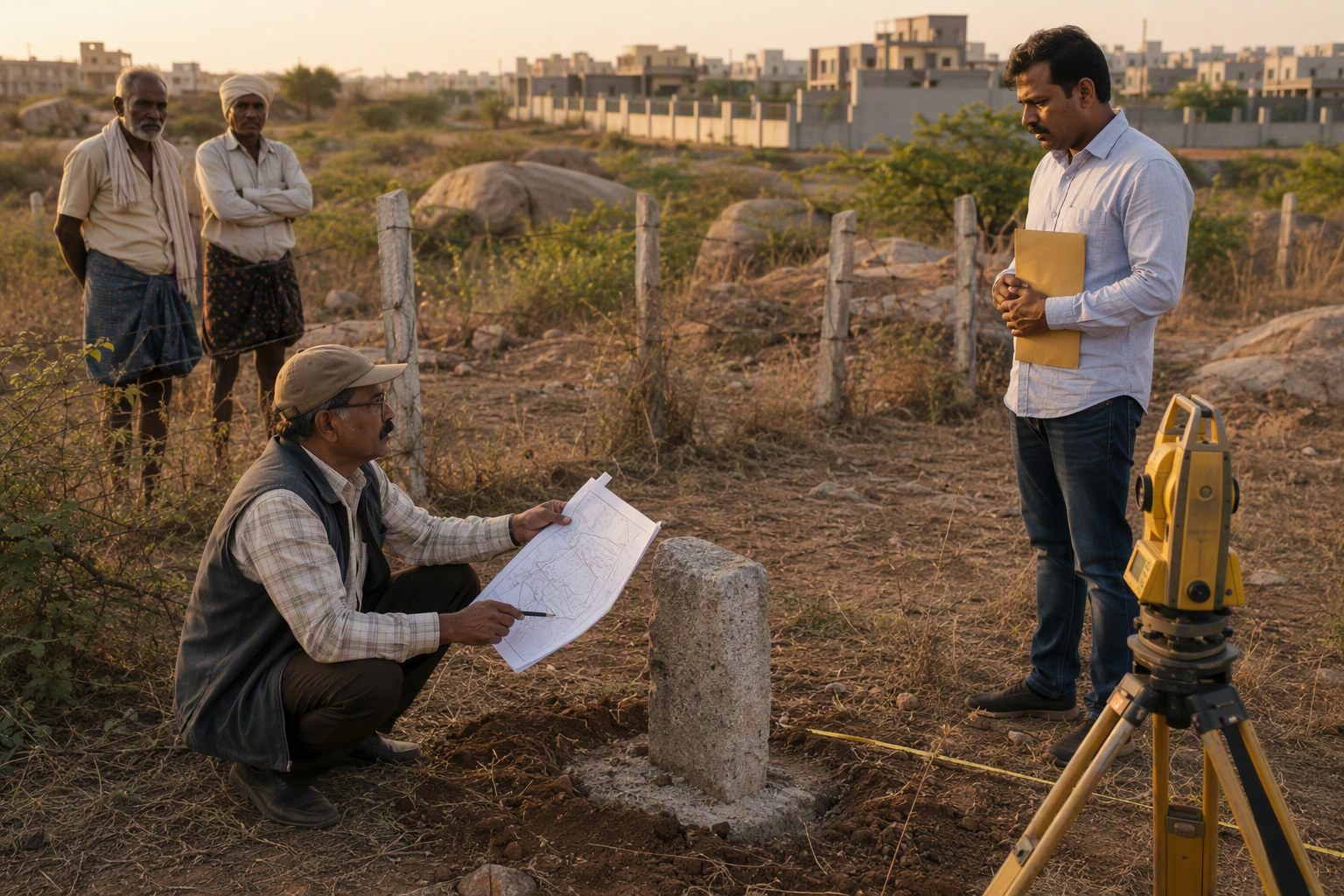



Telangana Valuers often see risk much before a buyer, seller or even a bank relationship manager realises there is a problem. A flat in Kondapur may look perfect. A plot near Shankarpally may have a tempting price. An independent house in Alwal may have tenants, borewell, compound wall and good road access. Still, a valuer can pause the file because one document, one boundary mismatch, or one doubtful market rate does not sit right.
For this article, I spoke to a Hyderabad-based bank valuer who has inspected properties across Serilingampally, Rajendranagar, Uppal, Medchal, Malkajgiri, Patancheru, Shamirpet, Hayathnagar and Maheshwaram mandals. He did not want his name published because he works with multiple lenders, but his observations are very practical.
"A risky property is not always a disputed property. Sometimes it is just a property where the paper story and site story are not matching. Banks become cautious there."
That one line explains how valuers think. They are not only checking whether a property exists. They are checking whether the property can be sold, mortgaged, insured, transferred and valued without future embarrassment for the lender.
Telangana Valuers First Look For Title Comfort, Not Paint Quality
Most buyers first notice floor tiles, lift size, parking, ventilation and water supply. Telangana Valuers start elsewhere. They ask: Who owns this property? How did they get it? Is the chain of title clear? Is the survey number clean? Is the flat linked to the correct undivided share of land? Is the property in the right mandal, village and SRO record?
In Hyderabad, this issue comes up often in older colonies like Kukatpally, Dilsukhnagar, Mehdipatnam, Malkajgiri, Sanathnagar and Secunderabad cantonment-side areas. The building may be occupied for 20 years, but the documents may carry old survey numbers, municipal door numbers that changed after GHMC merger, or link documents with missing schedules.
The valuer told me that buyers usually say, "Sir, loan was given earlier, so why problem now?" His answer is straight: earlier sanction does not make present title perfect. Banks update their risk filters. A new EC may show a mortgage, court attachment, release deed issue or rectification deed gap. One lender may accept a file; another may reject it.
Before paying token advance, buyers should run basic checks through the Property Verification Tool, confirm the correct SRO using Find Your SRO Office, and pull the latest Encumbrance Certificate Search. In our experience, these three checks catch many early warning signs.
Telangana Valuers Treat Section 22-A As A Serious Red Flag
The biggest government-record risk is Section 22-A prohibited property status. Telangana has 147,934 prohibited properties recorded under Section 22-A. This is not a small technical footnote. If a property falls under prohibited category, registration may be blocked or challenged, and lenders usually become extremely cautious.
Section 22-A entries may relate to government lands, assigned lands, endowment lands, wakf claims, ceiling surplus lands and other restricted categories. In local market talk, people may still say, "Registration is possible through adjustment" or "Neighbour got registered last year." A bank valuer will not accept that kind of comfort.
"If the land is in 22-A, I do not look at granite flooring or road width first. The first question is whether the bank can create a safe mortgage at all."
This is especially relevant in growth corridors where agricultural land, plotted layouts and villa projects are moving fast. We have seen buyers ask about Shankarpally, Mokila, Kollur, Tellapur, Ghatkesar, Yadagirigutta-side villages, Tukkuguda, Adibatla, Kandukur and Shadnagar after seeing social media ads. The first check should be whether the survey number is clear in government records.
Use the Section 22-A Prohibited Property Check before you even discuss final price. If the land is agricultural, cross-check survey number identity through the Survey Number Finder. Do not rely only on a layout brochure or Google pin.
What Makes Telangana Valuers Doubt The Quoted Property Value?
Valuation risk is different from title risk. A property can be legally clean but still overvalued. Banks care about this because their loan is secured against the property. If market value is inflated and the borrower defaults, recovery becomes difficult.
The valuer said he checks three numbers: government market value, recent local transactions and practical saleability. Government market value is available from the registration department ready reckoner. For a quick first cut, buyers can use the Market Value / Guideline Value Search. Then compare that with local asking rates and actual sale evidence.
In Hyderabad, the gap between ready reckoner value and market price can be wide. In prime IT belt localities like Jubilee Hills, Banjara Hills, Madhapur, Gachibowli, Kondapur and Kokapet, market rates can be several times higher than guideline values. In developing mandals like Maheshwaram, Chevella, Kandukur, Shabad or Yacharam, advertised plot prices may jump sharply whenever a road, pharma, airport, ORR or regional ring road story becomes popular.
A risky valuation pattern looks like this:
- The seller quotes a price far higher than recent registered values in the same survey number or colony.
- The sale deed consideration is much lower than the actual cash demand.
- The property is shown as residential, but the land use or layout approval is not supporting it.
- The flat super built-up area is inflated compared with sanctioned plan and carpet area.
- The approach road exists on ground, but not clearly in revenue or layout records.
For flats, the valuer will compare carpet area, plinth area, common area loading and undivided share. For open plots, he checks frontage, depth, road width, corner advantage, shape, level difference and access. For independent houses, he separates land value and structure value. A 25-year-old house in Himayatnagar or West Marredpally may have high land value but lower structure value. A new villa in Kompally or Tellapur may have both, provided approvals are clean.
The Bank Valuer’s Site Visit: Small Clues That Create Big Doubts
A site visit is not a formality. Good valuers look closely. They compare document schedule with physical boundaries. East, west, north and south boundaries must make sense. If the sale deed says road on east but site has neighbour wall on east, the file slows down.
In apartment projects, the valuer checks block name, flat number, floor number, parking marking, building stage and amenities. In many HMDA and GHMC areas, parking is a frequent dispute point. Stilt parking may be sold as exclusive even when the approved plan treats it differently. A bank may still lend on the flat, but the value of that parking claim may not be fully recognised.
In plotted layouts, the danger is often in approach and layout approval. A buyer may be shown a neat 200 sq yd plot in a gated layout near Ibrahimpatnam or Shadnagar. But the valuer checks whether internal roads, open space reservation, mortgage plots, LP number, conversion and land use are proper. If the road is only a private passage through another landowner’s parcel, that is a risk.
Road width also affects both value and building potential. A 30 ft road and a 40 ft road can change the future construction value. Before finalising a plot or redevelopment house, check the Road Width Check and the FSI/FAR Calculator. Builders know this very well; individual buyers often underestimate it.
Document Red Flags Telangana Valuers Notice Quickly
Here is a practical table based on the valuer’s comments and our field reporting across Hyderabad and Telangana districts.
| Red flag | Why it worries the valuer | Buyer action |
|---|---|---|
| Missing link document | Ownership chain is incomplete, especially in old houses and inherited properties | Ask for certified copies from the SRO and legal opinion |
| EC not matching sale story | Mortgage, attachment, release or prior sale may appear | Run latest EC, not an old downloaded copy |
| Survey number confusion | Wrong village, old survey split or boundary overlap can affect title | Verify pahani, Dharani records and survey sketch |
| Section 22-A entry | Registration and mortgage can be blocked or disputed | Check prohibited property status before paying advance |
| Unapproved layout | Plot may not get building permission or bank funding | Ask for HMDA, DTCP or municipal approval |
| Large cash component | Declared value and actual value differ; loan eligibility suffers | Keep transaction banking-channel based |
| Built-up area mismatch | Loan may be calculated on lower area than seller claims | Compare plan, sale deed and physical measurement |
The valuer made one strong point: "If a seller gets angry when you ask for papers, that itself is a signal." Genuine sellers may be busy, but they do not usually panic when buyers ask for EC, link documents, tax receipts, sanctioned plan and mutation records.
Why Dharani, Pahani And Mutation Still Matter For Land Deals
For agricultural and converted lands, revenue records remain central. Dharani entries, pahani, title deed passbook, mutation proceedings and old pattadar details can change the comfort level of a valuer. In mandals like Shankarpally, Moinabad, Chevella, Shamshabad, Maheshwaram, Kandukur and Medchal, many land parcels have passed through family partitions, GPA sales, development agreements and layout conversions.
A buyer may say, "The seller has possession." Possession is useful, but banks need documentary comfort. If Dharani shows one person, link deeds show another, and the current seller is relying on an old GPA, the file becomes sensitive. After the Dharani system came in, mutation and passbook clarity became even more visible to lenders.
Assigned land is another issue. Some assigned lands cannot be freely sold. Some have old transactions that appear normal in private documents, but government restrictions may still exist. This is where Section 22-A and revenue verification become essential.
In my view, Telangana land buyers should spend more time on village, mandal and survey number checks than on entrance arch and clubhouse claims. The land record decides long-term peace.
Apartment Risks: RERA, OC, UDS And The Builder’s Track Record
For apartments, Telangana Valuers focus on approvals and construction stage. If the project is ongoing and falls under RERA, the buyer should check registration, approved plans, completion date, promoter details and quarterly updates. Use the RERA Project Lookup before booking in any new project in Kokapet, Narsingi, Puppalaguda, Tellapur, Bachupally, Miyapur, Kompally, Pocharam or Adibatla.
One risk is UDS, or undivided share of land. Buyers often ignore it because builders market flats by sft rate. But UDS matters for ownership. If two similar 1,500 sft flats have very different UDS, the long-term land share value is different. Bank valuers notice this.
Occupancy Certificate is another comfort factor. In GHMC and HMDA areas, OC status can affect resale, water connection, property tax assessment and bank lending. Some lenders may fund under-construction flats based on stage and approvals, but resale buyers should be more careful with projects where deviations are visible.
Common apartment red flags include:
- Project name in marketing material differs from RERA or sanctioned plan name.
- Flat number changed after approval without clear allotment record.
- Parking allotment is handwritten or not part of registered documents.
- Builder has mortgaged flats or land and release letter is not available.
- OC is promised but not issued even after possession.
In premium corridors, valuation can also be tricky. A builder may quote a high sft rate because nearby projects are expensive, but the valuer may discount the value for weaker access road, lower specifications, smaller land parcel, poor resale evidence or delayed approvals.
Open Plot Risks In HMDA And Gram Panchayat Areas
Open plots attract many first-time investors in Telangana because entry ticket can be lower than apartments. But the risk is also high if the layout is not clean. In Shadnagar, Yadagirigutta, Bhongir, Ghatkesar, Bibinagar, Kandukur and Chevella belts, we have seen buyers focus only on "highway touch" language. The valuer does not value a slogan. He values land access, approval, title and saleability.
For HMDA-approved layouts, check LP number, mortgage plot release status, open space, road widths and whether the plot you are buying is part of the approved layout. For gram panchayat layouts, be extra cautious. Some old panchayat permissions may not satisfy present lending norms. DTCP approval may be required depending on location and layout status.
Land use is another silent issue. A plot shown for housing may fall in conservation, agriculture, industrial or other restricted zone. Use the Land Use Zone Finder before assuming future construction is possible. If the plot is part of a larger development, the OSR Calculator can help you understand open space reservation impact.
One valuer’s line stayed with me: "A plot without a legal road is not an investment; it is a negotiation with neighbours." That is harsh, but correct.
How Telangana Valuers Read Market Behaviour In Localities
Valuers do not work only from documents. They speak to local brokers, check recent registrations, visit nearby projects and compare unsold inventory. A flat in Gachibowli has different liquidity from a large farmhouse plot near Vikarabad. A small commercial shop in Ameerpet may have rental demand, but title and building age can reduce lender comfort. A villa in Mokila may look premium, but if the internal road, water, drainage and association handover are weak, valuation will be conservative.
Some locality-specific patterns we keep seeing:
- Kondapur and Gachibowli: high demand, but apartment age, parking, OC and maintenance quality influence resale value.
- Kokapet and Narsingi: premium pricing, but buyers must check RERA, access roads and actual handover timelines.
- Tellapur and Kollur: strong villa and apartment activity, but road width, approvals and project stage matter.
- Bachupally and Miyapur: good end-user demand, but some older apartment blocks have UDS and deviation issues.
- Shankarpally and Mokila: land and villa demand is high, but survey number, conversion and approach are key.
- Adibatla and Tukkuguda: growth story is visible, but overpricing based on future assumptions is common.
When market prices rise quickly, risky properties also sell faster because buyers fear missing out. That is when a valuer’s conservative view protects the buyer, even if it feels irritating during loan processing.
Cost, Stamp Duty And Declared Value: Another Risk Layer
Many buyers ask whether they can register at guideline value and pay the rest separately. From a banking and legal-risk point of view, that is a bad habit. If the sale deed value is low, the bank may calculate funding based on documented value or conservative valuation. Later, if there is a dispute, your recorded investment is also lower.
Before signing an agreement, estimate registration cost using the Stamp Duty Calculator. For mixed land and building deals, the Composite Value Calculator can help you understand how land and structure value may be viewed. If you are selling an old property in Hyderabad, use the Capital Gains Tax Calculator so tax planning does not become an afterthought.
The valuer said he becomes cautious when the agreement value, sale deed value, bank loan request and local market value are all telling different stories. Clean deals have fewer versions.
What Buyers Should Do Before The Bank Valuer Visits
If you are applying for a home loan, do not wait for the valuer to discover problems. Prepare the file properly. A neat file does not hide defects, but it avoids confusion.
For flats
- Sale deed or agreement of sale
- Link documents and mother deed
- Latest EC
- RERA details for applicable projects
- Sanctioned plan and approval copy
- OC or completion status
- Property tax receipt
- Builder NOC or society NOC for resale
- Parking allotment proof
For open plots and land
- Sale deed chain
- Latest EC
- Dharani details, pahani and mutation records
- Survey sketch and village map reference
- Layout approval copy
- Land conversion proceedings, if applicable
- Section 22-A check
- Approach road proof
- Property tax or vacant land tax, where applicable
If any document is missing, tell the bank early. Do not hope that nobody will notice. Experienced Telangana Valuers notice gaps because they have seen hundreds of similar files.
Telangana Valuers Are Not Deal Breakers; They Are Risk Translators
Many buyers feel the valuer is reducing their dream property to a number. I understand that frustration. But a good valuer is doing something useful: translating land, title, access, approval and market behaviour into a lending risk.
If the valuation comes lower than expected, ask why. Is it because the property is overpriced? Is the built-up area lower? Is the road narrow? Is the title unclear? Is the locality less liquid than the seller claims? The answer will help you renegotiate or walk away.
My practical view is simple. If a property cannot satisfy a strict valuer today, it may trouble you during resale tomorrow. Telangana real estate is growing fast, from Hyderabad’s western corridor to district headquarters and highway towns. Good opportunities exist. But clean paperwork, realistic pricing and proper approvals are still the real premium features.
Before you fall in love with a flat balcony view or a plot entrance arch, check the record. The safest property is not always the cheapest. It is the one where the site, documents and market value speak the same language.
Frequently Asked Questions
What do Telangana Valuers check first in a property?
They usually start with title, ownership chain, EC, survey number or flat details, approvals, access and market value. Site condition comes next, but documents set the comfort level.
Why is Section 22-A risky for buyers in Telangana?
Section 22-A covers prohibited properties where registration or transfer may be restricted. Telangana has 147,934 such prohibited properties, so buyers must check this before paying advance.
Can a bank reject a loan even if the property has a sale deed?
Yes. A registered sale deed alone is not enough. Banks may reject or reduce funding if EC, title chain, approval, valuation, land use, road access or prohibited status creates risk.
Why does the bank valuation come lower than the seller’s price?
The valuer may use recent local sale evidence, guideline value, property age, road width, approval status and resale liquidity. Seller expectations are not always equal to bankable value.
Which checks should I do before buying a plot near Hyderabad?
Check survey number, Dharani and pahani records, Section 22-A status, layout approval, land use zone, approach road, EC and correct SRO. Do these checks before paying token amount.