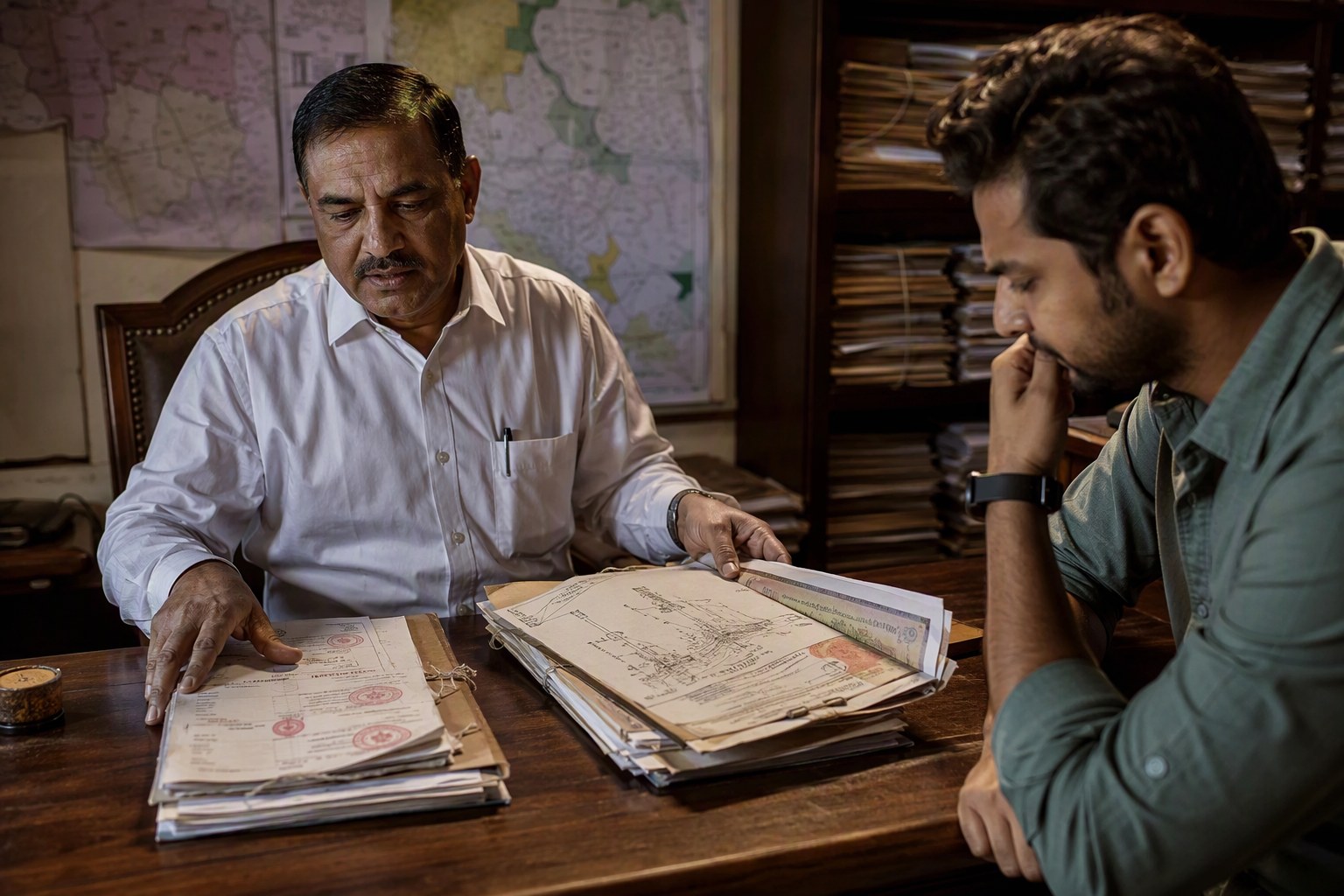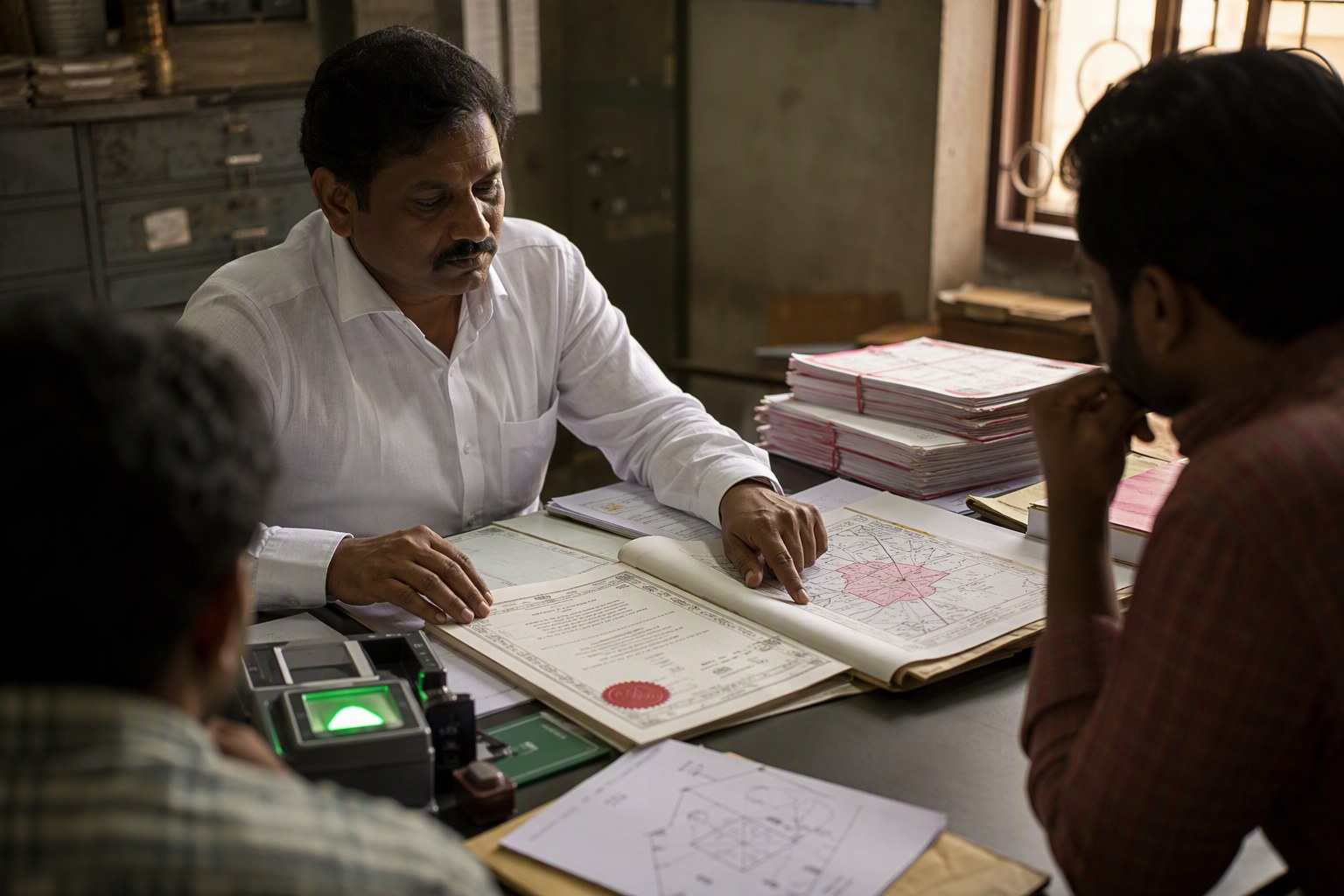
A buyer from Kondapur had almost finalised a plot near Mokila in Shankarpally mandal. The location looked right, the approach road was decent, and the seller had agreed to a small reduction after two rounds of bargaining. The buyer was ready with the token advance. Only when his lawyer asked for a Section 22-A check did the mood change. Telangana Title Lawyers Explain Why 22-A Checks Must Be Early because one late discovery can turn a friendly negotiation into a serious title problem.
We have seen this pattern many times in Hyderabad’s expanding edges: Kollur, Tellapur, Mokila, Nandigama, Maheshwaram, Shamshabad, Ghatkesar, Patancheru and Yacharam. The buyer first sees the land. Then comes price talk. After that, family approval. Then bank discussion. Only at the end, someone asks, "Is it in 22-A?" That order is risky.
Section 22-A is not a small clerical column. It deals with prohibited properties where registration may be refused or blocked. As per latest IGRS data available in our database, Telangana has 3,076,153 prohibited property records under Section 22-A. That number itself tells you why this check cannot be treated as a last-minute formality.
Telangana Title Lawyers: Why 22-A Checks Must Come Before Token Advance
For this story, I spoke to title lawyers who regularly handle Hyderabad and Telangana land transactions. Their common advice was simple: do not pay token advance before checking 22-A status, survey number details, EC entries, pahani references and SRO jurisdiction.
"A token may look small compared to the full sale consideration, but legally and emotionally it locks the buyer into the deal. If 22-A comes up later, the buyer is no longer negotiating freely," one Hyderabad title lawyer told us.
That is the real issue. Once money changes hands, the buyer starts hoping the problem will be solved. The seller may say, "It is only a technical issue." A broker may say, "Many plots here are like this, registration will happen." Sometimes those statements are true. Many times, they are half-truths. A title lawyer will not depend on verbal comfort. They will check the exact village, mandal, survey number, sub-division, old records, mutation trail, and whether the property falls under any prohibited category.
Before even discussing agreement wording, buyers should run a basic check through Section 22-A Prohibited Property Check. If the land is agricultural or converted from agricultural use, also verify survey identity through Survey Number Finder. For registration office mapping, use Find Your SRO Office. These three steps can save weeks of confusion.
Telangana Title Lawyers Explain the Practical Risk in a Late 22-A Discovery
When a buyer discovers a 22-A concern after paying token advance, three problems usually start together.
- Refund dispute: The seller may refuse to return the full token, saying the buyer backed out.
- Pressure to proceed: Brokers and relatives may push the buyer to continue because "registration will somehow happen".
- Weak negotiation position: The buyer loses bargaining strength because the seller knows money is already paid.
In our experience, the biggest mistake is treating 22-A like an EC issue. An Encumbrance Certificate is very useful, but it is not the same as a prohibited property check. EC generally shows registered transactions and certain recorded encumbrances. Section 22-A relates to whether registration itself is prohibited or restricted for that property category. You need both.
Use Encumbrance Certificate Search to read the transaction chain, and use EC Analyzer to understand entries better. But do not stop there. A clean-looking EC is not a guarantee that 22-A status is clear.
What Section 22-A Means in Telangana Property Deals
Section 22-A is connected to properties that are prohibited from registration under government records. Depending on the facts, land may be affected due to government land claims, assigned land concerns, endowment or wakf entries, ceiling matters, court-related restrictions, or other government-notified prohibitions. The exact reason must be checked in the relevant records, not guessed from locality reputation.
This is where Telangana land buying becomes very local. A plot in Tellapur is not the same as a plot in a nearby village of Sangareddy district. A parcel in Maheshwaram mandal cannot be judged by what happened in Shamshabad. Even inside one village, one survey number may be clean and the neighbouring survey number may have a history. Buyers often assume, "There are villas nearby, so this must be fine." That is not legal verification.
Title lawyers told us that the first level check should include these documents:
- Current and old pattadar passbook details, where applicable
- Pahani or adangal extracts
- Dharani entries for agricultural lands
- Link documents and registered sale deeds
- Encumbrance Certificate for relevant years
- Layout permission, if the land is plotted
- Conversion or land-use documents, where needed
- SRO-level registration status
- Section 22-A prohibited property result
For apartment buyers, 22-A may still matter where the underlying land has title complications. For plotted layouts, it is even more direct. If the base survey number has a prohibition issue, individual plot buyers may face problems later even if the brochure looks polished.
The Hyderabad Buyer Story: What Went Wrong
Coming back to the Mokila-side buyer, the sequence was very common. He first checked the road connectivity to Financial District and Nanakramguda. He compared nearby developments in Kollur and Velimela. He spoke to a bank representative. He asked the broker whether registration was possible. The answer was, "Yes, many people registered in this belt."
But the lawyer asked for the survey number and village details. Then came the uncomfortable part. The land needed a deeper 22-A check before any advance could be safely paid. The seller was not necessarily cheating. In many Telangana deals, even sellers do not fully understand old entries, classification changes, assigned land questions, or how a survey sub-division is reflected in records. But buyer risk remains buyer risk.
"Good intention is not good title. Even an honest seller can sell a property that has a registration block," another title lawyer said.
The buyer eventually paused the deal. That decision felt painful for two days. After that, it felt sensible. He had not paid token. He had not signed a loose agreement. He could still walk away without fighting for refund.
Telangana Title Lawyers on the Correct Order of Due Diligence
Most buyers follow this order: site visit, price negotiation, token, documents, lawyer. Title lawyers prefer the reverse.
| Stage | Common Buyer Practice | Lawyer-Preferred Practice |
|---|---|---|
| First interest | Visit site and ask price | Collect village, mandal, survey number, plot number and seller name |
| Before negotiation | Compare nearby asking prices | Check 22-A, EC, SRO jurisdiction and basic land classification |
| Before token | Trust broker confirmation | Get written document list and legal review |
| Before agreement | Use a simple receipt | Use clauses on title defects, refund and registration failure |
| Before registration | Check stamp duty and slot | Reconfirm 22-A status, EC updates and seller authority |
If you are checking market value for stamp duty planning, use Market Value / Guideline Value Search. For duty estimate, use Stamp Duty Calculator. These are useful after the basic title screen. Do not calculate stamp duty for a property that may not be registrable.
Why Brokers Often Miss 22-A Red Flags
This is not a broker-bashing point. Many brokers in Hyderabad know their pockets very well. A good local broker can tell you which road floods, where the access dispute is, who owns the neighbouring land, and whether the seller is flexible. But legal status is a different skill.
A broker may look at past registrations in the same layout and assume the next registration will pass. A lawyer will ask whether the same survey number, same extent, same sub-division and same classification are involved. A broker may say the land is near a famous project. A lawyer will ask if the subject property has independent title support. A broker may say the seller has pattadar passbook. A lawyer will check whether that record is consistent with old documents and current restrictions.
Hyderabad’s growth corridors are full of mixed land histories. In one stretch you may see HMDA layouts, old gram panchayat layouts, agricultural parcels, venture plots, villas, farm plots and unapproved subdivisions. Around places like Adibatla, Tukkuguda, Kandukur, Shankarpally and Ghatkesar, this mix is common. The same road can carry both clean and complicated properties.
What Buyers Should Ask Before Paying Token
Before paying even a small advance, ask these questions in writing or at least over a clear message trail:
- What is the exact village and mandal?
- What is the survey number and sub-division number?
- Which SRO handles this property?
- Is the land agricultural, converted, plotted, apartment land or commercial land?
- Is there any 22-A entry or past objection?
- Are all link documents available from the seller?
- Does the seller agree to refund token if title or registration restriction is found?
- Is the layout approved, and by which authority?
- Is there any court case, family dispute, loan, charge or mortgage?
For projects advertised as RERA registered, verify details through RERA Project Lookup. For broader property screening, use Property Verification Tool. If you want alerts on changes after shortlisting a property, Property Change Tracker can help you monitor it.
Agreement Clauses That Protect Buyers
If the preliminary checks look acceptable and you still want to pay token, do not use a vague receipt saying only "advance received". Ask your lawyer to draft a proper token or sale agreement clause covering title defects and registration restrictions.
A buyer-friendly clause should mention that the advance is refundable if:
- Section 22-A prohibition or restriction is found
- Seller fails to provide link documents
- EC reveals undisclosed transactions or charges
- Land classification does not match seller representation
- Registration is refused due to title or government record issues
- Seller authority is defective, such as invalid GPA or missing legal heirs
Use Legal Document Generator only after your facts are clear. A format cannot cure a title defect. It can only record your rights better.
Apartment Buyers Should Not Ignore 22-A
Many flat buyers think Section 22-A is only for open land. That is not always safe. If the apartment project is built on land with old title problems, buyers may face trouble during loan processing, resale, mutation, or future redevelopment. In Hyderabad, buyers in areas like Narsingi, Puppalaguda, Manikonda, Kokapet, Bachupally and Miyapur usually focus on amenities, carpet area, maintenance, and possession date. Those are valid checks. But land title should sit above all of them.
For a flat, check the parent documents, development agreement, GPA, building permission, RERA details, EC, and whether the land parcel has any government restriction. If the builder says everything is clear, ask for document access. A serious developer will not be offended by basic legal due diligence.
Ready Reckoner Value Is Not Title Clearance
One common misunderstanding is this: if a property has a market value or ready reckoner value in government systems, buyers assume it is legally safe. That is not correct. Guideline value helps calculate stamp duty and registration value. It does not by itself confirm ownership, possession, land use, absence of disputes, or absence of 22-A restriction.
Similarly, an SRO accepting documents for one property nearby does not mean your property will be accepted. Registration depends on the exact property particulars. Survey number accuracy matters. Boundaries matter. Extent matters. Village and mandal mapping matter.
If the land is in a growth zone, also check planning factors. Use Land Use Zone Finder for zoning context, Road Width Check for access and road width, and FSI/FAR Calculator if construction potential is part of your decision.
Our View: Early 22-A Check Is a Negotiation Tool
Many buyers see due diligence as a defensive exercise. I see it as a negotiation tool. If 22-A is clear, EC is clean, documents are proper and SRO mapping is correct, the buyer can move faster and negotiate with confidence. If there is a concern, the buyer can either walk away or ask the seller to resolve it before any major payment.
In Hyderabad land deals, speed without verification is not smart. Sellers like buyers who can close quickly, yes. But a buyer who closes quickly after checking documents is different from a buyer who pays first and checks later.
The number 3,076,153 prohibited property records in Telangana’s Section 22-A dataset should be enough warning. Not every record will affect your property. But without checking, you do not know whether your shortlisted land is clean, doubtful, or clearly blocked.
Simple Buyer Checklist Before Token Advance
- Get exact survey number, village, mandal and plot details.
- Run a Section 22-A check before token advance.
- Verify SRO jurisdiction and EC records.
- Ask for link documents and seller identity proof.
- Check Dharani, pahani or relevant revenue records for agricultural land.
- For layouts, verify approval and land conversion status.
- For apartments, verify parent land title and RERA details.
- Do not rely only on broker statements or nearby registrations.
- Put refund terms clearly in writing before paying any advance.
- Let a Telangana title lawyer review documents before signing.
A good deal is not just a good location and a negotiated price. It is a property that can be registered, financed, resold and enjoyed without title anxiety. In Telangana, that starts with an early 22-A check.
Frequently Asked Questions
Should I check Section 22-A before paying token advance?
Yes. Telangana title lawyers strongly prefer a 22-A check before token advance because a later prohibition finding can create refund disputes and registration risk.
Is an Encumbrance Certificate enough to confirm clear title?
No. EC is useful for registered transaction history, but it does not replace a Section 22-A prohibited property check, revenue record review, link document check and SRO verification.
Does Section 22-A apply only to agricultural land?
No. It is often discussed in land deals, but apartment buyers should also check the underlying land title, especially where the parent land has old revenue or government record issues.
What details are needed for a 22-A check?
You should collect the village, mandal, survey number, sub-division, plot number if any, seller name and SRO jurisdiction. Exact property identification is essential.
Can a seller fix a 22-A issue before registration?
Sometimes issues can be clarified or corrected through proper channels, depending on the reason. Do not assume it is fixable. Ask a Telangana title lawyer to review the exact record.