Telangana Patta Passbook vs Sale Deed: What Should Buyers Trust?
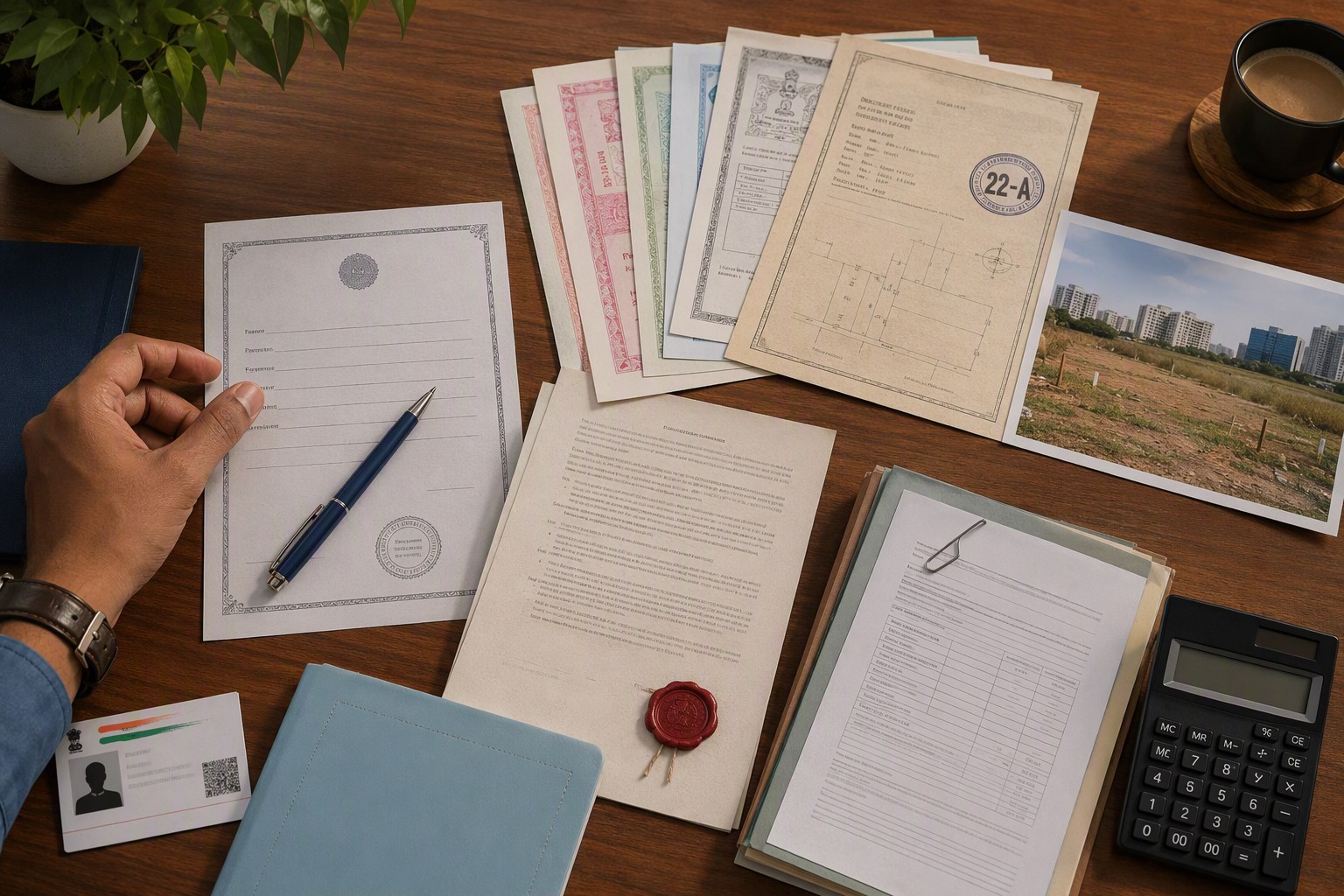
Telangana Patta Passbook vs Sale Deed is not a small paperwork debate. A patta passbook shows revenue recognition and possession details for agricultural land, while a registered sale deed is the core title document that transfers ownership. For a buyer in Hyderabad, Rangareddy, Medchal-Malkajgiri, Sangareddy or Yadadri-Bhuvanagiri, the safe answer is this: trust the sale deed for ownership, but never ignore the patta passbook, EC, Dharani status and Section 22-A check.
Our view is simple: a clean sale deed without revenue consistency is risky; a patta passbook without a valid chain of registered deeds is weaker. A serious buyer checks both.
| Document / Check | What it proves | What it does not prove | Buyer action |
|---|---|---|---|
| Patta Passbook / Dharani record | Revenue entry, pattadar name, land extent, survey number, agricultural land details | It does not replace a registered title deed | Match survey number, extent, nature of land and pattadar name |
| Registered Sale Deed | Legal transfer of ownership between seller and buyer | It may not show later revenue disputes, prohibitory entries or wrong mutation | Check chain of title for 30 years where possible |
| Encumbrance Certificate | Registered mortgages, sales, gifts, court attachments and other registered dealings | Unregistered family disputes, possession fights or some revenue issues may not appear | Pull EC from the right SRO and compare document numbers |
| Section 22-A check | Whether property is in prohibited category for registration | It does not validate your private title chain by itself | Check before paying token advance |
Telangana Patta Passbook vs Sale Deed: the short answer for buyers
If you are buying a flat in Gachibowli, a villa plot in Mokila, agricultural land near Shamirpet or converted land around Adibatla, the registered sale deed is the main title document. It is the document that records transfer of ownership before the Sub-Registrar Office, commonly called SRO.
The patta passbook, on the other hand, is a revenue record. In Telangana, after Dharani came in, agricultural land records became heavily linked to online pattadar details, passbooks, mutations and survey numbers. This is useful, but it is still not the same as a sale deed.
In our experience, many buyers get misled by one line: “Dharani lo name undi sir.” Yes, the seller’s name appearing in Dharani is a positive sign. But you still need to ask: how did the seller get the land? Through sale deed, inheritance, partition, gift, court decree or assignment? Is the land free from prohibition? Is the extent matching? Is the survey number the same on ground?
This is where the risk starts. Telangana has 1,47,934 prohibited property records under Section 22-A. That number alone should stop any buyer from trusting only one document.
What a Telangana patta passbook actually tells you
A patta passbook is mainly relevant for agricultural land. It generally contains the pattadar name, father or spouse name, survey number, extent, land classification and village details. In areas like Shankarpally mandal, Moinabad mandal, Shamirpet mandal, Ibrahimpatnam mandal and Maheshwaram mandal, buyers regularly ask for patta passbook first because many transactions are in agricultural or semi-agricultural land pockets.
For example, if a seller is offering land in Janwada village, Shankarpally mandal, the buyer should check whether the passbook extent matches the sale deed extent. If the seller says 2 acres are available but Dharani shows 1 acre 28 guntas, that gap needs explanation. Sometimes it is due to previous sale. Sometimes due to road widening. Sometimes due to family partition. Sometimes it is just careless selling.
Patta passbook is useful for:
- Confirming the pattadar name in revenue records
- Checking survey number and land extent
- Understanding whether land is agricultural in revenue records
- Verifying mutation after purchase or inheritance
- Checking whether seller’s claim matches village revenue data
But a patta passbook does not automatically prove that the seller has perfect marketable title. A wrong mutation can happen. A family member can challenge inheritance. A prior registered sale may exist. A court case may be pending. An assigned land issue may be hidden in older records.
Before you believe the passbook, cross-check the survey number through our Survey Number Finder and then run a broader check using the Property Verification Tool.
What a registered sale deed proves in Telangana
A sale deed is the legal instrument through which ownership is transferred. It is executed by the seller, accepted by the buyer, stamped, registered and stored at the concerned SRO. In practical terms, if a dispute lands in court, the sale deed and previous chain documents carry serious weight.
For apartments in areas like Kondapur, Financial District, Nallagandla, Miyapur, Kukatpally or Uppal, the buyer normally depends on sale deed, link documents, building permissions, occupancy certificate, RERA details where applicable, and EC. For open plots in Dundigal, Ghatkesar, Tukkuguda, Kandukur or Patancheru, the sale deed must be read along with layout approval, land conversion, HMDA/DTCP status and revenue records.
A sale deed usually proves:
- Who sold the property and who purchased it
- Consideration value declared for registration
- Schedule of property with boundaries, extent and survey number or flat number
- Document number, year and SRO details
- Stamp duty and registration fee payment
Still, sale deed alone is not enough. We have seen cases where sale deeds were properly registered, but later the buyer discovered an old mortgage, pending litigation, government land classification, ceiling issue or 22-A entry. Registration is not a magic shield. It records a transaction; it does not personally guarantee that every past defect has vanished.
Before signing, find the correct registration office through Find Your SRO Office and estimate costs through the Stamp Duty Calculator.
Telangana Patta Passbook vs Sale Deed: which one should you trust more?
If forced to choose one, trust the registered sale deed for ownership. But in real buying, do not choose only one. You need the sale deed for title and the passbook for revenue consistency.
Think of it like this:
- Sale deed answers: “Who legally transferred this property?”
- Patta passbook answers: “Who is recognised in revenue records for this agricultural land?”
- EC answers: “What registered transactions or encumbrances are visible?”
- 22-A check answers: “Is registration prohibited or blocked?”
For a buyer, the strongest position is when all four are aligned. The seller’s name appears in the latest title chain. The Dharani pattadar details match. EC shows a clean or explainable transaction history. Section 22-A does not block the property. Boundaries match on ground. Neighbours confirm possession. That is when confidence improves.
Where EC fits in between patta passbook and sale deed
The Encumbrance Certificate, or EC, is one of the most practical checks before buying. It shows registered transactions for a property during the selected period. For Hyderabad buyers, I usually suggest checking at least 30 years where documents are available, especially for land and independent houses. For a newly built flat, check land parent documents, development agreement, GPA if any, mortgage release deeds and the builder’s title chain.
Use the Encumbrance Certificate Search before paying a big advance. Do not wait till the bank lawyer asks for it. If the EC shows a mortgage, release deed must be checked. If it shows a GPA sale, examine whether it was validly acted upon. If there are multiple sale deeds in the same survey number, verify sub-division and exact schedule.
EC is very useful, but it has limits. It will not always reveal unregistered possession claims, oral family arrangements, boundary encroachments, some revenue restrictions, or ongoing disputes not reflected through registered documents. That is why EC should sit between sale deed and revenue checks, not replace them.
Why Section 22-A check is now non-negotiable in Telangana
Section 22-A of the Registration Act deals with prohibited properties. These may include government lands, assigned lands, endowment lands, wakf lands, ceiling surplus lands and other categories where registration is restricted. Telangana has 1,47,934 prohibited property records. That is not a small number. It is a loud warning for buyers.
In hot corridors like Kokapet-Gandipet, Narsingi-Manchirevula, Tellapur-Osman Nagar, Kollur-Mokila, Adibatla-Tukkuguda and Shamirpet-Medchal, land values have moved sharply. When prices rise, disputed land also gets packaged beautifully. A seller may show a passbook. A broker may show a photocopy of an old sale deed. But if the survey number falls under a prohibited list, your registration can be stopped or your title can become a long fight.
Before giving token advance, run a Section 22-A Prohibited Property Check. If the property is flagged, do not accept casual explanations like “small technical issue” or “registration office lo manage chestham.” Ask for written legal clarity, revenue proceedings and the exact basis of deletion if the seller claims it was removed.
Local Hyderabad examples: how the mismatch happens
Let us take practical examples from the market.
Kokapet and Narsingi, Gandipet mandal
In Kokapet and Narsingi, apartment and land rates can be very different from official ready reckoner values. Buyers may hear market quotes running into lakhs per square yard depending on road width, frontage and development potential. The mistake is assuming high price means clean title. In these areas, check sale deed chain, HMDA approvals, road affectation, land use and EC carefully.
Tellapur and Osman Nagar, Ramachandrapuram side
Tellapur has seen heavy apartment and villa activity. For flats, buyers often focus on carpet area, amenities and builder name. Still, the land title beneath the project matters. Check RERA registration through RERA Project Lookup, EC for land, development agreement, mortgage details and approvals. If you are buying a plot, check whether it is part of an approved layout.
Mokila and Shankarpally mandal
Mokila, Kondakal and surrounding villages are popular for villa plots and farm-style land purchases. Market conversations may range widely based on access road and layout approval. Here, patta passbook and Dharani details are useful, but not enough. Check survey number, old pahanis, link deeds, conversion, layout status and 22-A status.
Adibatla and Ibrahimpatnam mandal
Adibatla buyers often see fast development talk because of aerospace, IT and ORR access. In this belt, check whether land is agricultural, converted, assigned, under layout, or part of any government restriction. Do not rely only on a glossy brochure or a village map screenshot.
Shamirpet and Medchal side
Shamirpet, Thumkunta, Medchal and nearby villages attract buyers looking for weekend homes, open plots and long-term land banking. Many parcels have revenue history. Ask for passbook, pahani, link documents, EC, mutation proceedings and exact village map location.
Ready reckoner value, market rate and registration value
Buyers often confuse three numbers: market rate, ready reckoner or guideline value, and registered consideration. Market rate is what buyers and sellers are actually negotiating. Guideline value is the minimum value used for stamp duty and registration purposes. Registered consideration is the value written in your sale deed.
In high-demand Hyderabad locations, market rate is often higher than guideline value. For example, a plot discussion in Mokila may happen at one rate, while official value for registration may be different. A flat in Gachibowli may sell at a premium because of builder brand, floor, view and amenities. A land parcel in Tukkuguda may get priced based on road width and future development story.
Before budgeting, check the official value through Market Value / Guideline Value Search. If you are comparing apartment price, undivided share, construction value and amenities, the Composite Value Calculator can help you read the numbers better.
Buyer checklist before trusting either document
Here is the checklist we use when reviewing land and property papers in Telangana:
- Ask for the latest registered sale deed and all link documents.
- For agricultural land, ask for patta passbook, Dharani extract and latest pahani where available.
- Match survey number, extent, village, mandal and boundaries across every document.
- Pull EC for a long period and compare every visible transaction.
- Check Section 22-A prohibited property status before paying advance.
- Confirm SRO jurisdiction and registration history.
- Check guideline value and stamp duty impact.
- For flats and gated projects, check RERA, building permission and occupancy certificate.
- Visit the land physically; speak to neighbours and local revenue-aware people.
- For inherited property, insist on legal heir documents, partition deed or family settlement papers.
- For converted land, verify NA conversion and layout approval.
- For plots, check road width, land use zone and whether any master plan road affects the property.
If road access is a key part of pricing, use the Road Width Check. For development potential, especially in HMDA areas, check zoning through the Land Use Zone Finder.
Red flags we see again and again
Some warning signs repeat across Telangana property deals:
- Seller says original sale deed is lost but gives only photocopies.
- Passbook name and sale deed seller name do not match.
- Survey number is correct, but extent is different in each document.
- EC shows a mortgage, but no release deed is produced.
- Seller pushes for immediate cash advance before document review.
- Property falls near government land, lake buffer, nala, assigned land or endowment land.
- Broker says 22-A issue can be handled after registration.
- Layout approval is shown as “under process” for years.
- Land is sold as residential, but land use zone says otherwise.
One or two red flags do not always mean fraud. But they mean pause. In Telangana, rushing a land deal because “rate will increase next week” is how buyers lose sleep for years.
Final buyer view on Telangana Patta Passbook vs Sale Deed
The safest position is not blind trust in either document. A sale deed is stronger for ownership, but a patta passbook is valuable for agricultural land verification. EC tells you the registered transaction trail. Section 22-A tells you whether the property is blocked or prohibited. Together, they create a real picture.
For urban flats in Hyderabad, prioritise sale deed chain, EC, RERA, approvals and OC. For agricultural and peri-urban land in Rangareddy, Sangareddy, Medchal or Yadadri belts, give equal attention to Dharani, patta passbook, pahani, survey number, possession and 22-A status.
Our practical advice: do not pay more than a small refundable token until sale deed chain, EC, Dharani status and prohibited property check are reviewed. The best property deal is not the cheapest one. It is the one where title, possession, approval and registration all stand together.
Frequently Asked Questions
Is patta passbook enough to prove ownership in Telangana?
No. A patta passbook is a revenue record, mainly for agricultural land. It supports possession and pattadar details, but it does not replace a registered sale deed or full title chain.
Which is more reliable: patta passbook or sale deed?
For ownership transfer, the registered sale deed is more reliable. For agricultural land verification, the patta passbook and Dharani record are also necessary. Buyers should check both.
Can EC show all property problems?
No. EC shows registered transactions and encumbrances for the selected period. It may not show unregistered family disputes, possession issues, boundary problems or every revenue restriction.
Why is Section 22-A check needed before buying land?
Section 22-A covers prohibited properties where registration may be blocked. Telangana has 1,47,934 prohibited property records, so buyers should check this before paying advance.
Should flat buyers also check patta passbook?
Usually flat buyers focus on sale deed chain, EC, RERA, approvals and occupancy certificate. But for the project land, revenue history may still matter, especially where land was converted from agricultural use.