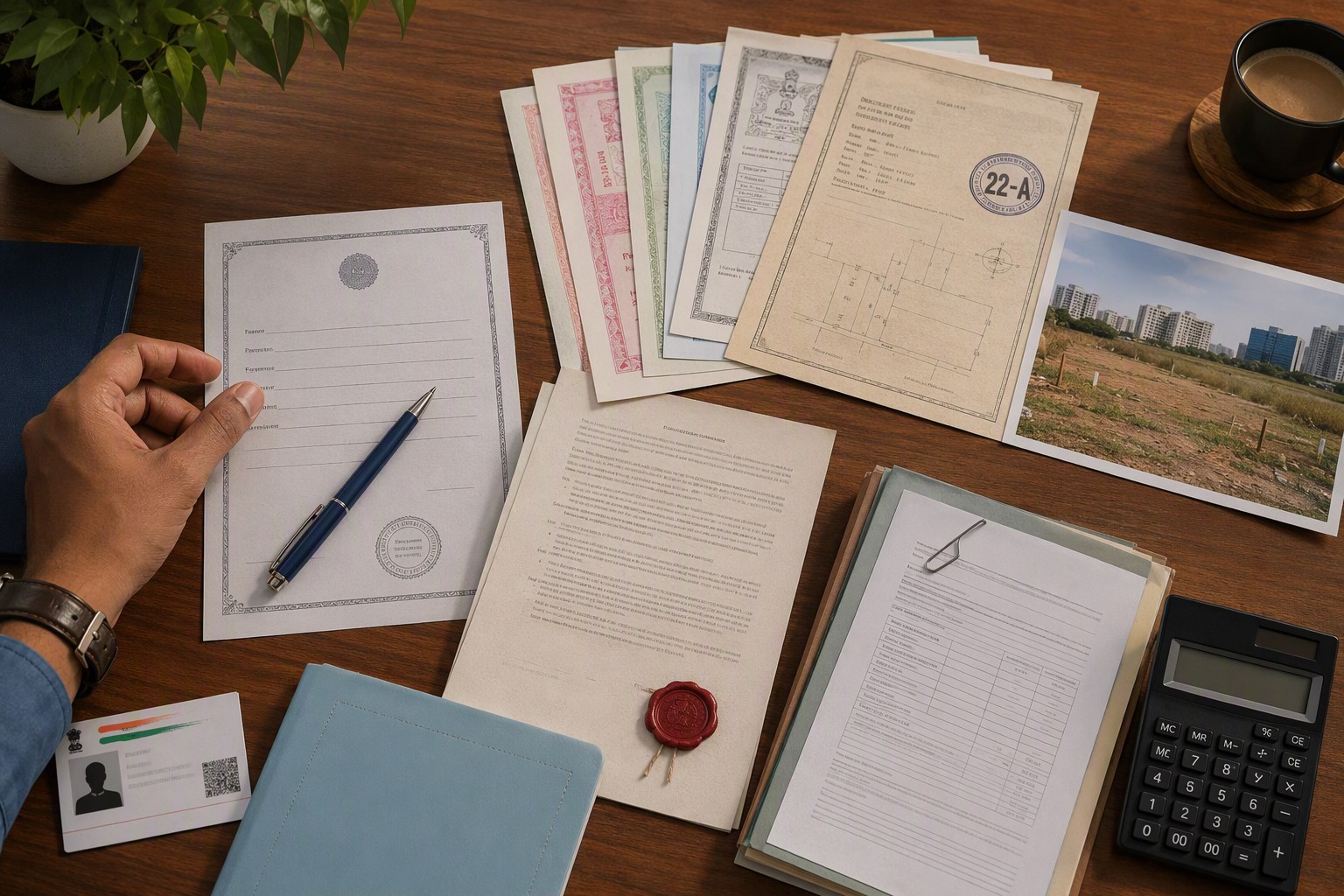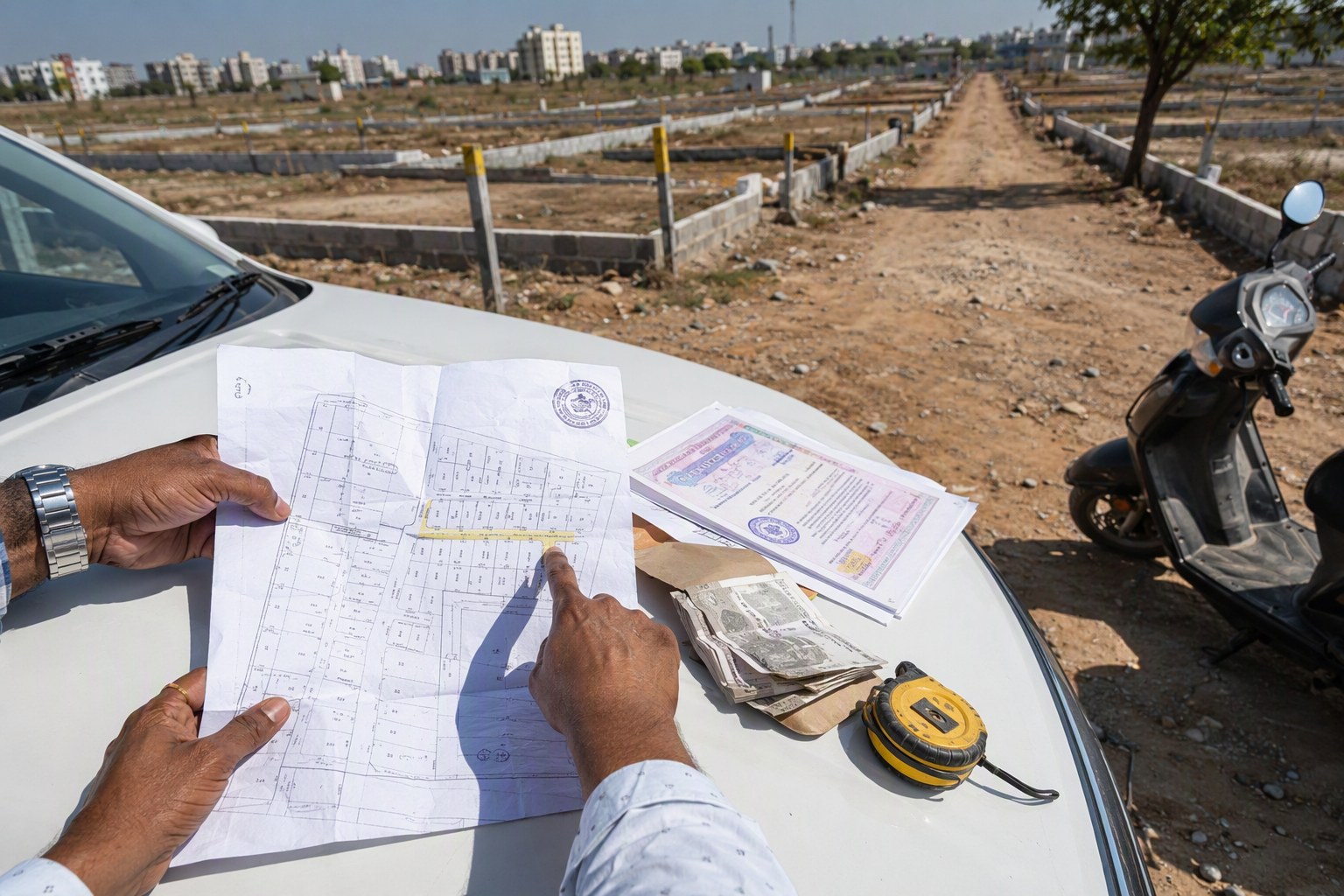
Short answer: an Occupancy Certificate is necessary before buying or occupying a flat, but it is not a full green signal. It only answers one part of the question: whether the building has been permitted for occupation by the competent local authority. Before you pay the booking amount, register the sale deed, or take possession, you still need to verify sanctioned plan compliance, completion certificate, RERA registration, Encumbrance Certificate, UDS, land title, bank loan documents, CERSAI charge, and Section 22-A status.
We have seen buyers in Gachibowli, Kondapur, Narsingi, Kokapet, Miyapur, Bachupally, Uppal and LB Nagar treat OC as the final stamp of safety. That is risky. A flat can have an OC and still carry issues in title flow, mortgage closure, UDS calculation, pending association handover, or wrong SRO valuation. In Telangana, where apartment buying often involves GHMC, HMDA, local municipalities, RERA, SRO and sometimes Dharani-linked land history, one document cannot do the whole job.
Our view: Buy a flat only when the OC is supported by clean title, correct sanctioned plan documents, valid RERA disclosures, clear EC, proper UDS, and loan-ready papers. OC is a strong checkpoint, not the finish line.
Occupancy Certificate enough? No, but never ignore it
An Occupancy Certificate, commonly called OC, is issued by the competent authority after checking whether the building can be occupied. For flats in GHMC limits, this usually relates to municipal building permission and completion-related checks. In HMDA layouts, municipalities and gram panchayat converted areas, the approval chain may differ. In practical terms, OC tells you that the building has crossed an official occupation-related stage.
For a buyer, OC matters because it is often linked with legal possession, utility connections, association formation, resale comfort and bank confidence. A flat without OC can become a headache when you want to sell, lease, take a loan, or regularise records. Some buyers take possession based on builder promises like ‘OC applied’ or ‘OC expected shortly’. In our experience, that phrase should make you pause. Applied is not issued. Expected is not proof.
But OC is not a title certificate. It does not prove that the land was acquired properly, that every earlier owner signed valid documents, that the flat has no mortgage, or that your undivided share is correctly calculated. It also does not replace RERA checks or the Encumbrance Certificate. So the correct question is not whether OC is useful. It is very useful. The question is whether it is enough before buying a flat. It is not.
Occupancy Certificate checks every Telangana flat buyer should do
Before you celebrate the OC, ask for a full document set. A good builder or seller will not hesitate. If they avoid sharing papers, give only WhatsApp photos, or say the bank has already checked everything, take it as a warning sign. Bank verification is for the bank’s risk. Your verification is for your ownership.
1. Compare OC with sanctioned plan and approved drawings
Ask for the building permit, sanctioned plan, approved floor plans, proceedings, and any revised permissions. Check whether the flat number, floor, tower/block, parking details, built-up area and common area match what is being sold. In areas like Kokapet in Gandipet mandal, Narsingi, Financial District side projects, and Tellapur belt, many projects have large tower-wise permissions and phase-wise approvals. Do not assume one approval covers every block automatically.
Look at the approved number of floors, setbacks, road width, cellar or stilt usage, fire safety requirements, and open space conditions. If the sale brochure shows something different from the sanctioned plan, trust the sanctioned plan first. For a rough planning sense, buyers can use the FSI/FAR Calculator and Road Width Check, but final confirmation must come from approved drawings and authority records.
2. Ask for the Completion Certificate, not only OC
In many apartment transactions, buyers hear OC and completion certificate used casually. They are not always the same in purpose. A completion-related certificate confirms that construction has been completed as per sanctioned permission and applicable norms. OC permits occupation. Depending on the authority and project type, the documents may be issued in a linked manner or under different references.
For resale flats in Kukatpally, Miyapur, Manikonda, Saroornagar, Uppal, Kompally and Bachupally, ask the seller for both, if available. If the seller says the society has them, take copies from the association office and verify the tower/block details. Many buyers collect only the possession letter and later struggle when the bank asks for OC or completion documents during resale loan processing.
3. Check RERA registration and project disclosures
If the project falls under RERA registration requirements, verify the project details, promoter name, land extent, approvals, completion status and uploaded documents. Do not rely only on the RERA number printed in the brochure. Type it and check. Use the RERA Project Lookup before paying token advance.
RERA is especially useful for under-construction and recently completed projects in growth corridors like Kollur, Mokila, Tellapur, Narsingi, Gandipet, Bachupally and Shamshabad. These locations have seen strong buyer interest, but they also involve multiple approval layers such as HMDA layouts, municipal permissions, land conversion records, and phase-wise project commitments. RERA status will not replace title verification, but it gives a structured view of what the promoter has declared.
4. Verify Encumbrance Certificate and title flow
The Encumbrance Certificate, or EC, shows registered transactions for a property over a selected period. For flats, you should check both land history and the specific flat sale history where available. A clean-looking OC cannot protect you if the land is under an old mortgage, court attachment, family dispute, or unregistered claim that later becomes litigation.
Use the Encumbrance Certificate Search and then get the EC reviewed along with link documents. For older properties in Himayatnagar, Ameerpet, Secunderabad, Dilsukhnagar, Mehdipatnam or Tarnaka, title flow may have multiple sale deeds, gift deeds, partition deeds and development agreements. For newer gated communities, check the landowner-builder development agreement, GPA, supplementary agreements, sharing schedule and sale deed chain.
In Telangana, Section 22-A prohibited property checks are also not optional. According to government records in the Verified database, there are 3,076,153 prohibited property entries under Section 22-A. That number alone should make buyers careful before assuming every urban flat land parcel is safe. Use the Section 22-A Prohibited Property Check for this layer.
5. Confirm UDS calculation carefully
UDS means undivided share of land. In a flat purchase, you do not own only walls and tiles. You own a proportionate share in the land under the apartment project. The sale deed should clearly mention UDS, usually linked to total land extent and your flat’s share as per project allocation.
This is where many buyers make mistakes. They compare only carpet area, built-up area, super built-up area and amenities. They ignore whether the UDS is fair and consistent with other flats in the same project. If two similar flats have strange UDS differences without a clear reason, ask questions. If the UDS is missing from the draft sale deed, do not proceed until it is corrected.
For buyers dealing with acres, guntas, square yards and square metres in the same file, the Area Unit Converter is useful. For apartment valuation where land and building components have to be understood together, try the Composite Value Calculator.
Occupancy Certificate is not a substitute for loan and mortgage checks
Many buyers say, ‘The bank approved the project, so why should I check again?’ I would not take that shortcut. Banks check documents for lending, but their approval can be limited to a particular tower, phase, builder arrangement or borrower profile. Also, project approval by one bank does not mean every flat is free from issues.
6. Ask for mortgage NOC and CERSAI check
If the builder has taken project finance, there may be a mortgage on the land or specific project inventory. Before registration, insist on a no-objection certificate from the lender for your flat. The NOC should mention the flat number, floor, tower/block and project name properly. Do not accept a generic letter with missing property details.
For resale flats, check whether the seller’s home loan is closed or will be closed through a proper tripartite process. If you pay the seller directly without clearing the lender’s charge, you may inherit a problem. Use the CERSAI Charge Check as part of your due diligence.
7. Match the draft sale deed with SRO and ready reckoner records
The sale deed is the document that finally transfers ownership. Before signing, verify names, PAN details, property schedule, flat number, parking rights, UDS, boundaries, municipal door number if allotted, and consideration details. The SRO will look at registration and market value aspects, but the SRO will not rewrite your commercial understanding for you.
Check the applicable market value using the Market Value / Guideline Value Search. For duty and registration budgeting, use the Stamp Duty Calculator. If you are unsure which registration office applies to the village or locality, use Find Your SRO Office. This matters in border locations such as Narsingi, Kokapet, Gandipet, Manikonda, Puppalaguda, Bachupally, Dundigal and Shamshabad where buyers sometimes confuse municipal branding with revenue village and SRO jurisdiction.
8. Check land records where the apartment land history demands it
For urban flats built on converted agricultural land, especially in the expanding edges of Hyderabad, land history matters. Ask for old pahani copies, land conversion proceedings, Dharani passbook references where applicable, mutation records, layout approval and development agreement documents. Not every flat buyer needs to personally read every pahani entry, but someone competent should review the land trail.
In areas like Kollur, Mokila, Shankarpally side, Adibatla, Tukkuguda, Maheshwaram, Shamshabad and Medchal belt, village records and survey numbers are often central to the title story. Use the Survey Number Finder and Property Verification Tool to organise your first-level checks. For zoning questions, the Land Use Zone Finder can help you ask better questions before legal review.
What OC can confirm and what it cannot
| Document or check | What it tells you | Buyer caution |
|---|---|---|
| Occupancy Certificate | Building has been permitted for occupation by the authority | Does not prove clean title or absence of loan charge |
| Sanctioned plan | Approved construction details, floors, setbacks and layout | Compare with actual flat, tower and brochure promises |
| Completion Certificate | Construction completion as per permission, where applicable | Ask for tower-wise or phase-wise clarity |
| RERA record | Promoter disclosures, project status and registered details | Check whether your tower/phase is covered |
| EC | Registered transactions and encumbrances for selected period | Review land and flat-level records |
| UDS in sale deed | Your share in the project land | Must be clear and consistent |
| CERSAI and lender NOC | Mortgage or charge information | Needed for builder loan and resale loan cases |
Red flags even when the Occupancy Certificate is available
- OC copy has no clear tower or block reference: Large projects may receive approvals in parts. Make sure your flat is covered.
- Builder refuses sanctioned drawings: OC alone should not be used to hide deviations or changed common areas.
- UDS missing in draft sale deed: This is a serious drafting issue for flats.
- Seller has an active loan but no closure plan: The bank charge must be handled before or during registration through a proper process.
- EC period is too short: A short EC may miss older land transactions. Ask for a suitable period based on title history.
- RERA name differs from marketing name: This can happen, but the legal project identity must be clear.
- Parking sold without clarity: Check whether it is exclusive right, allocation, or common area arrangement.
- Possession letter before OC: Physical handover without OC can create later problems.
Practical document checklist before paying token advance
Before you pay even a small amount, collect these documents. A serious seller will understand. In Hyderabad, token advances move quickly, especially in resale flats near metro corridors like Miyapur, Kukatpally, Hitec City, Raidurg, Nagole and LB Nagar. But speed should not replace paper verification.
- Occupancy Certificate copy for the relevant tower/block
- Completion Certificate or completion-related approval, if applicable
- Building permit and sanctioned plan
- Revised permissions, if any
- RERA registration details and project status
- Sale deed draft with UDS, parking and property schedule
- Link documents and parent deeds
- Development agreement and GPA, if builder-landowner project
- EC for land and flat, based on title history
- Mutation, pahani, Dharani or revenue records where land history needs review
- Section 22-A prohibited property check
- Mortgage NOC from builder’s lender or seller’s bank, where applicable
- CERSAI check
- Property tax, maintenance dues and association handover papers for resale flats
How I would approach a flat purchase in Hyderabad
If I were buying a flat in Hyderabad today, I would first shortlist by location and livability, then verify documents before negotiating too deeply. For example, in Kondapur or Gachibowli, I would check whether the project approval and OC match the tower being sold. In Narsingi or Kokapet, I would be extra careful about land title chain, HMDA or municipal approval trail, and RERA phase details. In Miyapur or Kukatpally resale flats, I would focus on OC, association records, EC, loan closure and UDS. In Shamshabad or Maheshwaram side projects, I would pay close attention to survey numbers, land conversion and zoning.
That is not fear. That is normal Telangana property discipline. The market has good projects and good sellers, but the buyer has to separate marketing comfort from legal comfort. OC gives comfort on occupation. The rest of the file gives comfort on ownership.
Final word: OC is a must, not a full stop
An Occupancy Certificate is one of the first documents I would ask for before buying a flat. If the flat has no OC and the builder is giving vague answers, I would slow down immediately. But once OC is available, I would not stop there. I would verify sanctioned plan compliance, completion certificate, RERA, EC, UDS, title documents, Section 22-A status, mortgage release and SRO valuation.
A flat purchase is usually one of the largest financial decisions for a family. Spend time on the file before you spend money on interiors. Tiles can be changed. A weak title or missing UDS clause is much harder to fix.
Frequently Asked Questions
Is an Occupancy Certificate enough before buying a flat?
No. An Occupancy Certificate is necessary, but it is not enough by itself. You should also verify sanctioned plan, completion certificate, RERA details, EC, UDS, title chain, mortgage NOC and Section 22-A status.
Can I take possession of a flat without OC?
It is risky. Possession without OC may create problems with resale, loans, utilities, association handover and legal compliance. Ask for written proof and avoid relying on promises like OC applied.
Does OC prove that the land title is clear?
No. OC relates to occupation permission for the building. Land title must be checked through link documents, EC, development agreement, revenue records where relevant, and prohibited property checks.
What is UDS and why does it matter in flat purchase?
UDS is your undivided share in the project land. It should be clearly mentioned in the sale deed. Wrong or missing UDS can affect ownership clarity and future resale comfort.
Should I still check documents if a bank has approved the project?
Yes. Bank approval is not a personal legal guarantee for your flat. Do your own checks on OC, EC, title, UDS, RERA, CERSAI and mortgage release before registration.