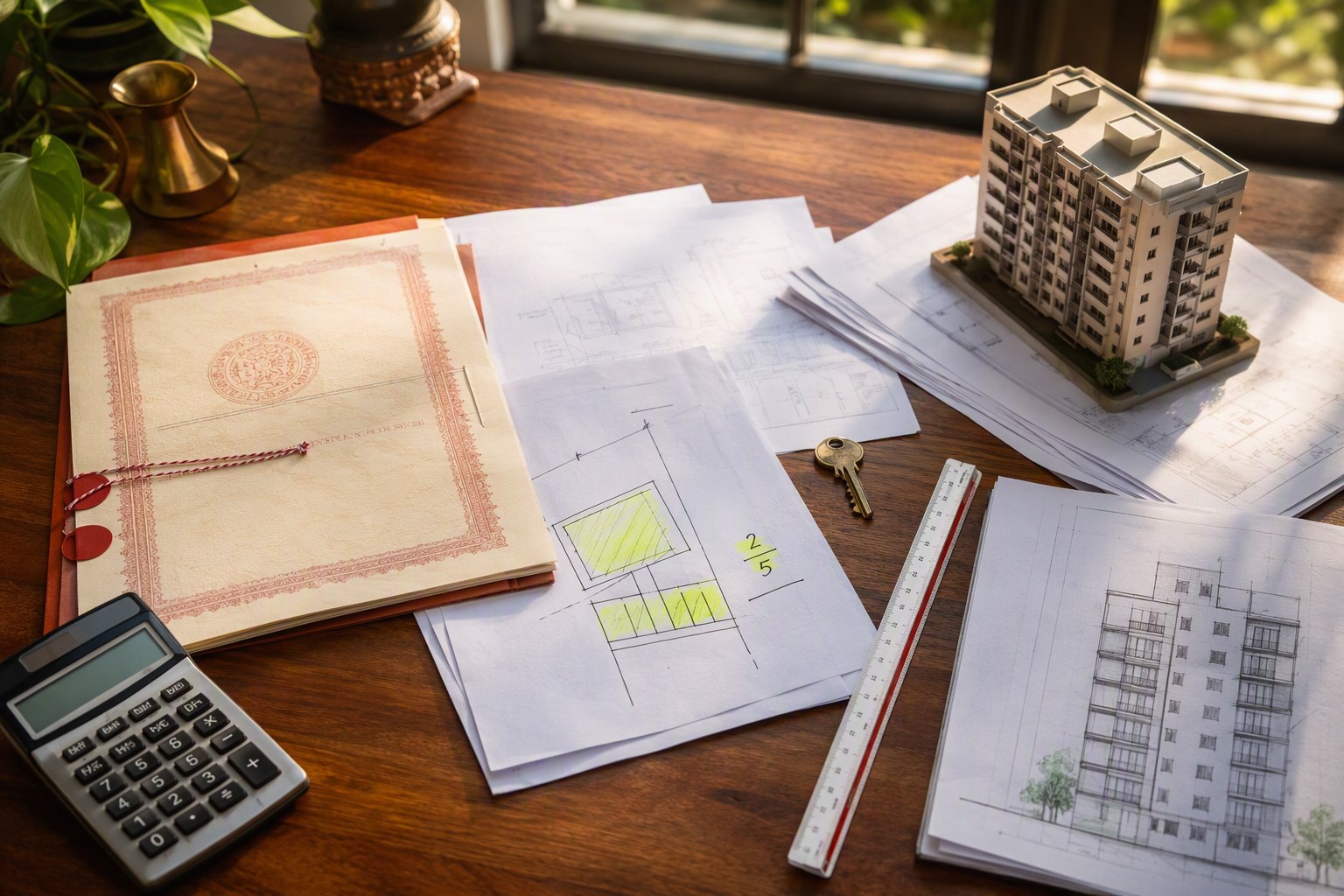


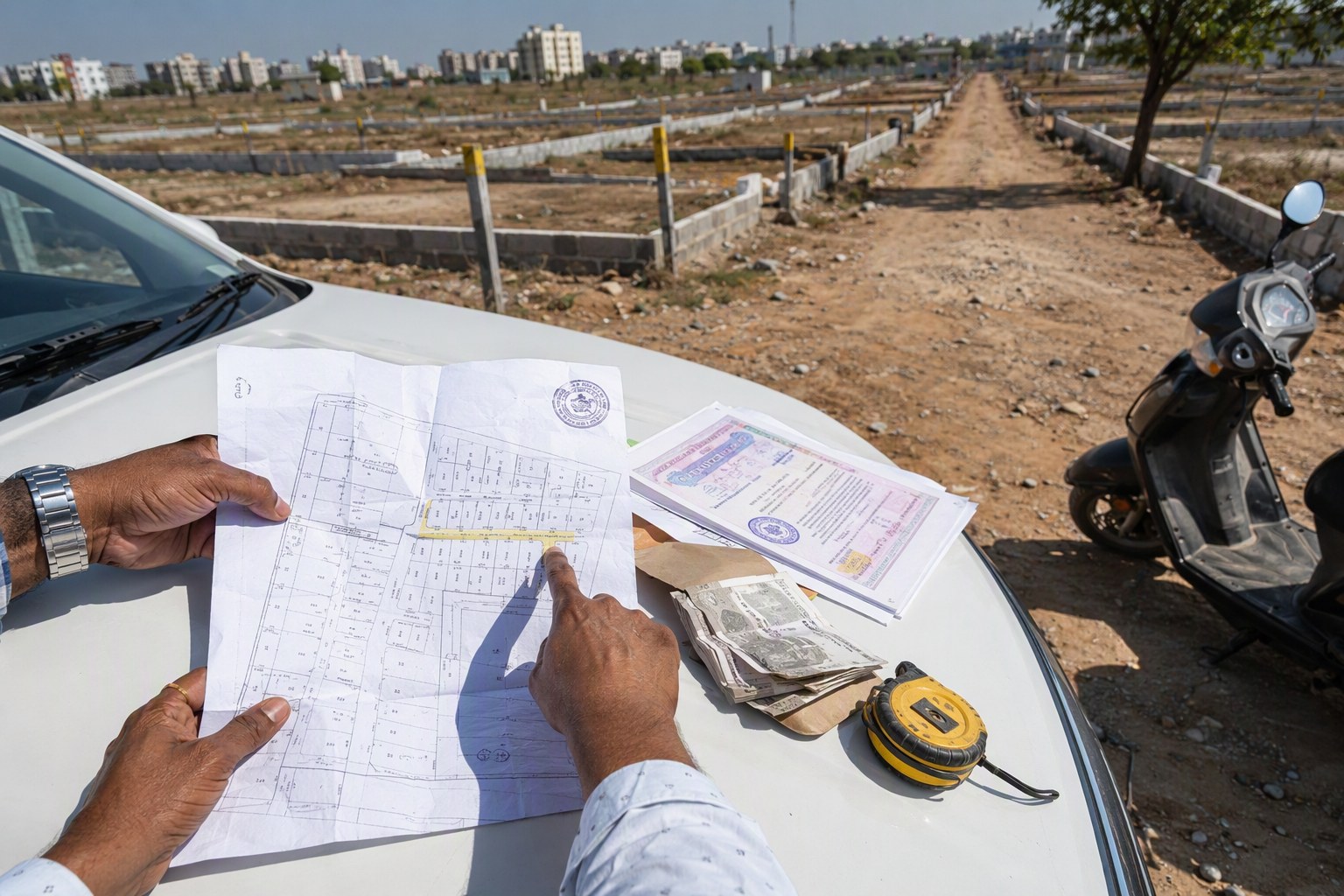
Short answer: before paying token advance, check whether the plot access road is legally recorded in the approved layout, revenue records, municipal plan or registered documents. If the road exists only on ground, or only in the seller’s words, your plot can become difficult to register, mortgage, construct on, sell, or even physically enter without dispute. This is one of the most common plot-buying traps we see around Hyderabad’s expanding edges — especially in Shankarpally, Mokila, Maheshwaram, Adibatla, Kandukur, Moinabad, Ghatkesar, Medchal, and Patancheru belts.
A road is not automatically legal just because a car can reach the plot today. In Telangana land records, the legal character of access depends on how the road is shown: in the HMDA/DTCP/municipal layout, in village maps, in pahanis, in Dharani land details, in registered sale deeds, or through a proper right of way. If these records do not support the approach road, the buyer is taking a serious title and usability risk.
At Verified.RealEstate, we treat access road verification as a pre-token check, not a post-agreement formality. Use our Road Width Check, Survey Number Finder, Encumbrance Certificate Search, and Property Verification Tool before you commit money.
Is Your Plot Access Road Legally Recorded Before You Buy? The practical test
Ask one simple question: Can the seller show the access road in an official record, not just on Google Maps or a brochure?
If the answer is no, slow down. A visible mud road, gravel road, panchayat road, internal layout road, cart track, or neighbour’s pathway may all look similar on site. Legally, they are not the same. A plot can have a nice compound wall, borewell, fencing and a broker board, but if its access is through another private survey number without a recorded easement or approved road, the buyer may face trouble later.
In our experience, road issues surface late because buyers focus on price, facing, plot size, and registration date. Many check the EC, but not the path from public road to the exact plot. That is risky. A property without lawful access is not just inconvenient; it can become commercially weak.
Our opinion: Never treat access road verification as a small technical point. For plots around Hyderabad, access is part of the property’s value. If the road is doubtful, the plot’s marketability is doubtful.
Why access road records matter before token payment
Token advance creates pressure. Once you pay, the seller and broker may push for agreement, registration, and quick closure. If you discover later that the access road is not legally recorded, getting your money back can become a separate fight.
A legally recorded road helps you in five ways:
- Registration comfort: The SRO may accept the document, but registration alone does not prove practical access. Still, proper road description reduces future objections.
- Bank loan and mortgage: Banks often ask for approved layout plans, access details and legal scrutiny. A landlocked or doubtful-access plot may be rejected.
- Building permission: Gram panchayat, municipality, GHMC, HMDA or DTCP-related approvals depend on road width and layout status.
- Resale value: Future buyers will ask tougher questions than first-time buyers. A plot with clean road access sells faster.
- Neighbour disputes: If the road passes through private land, the owner of that land can object, fence it, or demand money later.
This is especially relevant in peri-urban mandals where agricultural lands are being converted into plotted layouts. Around Kollur, Tellapur, Nandigama, Shankarpally, Velimela, Bhanur, Tukkuguda, Lemoor, Mucherla, Pocharam and Rampally, access may run through old survey boundaries, nala margins, assigned lands, private patta lands or unapproved layout strips. Some roads are genuine. Some are only informal pathways created for marketing.
Is Your Plot Access Road Legally Recorded Before You Buy? Check these documents
Do not depend on one document. Road status must be cross-checked from multiple records. Here is the order we prefer during buyer-side due diligence.
1. Approved layout plan
If the plot is in an approved layout, the road should be clearly shown in the sanctioned plan. Check road width, plot number, open space, approach from main road, and whether the plan carries approval details from the competent authority. In HMDA or DTCP areas, the layout copy must match the plot being sold.
Be careful with “LP number will come soon” sales. If the layout is not approved yet, the roads shown in the marketing sketch may not be legally final. The seller may say, “Sir, road is there, everyone is buying.” That is not enough.
2. Registered sale deed and link documents
The sale deed should mention boundaries and access. For example, if the eastern boundary says “30 feet road,” ask where that road came from legally. Was it part of an approved layout? Was it transferred to the local body? Was it carved out from the vendor’s land? If yes, is that road portion excluded from saleable plots?
Read link documents too. If older deeds show agricultural land with no layout road, and the present seller is selling plot numbers using a private sketch, there may be a conversion or approval gap.
3. Revenue records: pahani, survey map and Dharani details
For land in Telangana, pahani and revenue records help identify survey numbers, land classification and possession entries. They do not always prove road rights, but they can reveal whether the approach road passes through private patta land, government land, assigned land, shikam, kunta, nala or other sensitive categories.
Use the Survey Number Finder to start with the correct survey number. Then check Dharani and local revenue records. If the approach road cuts across another survey number, get clarity before token.
4. Village map and field measurement sketch
Village maps can show old cart tracks, public roads, tanks, streams and survey boundaries. In mandals such as Chevella, Moinabad, Yacharam, Kandukur, Shabad, Ibrahimpatnam and Ghatkesar, older access routes may not match today’s plotted development. A field measurement sketch from a competent surveyor can help you understand whether your plot actually touches a legal road.
5. Municipal, panchayat or layout road records
If the area is under a gram panchayat, municipality or municipal corporation, check whether the road is recognised by that local body. In urbanising pockets, buyers often assume every blacktop road is public. Some roads are laid by private developers and not handed over. Some are internal roads inside gated plotted projects. Some are temporary construction roads.
When a seller claims “municipality road,” ask for proof. Road tax payment by someone, street lights, drainage work or garbage collection may support usage, but they may not by themselves prove title to the road.
Common access road traps in Hyderabad plot deals
Hyderabad buyers are sharp, but land sellers can be sharper. These are the patterns we regularly see.
Trap 1: Road shown in brochure, not in approval
The marketing brochure shows a neat 40 feet road. The approved plan, if available, shows a different road alignment or smaller width. Sometimes the brochure includes future proposed roads that are not sanctioned. Buy based on approved records, not colourful maps.
Trap 2: Access through neighbour’s private land
The plot is reachable because the neighbour has not fenced his land yet. After your purchase, the neighbour sells, fences, or develops his property. Suddenly, your access disappears. If access is through private land, it must be backed by a registered right of way or clearly recognised legal arrangement.
Trap 3: Internal road sold as plot area
In some unapproved layouts, developers carve roads physically but do not legally dedicate them. Later, road portions remain in the name of the original pattadar or get dragged into disputes. Buyers of interior plots suffer first.
Trap 4: Road width not enough for building permission
A narrow lane may allow walking and two-wheelers, but building permission can depend on minimum road width and planning norms. Before buying, check whether the road width supports your intended construction. Our Road Width Check and FSI/FAR Calculator can help you assess this early.
Trap 5: Plot touches a road, but road passes through prohibited or disputed land
Telangana has a large prohibited property database under Section 22-A. As per latest IGRS data available in our database, 3,076,153 properties are listed under prohibited properties. That number should make every buyer cautious. If the access road or parent land touches a prohibited category, assigned land issue, government land entry or court dispute, do not proceed casually. Run a Section 22-A Prohibited Property Check before token.
What exactly should be written in the sale agreement?
If road access is clean, record it properly in the agreement of sale. Do not rely on verbal assurance. The agreement should mention the plot number, survey number, layout approval details if any, boundaries, road width, approach road, and seller’s confirmation that the access is lawful and free from obstruction.
For unapproved or semi-developed lands, buyers should be extra careful. If the seller promises to provide road access later, the promise must be specific: from which survey number, what width, by what date, and through what registered document or approved layout process. A vague line like “vendor shall provide road” is weak.
Use the Legal Document Generator only after your lawyer reviews the facts. Tools can structure clauses, but they cannot convert an illegal road into a legal one.
How to verify access road before paying token: buyer checklist
Here is a practical checklist we suggest for Telangana plot buyers.
| Check | What to ask | Why it matters |
|---|---|---|
| Site visit | Does the plot physically touch a road? | Confirms actual ground access, but not legal status. |
| Approved layout | Is the road shown in sanctioned plan? | Strongest proof in plotted developments. |
| Survey number | Which survey number does the road pass through? | Identifies whether it is private, public or sensitive land. |
| Sale deed | Are boundaries and road width clearly mentioned? | Reduces future ambiguity. |
| EC | Any sale, mortgage or dispute affecting access land? | Reveals registered transactions and charges. |
| Section 22-A | Is parent land or access strip prohibited? | Prevents registration and title risk. |
| Local body | Is road recognised by panchayat/municipality/HMDA/DTCP? | Supports building permission and resale. |
For EC review, start with Encumbrance Certificate Search and use EC Analyzer to understand entries better. To identify the correct registration jurisdiction, use Find Your SRO Office. For market value context, check Market Value / Guideline Value Search and then estimate registration cost using the Stamp Duty Calculator.
Local examples: where buyers must be extra alert
I am not saying every plot in these areas has a road problem. Many projects are clean and well-planned. But because land conversion and plotting activity is active, buyers should verify access carefully in these belts.
- Shankarpally and Mokila: Multiple layouts sit between old village roads, farm tracks and new approach roads. Check whether internal roads are approved and connected to a legal public road.
- Maheshwaram, Tukkuguda and Adibatla: Fast development around ORR-side corridors has created many layouts. Verify road width and land use before buying.
- Kandukur and Mucherla side: Larger land parcels may be split into plotting ventures. Access through neighbouring survey numbers should be documented.
- Moinabad, Chevella and Shabad: Farm plots and weekend plots often use informal approach roads. Ask for registered access rights.
- Ghatkesar, Pocharam and Rampally: Urban expansion and older village layouts overlap. Confirm municipal road recognition and layout status.
- Patancheru, Nandigama and Bhanur: Industrial, residential and agricultural pockets mix closely. Road alignment and zoning checks matter.
Also check land use before assuming you can build. The Land Use Zone Finder is useful for this, especially when the plot is near growth corridors, conservation zones, industrial pockets or water bodies.
Red flags that should stop your token payment
If you see any of these signs, pause the transaction and take legal advice:
- The broker says, “Road is there on ground, document is not needed.”
- The road is shown only in a private sketch, not in approved layout records.
- The access road passes through another pattadar’s land.
- The seller refuses to share link documents or survey details.
- The plot is inside an unapproved layout with no clear road dedication.
- The road width differs between brochure, site and deed.
- The approach road touches nala, tank bed, government land or assigned land entries.
- The seller asks for token before document verification.
A genuine seller may not have every paper ready on day one, but he will not block verification. If someone rushes you by saying another buyer is waiting, take it as pressure selling.
What if you already paid token and then found access issues?
First, do not pay the next instalment until the issue is clarified. Send a written message or email asking the seller to provide proof of legal access. If the agreement has refund terms linked to title defects, invoke them through your lawyer.
If the seller can regularise access through a registered right of way, approved layout correction, or proper road transfer, evaluate the solution carefully. Do not accept oral assurances. If the road issue affects the basic usability of the plot, exit is often safer than adjustment.
We have seen buyers accept a discount for doubtful access. Personally, I do not like that approach unless the buyer fully understands the risk and has independent legal advice. Cheap land with no legal access is rarely cheap in the long run.
Final buyer view
The safest plot is not just the one with good location, good facing and attractive price. It is the one where the access road is physically available and legally recorded. Before paying token, verify the road in layout records, revenue records, sale deeds, EC, local body records and survey maps. If the plot fails the road test, do not convince yourself that things will get sorted after registration.
Hyderabad’s outskirts still offer good land opportunities, but the paperwork has to be respected. A few hours of road verification before token can save years of dispute later.
Frequently Asked Questions
Is a road shown on Google Maps enough proof for buying a plot?
No. Google Maps can show physical access, but it does not prove legal access. You must verify the road in approved layout plans, revenue records, registered deeds, municipal or panchayat records, and survey documents.
What if the plot has a road on ground but not in the approved layout?
Treat it as a serious risk. The road may be informal, temporary or passing through private land. Ask the seller to prove legal access before token payment. If proof is not available, avoid the deal or take strong legal advice.
Can I register a plot even if the access road is disputed?
Registration may happen in some cases, but registration does not automatically solve access disputes. A legally weak road can affect construction permission, bank loan, resale and peaceful possession.
Which records should I check for plot road access in Telangana?
Check the approved layout plan, sale deed, link documents, EC, pahani, Dharani details, village map, field measurement sketch, local body records and Section 22-A status where relevant.
Should road access verification be done before or after token advance?
Do it before token advance. Once money is paid, the buyer loses negotiation strength. Access road verification should be part of your first-stage due diligence.