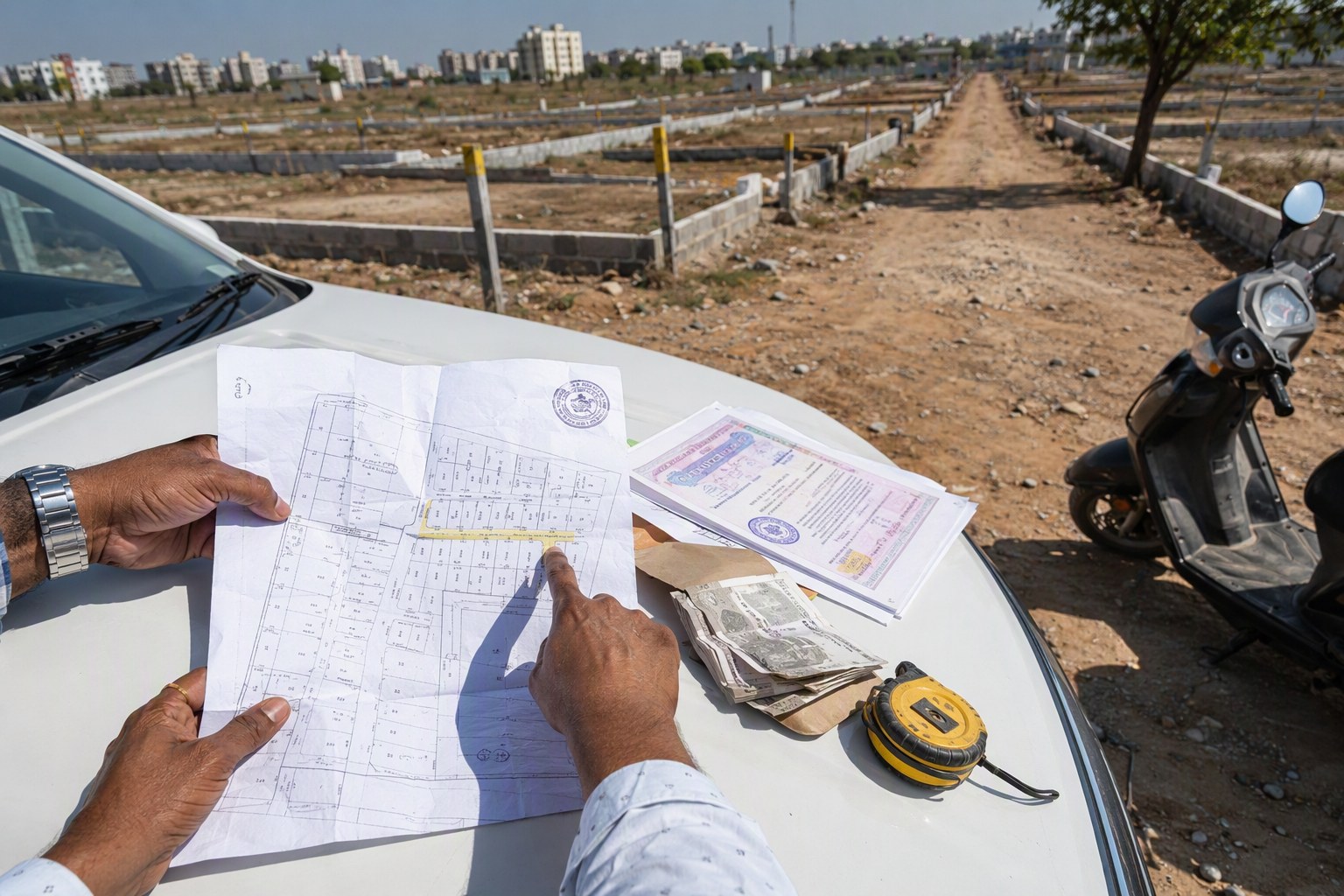



Telangana Buyer Due Diligence File Before a Site Visit is not office paperwork. It is buyer self-defence. As per latest IGRS data available with us, Telangana has 30,76,153 prohibited property entries under Section 22-A. That single number should make every buyer slow down before paying token advance for a plot in Shankarpally, a flat in Gachibowli, a villa near Kollur, or agricultural land outside Maheshwaram.
In our experience, the riskiest stage is not registration day. It is the first site visit, when the buyer likes the location, the broker says “sir, two more parties are coming”, and a small UPI token suddenly becomes emotional pressure. A simple due diligence file prepared before visiting the property can stop that mistake.
My view is clear: if the seller cannot share basic survey number, village, mandal, link documents and approval details before the visit, the property is not ready for your money.
Telangana Buyer Due Diligence File Before a Site Visit: why the 30,76,153 number matters
Section 22-A prohibited properties are properties where registration may be restricted because of government interest, assigned land issues, endowment land, court matters, ceiling matters, wakf-related entries, or other notified restrictions. The buyer need not understand every legal category on day one. But the buyer must check whether the land or flat site has a red flag before handing over token advance.
The count of 30,76,153 prohibited property entries is a wake-up call because Telangana property buying is still heavily driven by word of mouth. “Known person”, “local patwari knows”, “registration happened in nearby survey number”, “same venture lo plots sold ayyai” — these statements are not proof. In Hyderabad’s growth corridors, one survey number can be clean while the adjacent survey number can carry a restriction.
We have seen this around fast-moving belts like Mokila and Shankarpally, Narsingi and Gandipet, Tellapur and Ramachandrapuram, Adibatla and Ibrahimpatnam, Kompally and Medchal, Shamshabad and Maheshwaram. The locality name sounds premium. The actual verification still depends on survey number, village, mandal, SRO jurisdiction, title flow, approvals and encumbrances.
Before you even plan the drive, run the basic check using Section 22-A Prohibited Property Check. If you do not have survey number and village, ask the seller. If they avoid sharing it, treat that itself as a due diligence result.
Telangana Buyer Due Diligence File Before a Site Visit: what to create
Create one folder on your phone and laptop. Name it with the property location and seller name. For example: “Kollur Villa Plot - Seller Ramesh - Due Diligence”. Inside, keep screenshots, PDFs, notes, call summaries and pending questions. This is your buyer file.
The file should not be fancy. It should be usable. On site, network may fail. Broker may rush. Family members may ask different questions. If your file is ready, you will speak with confidence.
| File section | What to keep | Why it matters before site visit |
|---|---|---|
| Identity of property | Survey number, sub-division number, village, mandal, district, plot or flat number | Without exact identity, no meaningful check is possible |
| Seller identity | Name as per deed, Aadhaar/PAN copy if shared, legal heir details if any | Many disputes start with mismatch between seller and title holder |
| Title papers | Sale deed, link documents, gift deed, partition deed, release deed where applicable | You need to see how the seller got ownership |
| Revenue records | Dharani details, pattadar passbook, pahani/adangal, mutation extracts where relevant | Revenue name and registered title should not contradict each other |
| Registration checks | EC, SRO, market value, prohibited property status | This gives early warning before payment |
| Approval checks | RERA, HMDA/DTCP approval, building permission, layout plan | Useful for flats, villas, gated communities and plotted layouts |
| Site questions | Road width, approach road, nala, lake buffer, land use, physical boundaries | Some issues are visible only when you know what to look for |
Start with survey number, village and mandal
Hyderabad buyers often ask the wrong first question: “What is the rate?” The correct first question is: “What is the exact survey number, village and mandal?” In Telangana land records, these three details carry more weight than the marketing name of the area.
A project may be advertised as “near Financial District” but actually fall under a village in Gandipet mandal or a different SRO area. A plotted layout may be sold as “Shamshabad side” but the actual land may be in another village belt. That difference affects land use, SRO, market value, approvals and future resale comfort.
If the seller does not know the survey number, ask for the parent document. If the broker only sends location pin, ask again. Location pin is useful for driving. It is not due diligence.
Use Survey Number Finder to organise the basic property identity. If you are confused with village spellings, old mandal names or SRO mapping, keep SRO Village Directory and Find Your SRO Office open while preparing the file.
Check Section 22-A before believing the sales pitch
For land and plotted property, this is non-negotiable. A beautiful approach road and a compound wall do not make title clean. Section 22-A status must be checked early, especially in areas where old agricultural lands have moved into residential demand.
Ask for the exact survey number and village. Then check whether any prohibited entry appears. If the land is part of a larger survey number, check the parent survey details also. Do not accept “layout approval undi sir” as a replacement for 22-A checking. Both are separate issues.
When you find a match or possible match, do not panic immediately. Spellings, sub-divisions and survey extents need legal reading. But do not pay token advance until the seller gives a proper clarification with documents. A buyer should not fund the seller’s explanation.
Keep the screenshot or PDF in your file from Section 22-A Prohibited Property Check. Mark it as “clear”, “matched”, or “needs advocate review”. Use plain words. You should be able to understand your own file after one week.
Pull EC and read it like a buyer, not like a clerk
Encumbrance Certificate is one of the most misunderstood documents in Telangana property buying. Many buyers collect EC only because the bank asks for it. That is late. EC should be part of your first due diligence file.
Use Encumbrance Certificate Search and then read the flow. Look for seller name, previous owners, document numbers, mortgage entries, release deeds, gift or settlement entries, partition entries and any unusual transfer. If you already have EC but cannot understand the entries, run it through EC Analyzer.
For flats in areas like Kondapur, Miyapur, Puppalaguda, Nallagandla and Bachupally, EC can show land owner documents, development agreement clues and mortgage releases. For plots around Ghatkesar, Tukkuguda, Kadthal, Kandukur, Shadnagar or Shankarpally, EC can reveal whether the same land has moved through multiple hands in a short period. I do not say every quick transfer is fraud. But it deserves questions.
One practical tip: match the schedule in the sale deed with the EC property description. Boundaries, extent and survey number should not casually change. If the deed says one village and EC search is being shown for another village, pause.
Use market value as a sanity check, not as final price
Telangana registration values, often called ready reckoner or guideline values in everyday speech, are not the same as market selling price. Still, they are useful. They tell you the government value used for registration and stamp duty calculation. If the quoted transaction structure is strange, the buyer should understand why.
Before site visit, check the official market value range using Market Value / Guideline Value Search. Then estimate registration cost using Stamp Duty Calculator. For apartment purchases, especially where undivided share, construction value and amenities are being split, Composite Value Calculator can help you organise the numbers.
Do not use guideline value to argue blindly with the seller. Local resale prices in Jubilee Hills, Banjara Hills, Kokapet, Narsingi, Tellapur and other high-demand pockets may behave differently. But if the seller insists on an unusual cash component or says registration will be done for a different value without clear reasoning, you need professional advice before token.
For flats and villas, RERA and approvals must enter the file
If the property is in an ongoing project, RERA verification is a basic step. This applies to high-rise flats in Kokapet, Nanakramguda, Puppalaguda, Tellapur, Nallagandla, Miyapur, Bachupally and similar markets. It also applies to villa projects and larger plotted developments where registration and project marketing are linked to approvals.
Use RERA Project Lookup before the site visit. Keep the project name, promoter name and registration details in your file. During the visit, ask the sales team to show the same name on brochure, application form, draft agreement and payment schedule. Small naming differences can create confusion later.
For plotted layouts, ask whether the approval is HMDA, DTCP, municipal, gram panchayat-era, or another category. Do not treat a colourful layout plan as approval. Ask for the proceeding number and approved layout copy. If open space, road width or land use looks doubtful, check Road Width Check, OSR Calculator and Land Use Zone Finder.
Visit the site with a question sheet
A good site visit is not only about sunlight, road feel and neighbourhood. Those matter, yes. But the best buyers go with written questions. They do not rely on memory.
Questions for plot or land visits
- What is the exact survey number and sub-division?
- Where are the physical boundaries on ground?
- Is the approach road private, revenue road, panchayat road or layout road?
- Is there any nala, tank buffer, high-tension line or burial ground nearby?
- Is the land converted or still agricultural in revenue records?
- Who owns neighbouring land on all sides?
- Is the layout approved, and by which authority?
Questions for flat or villa visits
- Is the project registered under RERA if applicable?
- What is the land ownership structure?
- Is there a development agreement or GPA?
- Has the project land been mortgaged to any bank or lender?
- Are approvals matching the actual construction?
- What is the undivided share for the unit?
- Which SRO will handle registration?
Record answers in your file immediately after the visit. Do not write “all okay”. Write specific answers. For example: “Approach road shown from east side; seller says panchayat road; document not yet shared.” This style saves you later.
Token advance: keep it boring and written
Token advance is where many Telangana buyers lose bargaining power. The amount may look small compared to the full property value, but the emotional shift is big. Once paid, buyers start justifying problems instead of examining them.
My rule is simple: no token before identity, title basics, EC, 22-A check and approval status are seen. If the seller insists, pay only with a written receipt or token agreement clearly stating refund conditions. Mention property details, seller name, buyer name, amount, payment mode, purpose, due diligence period and refund clause if title or approvals are not satisfactory.
You can prepare a clean draft using Legal Document Generator, but get an advocate to review it for a serious purchase. If there is an existing loan or mortgage, check charges through CERSAI Charge Check and ask for closure documents before final payment planning.
A practical Telangana buyer due diligence file format
Here is the format we suggest to buyers across Hyderabad and surrounding districts. Keep it short enough that you will actually use it.
- Page 1: Property snapshot — locality, village, mandal, district, SRO, survey number, plot or flat number, seller contact.
- Page 2: Price and payment notes — quoted price, advance requested, registration value checked, stamp duty estimate, payment timeline.
- Page 3: Title chain — present owner, previous owner, link documents received, missing documents.
- Page 4: Government checks — Section 22-A status, EC status, Dharani or revenue record notes, SRO notes.
- Page 5: Approval checks — RERA, HMDA/DTCP, building permission, layout plan, land use and road notes.
- Page 6: Site visit observations — access road, boundaries, neighbouring use, visible risks, photos.
- Page 7: Pending questions — seller replies, documents promised, advocate comments, final decision.
If Telugu terms in pahani, adangal, sethwar, passbook or old deeds confuse you, use Telugu-English Property Terms Dictionary. Many urban buyers miss simple clues because the document language is unfamiliar.
Red flags that should stop the site visit or token
Not every missing document means fraud. But some behaviours are strong warning signs.
- Seller refuses to share survey number before visit.
- Broker says EC and 22-A can be checked only after token.
- Property is sold with only location pin and brochure.
- Names differ across sale deed, revenue record and seller ID without explanation.
- Old GPA is being used without clear legal review.
- Layout approval is claimed, but proceeding copy is not shared.
- Seller pushes cash-heavy payment structure.
- Bank loan closure, mortgage release or CERSAI charge status is unclear.
- Boundary shown on ground does not match document schedule.
- Land is marketed as residential, but land use is not checked.
In such cases, do not get embarrassed to walk away. Hyderabad has many properties. Your peace of mind is also an asset.
Final word for Telangana buyers
The Telangana property market rewards speed, but only after verification. A buyer who prepares a due diligence file before site visit will ask better questions, resist pressure and spot weak documents early. The 30,76,153 prohibited property entries under Section 22-A are enough proof that property buying cannot run on trust alone.
Visit the site after you know the survey number. Pay token after you know the risk. Register only after your advocate, banker and own common sense are aligned. That is how a Hyderabad buyer should behave in this market.
Frequently Asked Questions
What is a Telangana buyer due diligence file?
It is a simple folder containing survey number, village, mandal, seller details, title papers, EC, Section 22-A check, approval copies, market value notes and site visit questions. It helps you verify the property before paying token advance.
Should I check Section 22-A before visiting the property?
Yes, especially for land, plots and villa projects. Telangana has 30,76,153 prohibited property entries as per latest IGRS data available with us. A quick check before the visit can save time and prevent a rushed token payment.
Is an Encumbrance Certificate enough to buy a plot in Telangana?
No. EC is necessary, but not enough. You should also check title chain, revenue records, Dharani details where applicable, Section 22-A status, layout approval, land use, road access and seller authority.
Can I pay token advance before document verification?
In our opinion, avoid it. If you must pay, use a written token agreement with refund conditions linked to satisfactory title, approvals, EC and prohibited property checks.
Which details should I ask the seller before a site visit?
Ask for survey number, village, mandal, SRO, plot or flat number, seller name as per document, link deed copies, EC, approval details and whether any loan or mortgage exists on the property.