RERA Approval vs HMDA Permit: the short answer for Hyderabad buyers
RERA Approval vs HMDA Permit is one of the most misunderstood checks in Hyderabad property buying. My straight answer: RERA tells you whether a real estate project is registered under the Telangana RERA framework and gives you buyer-facing project disclosures. HMDA permission tells you whether the layout or building proposal has planning approval under the metropolitan development rules. Both are useful. Neither is a complete title verification.
If you are buying a flat in Kokapet, Tellapur, Narsingi, Bachupally, Miyapur, Kompally or Adibatla, you should not stop after seeing only one certificate. RERA registration is not a substitute for HMDA sanction. HMDA permit is not a substitute for RERA compliance. And both together still do not replace EC, link documents, pahani or 22-A prohibited property checks.
In our experience, the safest Hyderabad buyer reads RERA and HMDA as two different signals: one about project regulation, the other about planning permission. Title has to be checked separately.
Before paying token advance, use RERA Project Lookup, Encumbrance Certificate Search, Section 22-A Prohibited Property Check and Market Value / Guideline Value Search. These four checks catch different risks.
RERA Approval vs HMDA Permit: what each one actually proves
| Buyer check | What it proves | What it does not prove | Where buyers usually see it |
|---|---|---|---|
| RERA registration | The project is registered with Telangana RERA and the promoter has made required project disclosures. | It does not by itself prove clear title, absence of mortgages, no court disputes, or that every land document is clean. | Apartment projects, gated communities, plotted development projects where RERA registration is applicable. |
| HMDA permission | The layout or building plan has planning permission from HMDA, where the land falls under HMDA jurisdiction and permission is required. | It does not by itself prove ownership, mutation, clear EC, or that the land is free from Section 22-A restriction. | Layouts, villas, apartments and building permissions in HMDA areas such as parts of Rangareddy, Medchal-Malkajgiri, Sangareddy and Yadadri-Bhuvanagiri districts. |
| EC check | Shows registered transactions and encumbrances recorded with the Registration Department for the selected period. | It may not show unregistered agreements, family disputes, some pending litigations or possession issues. | SRO records through document number, survey number, schedule or owner details. |
| 22-A prohibited property check | Helps identify whether the property appears under prohibited categories affecting registration. | It is not a full title opinion; it must be read with survey, revenue and registration records. | Government prohibited property records and registration checks. |
That table is the whole debate in one place. Many sales teams casually say, “Sir, RERA is there, no problem.” Some others say, “HMDA final approval is there, bank loan also available.” Both statements may be true, but neither statement completes your due diligence.
What RERA registration gives a buyer
RERA registration is mainly about project-level discipline. It pushes the promoter to disclose details such as project name, promoter information, approvals, layout details, proposed completion, project updates and other documents required by the regulator. For a buyer, it creates a formal trail.
In Hyderabad’s active corridors like Financial District, Nanakramguda, Kokapet, Narsingi, Puppalaguda, Kondapur and Gachibowli, buyers often shortlist projects based on brand, amenities and payment plan. RERA registration brings some structure into that process. You can verify whether the project registration exists instead of depending only on brochure language.
Use RERA Project Lookup to cross-check the project name and registration details. Small spelling differences matter. Builders sometimes market a tower name, phase name or community name which may not exactly match the registered project name. Ask the sales team for the RERA registration number and check it yourself.
RERA is strong on disclosures, but it is not a magic title certificate
This is where buyers need to be practical. RERA registration is not the same as a lawyer certifying forty years of title. It does not mean the land has no old family settlement issue. It does not mean there is no mortgage charge. It does not mean the survey number is free from all revenue objections.
For example, a project may be RERA registered, but you still need to see whether the land schedule in the sale agreement matches the registered land parcels. In mandals like Serilingampally, Gandipet, Rajendranagar, Patancheru, Ameenpur, Medchal, Quthbullapur, Maheshwaram and Ibrahimpatnam, village names, survey numbers and old layouts can create confusion if you do not read the documents carefully.
RERA also does not replace your bank’s legal scrutiny. Bank approval helps, but a bank lawyer checks the file for the bank’s lending risk. Your purchase risk can be wider: road access, promised UDS, OSR, amenity handover, maintenance corpus, car parking wording and future association control.
What HMDA permission gives a buyer
HMDA permission is about planning. If the property falls under HMDA jurisdiction, the layout or building permission tells you that the proposed development has been processed under the planning framework applicable to that location. For plotted ventures, buyers usually ask for layout permission. For apartments and villas, they ask for building permission, approved plans and sometimes occupancy-related documents depending on project stage.
In growth belts like Kollur, Mokila, Shankarpally side, Tellapur, Osman Nagar, Bowrampet, Dundigal, Kompally, Ghatkesar, Pocharam, Adibatla and Tukkuguda, this check is especially relevant. A plotted layout without proper permission can look attractive on ground because roads are marked and stones are fixed. But registration and future resale can become painful if the layout status is weak.
HMDA permission helps answer questions like: Is the layout approved? Is the building plan sanctioned? Are roads, open spaces and land use aligned with planning records? Is the construction broadly as per approved plan? It is a planning-side document, not an ownership certificate.
HMDA permit does not cure title defects
One common buyer mistake is assuming HMDA permission means the land is fully clean. It does not. A planning authority can process a permission based on documents and declarations submitted, but disputes over inheritance, prior sale deeds, boundaries, mortgages or government land claims need separate checking.
We’ve seen buyers in outskirts feel safe because a venture has an impressive entrance arch, compound wall, black-top roads and an approval plan copy. That is not enough. Ask for the permission number, approved layout copy, land schedule, link documents, pattadar passbook details where applicable, latest pahani or Dharani details for agricultural-origin land, conversion papers if relevant, and EC.
For land-use comfort, run Land Use Zone Finder. For road-related practical issues, use Road Width Check. If you are comparing built-up area, floors and permissible construction, FSI/FAR Calculator is useful before you rely on a verbal statement.
RERA Approval vs HMDA Permit: why buyers need both in apartment projects
For most apartment buyers, the safest reading is simple: RERA tells you the project is under the real estate regulator’s registration system, while HMDA permission tells you the building or layout has planning sanction. If one is missing where it should be present, ask why before booking.
Take a buyer considering a flat in Puppalaguda or Narsingi. The brochure may show clubhouse, pool, co-working area, EV charging, landscape decks and smart access systems. These amenities are good, but your first file should be boring: RERA number, HMDA sanctioned plan, land title documents, EC, mortgage details, draft agreement of sale, construction stage and delivery commitment.
For high-rise apartments, also check whether the sanctioned plan matches what is being sold. Tower count, floors, parking levels, common areas, amenity blocks, UDS and phase boundaries should be clear. If Phase 1 and Phase 2 share amenities, understand who pays, who owns, and when handover happens.
Under-construction buyers should read the RERA page like a file, not like an advertisement
Do not just confirm that a RERA number exists. Read project details. Look for consistency between RERA disclosures, HMDA plan, sale agreement and payment schedule. If there are multiple phases, check whether your unit falls in the same registered project or another phase. Ask whether approvals cover the tower being sold to you.
Use EC Analyzer after collecting the EC, especially when the land has multiple past transactions. For registration cost planning, Stamp Duty Calculator can help you estimate statutory charges based on the property details you input.
RERA Approval vs HMDA Permit in plotted layouts
Plotted layout buyers face a slightly different risk profile. In plotted ventures, people often focus on location and price talk: “near ORR”, “near pharma city side”, “future growth”, “close to proposed road”, “HMDA layout”, “bank loan available”. These phrases can be useful starting points, but they are not due diligence.
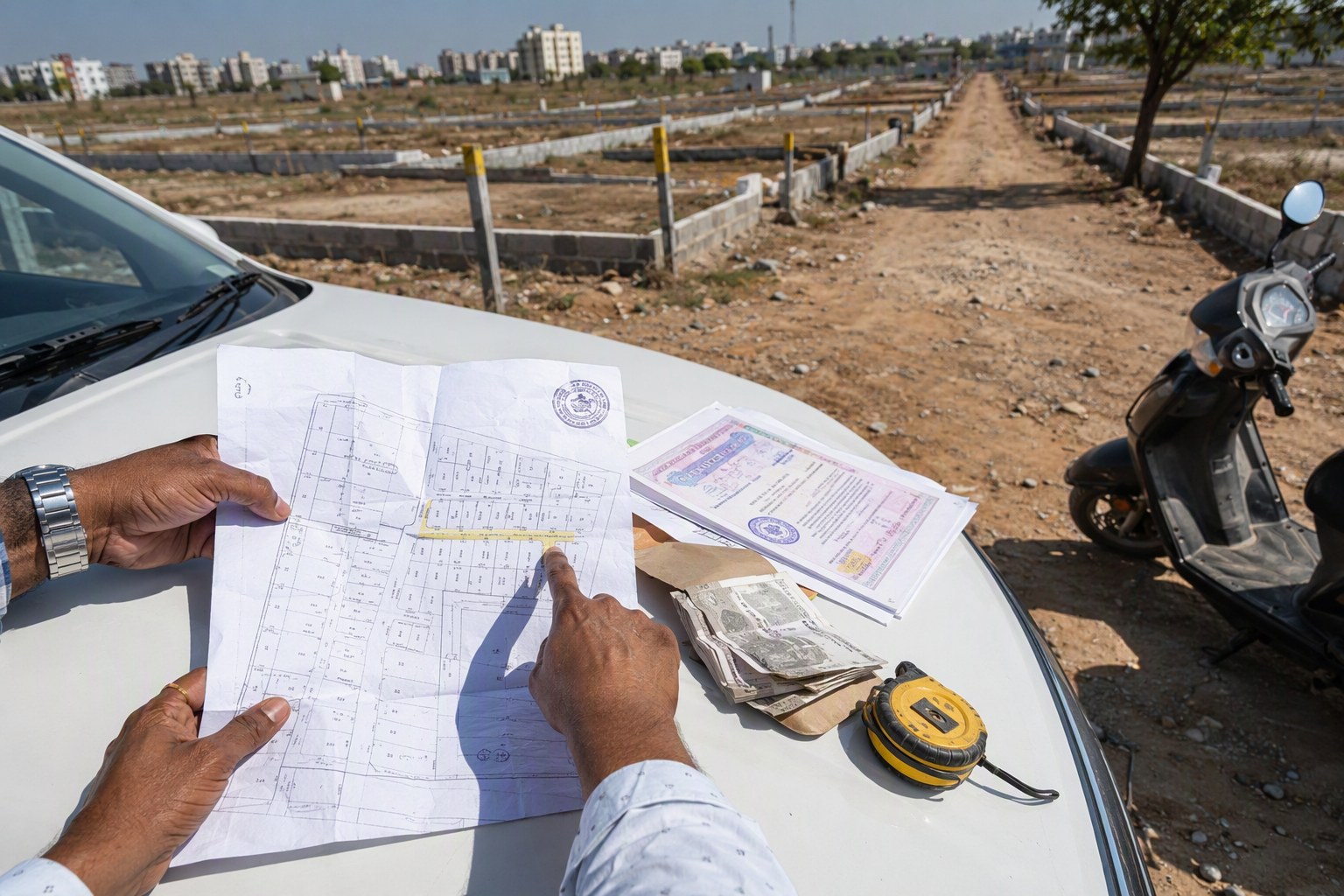
For an HMDA-region plot, ask for the approved layout plan, permission proceedings, survey numbers, village and mandal details, plot number, approach road details and link documents. Confirm whether the exact plot number you are buying appears in the approved layout. Do not rely only on a coloured marketing layout.
RERA applicability for plotted developments depends on the project and legal requirement. If the venture is RERA registered, that helps with project disclosure. If the seller says RERA is not applicable, do not argue blindly; ask for a written explanation and get legal advice. But HMDA layout permission, title, EC and 22-A check remain non-negotiable in my book.
Survey number discipline is critical in outskirts
In areas like Shamirpet, Medchal, Keesara, Ghatkesar, Hayathnagar, Maheshwaram, Kandukur, Shankarpally and Moinabad, one village can have several survey numbers with different histories. One parcel may be private patta land, another may have assignment issues, another may be affected by road widening or public purpose marking.
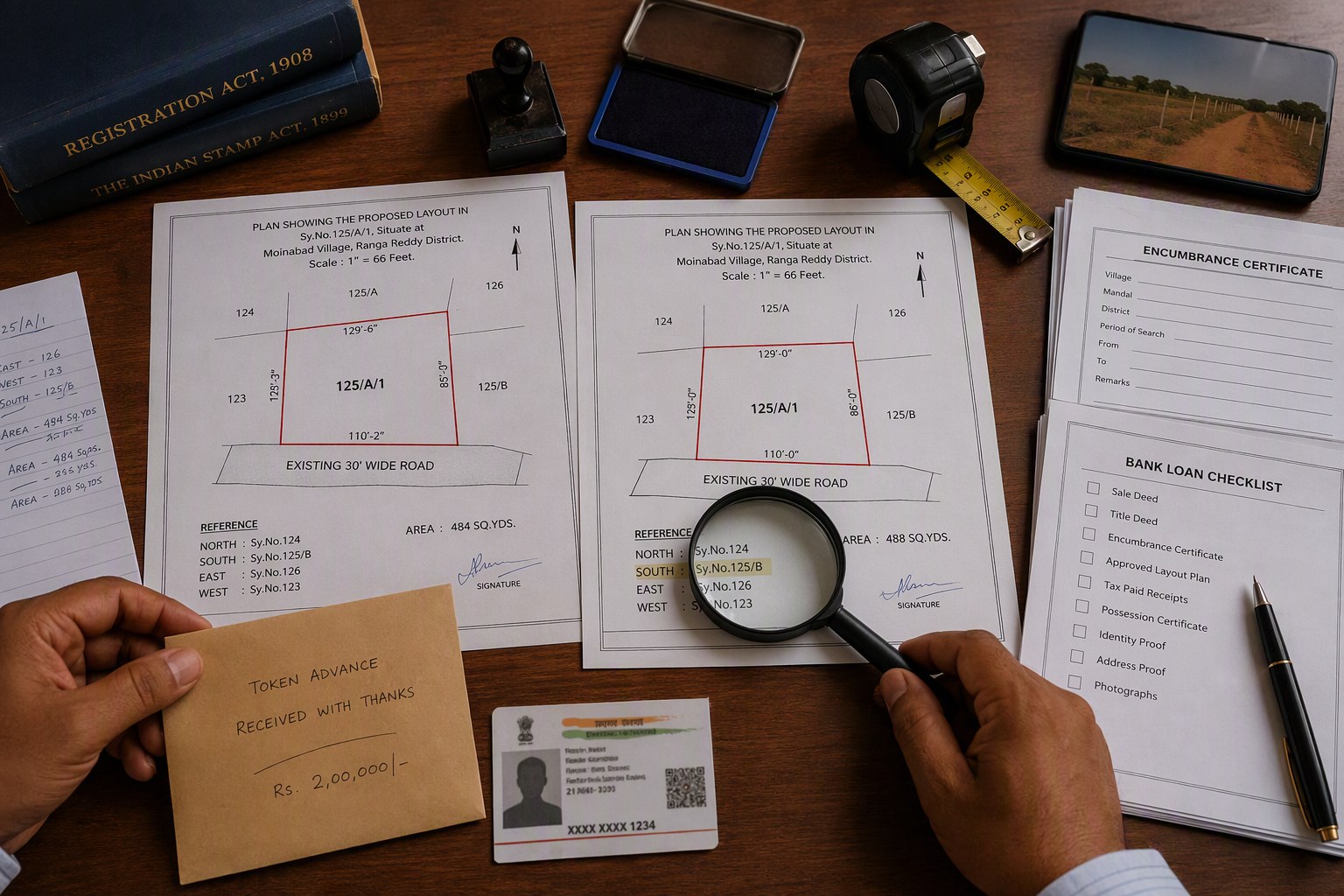
Use Survey Number Finder and then compare the survey details with sale deed schedules, HMDA plan and revenue extracts. If the survey number in the brochure, agreement and EC do not match properly, pause the transaction.
Why EC still matters even when RERA and HMDA are present
An Encumbrance Certificate is a registration record check. It shows registered transactions such as sale deeds, gift deeds, mortgages, releases and other recorded instruments for the period searched. It gives a buyer a view of what has been registered against the property.
In Hyderabad, many buyers ask for a short EC only from the date of developer purchase. That is risky. For land-based due diligence, lawyers often trace title through older link documents and longer EC periods depending on the property history. If a large land parcel was assembled from many owners, every link has to be understood.
Run Encumbrance Certificate Search as an early screening step. Then get a property lawyer to review the document chain. EC is not perfect, but skipping EC is careless. It can reveal mortgages, earlier transfers and document numbers that your seller may not mention in the first meeting.
Check for CERSAI and lender charges too
For apartments, builders often take project finance. That is not automatically a problem. But the release mechanism should be clear. If your flat or undivided share is under a lender charge, you need proper NOC or release documentation at the right stage. Use CERSAI Charge Check as one part of the finance-side review.
For resale flats in Manikonda, Kondapur, Kukatpally, Miyapur, Chandanagar, Ameerpet, Begumpet or Uppal, ask for the seller’s loan closure proof if there was a home loan. The EC may show a mortgage entry and release deed. If the release is missing, do not proceed only on oral assurance.
The 22-A prohibited property check is not optional
Telangana registration records include a large universe of properties under Section 22-A prohibited categories. As per the database context available to us, prohibited properties under Section 22-A stand at 3,076,153. That number itself tells you why this check cannot be treated as a formality.
Section 22-A issues may relate to government lands, assigned lands, endowment lands, wakf lands, ceiling surplus lands or other categories where registration is restricted or prohibited as per government records. The exact reason must be verified for the specific survey number and village.
Use Section 22-A Prohibited Property Check before you pay a major advance. This is very relevant for open plots, agricultural-origin lands, gram panchayat layouts, old village lands and even some urban parcels where survey history is not clear.
RERA and HMDA do not automatically remove 22-A risk
A buyer may ask: if a project has approvals, why should I still check 22-A? Because each system has a different purpose. Planning approval, project registration and registration prohibition records are not the same thing. A clean buyer file should have all of them aligned.
If a survey number appears in a prohibited list, do not accept casual explanations like “it is only old data” or “all nearby plots got registered”. Ask for documentary clarification, government proceedings if any, and legal opinion. If the seller is genuine, they should not object to this check.
Ready reckoner, market value and stamp duty: another separate check
Government market value, often called guideline value or ready reckoner value in buyer conversations, is used for registration valuation and stamp duty calculation. It is not the same as open market price. In localities like Jubilee Hills, Banjara Hills, Madhapur, Gachibowli, Kokapet, Tellapur, Miyapur, LB Nagar and Uppal, market price and government value may differ depending on property type, road, age, approvals and demand.
Use Market Value / Guideline Value Search to check the government value for the relevant village, locality or registration area. Then use Find Your SRO Office to identify the correct Sub-Registrar Office. Wrong SRO assumptions can delay documentation, especially near boundaries between urban localities and surrounding mandals.
For flats, buyers should also understand composite value and construction value where applicable. Composite Value Calculator and Building Value Calculator can help you structure the discussion before registration.
A practical buyer checklist before paying token advance
- Ask for the RERA number: Verify it through RERA Project Lookup. Match project name, promoter name and phase details.
- Ask for HMDA permission: For applicable properties, collect sanctioned layout or building plan and permission proceedings.
- Match survey numbers: Compare survey number, village, mandal and extent across title deeds, HMDA plan, RERA disclosures and agreement draft.
- Check EC: Use Encumbrance Certificate Search and get a lawyer to read older link documents.
- Run 22-A check: Use Section 22-A Prohibited Property Check for the exact survey number or property details.
- Verify SRO: Use Find Your SRO Office so registration jurisdiction is clear.
- Check market value: Use Market Value / Guideline Value Search before budgeting stamp duty and registration charges.
- Review agreement wording: Look at UDS, carpet area, possession date, delay clauses, cancellation terms, parking, amenities and corpus.
- Check charges: For resale or mortgaged property, use CERSAI Charge Check and ask for lender NOC where needed.
What I would prioritise as a Hyderabad buyer
If I am buying an under-construction flat in West Hyderabad, I would first verify RERA registration and HMDA sanction. Then I would read the sale agreement, EC, land schedule and mortgage status. Amenities can wait for the second meeting.
If I am buying an open plot in an HMDA belt, I would start with HMDA layout approval, survey number, 22-A check, EC and title chain. I would not get carried away by “near ORR” language unless the approach road and land-use position are clear.
If I am buying a resale apartment, I would focus on parent document, prior sale deed, EC, society or association dues, property tax, occupancy status, building permission, car parking proof and loan closure. RERA may not always be central for older completed projects, but title and registered history definitely are.
My rule is simple: RERA for project discipline, HMDA for planning permission, EC for registered history, 22-A for registration risk, and lawyer review for title. Miss any one of these and you are taking an avoidable chance.
RERA Approval vs HMDA Permit: final buyer view
RERA Approval vs HMDA Permit is not an either-or choice. A serious buyer checks both wherever applicable. RERA helps you verify project registration and disclosures. HMDA permission helps you verify planning approval. But ownership, encumbrance, prohibited property status and registration value need their own checks.
Hyderabad’s property market is mature, but land records can still be layered. Old village boundaries, mandal changes, family partitions, developer land aggregation, mortgage releases and planning permissions all sit in the same file. A clean-looking brochure cannot replace document work.
Do the boring checks early. It may save you from a very expensive mistake later.
Frequently Asked Questions
Is RERA approval enough to buy a flat in Hyderabad?
No. RERA registration is a key project check, but it is not a complete title certificate. Also verify HMDA permission where applicable, EC, title chain, mortgage status, agreement terms and Section 22-A status.
Does HMDA approval mean the land title is clear?
No. HMDA approval is mainly a planning permission. It does not by itself prove ownership, clear title, absence of family disputes, or freedom from encumbrances. Get the land documents and EC reviewed separately.
Which is more important: RERA registration or HMDA permit?
They serve different purposes. For an under-construction project, both matter where applicable. RERA covers project registration and disclosures, while HMDA permission covers planning approval. A buyer should not treat one as a replacement for the other.
Why should I check Section 22-A if a project has approvals?
Because Section 22-A relates to prohibited property records and registration restrictions. As per the database context, there are 3,076,153 prohibited properties under Section 22-A. This check is separate from RERA and HMDA verification.
What should I verify before paying advance for a plot near Hyderabad?
Verify HMDA layout approval where applicable, survey number, village and mandal details, EC, title chain, 22-A status, land-use position, approach road and SRO jurisdiction. Do not rely only on marketing layout or verbal promises.