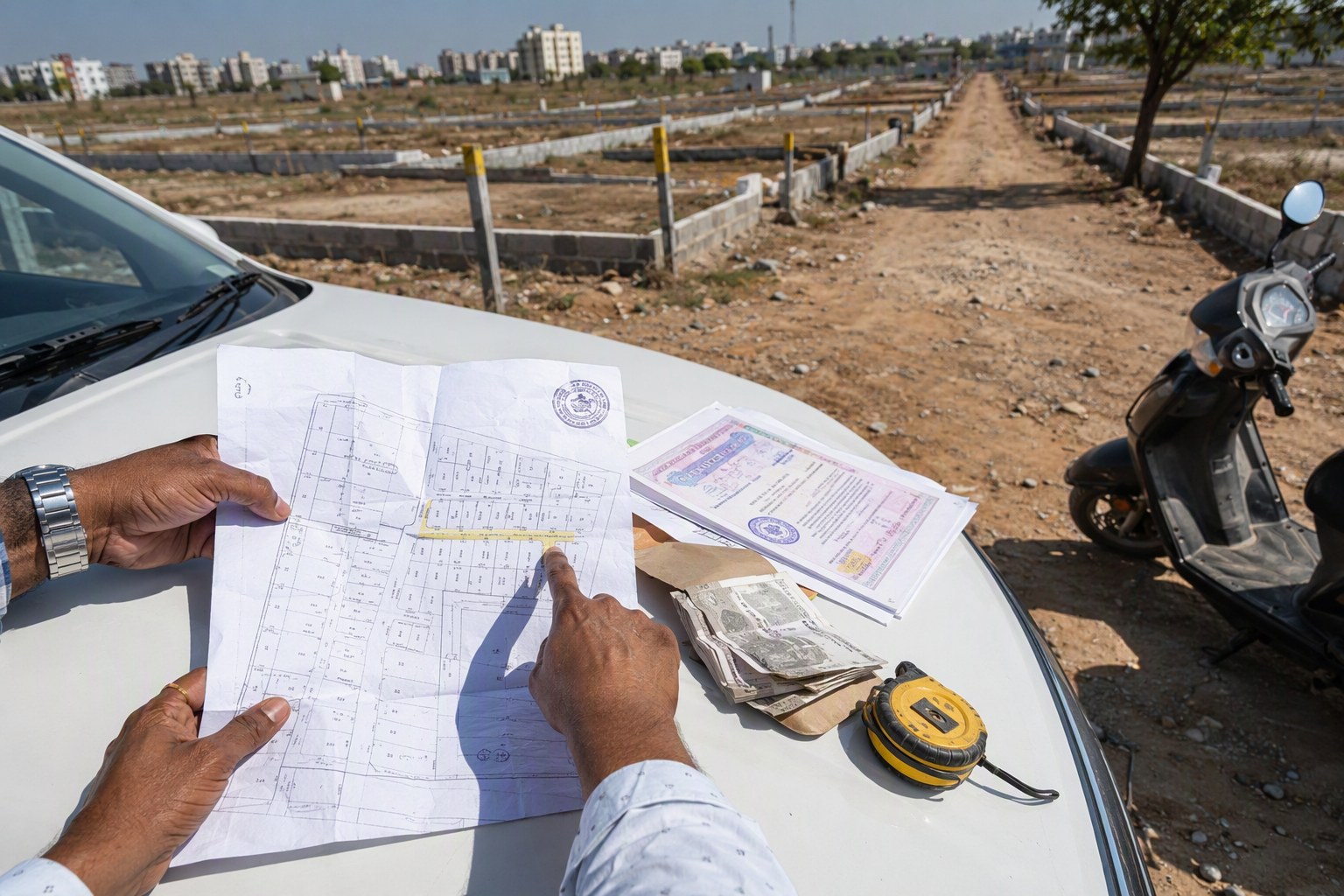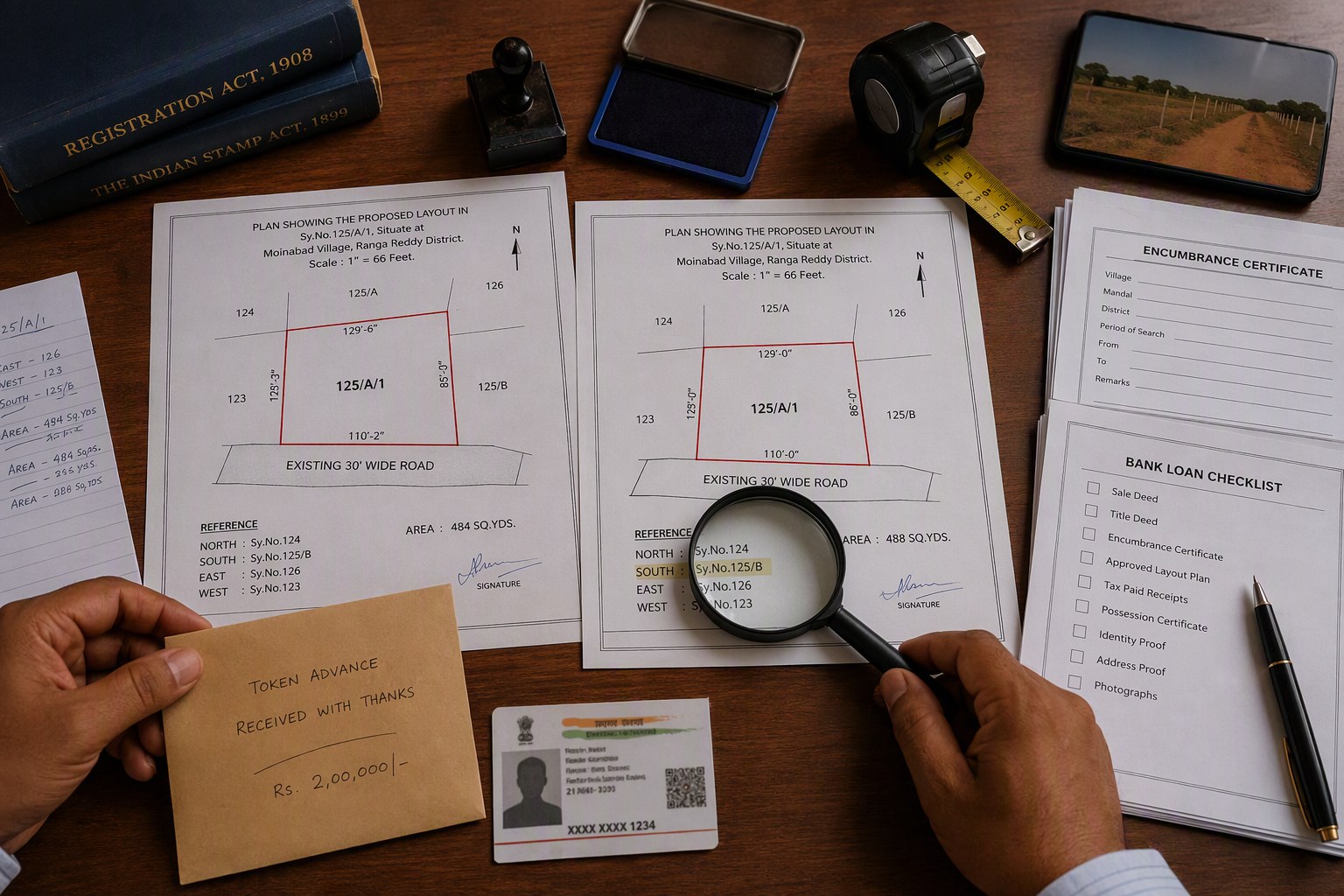
Telangana Plot Search Check has become non-negotiable for anyone buying open plots around Hyderabad. As per latest IGRS data, Telangana has 30.76 lakh prohibited property records under Section 22-A. That is 3,076,153 records where registration can be blocked or questioned at the SRO level. For buyers shortlisting plots in Mokila, Shankarpally, Adibatla, Tukkuguda, Patancheru, Kollur, Medchal, Ghatkesar, Maheshwaram, or Yadagirigutta-side growth belts, this single number should change how you search.
My straight opinion: do not fall in love with a plot layout before checking the survey number, village, mandal, and SRO mapping. In Hyderabad’s land market, location excitement often comes first and document checking comes much later. That order is risky. A plot may have a beautiful approach road, compound stones, HMDA-looking brochure, and a convincing sales team. Still, if the parent survey number is hit by Section 22-A, assignment restriction, endowment claim, government land entry, litigation note, or mismatch in revenue records, your registration can become a problem.
Buyer rule: shortlist only after survey-number and village-level checks. Not after seeing the venture gate, not after paying token advance, and definitely not after signing an agreement.
Telangana Plot Search Check: why 30.76 lakh blocked records matter
Section 22-A prohibited property entries are not a small technical footnote. They directly affect whether a property can be registered. When a property is listed in prohibited records, the Sub-Registrar Office may refuse registration or ask for clarification. In some cases, the issue is limited to a specific survey number. In other cases, it can cover a larger land extent, a village entry, or a class of land.
We’ve seen buyers focus only on square-yard price and road access in fast-moving corridors like Shankarpally mandal, Gandipet mandal, Maheshwaram mandal, Ibrahimpatnam mandal, Ghatkesar mandal, Medchal mandal, Keesara mandal, Patancheru mandal, and Kandukur mandal. But prohibited-list checking is not optional in these markets. Many of these areas have old agricultural holdings, multiple family partitions, assignment histories, ORR-driven appreciation, and conversion layers. That combination makes document verification more serious.
A prohibited entry does not always mean fraud. Sometimes it may be an old record, a clerical mismatch, a partial survey issue, or a restriction that needs proper government clearance. But as a buyer, your job is not to assume it will be solved. Your job is to detect it before money leaves your account.
Start with the Section 22-A Prohibited Property Check. Then verify the survey number using the Survey Number Finder. For a broader document risk view, run the Property Verification Tool. These checks are not a substitute for legal opinion, but they help you avoid obviously risky shortlists.
Telangana Plot Search Check before shortlisting: the correct order
Most buyers follow the wrong sequence. They visit the site, like the plot, negotiate, pay advance, collect documents, and then ask a lawyer. By that time, the seller has emotional and financial hold over the deal. In our experience, the better sequence is boring but safer.
- First: identify the exact village, mandal, and survey number.
- Second: check whether the survey number appears in prohibited property records.
- Third: verify SRO jurisdiction and registration history.
- Fourth: compare pahani, Dharani details, link documents, EC, and layout approvals.
- Fifth: visit the land and check physical access, road width, boundaries, and neighbouring usage.
- Sixth: negotiate price and payment terms only after document comfort.
This order matters because plot marketing in Hyderabad is highly location-driven. A buyer hears “near Kokapet”, “close to Regional Ring Road”, “ten minutes from Tukkuguda”, “near Pharma City side”, or “beside upcoming development” and starts thinking of appreciation. But land title does not improve just because the road is good. The parent survey number must be clean.
Survey number, village, mandal: the three basic identifiers
For apartments, buyers usually ask for flat number, tower, RERA registration, sanctioned plan, and occupancy certificate. For plots, the critical identity starts with survey number, village, and mandal. If the seller cannot clearly give these three, pause the deal.
In Telangana land records, the same survey number may exist in different villages. So “Survey No. 120” alone is not enough. You need Survey No. 120 of which village? Which mandal? Which district? Which SRO? A plot in Survey No. 120, Mokila village, Shankarpally mandal is not the same as Survey No. 120 in another village. This is where many first-time buyers make mistakes.
Ask the seller or developer for:
- Full village name as per revenue records
- Mandal name
- District name
- Survey number and sub-division number, if any
- Extent of land in the parent document
- Plot number in the layout
- Layout approval details, where applicable
- Latest pahani or Dharani extract
- Link documents showing title flow
- EC for the relevant period
If the layout is in a growth pocket like Kollur, Velimela, Tellapur outskirts, Mokila, Nandigama, Kothur, Kandukur, Adibatla, Kongara Kalan, Bongloor, Ghatkesar, Bibinagar, Medchal, Kompally outskirts, or Patancheru belt, survey-level clarity becomes even more valuable because multiple development stories overlap there.
Where Section 22-A risk usually shows up in plot deals
Section 22-A issues can come from different types of restrictions. A buyer does not need to become a revenue-law expert, but you should know the common danger zones. These are the entries that can block or complicate registration:
- Government land entries: land recorded as government land or connected with government ownership.
- Assigned land restrictions: land granted under assignment rules, often with transfer restrictions.
- Endowment or wakf-related claims: religious or institutional land issues that can affect saleability.
- Ceiling or acquisition-related entries: old proceedings that may still reflect in records.
- Court or departmental restrictions: entries flagged because of pending disputes or official instructions.
- Mismatch between registration and revenue records: sale deed may exist, but revenue records may not fully support marketable title.
Many buyers ask, “If the land is prohibited, how is the seller showing documents?” That is a fair question. The answer is simple: having documents does not automatically mean present registrability. A land parcel may have old sale deeds, but the current government record may still show restriction. Or part of a survey number may be clean and another part may be under restriction. That is why survey-number-level checking is so useful.
Hyderabad plot belts where buyers should be extra careful
I am not saying these locations are bad. In fact, many of them are active and attractive real estate markets. But because demand is high, document checking must be stricter. When land prices move fast, weak-title plots also get aggressively marketed.
| Growth belt | Common buyer interest | Checks I would not skip |
|---|---|---|
| Mokila, Shankarpally, Nandigama | Villa plots, weekend homes, west Hyderabad spillover | Survey number, pahani, layout approval, SRO mapping, prohibited list |
| Kollur, Velimela, Tellapur side | IT corridor access, gated plotted layouts, premium land | Parent title, conversion, EC, road access, land use |
| Adibatla, Kongara Kalan, Bongloor | Aerospace, ORR access, south-east growth story | Village-level 22-A check, layout approval, approach road verification |
| Tukkuguda, Maheshwaram, Kandukur | Airport-side expansion, plotted ventures, investment plots | Dharani records, assigned land risk, land use zone, SRO jurisdiction |
| Patancheru, Isnapur, Rudraram | Industrial belt, west-side affordability, highway access | EC, conversion, pollution-sensitive surroundings, road width |
| Ghatkesar, Bibinagar, Yadagirigutta route | Highway plots, long-term investment, temple corridor interest | Survey match, prohibited property check, village map, title chain |
| Medchal, Kompally outskirts, Keesara | North Hyderabad expansion, warehouse and residential mix | Land use, access road, SRO, EC, revenue record consistency |
For land use and physical feasibility, use the Land Use Zone Finder, Road Width Check, and Geo Insights. A plot can be legally transferable but still unsuitable for your intended construction or resale plan.
How to run a Telangana Plot Search Check like a local professional
A good plot search is not one search. It is a stack of checks. Each check answers a different question. If one layer fails, do not rush to the next layer with optimism. Ask for clarification in writing.
1. Start with the prohibited property check
Enter the village and survey number carefully. Spelling variations can create confusion, especially where village names sound similar in Telugu and English. Cross-check with the sale deed and pahani. If you find a possible match in prohibited records, do not rely on the seller’s verbal explanation. Ask for government clarification, deletion order, court order, or official proceedings, as applicable.
2. Confirm the SRO office
Plot buyers often assume the nearest registration office is the correct SRO. That is not always safe. SRO jurisdiction depends on village mapping. Use Find Your SRO Office or SRO Village Directory before checking EC or planning registration.
3. Pull the Encumbrance Certificate
The EC tells you registered transactions, mortgages, releases, agreements, and other registered movements that appear in the registration system. Use Encumbrance Certificate Search and, if you already have an EC copy, read it with the EC Analyzer. Match names, survey numbers, extents, document numbers, and SRO details.
4. Compare market value and registration cost
Ready reckoner values influence stamp duty and registration charges. Check the government guideline value through Market Value / Guideline Value Search. For cost planning, use the Stamp Duty Calculator. Do this before final negotiation so you understand the official value angle.
5. Check layout, road, and usability
If you are buying inside a plotted layout, ask for approval details and verify whether your plot number falls inside the approved layout boundary. Also check road width, open space, access, and land use. For plotted development, OSR and road width are not decorative details; they affect liveability and resale comfort. The OSR Calculator and Road Width Check can help you ask sharper questions.
What documents should you collect before paying token advance?
Token advance is where many buyers lose control. Once you pay, even a small amount, the seller may pressure you to close quickly. So ask for documents before token. A genuine seller may negotiate timing, but should not avoid basic papers.
- Parent sale deed or link documents
- Latest sale deed in seller’s name
- Pahani or Dharani extract
- Survey number and sub-division details
- Village map or sketch, where available
- Layout approval copy, if it is a layout plot
- Conversion or NALA-related papers, where applicable
- EC from the correct SRO
- Tax receipts, if relevant
- Identity and authority documents of seller
- Power of attorney, if someone else is selling
- Mutation or revenue update proof, where relevant
If the seller says “sir, first pay advance, then we will give documents”, I would step back. In Hyderabad plot transactions, serious buyers are ready with funds. Serious sellers should be ready with papers.
Red flags during Telangana Plot Search Check
Some warning signs are very clear. Do not ignore them because the price looks attractive.
- Survey number not disclosed: The seller talks only about plot number and venture name.
- Village name keeps changing: Marketing name and revenue village name do not match.
- Only photocopies are shown: No originals, no certified copies, no proper document trail.
- Power of attorney sale: Not always bad, but needs strict verification.
- Large discount for quick payment: Often used to stop buyers from checking properly.
- EC does not match the story: Seller claims long ownership, but EC shows different movement.
- Pahani name mismatch: Revenue record and sale deed owner differ without explanation.
- Part survey risk: Seller says only “our part is clear” but has no demarcation proof.
- Oral layout approval claims: Brochure says approved, but approval copy is missing.
One more practical red flag: the seller gets irritated when you mention Section 22-A or SRO checking. Clean-title sellers may be busy, but they usually understand buyer diligence. Irritation is not proof of fraud, but it is a signal to slow down.
What if the survey number appears in prohibited records?
Do not panic, but do not proceed casually. First confirm whether the entry is for the same village, mandal, survey number, and extent. Sometimes buyers see similar entries and assume the worst. Sometimes sellers dismiss a genuine match as “old issue”. Both reactions are unsafe.
Ask these questions:
- Is the prohibited entry for the exact survey number?
- Does it cover full extent or part extent?
- What is the nature of restriction?
- Is there a government order, court order, or deletion proceeding?
- Has the SRO accepted registrations recently in the same survey number?
- Can the seller provide certified clarification from the concerned authority?
- Will your bank or legal counsel accept the explanation?
If the answer is unclear, do not pay. If advance is already paid, avoid further payments until a property lawyer and local document writer familiar with that SRO review the file. For high-value plots, a mandal-level revenue enquiry may be sensible.
Do not confuse RERA, HMDA, DTCP, and title
Approvals and title are connected, but they are not the same thing. RERA registration, HMDA approval, DTCP approval, gram panchayat history, layout regularisation, land conversion, and title flow all answer different questions. A buyer must not treat one approval as a full guarantee of ownership.
For plotted projects promoted as larger developments, check whether RERA applies and search through RERA Project Lookup. For apartments or villas, RERA becomes even more relevant. But for open plots, still go back to survey number, village, mandal, EC, and prohibited property records.
Land use is another separate layer. A survey number may be transferable, but if the land use does not support your plan, you may face construction or resale limitations later. Buyers planning farmhouses, villas, warehouses, or commercial sheds should not skip zoning checks.
Ready reckoner, stamp duty, and the price story
Plot sellers quote market price. Government registration works with guideline value or market value as recorded for that area. Both matter. If a seller pushes for a strange structure where part payment is outside the agreement, be careful. Apart from tax and legal risks, it can weaken your position if the deal later goes into dispute.
Before finalising, check guideline value using the Market Value / Guideline Value Search and estimate charges using the Stamp Duty Calculator. If you are comparing land plus construction, the Composite Value Calculator may help. For plot-size conversion between square yards, acres, guntas, and square metres, use the Area Unit Converter.
We have seen buyers negotiate hard on per-square-yard rate but ignore stamp duty, mutation follow-up, compound wall cost, road access, and legal checking. That is not smart buying. The cheapest plot can become expensive if the title is weak.
Village-level checking is better than brochure-level buying
Many ventures use attractive location names. A plot may be marketed as “near Kokapet” but the revenue village may be different. “Shamshabad side” can include many villages across different mandals and SROs. “Near Pharma City” is used widely across southern belts. “Yadadri highway project” may cover very different villages with different title histories.
So, always bring the discussion back to official identity:
- Revenue village name
- Mandal
- District
- Survey number
- SRO
- Document number
- Layout approval reference
If the marketing name and official village name are different, that is not automatically wrong. But it must be transparent. Your sale deed will not say “premium growth corridor near Hyderabad” as the legal identity. It will mention hard identifiers. Those identifiers must pass checks.
My practical checklist before saying yes to a Telangana plot
If I were advising a family buying one plot for long-term holding near Hyderabad, I would use this checklist before agreement:
| Check | Why it matters | Buyer action |
|---|---|---|
| Section 22-A prohibited property search | Registration can be blocked if the land is restricted | Check exact survey number, village, mandal |
| SRO verification | EC and registration must be checked in correct jurisdiction | Confirm SRO before EC search |
| EC review | Shows registered title movement and charges | Match names, extents, document numbers |
| Pahani / Dharani check | Revenue record should support ownership story | Compare with sale deed and link documents |
| Layout approval | Plot should fall within approved layout boundary | Check approval copy and plot marking |
| Physical inspection | Access, boundary, road width, and occupation matter | Visit site with map and documents |
| Legal opinion | Final title call needs document review | Use a property lawyer before payment |
A plot purchase is not like buying a phone where you can return it next week. Once registered, problems become yours. That is why the 30.76 lakh blocked-record figure should not scare you away from land. It should make you disciplined.
Telangana Plot Search Check: final advice for buyers
The best plots around Hyderabad are not just the ones near ORR exits, metro talk, IT corridors, airport roads, or proposed growth nodes. The best plots are the ones where location, access, approval, title, and registrability all align. If even one layer is weak, negotiate only after knowing the risk. If the risk is not measurable, walk away.
Use the tools, collect documents, speak to the correct SRO, and take local legal advice. Telangana has 3,076,153 prohibited property records as per latest IGRS data. That number is not meant to create fear. It is a reminder that land buying here is a document-first activity.
In our experience, buyers who check survey number and village first save time, money, and stress. Buyers who check only after paying advance spend the next few weeks chasing clarifications. Be in the first group.
Frequently Asked Questions
What is a Telangana Plot Search Check?
It is a set of checks done before buying a plot in Telangana, mainly around survey number, village, mandal, SRO, EC, pahani or Dharani record, layout approval, and Section 22-A prohibited property status.
Why should I check Section 22-A before buying a plot?
Section 22-A entries can block or complicate registration. Telangana has 3,076,153 prohibited property records as per latest IGRS data, so buyers should verify the exact survey number and village before paying advance.
Is a layout approval enough to prove clean title?
No. Layout approval and title verification are different. You still need to check parent documents, EC, pahani or Dharani details, prohibited property records, and whether the plot falls within the approved layout boundary.
What details should I ask from the seller first?
Ask for revenue village, mandal, district, survey number, plot number, SRO, latest sale deed, link documents, EC, pahani or Dharani extract, and layout approval copy if it is part of a plotted venture.
What should I do if my plot survey number appears in prohibited records?
Stop further payment and verify whether the entry matches the exact village, mandal, survey number, and extent. Ask for official clarification or deletion proceedings, and take legal advice before proceeding.