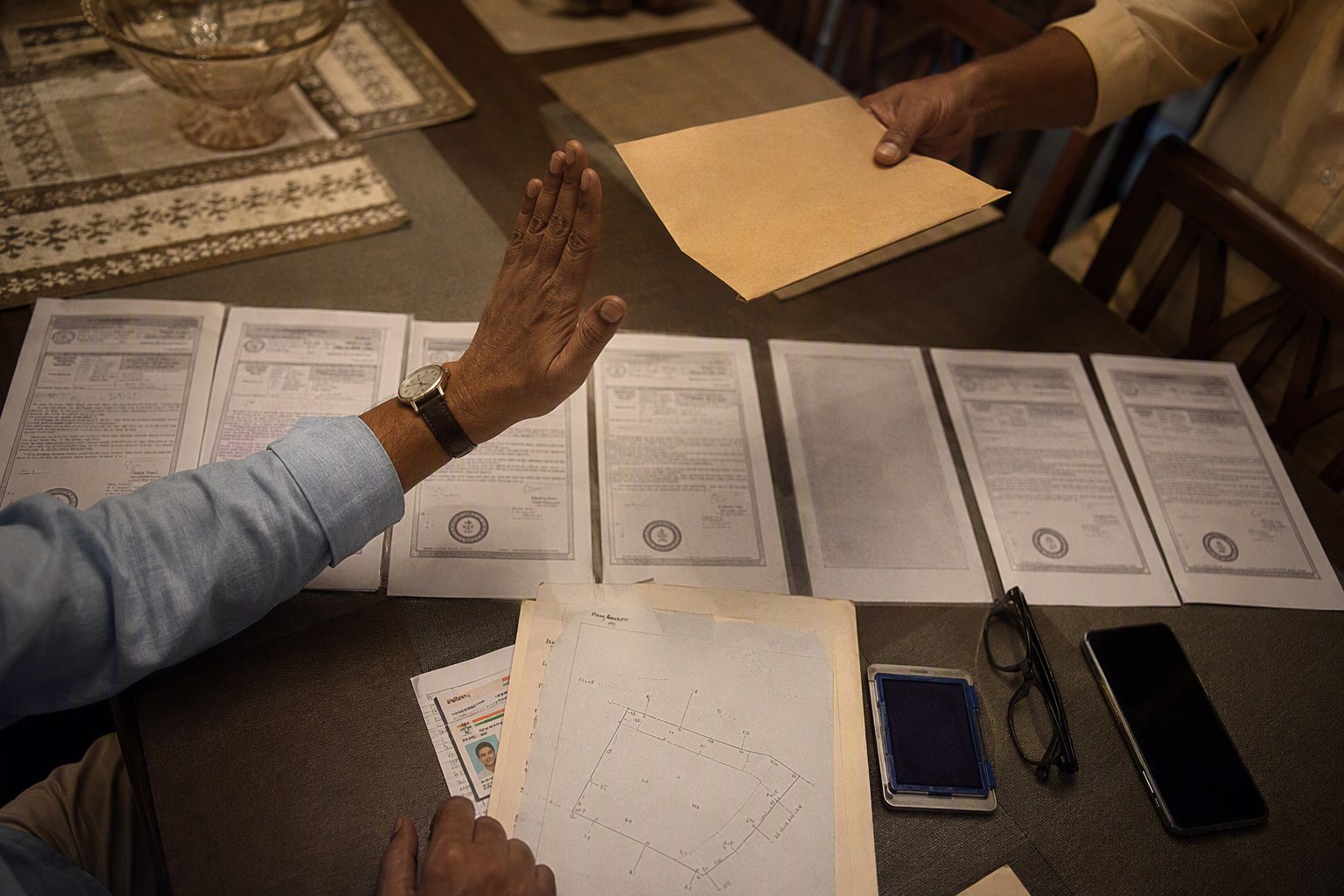



Telangana Case Study: Can an Inherited Plot Be Registered?
Can an inherited plot be registered in Telangana without first transferring it to the legal heirs? Short answer: yes, in many cases it can be sold and registered, but only if the title chain, legal heirs, Encumbrance Certificate, stamp duty value and Section 22-A status are clean. In this Telangana Case Study: Can an Inherited Plot Be Registered?, we take a realistic Hyderabad family sale situation and show where buyers usually make mistakes before paying token advance.
Our view is simple: inherited property is not risky by default. Unverified inherited property is risky. The difference is one afternoon of proper checking at EC, SRO, 22-A and market value level.
Telangana Case Study: Can an Inherited Plot Be Registered Safely?
We recently reviewed a common type of transaction from the western Hyderabad side. A family wanted to sell a 267 square yard open plot near Nizampet, under Bachupally mandal in Medchal-Malkajgiri district. The father had purchased it through a registered sale deed in 1998. He passed away in 2019. The surviving family members were his wife, two sons and one daughter.
The buyer liked the location because Bachupally, Nizampet, Pragathi Nagar and Miyapur have seen strong end-user demand. In our experience, resale plot conversations in this belt often happen in the broad range of ₹55,000 to ₹90,000 per square yard depending on road width, layout approval, exact approach road and whether the plot is in a clean residential pocket. This family was quoting around ₹1.08 crore for 267 square yards, which came to roughly ₹40,450 per square yard. On paper, it looked attractive.
But there was one uncomfortable point: the father’s name was still appearing in the old sale deed and some revenue references. The buyer asked the correct question: can a dead person’s property be registered by the family members now?
The answer was yes, but not casually. The sale deed could be executed by all legal heirs of the deceased owner, provided the link documents, death proof, legal heir proof, EC, mortgage release, market value and prohibited property status were verified. If even one legal heir was left out, the buyer would be buying future litigation along with the plot.
Telangana Case Study: Can an Inherited Plot Be Registered Without Mutation?
Mutation is useful, but it is not the only source of title. Many buyers confuse revenue mutation with ownership. In Telangana, especially for urbanising plots around Hyderabad, the title generally flows from registered documents. Mutation in municipal or revenue records supports possession and tax records, but it does not cure a defective sale deed or missing legal heir consent.
In this case, the father had a registered sale deed from 1998. That was the root document. After his death, his Class I legal heirs inherited the property. If there was no registered will, the wife, sons and daughter had to join the sale deed as vendors. If one daughter was living in Bengaluru or the USA, she still had to sign or give a properly executed and adjudicated power of attorney. Family understanding is not enough for registration safety.
We have seen buyers in Serilingampally, Quthbullapur, Hayathnagar and Maheshwaram mandals accept only two brothers’ signatures because the brothers say, "Our sister has no objection." That is a bad shortcut. If the sister is a legal heir, her registered release deed, consent or signature in the sale deed is required. Otherwise, she can question the sale later.
The Documents We Asked For Before Token Advance
For this inherited plot, we asked the selling family to share documents before any serious advance. Not WhatsApp promises. Actual scans and, where needed, certified copies.
- Father’s original registered sale deed of 1998 with document number, book number and SRO details.
- Death certificate of the father.
- Family member certificate or legal heir certificate showing wife, two sons and daughter.
- Aadhaar and PAN of all legal heirs.
- Latest property tax receipt or municipal assessment reference, if applicable.
- Layout approval copy or old gram panchayat/HMDA/LRS reference, depending on the age and location of the layout.
- Latest EC and historical EC from the date of father’s purchase.
- Survey number, plot number, village and mandal details.
- Section 22-A prohibited property verification.
- Market value statement from the relevant SRO or ready reckoner reference.
The first practical step for the buyer was to identify the correct registration office. Hyderabad buyers often assume the nearest SRO is enough. It is not. SRO jurisdiction depends on property location. For this reason, we asked the buyer to check the office through Find Your SRO Office before preparing the sale deed.
EC Check: The First Red Flag Filter
The Encumbrance Certificate is not a full title report, but it is the fastest way to catch many transaction risks. For inherited plots, I prefer checking EC from the original purchase date, not only the last 13 years. In this case, the father bought the plot in 1998, so we wanted EC from 1998 till the current date.
The buyer used Encumbrance Certificate Search to start the process and then cross-checked the document references. The EC showed the 1998 purchase deed in the father’s name. It also showed one bank mortgage created in 2011 and a registered release deed in 2016. That was a good sign. If the mortgage release had not appeared, we would have asked for a bank closure letter, registered release deed and possibly certified copies.
One important point: EC will not always show unregistered family disputes, oral partitions, pending civil claims or possession issues. That is why EC is a filter, not the full answer. Still, if EC itself shows a mortgage, attachment, court order or agreement of sale, the buyer must pause.
Section 22-A Verification: Non-Negotiable in Telangana
Telangana has a serious issue with prohibited properties. As per the available database fact we track, there are 147,934 prohibited properties under Section 22-A. This number should make every buyer careful, especially in fast-growing outskirts such as Shankarpally, Mokila, Kollur, Tukkuguda, Adibatla, Maheshwaram, Keesara, Ghatkesar and Shamirpet.
Section 22-A can block registration for different categories of properties, including government land, assigned land, endowment land, wakf-related land, ceiling surplus land, protected land and properties affected by specific notifications. In many cases, the buyer discovers the problem only when the SRO refuses registration. By then, token advance may already be paid.
For our Nizampet case, we checked the survey number and village details through Section 22-A Prohibited Property Check. We also matched the survey number using Survey Number Finder. This matters because a plotted layout may have plot numbers for buyers, but the government restriction, if any, usually sits at survey number level.
The result did not show the plot as prohibited. That cleared one major risk. But we still advised the buyer to attach a clause in the sale agreement saying the vendors confirm the property is not covered under 22-A, government claim, endowment claim, wakf claim, land acquisition, court attachment or family litigation.
Stamp Duty and Ready Reckoner Value: Do Not Calculate on Guesswork
In Telangana, a normal sale deed is generally calculated at an overall registration cost of about 6% of the value, usually made up of 4% stamp duty, 1.5% transfer duty and 0.5% registration fee. The value is not always the price written between buyer and seller. The department will consider the higher of the market value/guideline value and the consideration value.
For example, in our case study, the agreed sale price was ₹1.08 crore. Suppose the SRO market value for that exact plot worked out to ₹1,01,46,000 based on the ready reckoner rate and area. Since the agreed price was higher, stamp duty and registration charges would be calculated on ₹1.08 crore. At 6%, the buyer had to budget around ₹6.48 lakh for stamp duty, transfer duty and registration fee.
If the ready reckoner value had been higher than the sale price, duty would be payable on the higher ready reckoner value. That is why buyers should check value before negotiation, not one day before registration. Use Market Value / Guideline Value Search and then run the numbers through the Stamp Duty Calculator.
We have seen this surprise in Mokila and Shankarpally mandal also. A buyer negotiates a plot at ₹38,000 per square yard, then realises the market value adopted for that road and village is higher than expected. The buyer then blames the broker. Actually, the ready reckoner should have been checked on day one.
What If One Legal Heir Is Not Available?
This is where many inherited plot sales get delayed. If all legal heirs cannot come to the SRO, there are options, but they must be handled properly.
- Power of Attorney: An absent heir can give a valid power of attorney to another family member. If executed outside Telangana or outside India, proper stamping, notarisation, embassy/consulate process and adjudication may be needed.
- Release deed: One heir may release his or her share in favour of another heir. This itself should be registered.
- All heirs as vendors: The cleanest route is for all legal heirs to sign the final sale deed directly.
- Will and probate questions: If the father left a will, the buyer must review the will, witnesses, beneficiary details and whether any probate or court process is needed based on facts.
In our case, the daughter was initially not involved in negotiation. We insisted that she must either sign as vendor or execute a proper POA/release. The buyer wisely refused to pay a large advance until her consent was documented. This single decision probably saved him from a future family dispute.
Inherited Plot Registration Checklist for Hyderabad Buyers
| Check | Why It Matters | Practical Tool |
|---|---|---|
| Root sale deed | Confirms how the deceased owner got title | Certified copy from SRO |
| Legal heir proof | Shows who must sign the sale deed | Family member certificate / legal heir certificate |
| EC from purchase date | Shows registered mortgages, releases and transfers | EC Search |
| 22-A check | Detects prohibited property risk before SRO refusal | 22-A Check |
| Guideline value | Helps calculate stamp duty correctly | Guideline Value Search |
| SRO jurisdiction | Ensures registration is planned at the correct office | Find Your SRO |
| Land use and road | Important for future construction and resale | Land Use Zone Finder, Road Width Check |
Locality Lessons: Nizampet Is Not the Same as Mokila or Tukkuguda
Every Hyderabad micro-market has its own risk pattern. In Nizampet, Bachupally and Pragathi Nagar, buyers usually worry about old layouts, road access, municipal permissions, UDS confusion in small apartments and family title issues. In Mokila and Shankarpally mandal, survey number mapping, HMDA layout approval, 22-A entries and agricultural-to-non-agricultural transition become more important. Around Tukkuguda and Maheshwaram mandal, buyers should be extra careful about layout approval, land pooling rumours, ORR influence, road widening and title flow from agricultural pattas.
Market rates also move differently. Bachupally/Nizampet plots generally trade at higher end-user rates because families can live there immediately. Mokila and Shankarpally are more future-growth driven, with many transactions in the broad ₹30,000 to ₹55,000 per square yard band depending on layout quality and approach. Tukkuguda, Adibatla and Maheshwaram can range widely, often ₹25,000 to ₹60,000 per square yard in active plotted pockets. These are market conversation bands, not official ready reckoner values. For duty, the SRO value rules.
If you are planning to construct, do not stop with title checks. Look at road width, zoning and FSI. A 267 square yard plot on a narrow internal road will behave very differently from the same size plot on a 40-feet road. Tools like FSI/FAR Calculator and Property Verification Tool can help you catch basic planning issues early.
What We Finally Advised in This Case
After reviewing the documents, our advice to the buyer was conditional approval. The inherited plot could be registered, but only if these conditions were completed before final payment:
- All four legal heirs must be shown as vendors in the sale deed, or absent heirs must give valid registered POA/release.
- The sale deed must mention the father’s death and succession details clearly.
- The 1998 sale deed, death certificate and legal heir proof must be referenced in the title flow.
- EC must be updated till the week of registration.
- Mortgage release deed must be verified through document number and SRO records.
- 22-A status must be checked using survey number, village and mandal.
- Stamp duty must be calculated on the higher of sale price and guideline value.
- Advance payment must be linked to document clearance, not only oral family assurance.
The family accepted these terms. The daughter signed through a properly prepared POA. The buyer paid a modest advance only after EC and 22-A checks. Registration was then planned at the correct SRO with the duty calculated on the agreed value of ₹1.08 crore. This is how inherited plot transactions should be handled: calmly, document by document.
Buyer Opinion: When Should You Walk Away?
Not every inherited plot is worth chasing. Walk away or pause if the seller refuses to disclose all legal heirs, says a daughter or mother need not sign, avoids EC, gives only photocopies of link documents, or asks for heavy cash advance before verification. Also be careful if the plot number is clear but survey number is vague. In Telangana, survey number is not a small detail; it can decide 22-A, land use and title risk.
I would also be cautious if the price is far below the local market without a convincing reason. A Nizampet plot selling much below surrounding rates, or a Mokila plot offered at a discount compared to neighbouring layouts, may still be genuine. But the discount should make you verify harder, not faster.
Final Take: Can an Inherited Plot Be Registered in Telangana?
Yes, an inherited plot can be registered in Telangana when the deceased owner had valid title and all present legal heirs properly join the transaction. The buyer’s job is to prove three things before commitment: the sellers have the right to sell, the property is free from registered encumbrances, and the land is not blocked under Section 22-A or any other restriction.
Do the EC search. Check the SRO value. Verify 22-A. Confirm every legal heir. Calculate stamp duty before negotiating the final number. In Hyderabad’s active plot markets, this discipline is not over-caution. It is basic buying sense.
Frequently Asked Questions
Can an inherited plot be sold without transferring it first to legal heirs?
Yes, in many Telangana cases, all legal heirs can directly execute the sale deed in favour of the buyer. The deed should clearly mention the deceased owner, death details and succession. If any heir is missing, the buyer should not proceed without proper POA, release deed or consent.
Is an Encumbrance Certificate enough for buying an inherited plot?
No. EC is necessary but not enough. It shows registered transactions like sale deeds, mortgages and release deeds. It may not show every family dispute, unregistered claim or possession issue. Use EC along with legal heir verification, link document review and 22-A check.
How is stamp duty calculated for an inherited plot sale in Telangana?
For a normal sale deed, Telangana registration cost is generally around 6% including stamp duty, transfer duty and registration fee. It is calculated on the higher of the sale consideration and the official market value or guideline value.
Why is Section 22-A checking important before buying a plot?
Section 22-A covers prohibited properties where registration may be refused. Telangana has 147,934 prohibited properties in the available database fact. Buyers should check survey number, village and mandal before paying advance.
Should daughters sign when inherited family property is sold?
Yes, if the daughter is a legal heir and there is no valid document excluding or transferring her share, she must sign the sale deed or execute a valid release deed or POA. Oral family understanding is not safe for the buyer.