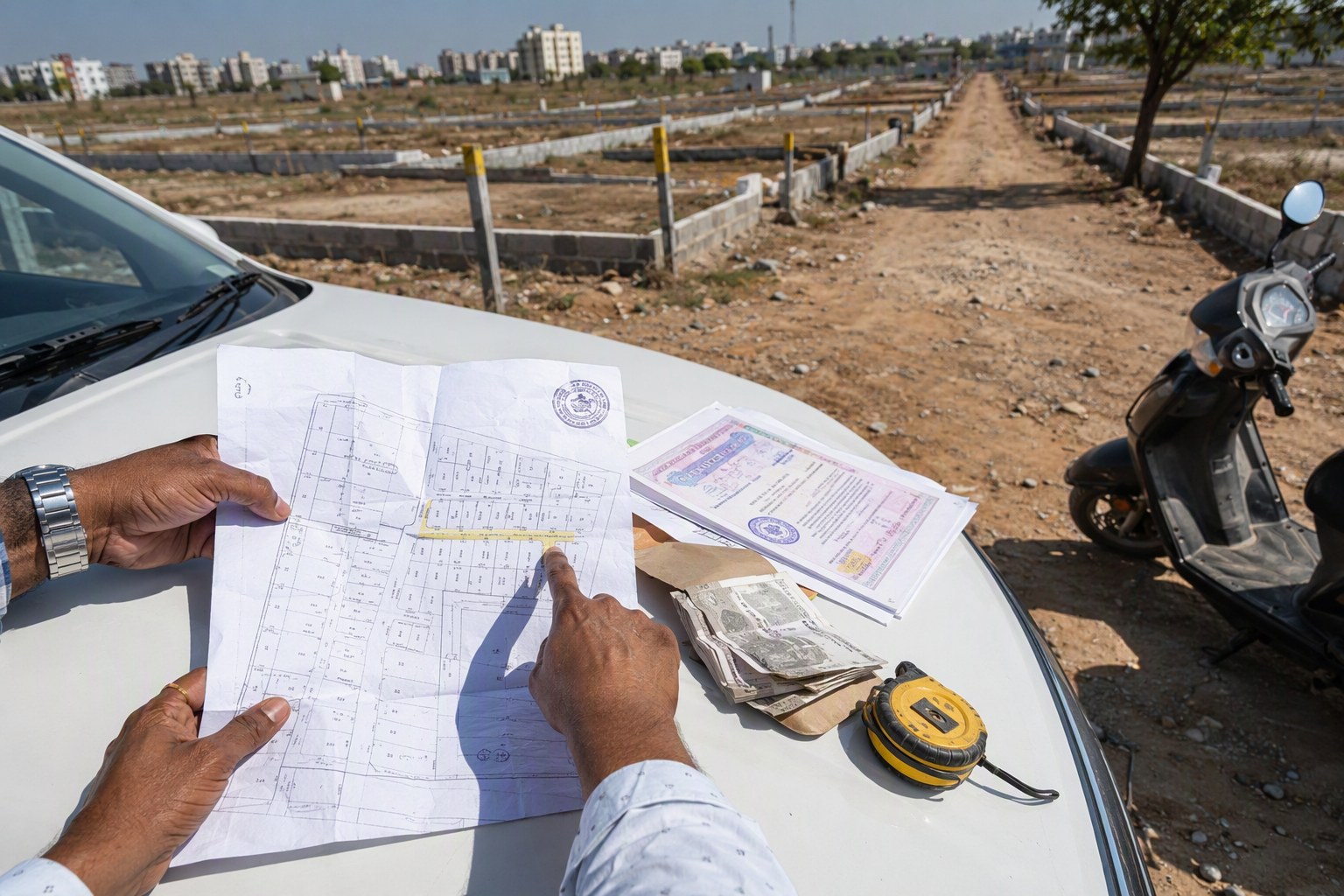
Telangana GPA property deals can be registered safely only when the General Power of Attorney is valid, still in force, properly stamped where required, and clearly authorises the agent to sell that exact property. A GPA by itself is not ownership. It is only authority given by the owner to another person. Before paying even a token advance, buyers should verify the parent title, EC, 22-A status, survey number, SRO records, family consent, and the exact wording of the GPA.
In Hyderabad, GPA sales keep coming up in places like Narsingi, Manikonda, Puppalaguda, Kollur, Patancheru, Shankarpally, Bachupally, and Adibatla. Some are clean family-authorised transactions. Some are risky shortcuts. We have seen both. The difference is usually not in the broker pitch, but in the papers.
Our blunt view: never treat a GPA holder as the owner unless the title chain, authority, identity, and property status are verified independently. A registered sale deed in favour of the buyer is what matters.
Telangana GPA Property: The Short Answer for Buyers
If you are buying a Telangana GPA property, registration is possible in some cases, but it is not automatically safe. The buyer must check three things first:
- Who owns the property? The original owner must have a clear and marketable title.
- Who is signing for the owner? The GPA holder must have valid authority to sell, receive money, execute sale deed, appear before the SRO, and hand over possession.
- Can the property legally be registered? The property should not be hit by Section 22-A, court orders, pending attachments, prohibited list entries, or serious EC defects.
Telangana has a large prohibited property dataset. As per the available database fact used for this article, there are 147,934 prohibited properties under Section 22-A. That number alone should make any buyer pause before paying advance on land, open plot, old house, farmhouse land, or disputed layout plot.
Before you proceed, run basic checks through Encumbrance Certificate Search, Section 22-A Prohibited Property Check, Property Verification Tool, and Find Your SRO Office. These tools will not replace a lawyer, but they will catch many obvious red flags early.
Telangana GPA Property Is Not the Same as Ownership
This is where many buyers get confused. A GPA, or General Power of Attorney, is a document where one person, called the principal, authorises another person, called the attorney or agent, to act on his or her behalf. The GPA holder may be allowed to manage, lease, sign, sell, collect consideration, present documents at the SRO, or do other acts depending on the wording.
But the GPA holder does not become the owner merely because he has the GPA. Title still remains with the principal unless there is a valid registered sale deed transferring ownership. If a broker says, ‘GPA is equal to ownership’, please slow down. That is not correct.
In our experience, risky GPA cases usually appear in four patterns:
- Old agricultural land around Shankarpally, Chevella, Moinabad, Maheshwaram, Kandukur, Yacharam, or Ibrahimpatnam where revenue records and registration records do not match cleanly.
- Open plot layouts in gram panchayat areas near Patancheru, Ghatkesar, Medchal, Shamshabad, and Hayathnagar where original developer GPAs are still being circulated.
- Family properties in old Hyderabad localities like Mehdipatnam, Toli Chowki, Malakpet, Himayatnagar, Dilsukhnagar, and Secunderabad where one heir claims GPA from others.
- NRI-owned flats or villas in Gachibowli, Kondapur, Financial District, Tellapur, Nallagandla, Kokapet, and Manikonda where the attorney is a relative or local caretaker.
Some of these are perfectly valid. Some are paper traps. The buyer's job is to separate one from the other before money leaves the bank account.
Why GPA-Based Deals Still Happen in Telangana
GPA transactions are common because owners may be abroad, elderly, travelling, unwell, or living in another city. NRIs in the US, UAE, UK, Australia, and Singapore often give GPA to parents, siblings, or trusted friends to sell flats in Hyderabad. Builders also use powers of attorney in development agreements, though those are different structures and need deeper legal review.
Another reason is speed. In land pockets near Mokila, Kollur, Velimela, Ghatkesar, Bibinagar, Tukkuguda, and Adibatla, sellers sometimes push GPA documentation saying registration can happen quickly. Buyers should not mistake speed for safety. The faster someone pushes you to pay, the more calmly you should verify.
Current market behaviour adds pressure. In areas like Kokapet and Neopolis, premium residential plots and apartments are quoted at high ticket sizes. In Tellapur and Nallagandla, good gated community flats often command strong resale demand. In Kollur and Mokila, plotted development prices have moved sharply compared to five years back. Around Patancheru and Isnapur, buyers still chase relatively lower entry prices. A discount through GPA may look attractive, but a 5 percent cheaper deal can become a 100 percent loss if title fails.
Telangana GPA Property: Legal Checks Before Paying Advance
Before giving token, advance, booking amount, or signing an agreement of sale, ask for scanned copies first. Do not feel shy. A genuine seller will share papers. A defensive seller is already giving you information.
1. Read the GPA line by line
The GPA should clearly mention the property. Check survey number, plot number, flat number, extent, boundaries, village, mandal, district, and SRO. If it says only ‘all my properties’ without proper schedule, be careful. For land, match the survey number with village and mandal. For flats, match apartment name, flat number, undivided share, parking, and municipal door number if available.
The GPA should also give sale-related powers. Look for authority to negotiate, receive sale consideration, execute sale deed, admit execution before Sub-Registrar, sign forms, hand over possession, and collect original documents where relevant. If the GPA only allows management or rent collection, it cannot be used for sale.
2. Confirm whether the GPA is registered or notarised
For property sale, a registered GPA is far safer than a loose notarised paper. In many Telangana property transactions, SRO offices will scrutinise the authority closely. If the owner is abroad, the GPA may have been executed before an Indian Consulate or local notary and then adjudicated or validated in India as per stamp requirements. Ask your lawyer to check this properly.
Do not accept photocopy comfort. Ask to see the original GPA before registration. If the attorney says original is with bank, court, builder, or another party, ask for written proof.
3. Check if the principal is alive and mentally capable
A GPA normally ends on the death of the principal, unless the law treats it differently in very specific interest-based cases. If the original owner has died, the GPA holder cannot casually sell the property as though nothing happened. Legal heirs come into the picture.
We have seen buyers nearly proceed with GPA sales where the principal had passed away months earlier. The broker kept saying ‘registration will happen’. That is exactly why independent verification matters.
4. Verify identity and relationship
Match Aadhaar, PAN, passport, photographs, signatures, and address details of the owner and GPA holder. If the seller is an NRI, arrange a live video call with the owner. Record written confirmation through email from the owner's known email ID. For high-value Hyderabad deals, insist on direct confirmation from the principal, not only from the attorney.
5. Check for cancellation of GPA
A GPA can be revoked by the principal. Ask for a non-revocation affidavit if advised by your lawyer, but do not rely only on that. Check whether any cancellation deed is registered. Ask the SRO and examine EC entries. A revoked GPA used for sale can drag the buyer into litigation.
Where EC Fits in a Telangana GPA Property Deal
The Encumbrance Certificate is one of the first documents buyers should check. It shows registered transactions against the property for the selected period. For most serious purchases, check at least 30 years where available. In older Hyderabad properties, even longer parent document review may be needed.
Use Encumbrance Certificate Search to identify sale deeds, gift deeds, mortgages, release deeds, development agreements, GPA-related documents, court attachments, and other registered entries. EC is not perfect, but it is a powerful starting point.
For a GPA deal, the EC should be checked for:
- Original acquisition by the owner who gave GPA.
- Any previous sale agreement with possession.
- Mortgage to bank, private lender, chit fund, or finance company.
- Registered cancellation of GPA.
- Development agreement-cum-GPA in favour of builder.
- Partition, gift, settlement, or release deed affecting ownership.
- Pending court attachment or prohibitory order if registered.
Flat buyers should also check whether the builder has mortgaged unsold inventory or land share. Plot buyers should examine parent land transactions and layout approvals. Agricultural land buyers should not stop with EC; they must also check Dharani, pahani, mutation, pattadar passbook history, and land classification.
Why Section 22-A Check Is Non-Negotiable
Section 22-A prohibited property check is one of the most ignored steps in Telangana property buying. That is a mistake. If a property is on the prohibited list, the SRO may refuse registration. Even if somebody promises ‘setting will be done’, do not build your purchase plan on such talk.
As mentioned earlier, the available database fact shows 147,934 prohibited properties under Section 22-A. These can include government lands, assigned lands, wakf lands, endowment lands, ceiling surplus lands, certain court-disputed lands, and other notified categories. The exact reason must be checked property by property.
Use Section 22-A Prohibited Property Check before advance. For land, verify survey number, village, mandal, and district. One digit mistake in survey number can mislead you. In Ranga Reddy and Sangareddy belts, survey subdivisions are common, so check full numbers like 123/A, 123/AA, or 123/1 where applicable.
In mandals such as Gandipet, Serilingampally, Rajendranagar, Shamshabad, Maheshwaram, Moinabad, Chevella, Shankarpally, Patancheru, Ameenpur, Keesara, Medchal, and Ghatkesar, land values are high enough for disputes to become aggressive. A 22-A entry can stop your registration plan at the last minute.
Check Dharani, Pahani, Survey Number and Land Classification
If the GPA property is agricultural land or land converted from agricultural use, go beyond registration papers. Telangana land records live in both revenue and registration systems. They do not always speak the same language.
For land parcels, check:
- Pattadar name in Dharani.
- Latest pahani and 1-B records where applicable.
- Survey number and extent.
- Nature of land: patta, assigned, government, wakf, endowment, ceiling, shikam, nala, or other classification.
- Mutation history.
- Conversion order if non-agricultural use is claimed.
- Layout permission from HMDA, DTCP, or local authority as applicable.
If you do not know the exact survey number, use Survey Number Finder. For broader land verification, use Property Verification Tool. These early checks are very useful before you spend money on lawyer opinions, travel, and bank processing.
In rural-urban fringe areas like Kandukur, Kadthal, Yacharam, Ibrahimpatnam, Shamirpet, Shadnagar, and Choutuppal, many sellers quote future growth stories. Fine, growth may come. But title should come first. A future road, pharma cluster, airport corridor, or regional ring road rumour will not cure a bad title.
Market Value, Stamp Duty and SRO Checks in GPA Registrations
Buyers often focus only on sale price. Registration cost is equally relevant. Telangana registration charges depend on market value, consideration, property type, and applicable duties. Check the ready reckoner value before finalising the agreement. If you understate consideration, you may create future tax and evidence problems.
Use Market Value / Guideline Value Search to compare the government market value with your agreed price. Then use Stamp Duty Calculator to estimate registration cost. If you are buying a flat with land share and construction value, the Composite Value Calculator can help you understand valuation better.
Typical resale asking bands we are seeing in Hyderabad vary sharply by locality and product. Premium plotted or villa pockets in Kokapet, Narsingi, Gandipet, and Neopolis command very high rates compared to outer growth corridors. Tellapur, Nallagandla, Gachibowli, and Kondapur remain strong end-user markets. Patancheru, Isnapur, Bachupally, Kompally, Adibatla, Tukkuguda, and Ghatkesar attract budget and growth buyers. Because prices differ so much, a GPA discount should be judged against both legal risk and true market value.
The relevant SRO also matters. Use Find Your SRO Office to identify where the sale deed will be registered. A property in one mandal may fall under a specific SRO jurisdiction, and wrong assumptions can delay registration.
Special Risk: Agreement of Sale-cum-GPA
Many older Telangana documents use the phrase Agreement of Sale-cum-GPA. Buyers must treat these carefully. Some people believe that holding an agreement-cum-GPA means they already own the property. That is not always correct. Ownership depends on the legal effect of the document, registration, possession, payment, later court rulings, and whether a final sale deed was executed.
If your seller is not the original owner but claims rights through an old agreement-cum-GPA, ask these questions:
- Was the document registered?
- Was full consideration paid?
- Was possession delivered?
- Did the original owner later cancel or dispute it?
- Was a sale deed ever executed?
- Are legal heirs of the original owner now objecting?
- Does the EC show later transactions by the original owner?
This is not a place for casual decision-making. Take a written legal opinion. If the chain has multiple GPA holders selling to other GPA holders, the risk goes up.
Flat, Plot and Land: GPA Risk Is Different in Each Case
| Property type | Common GPA situation | Main buyer risk | Must-check documents |
|---|---|---|---|
| Apartment flat | NRI owner gives GPA to relative | Invalid or revoked authority, loan mortgage, unpaid dues | Sale deed, EC, GPA, society NOC, loan closure, tax receipts |
| Open plot | Developer or landowner GPA holder sells plots | Layout approval issue, parent land dispute, 22-A entry | Parent deeds, layout approval, EC, survey record, 22-A check |
| Agricultural land | Pattadar authorises agent to sell | Dharani mismatch, assigned land, family claims, extent variation | Dharani, pahani, passbook, EC, survey map, legal heir checks |
| Old independent house | One family member holds GPA from others | Missing heir consent, old mortgage, municipal mismatch | Partition deeds, legal heir records, EC, tax receipts, GPA |
For RERA-registered new projects, check the project details through RERA Project Lookup. But remember, RERA project registration does not automatically validate every private resale GPA deal inside that project. Resale title still needs checking.
How to Structure Payment Safely
Do not pay large cash advances in GPA transactions. Keep banking trail clean. Ideally, the sale consideration should go to the owner/principal's bank account, or as advised in writing by the owner and your lawyer. If money is going to the GPA holder, the GPA must clearly authorise receiving consideration.
Your agreement of sale should mention:
- Full details of owner and GPA holder.
- GPA document number, date, SRO, and scope.
- Property schedule exactly matching title documents.
- Seller warranty that GPA is valid and not revoked.
- Seller warranty that principal is alive.
- Condition that advance is refundable if EC, 22-A, title, bank, or SRO checks fail.
- Clear registration deadline.
- Original documents to be produced before registration.
- Indemnity for title defects and authority defects.
In a clean transaction, sellers usually agree to reasonable verification clauses. If they say ‘pay first, papers later’, walk away. Hyderabad has enough inventory. You do not need to marry one risky file.
Red Flags We See in Telangana GPA Property Deals
- GPA holder refuses to connect you with the owner.
- Owner is abroad but no consulate-attested or properly validated document is shown.
- GPA schedule does not match the property being sold.
- EC shows a mortgage but seller says it is closed without proof.
- Survey number in Dharani differs from sale deed.
- Property appears in 22-A or has unclear prohibited status.
- Legal heirs are not traceable in family property.
- Seller wants cash advance urgently.
- Old agreement-cum-GPA is treated as final title without sale deed.
- Broker says lawyer verification is unnecessary.
One or two small clerical issues may be curable. But authority defects, ownership defects, 22-A entries, and family disputes are serious. Do not let a low price silence your common sense.
Practical Buyer Checklist Before Registering a Telangana GPA Property
Here is the checklist I would personally use before advising a buyer to proceed:
- Collect parent documents for at least 30 years where possible.
- Check latest EC through Encumbrance Certificate Search.
- Run Section 22-A Prohibited Property Check.
- Verify survey number using Survey Number Finder.
- Check Dharani, pahani, pattadar name, and land classification for land.
- Confirm GPA registration, stamping, schedule, and sale powers.
- Speak directly with the original owner.
- Check if GPA is cancelled or disputed.
- Confirm SRO using Find Your SRO Office.
- Estimate market value and duty through Market Value / Guideline Value Search and Stamp Duty Calculator.
- Take a written lawyer opinion before paying non-refundable advance.
My practical advice is simple: GPA is not bad by default. Blind trust in GPA is bad. If the original title is clean, the GPA is valid, the principal confirms, the EC is clear, the property is not in 22-A, and the SRO accepts the document structure, a buyer can proceed with much better confidence. If any of these fail, pause immediately.
Telangana property buying rewards patience. Whether you are looking at a flat in Kondapur, a villa in Tellapur, a plot in Mokila, or agricultural land near Chevella, the same rule applies: verify first, negotiate next, pay last.
Frequently Asked Questions
Can a GPA holder sell property in Telangana?
Yes, a GPA holder can sign and present sale documents if the GPA is valid, properly executed, not revoked, and clearly authorises sale of that specific property. The buyer must still verify ownership of the principal.
Is GPA proof of ownership?
No. GPA is only authority to act on behalf of the owner. Ownership normally transfers through a valid registered sale deed. Treating GPA as ownership is a major buyer mistake.
Should I check EC before buying GPA property?
Yes. EC helps identify registered sale deeds, mortgages, cancellations, attachments, and other transactions. For GPA deals, EC should be checked before paying advance.
Why is 22-A check needed for GPA property?
If the property is listed as prohibited under Section 22-A, registration may be refused. Telangana has 147,934 prohibited properties in the available database fact, so this check is not optional.
Can I pay advance to the GPA holder?
Pay only after verification. The GPA must authorise the holder to receive money, and payment should ideally be through bank transfer with proper agreement clauses and refund protection.