

Telangana Case Study: Why Did a Gift Deed Hit 22-A?
Telangana Case Study: Why Did a Gift Deed Hit 22-A? Because the Sub-Registrar system saw a prohibited property flag against the survey number, even though the transaction was only a family gift deed. This is the part many Hyderabad families miss: a gift deed between father and son, mother and daughter, or siblings still needs registration clearance. If the land parcel touches the Section 22-A list, the SRO will not treat it as a simple family matter.
In this case study, I am using an anonymised Hyderabad family file from the Miyapur-Hafeezpet side of the city, around Serilingampally mandal. The family names are changed, but the pattern is very common. We have seen similar issues in Kukatpally, Nizampet, Bachupally, Manikonda, Shamshabad, Maheshwaram, and even in fast-moving plot belts like Mokila and Shankarpally.
A gift deed does not clean the title. It only transfers whatever title already exists. If the parent’s land record has a 22-A shadow, the child receives that shadow too.
Telangana Case Study: Why Did a Gift Deed Hit 22-A? The short answer
The family believed the transaction was low-risk because no outsider was buying the property. The father wanted to gift a 300 sq yd open plot to his daughter before her home loan application. The plot was part of an old layout near the Miyapur-Hafeezpet belt, originally purchased in the early 2000s. The family had a registered sale deed, old link documents, tax receipts, and a recent EC. On paper, it looked good enough for a gift deed.
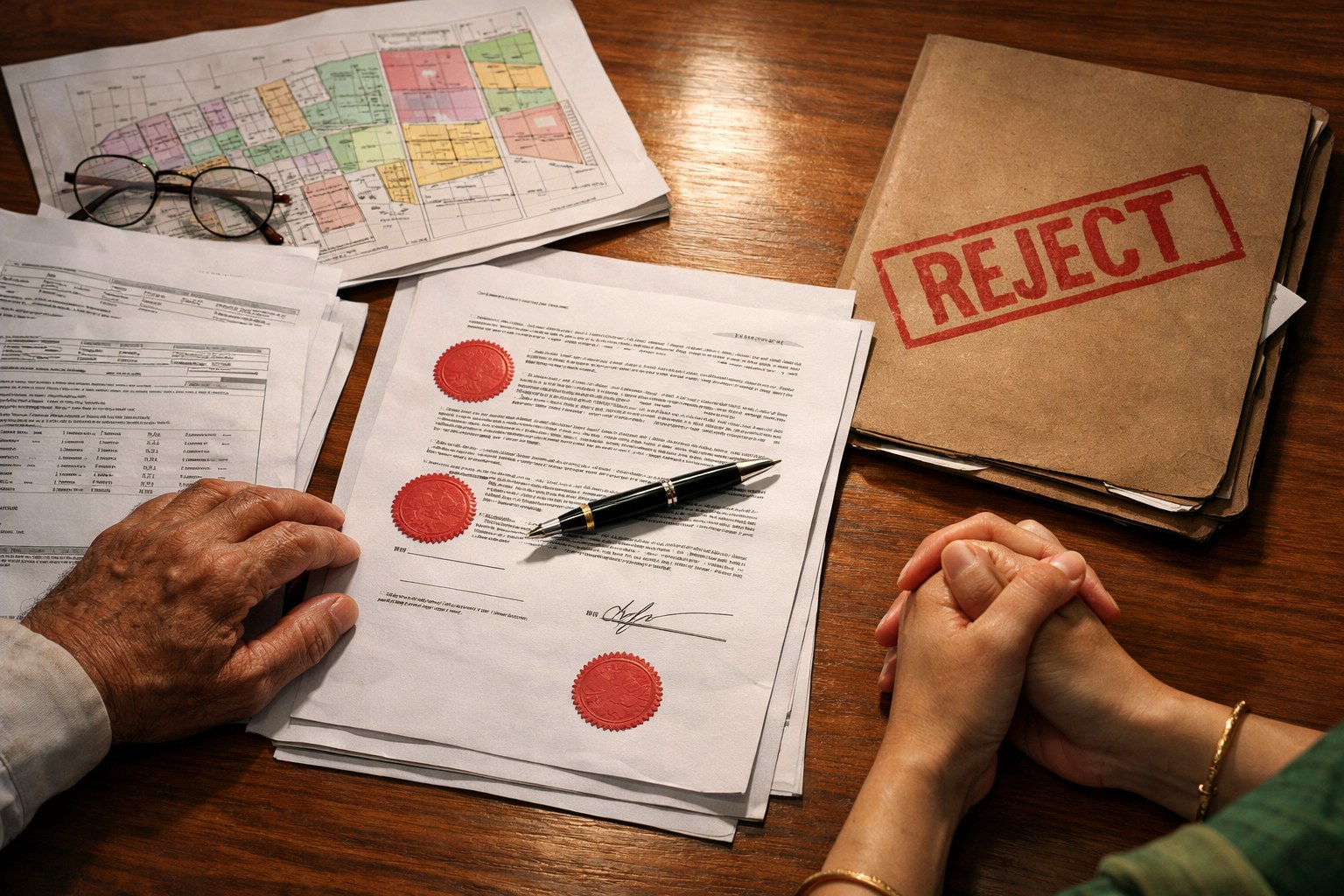
But when the document writer prepared the gift settlement deed and took it to the concerned SRO, the registration process stopped. The system showed a Section 22-A prohibition alert against the underlying survey number. That meant the Sub-Registrar could not complete registration unless the flag was removed or clarified by competent authority.
For context, Telangana has 147,934 prohibited property entries under Section 22-A. That number itself tells us why this is not a rare issue. A single entry may cover a full survey number, a part survey number, an assigned land parcel, government land, endowment land, waqf land, ceiling surplus land, court-disputed land, or land notified by a department. Sometimes the family plot is genuinely affected. Sometimes the flag is a broad-brush entry and the private plot needs correction. Either way, the SRO will not ignore it.
What exactly is a 22-A flag in Telangana?
Section 22-A of the Registration Act allows the government to prohibit registration of certain categories of properties. In Telangana property practice, we commonly see 22-A flags linked to government land, assigned land, endowment land, waqf properties, ceiling surplus land, forest land, and properties under specific court or department restrictions.
The practical effect is simple: if your property or survey number appears in the prohibited list, the SRO registration software can block registration. It can block sale deeds, gift deeds, exchange deeds, development agreements, and sometimes release deeds too. The relationship between parties does not override the restriction.
Before preparing any deed, families should run a basic check through the Section 22-A Prohibited Property Check. If the land is agricultural or converted from agricultural origin, verify the survey number using the Survey Number Finder. For a stronger first-level screening, use the Property Verification Tool and match it with EC, pahani, Dharani and SRO data.
The family file: why everyone thought the gift deed was safe
The plot had a familiar Hyderabad story. The father, let us call him Mr Rao, purchased the plot in 2003 from a local developer. The layout was not a luxury gated community. It was an old plotted layout with internal roads, electricity lines, municipal tax payments and a few houses already built nearby.
The family had these papers:
- Registered sale deed from 2003.
- Link deed from the previous owner.
- Old layout sketch given by the developer.
- Property tax receipt from the municipality.
- Electricity connection proof from a neighbouring constructed house.
- Recent Encumbrance Certificate showing no mortgage or sale after Mr Rao’s purchase.
This is why the family felt confident. In Hyderabad, many people treat EC as the final truth. It is not. An EC only shows registered transactions in the selected period at the SRO. It does not confirm whether the land is government land, assigned land, part of a prohibited survey number, or caught in a revenue classification issue.
In our experience, the most dangerous sentence in family property matters is: Registration happened once, so it will happen again. That is not always correct. A document registered in 2003 may still face trouble in 2026 if later digitisation, department lists, court orders, Dharani updates or 22-A entries changed the registration environment.
Where the problem started: survey number mismatch
The gift deed draft mentioned the plot number, layout name, village and extent. But the old sale deed carried a broad survey number reference. The layout sketch mentioned one survey number, the revenue record showed another sub-division, and the SRO record mapped it to a larger parent survey number. That parent survey number had a 22-A entry.
This happens often in older Hyderabad layouts. Developers sold plots based on layout sketches, but survey sub-divisions were not cleanly reflected in revenue records. Some plots may be private patta land, while a neighbouring portion in the same parent survey number may be government or assigned land. When the system flags the parent number, even genuine private plots can get trapped unless there is a clear demarcation and official correction.
In Serilingampally mandal and adjoining areas, land values have moved sharply. Apartments in Kondapur and Gachibowli commonly quote around Rs 8,500 to Rs 12,500 per sq ft depending on age, road access and builder profile. Narsingi and Kokapet flats often sit around Rs 7,500 to Rs 11,500 per sq ft. Open plots in Mokila and Shankarpally can move between Rs 35,000 and Rs 60,000 per sq yd in better pockets. When land becomes this valuable, even a small title defect becomes expensive.
Telangana Case Study: Why Did a Gift Deed Hit 22-A? Checks we would run
If this file came to our desk before the SRO appointment, we would not start with stamp duty. We would start with identity of land. In Telangana, land identity is not just plot number. The real chain is village, mandal, survey number, sub-division, extent, boundaries, layout approval, revenue classification and registration history.
| Check | What we look for | Why it matters |
|---|---|---|
| 22-A prohibited list | Survey number, village and mandal match | Confirms whether SRO may block registration |
| EC search | Past registered transactions, mortgages, court attachments | Shows transaction history but not full title |
| Pahani and Dharani | Revenue classification, pattadar, nature of land | Useful for agricultural-origin parcels |
| Layout and approval | HMDA, DTCP, gram panchayat or municipal record | Shows planning status and road access |
| Market value | Guideline value and ready reckoner rate | Needed for duty, fee and valuation sanity check |
| SRO mapping | Correct registration office | Prevents wrong-office assumptions |
Families can do part of this homework themselves. Use the Encumbrance Certificate Search for registered transaction history. Check market value through the Market Value / Guideline Value Search. Confirm the registration office with Find Your SRO Office. If stamp duty is the next step, use the Stamp Duty Calculator, but only after the title screen is done.
Why EC did not save the gift deed
The daughter had taken a 30-year EC because the bank asked for it. The EC showed Mr Rao’s 2003 purchase and no further encumbrance. That was useful, but it did not answer the 22-A question.
Think of EC as a register of registered dealings. It tells you whether someone registered a sale, mortgage, release, gift, lease or court attachment in a given period. It does not certify that the survey number is free from government claims. It does not certify land classification. It does not validate layout approval. It does not remove a revenue prohibition.
That is why a clean EC and a blocked registration can exist at the same time. Many buyers learn this only at the SRO counter. In a gift deed, the pain is emotional too. The family has already planned the transfer, maybe even loan paperwork, tax planning or a sibling settlement. Then one red line in the system stops the file.
What happened at the SRO
The SRO staff did what the law requires. They checked the property details, saw the prohibited entry, and refused to proceed with registration. The family was advised to approach the revenue authorities with supporting records. In some cases, the SRO may issue a refusal order or ask for clarification depending on the nature of the entry and the document presented.
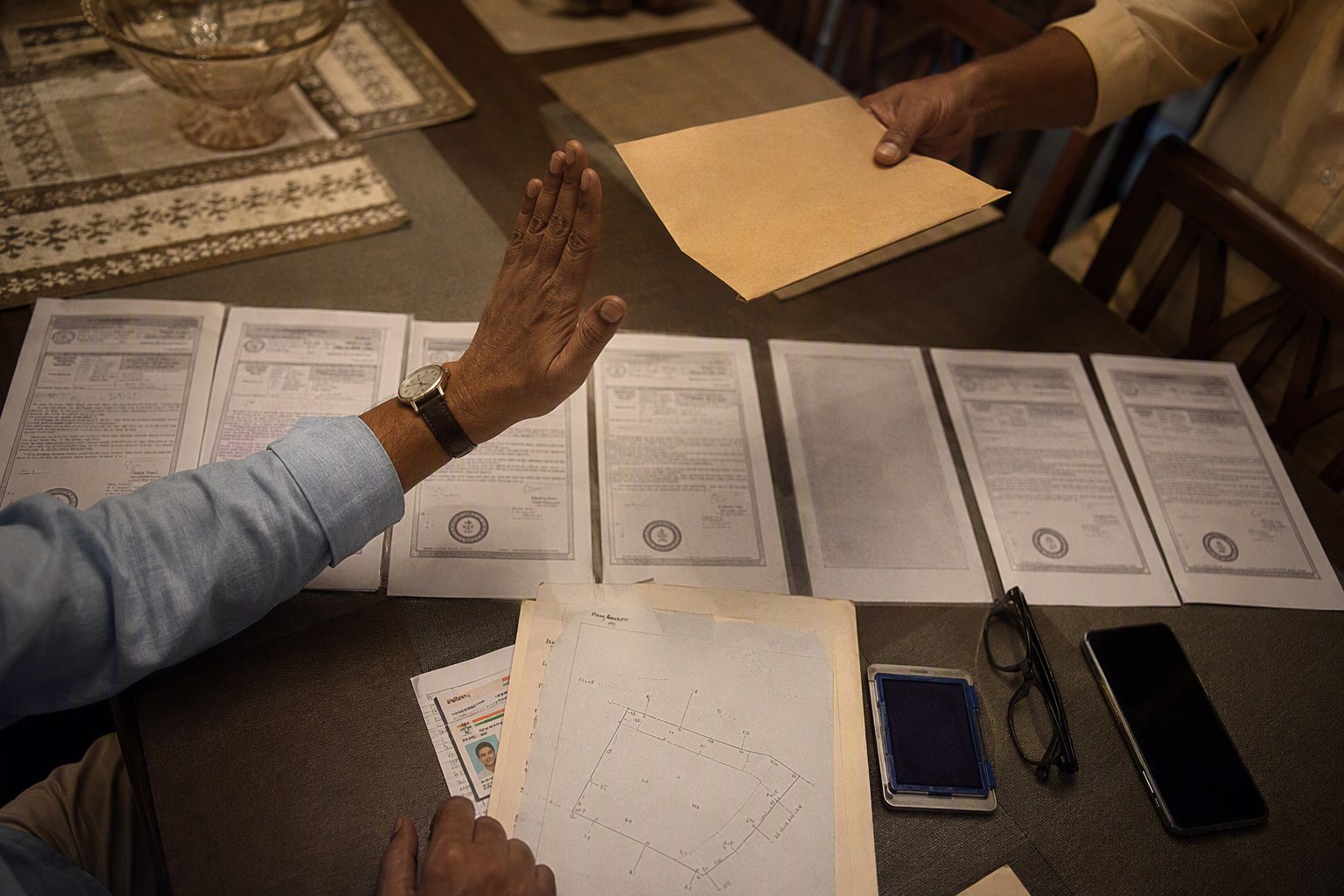
The family then had to assemble a correction file. It included the old registered sale deed, link documents, layout plan, municipal tax papers, location sketch, neighbouring title references, and a request to verify whether their plot actually fell within the prohibited portion. A local surveyor was also engaged to map the plot boundaries against the survey number.
This is where many families get impatient. They say, my father bought it long back, why should we prove it again? I understand that frustration. But Telangana land records have moved through paper pahanis, manual registers, computerised registration, Dharani and multiple departmental lists. Old private rights and new digital flags do not always sit neatly together.
Stamp duty was not the main issue
Gift deeds in Telangana have concessional treatment in certain family transfers compared to normal sale deeds, but the exact duty depends on relationship, property type and current rules. People usually focus on this first. They calculate gift duty, registration fee and transfer duty, then prepare the deed.
In this case, duty was secondary. Whether the plot was valued at Rs 30,000 per sq yd or Rs 60,000 per sq yd, the SRO could not register while the 22-A flag remained unresolved. This is why I prefer a two-step approach: first verify title and prohibitions, then calculate duty. The Stamp Duty Calculator is useful, but not a substitute for a 22-A and revenue check.
How this affects buyers in Hyderabad, not just families
A family gift deed case may look personal, but the lesson is wider. Buyers in Hyderabad often buy resale plots and flats where the land history is old. A flat in a small apartment in Manikonda may sit on land converted years ago. A villa in Bachupally may trace back to agricultural land. A plot in Tukkuguda, Maheshwaram or Shadnagar may depend heavily on survey number accuracy.
Rates are high enough now that casual checking is risky. A 200 sq yd plot at Rs 45,000 per sq yd is a Rs 90 lakh asset. A 300 sq yd plot at Rs 55,000 per sq yd is Rs 1.65 crore before construction. Even one blocked registration can disturb loan plans, family settlements and resale value.
For apartments, also check the builder and project status. If the property is in an ongoing project, the RERA Project Lookup should be part of your basic file. For redevelopment or bigger land parcels, check road width, land use and built-up feasibility through tools like the Road Width Check, Land Use Zone Finder and FSI/FAR Calculator.
What the family should have done before drafting the gift deed
Here is the order I would suggest for any Telangana family transfer, whether in Hyderabad, Rangareddy, Medchal-Malkajgiri, Sangareddy or Yadadri:
- Confirm the exact village, mandal, survey number and sub-division from the parent deed and revenue records.
- Run a Section 22-A check before fixing the SRO appointment.
- Take an EC for the right period and correct SRO jurisdiction.
- Compare plot boundaries with layout sketch and physical possession.
- Check Dharani or revenue records where the land has agricultural origin.
- Verify market value or guideline value for duty calculation.
- Keep all link documents ready, not only the latest sale deed.
- If any mismatch appears, resolve it before paying deed writer charges or booking loan processing.
This order may feel slower, but it is cheaper than a blocked document. In property work, speed without verification is not efficiency. It is risk wearing a formal shirt.
Our view on 22-A flags in family transfers
I do not treat every 22-A flag as proof that the family has a bad title. Some entries are accurate and serious. Some are broad entries that need parcel-level clarification. Some arise because survey numbers were not updated properly after subdivision, conversion or layout formation. But I never advise ignoring the flag.
The correct response is documentary. Get the exact prohibited entry. Match it with your survey number, extent and village. Check whether the prohibition covers the full survey number or only a portion. Compare revenue classification. If there is a genuine mistake, approach the proper revenue authority with evidence. If the land is truly prohibited, do not attempt a shortcut registration through pressure or informal channels. That can create bigger trouble later.
For high-value Hyderabad localities like Gachibowli, Kondapur, Kokapet, Tellapur, Narsingi, Puppalaguda and Miyapur, even families should think like buyers. A gift deed today may become a sale, mortgage or redevelopment tomorrow. The next party will ask tougher questions.
Final takeaway
The answer to the title question is clear: the gift deed hit 22-A because the registration system linked the property to a prohibited survey number. The family relationship did not matter. The old sale deed did not automatically override the current prohibition. The clean EC did not answer the revenue restriction.
Before any internal transfer in Telangana, do three things: check 22-A, verify the survey number, and match EC with revenue records. Only then discuss stamp duty and deed drafting. That small discipline can save months of running between SRO, mandal office, surveyor and bank.
Frequently Asked Questions
Can a gift deed be registered if the property is in the 22-A list?
Usually no. If the property or survey number is flagged under Section 22-A, the SRO can refuse registration until the prohibition is removed or clarified by the competent authority.
Does a clean EC mean there is no 22-A problem?
No. An Encumbrance Certificate shows registered transactions for a period. It does not certify revenue classification, government land status, assigned land status or prohibited property status.
Is Section 22-A relevant for family gift deeds in Telangana?
Yes. A family gift deed still needs registration. The SRO checks the property, not only the relationship between donor and donee. A 22-A flag can block internal transfers too.
What should I check before making a gift deed in Hyderabad?
Check the survey number, village, mandal, EC, 22-A status, Dharani or pahani records where relevant, guideline value and correct SRO jurisdiction before drafting the deed.
Can a wrong 22-A entry be corrected?
In some cases, yes. If the entry wrongly covers a private plot, the owner must approach the proper revenue authority with sale deeds, link documents, layout records, survey sketch and supporting evidence.