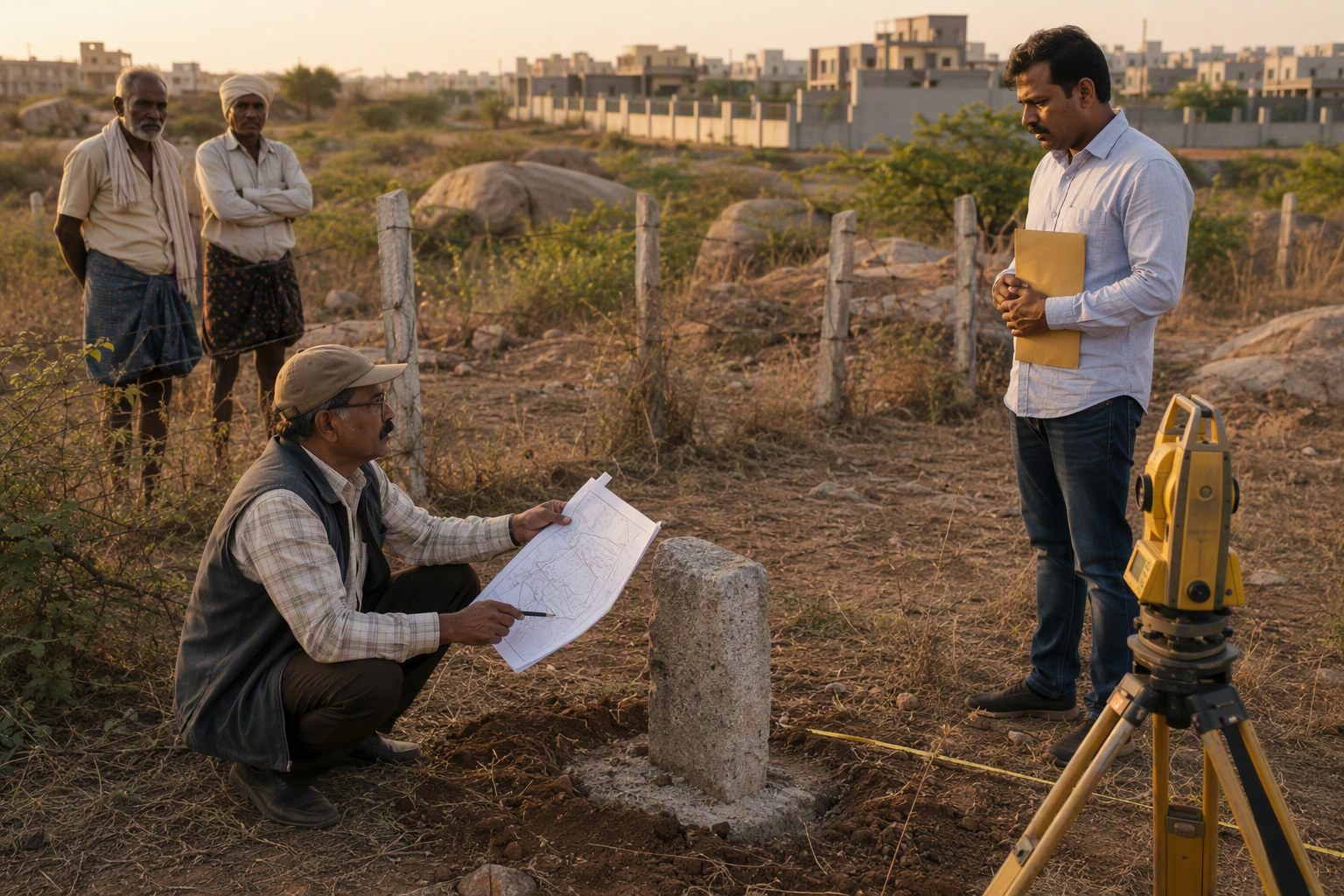



Telangana Deed Clues can be as small as one extra phrase in a sale deed, one missing link document in the EC, or one odd stamp duty value that does not match the ready reckoner. A Hyderabad buyer may read a deed casually. An ex-SRO reads it like a case file.
Last month, a family from Miyapur almost closed a resale flat in Kondapur. The price was attractive, the society was decent, and the seller had a thick folder: sale deed, EC, tax receipts, electricity bill, Aadhaar copies. The buyer’s brother said, “Documents are there, what else?” Then an ex-Sub Registrar we know looked at the sale deed for ten minutes and circled three lines.
The deed mentioned “link document not traceable” for one earlier transaction. The Encumbrance Certificate had a gap of two years during which a development agreement was registered. The stamp duty paid on the current deed looked unusually low compared with the locality’s market value. Nobody had lied loudly. But the documents were whispering warnings.
That is why I like involving retired SRO staff or senior document writers in serious purchases. They have seen how small wording becomes a big court fight later.
Telangana Deed Clues ex-SROs check first
An ex-SRO does not start with vastu, balcony view or clubhouse. They begin with the identity of the property. In Telangana, a deed must clearly connect the seller, property, survey number, extent, boundaries, title flow, consideration, stamp duty and registration details. If any one of these is vague, the deal deserves a pause.
We’ve seen this in Gachibowli, Narsingi, Bachupally, Uppal and Saroornagar. Buyers focus on price per square foot. Ex-SROs focus on whether the property described today is the same property described in the first link document.
Before paying token advance, run the basics through these tools: Encumbrance Certificate Search, Section 22-A Prohibited Property Check, Market Value / Guideline Value Search and Find Your SRO Office. These do not replace legal opinion, but they help you ask sharper questions.
1. The property description must be boringly clear
A good deed is not poetic. It is dry, specific and repetitive. Flat number, floor, block, undivided share of land, built-up or super built-up area, parking slot, municipal number, survey number, village, mandal and SRO jurisdiction should not fight with each other.
For example, a flat in Nanakramguda may come under Serilingampally mandal, while a villa plot in Mokila may fall under Shankarpally mandal. If the sale deed says one village, the tax receipt says another, and the EC shows a different SRO, that is not a spelling issue. It may be a title identity issue.
For open plots, survey number is the backbone. In places like Adibatla, Maheshwaram, Shadnagar, Patancheru and Ghatkesar, one survey number may have multiple layouts, part sales, road surrenders and old agricultural links. Use the Survey Number Finder before you assume the brochure map is enough.
2. Boundaries reveal more than area
Old SRO hands love boundaries. North, South, East and West boundaries can expose double sales, wrong plot numbers, road widening impact and encroachments. If a deed says “road on East” but the site has a neighbour’s compound wall on East, ask why.
In Hyderabad outskirts, we often see plot extents like 200 sq yards, 267 sq yards or 605 sq yards repeated across layouts. But boundaries are harder to fake across link documents. If a 200 sq yard plot in Beeramguda suddenly shifts from “Plot No. 42” to “Plot No. 24” in one link deed, do not treat it as a typing mistake without written clarification.
Opinion from our desk: In resale deals, boundaries are more useful than glossy layout plans. A plan can be reprinted. A registered boundary trail is harder to casually clean up.
Telangana Deed Clues in EC, link documents and SRO trail
The Encumbrance Certificate is where many buyers relax too early. “EC is nil” sounds safe, but it can also mean wrong search period, wrong document details, wrong SRO, or a transaction that was not captured due to spelling and survey variations.
For a flat in Banjara Hills or Jubilee Hills, buyers usually search by document number and apartment name. For land in Kandukur, Yacharam or Medchal, you must search by survey number, executant name and claimant name wherever possible. Names change spellings. Survey sub-divisions get written differently. Old pattadar names may remain in revenue records even after registered sales.
3. EC gaps are not harmless
An ex-SRO will ask for EC from the earliest available link document till date, not just 13 years because the bank asked. If the seller has link documents from 1998, why take EC only from 2011? Take the longer trail.
Red flags in EC include:
- Mortgage entries not followed by release deeds.
- Agreement of sale with possession before the present sale deed.
- Development agreement-cum-GPA entries where the developer’s rights are not closed clearly.
- Court attachment, injunction or lis pendens entries.
- Different extents appearing for the same survey number or flat.
- Sale by GPA holder where the GPA document is missing.
In our experience, flats in older parts of Ameerpet, Himayatnagar, Somajiguda and Secunderabad Cantonment require extra care because redevelopment, old societies, family settlements and GPA sales often overlap. In new corridors like Kokapet, Puppalaguda and Tellapur, the issue is often development rights and land aggregation.
4. Link documents should make a clean chain
A title chain should read like a family tree, not a mystery novel. A sold to B, B gifted to C, C sold to D, D is selling to you. If one person appears suddenly without a registered document, get legal help before paying more.
Common weak links include unregistered family arrangements, notarised agreements, missing partition deeds, old pahanis not matching sale deeds, and GPA sales after legal restrictions tightened. For agricultural land, check pahani, Dharani status, pattadar passbook details and mutation trail. For urban flats, check link sale deeds, building permission, occupancy certificate, UDS calculation and association records.
A quick scan through Property Verification Tool can help buyers list the first round of missing documents. For RERA projects, use RERA Project Lookup to match project registration, promoter name, land extent and promised approvals.
Telangana Deed Clues hidden in stamp duty and guideline value
Stamp duty is not just a payment. It is a clue. Telangana sale deed registration usually carries stamp duty at 4%, transfer duty at 1.5% and registration fee at 0.5%, making the common total 6% for many sale transactions. Exact applicability can change by instrument type, property type and government notification, so buyers should calculate before signing.
Use the Stamp Duty Calculator and compare the declared consideration with the ready reckoner through the Market Value / Guideline Value Search. If a seller insists on showing a much lower deed value than the actual transaction price, you are not just saving registration cost. You are weakening your future proof of payment and capital gains position.
5. Low stamp duty may point to undervaluation or wrong classification
Suppose a resale flat in Kondapur is negotiated at around ₹9,500 to ₹12,000 per sq ft depending on age, amenities and road access. If the deed value is strangely close to an older basic value and the cash component is heavy, think twice. Tomorrow, if a dispute starts, your registered document will speak louder than your WhatsApp chats.
In Kokapet and Neopolis, land price expectations changed after HMDA auction numbers touched ₹100.75 crore per acre in 2023, with average auction prices reported above ₹70 crore per acre in that phase. That does not mean every nearby acre is worth that number. But it does mean a very low declared value in a surrounding premium pocket deserves explanation.
In working markets, we are seeing broad resale asking bands like these, though every project and road changes the final quote:
| Locality | Typical market talk for flats | What deed readers check |
|---|---|---|
| Kondapur / Gachibowli | ₹8,500 to ₹13,000 per sq ft in many resale projects | UDS, parking, link developer agreements |
| Narsingi / Puppalaguda | ₹7,500 to ₹11,500 per sq ft depending on project and ORR access | Land aggregation, RERA, mortgage release |
| Bachupally / Nizampet | ₹5,500 to ₹7,500 per sq ft in many mid-market projects | HMDA permissions, road width, UDS clarity |
| Uppal / Nagole | ₹5,500 to ₹8,000 per sq ft near metro and main roads | Old link deeds, municipal number, loan release |
| Tellapur / Osman Nagar | ₹7,000 to ₹10,500 per sq ft in newer gated projects | RERA status, OC, land owner share flats |
These are street-level market ranges, not government values. The deed still must respect the official market value for registration. A buyer should compare both: actual negotiated price and government guideline value.
6. Ready reckoner mismatch needs a reason
If the government market value is higher than the deed value, the SRO may ask for deficit duty. If the deed value is far lower than the actual sale price, the buyer may face tax and evidence issues later. If the classification is wrong, such as agricultural shown where plotted layout exists, trouble may surface during mutation or bank loan.
For land parcels, also check land use. A plot advertised as “future residential” near Pharma City side in Yacharam or Kandukur may still sit in a different land use zone. The Land Use Zone Finder and Road Width Check are useful before you trust layout promises.
Section 22-A: Telangana Deed Clues buyers cannot ignore
Section 22-A prohibited property lists are a serious deal breaker. The database count we track shows 147,934 prohibited properties under Section 22-A. That number itself should stop buyers from saying, “Registration happened before, so no issue.”
A prohibited property may relate to government land, assigned land, endowment land, waqf land, ceiling surplus land, court-disputed categories or other restricted entries. Sometimes the issue is visible before registration. Sometimes it appears when a buyer tries to sell, mortgage or mutate later.
Use the Section 22-A Prohibited Property Check for survey number and locality screening. For agricultural land, match it with Dharani records and pahani history. For urban property, ask whether the land on which the apartment stands had any earlier prohibition, acquisition notice or litigation.
7. “Already registered” is not a clean chit
Many buyers assume that if a sale deed was registered in 2016 or 2020, the title is safe. Not always. SRO registration records the document. It does not give a government guarantee that title is perfect. The SRO checks stamp duty, parties, presentation, basic prohibitions and formal requirements. Title risk still remains with the buyer.
This is why banks also do legal scrutiny. Even then, a bank loan approval is not full title insurance. Bank lawyers usually review from the lending angle. A buyer planning long-term holding, redevelopment or resale should take a deeper view.
Wording in sale deeds that makes ex-SROs uncomfortable
Certain phrases make experienced deed readers slow down. They are not automatic deal killers, but they demand documents.
- “As is where is” — fine in some bank auction cases, risky if seller uses it to avoid title responsibility.
- “Link document not available” — ask for certified copies from SRO or a legal explanation.
- “Possession delivered earlier” — check if there was an agreement with possession that attracted duty.
- “Vendor assures marketable title” — assurance is not proof; verify chain.
- “Property free from encumbrances” — match with EC and loan closure documents.
- “GPA holder is authorised” — read the GPA powers, validity and principal’s status.
- “Subject to pending approvals” — risky in under-construction and plotted development deals.
In villa and plotted projects around Kollur, Mokila, Tukkuguda and Shadnagar, I pay special attention to land owner share, developer share, release deeds, layout approval conditions and mortgage plots. In apartments around Kukatpally and Manikonda, UDS, parking, OC and deviation history matter more.
What buyers should do before paying advance
Token advance is where buyers lose bargaining power. Once you pay ₹2 lakh or ₹5 lakh emotionally, every red flag feels like an inconvenience. Do the document reading before that payment, not after.
Here is the practical order I prefer:
- Confirm correct SRO using Find Your SRO Office.
- Pull EC for the full title period, not just loan requirement period.
- Check Section 22-A prohibition by survey number.
- Compare deed value, guideline value and actual negotiated price.
- Verify link documents through certified copies if photocopies are unclear.
- For flats, check RERA, OC, building permission, UDS and parking schedule.
- For plots, check survey number, layout approval, road width, land use and pahani/Dharani trail.
- Ask for loan release deed or no-dues letter where the property was mortgaged.
- Put every seller promise in the agreement, not only in conversation.
For larger land or redevelopment-sensitive property, keep a document tracker. The Property Change Tracker helps buyers monitor changes that may affect risk after the first check.
How an ex-SRO reads a deed differently from a normal buyer
A normal buyer reads the deed to see names and price. An ex-SRO reads it for risk pattern. They ask: Why was this document registered at that SRO? Why is the extent rounded? Why is the witness a document writer from a different district? Why does the link deed mention a mother document but the seller did not give it? Why is there no release deed after a bank mortgage?
That habit comes from seeing thousands of instruments: sale deeds, gifts, partitions, rectification deeds, development agreements, GPAs, mortgages, releases and court attachments. A buyer may see one property in five years. SRO staff see document behaviour every working day.
My frank view: in Hyderabad’s high-value corridors, document reading is now as important as site visit. A west-facing flat with lake view is nice. Clean title is better.
When to walk away
Not every defect needs cancellation. Some issues can be fixed through rectification deed, missing certified copy, bank release, updated EC, mutation or proper indemnity. But certain cases deserve a hard stop unless a senior property lawyer clears them.
- Seller refuses to share link documents.
- Survey number appears in Section 22-A list.
- EC shows unreleased mortgage or court case.
- GPA seller cannot prove valid authority.
- Boundaries do not match physical site.
- Land use does not support intended construction.
- Seller demands large cash outside deed value.
- Developer share and land owner share are mixed up.
Hyderabad buyers are sharp on negotiation. We bargain on ₹100 per sq ft, car parking charges and floor rise. We should be equally stubborn on documents. One unchecked deed clue can cost more than any discount you win.
The safest deal is not always the cheapest. It is the one where the property identity, title chain, EC, stamp duty, SRO trail and possession story all say the same thing.
Frequently Asked Questions
What are Telangana Deed Clues in a sale deed?
They are small document signals such as mismatched boundaries, missing link deeds, EC gaps, low stamp duty, wrong survey number, unclear GPA powers or Section 22-A entries. These clues help buyers spot title risk before registration.
Is an Encumbrance Certificate enough to buy property in Hyderabad?
No. EC is essential, but it is not full title proof. You should also verify link documents, SRO details, Dharani or pahani records for land, RERA and OC for flats, mortgage releases and prohibited property status.
How much is stamp duty for a sale deed in Telangana?
For many sale deeds in Telangana, the common total is 6%, made up of 4% stamp duty, 1.5% transfer duty and 0.5% registration fee. Check the latest amount based on instrument type and property value before signing.
Why is Section 22-A check needed before buying land?
Section 22-A covers prohibited properties where registration or transfer may be restricted. Our tracked database count shows 147,934 such prohibited properties. A survey number check is a must for land and plotted development deals.
Should I trust a bank-approved property?
Bank approval is useful, but it is not a complete title guarantee. Banks check from the loan risk angle. Buyers should still verify EC, title chain, boundaries, approvals, stamp duty value and SRO records independently.