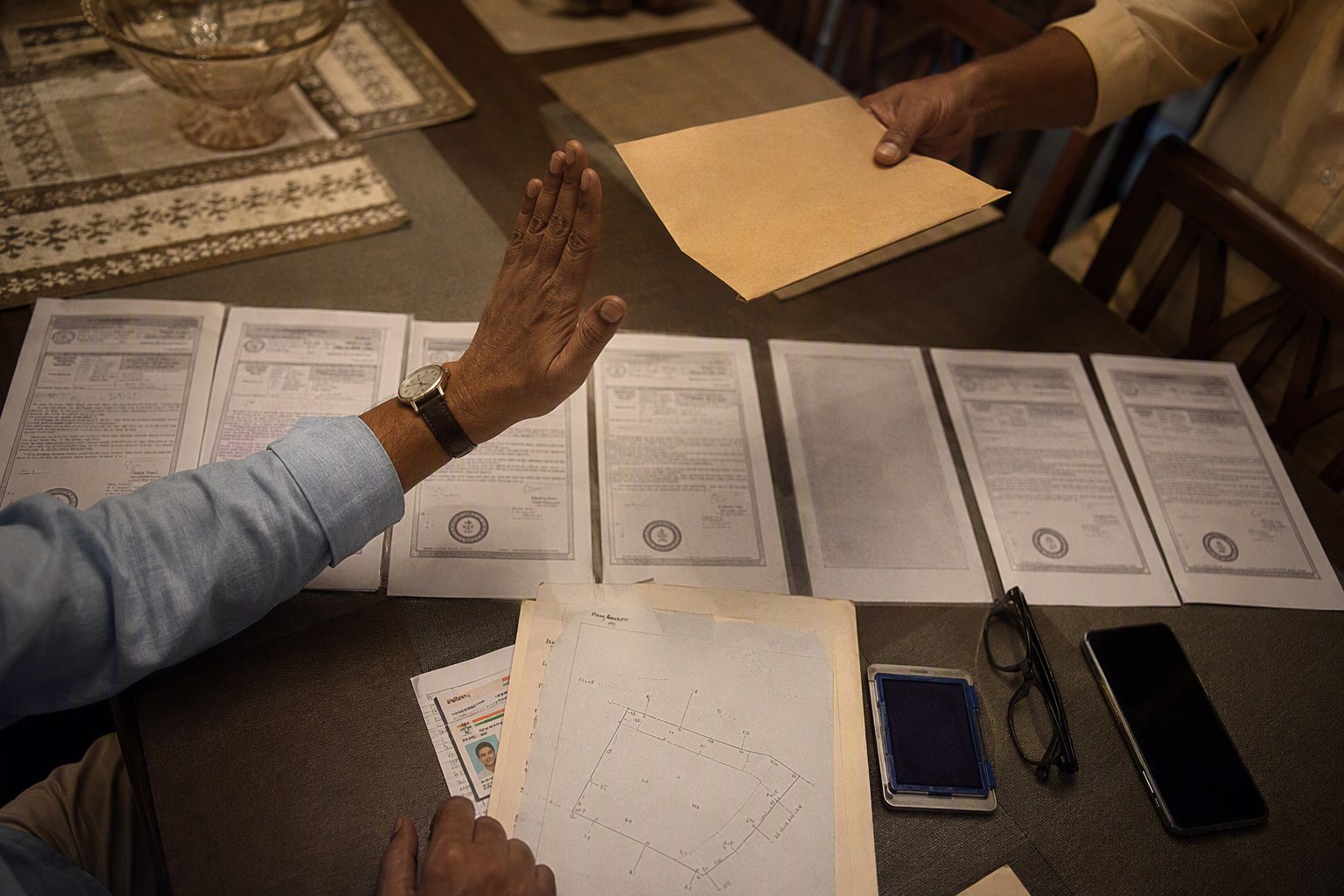



Telangana Case Study: Two Plots, One Passed, One Paused
This Telangana Case Study: Two Plots, One Passed, One Paused comes from a very common Hyderabad land story. Two 200 sq yd open plots near Bachupally looked almost the same on paper. Same access road, same broker circle, same buyer budget, same SRO jurisdiction. Plot A got registered without drama. Plot B stopped at the Sub-Registrar Office because its parent survey number matched Telangana’s prohibited property records under Section 22-A.
That one line in the prohibited list changed the entire transaction. The buyer of Plot A paid, registered, mutated and moved on. The buyer of Plot B had already paid a token amount, arranged funds, checked the Encumbrance Certificate, and still got stuck. In our experience, this is where many Telangana plot buyers get surprised: EC is not the same as a prohibited property check.
In Telangana, a clean EC can still sit on a survey number that is blocked for registration. The SRO looks at the survey number, not only at the plot number printed on the layout sketch.
For context, Telangana has 147,934 prohibited property entries under Section 22-A in the records available to us. That number is not small. It means a buyer in Hyderabad, Medchal-Malkajgiri, Rangareddy, Sangareddy, Yadadri-Bhuvanagiri or Vikarabad cannot treat survey-number verification as a formality.
Telangana Case Study: same area, same size, different result
We are masking the exact survey numbers and parties because these are real buyer situations. The area is a Bachupally-Mallampet belt example in Medchal-Malkajgiri district, around Bachupally mandal, where open plot demand has remained strong due to access towards Miyapur, Nizampet, Pragathi Nagar, Bowrampet and the Outer Ring Road side.
In this pocket, we have seen 200 sq yd and 267 sq yd plots being quoted between ₹38,000 and ₹52,000 per sq yd depending on road width, layout history, distance from main road, drainage condition and whether the plot falls in a regularised or approved layout. SRO market values are usually lower than street market value. For this case, both buyers were dealing around ₹46,000 per sq yd, which put each 200 sq yd plot at about ₹92 lakh.
At 7.5% total registration cost in Telangana for a sale deed, a ₹92 lakh registered consideration means roughly ₹6.90 lakh towards stamp duty, transfer duty and registration fee. Buyers can cross-check this before negotiation using our Stamp Duty Calculator. They can also compare the SRO market value through the Market Value / Guideline Value Search.
| Item | Plot A: Passed | Plot B: Paused |
|---|---|---|
| Locality belt | Bachupally-Mallampet side | Bachupally-Mallampet side |
| Mandal | Bachupally mandal | Bachupally mandal |
| Plot size | 200 sq yd | 200 sq yd |
| Agreed rate | About ₹46,000 per sq yd | About ₹46,000 per sq yd |
| Total deal value | About ₹92 lakh | About ₹92 lakh |
| EC result | No adverse registered transaction found | No adverse registered transaction found |
| Survey number status | Not found in Section 22-A prohibited records | Parent survey number matched prohibited property records |
| SRO outcome | Sale deed accepted and registered | Document presentation paused |
Telangana Case Study: why Plot A registered smoothly
Plot A had one boring but valuable advantage: the parent survey number did not show a prohibition flag. The seller had a chain of title from an older sale deed, the layout sketch matched the physical plot, and the plot boundaries were consistent with neighbouring registered plots. The buyer did the standard EC search, but did not stop there.
Before paying the larger advance, the buyer checked three things. First, the survey number in the current sale deed matched the old parent document. Second, the pahani and Dharani-linked land details did not show the land as government, assigned, endowment or other restricted category. Third, the SRO jurisdiction was confirmed, so the buyer did not waste time presenting the document at the wrong office. Our Find Your SRO Office tool helps with this basic but useful step.
Plot A also had a practical advantage on site. The neighbouring plots had recent registrations in the same survey group. This is not a legal guarantee, but it gives a working clue. If two or three nearby plots in the same parent survey were registered recently, the buyer can ask for document numbers and verify them through an Encumbrance Certificate Search. In Hyderabad plot markets, local intelligence still matters.
What Plot A buyer did right
- He did not rely only on the broker’s layout map.
- He checked the survey number from the sale deed and not only the plot number.
- He compared market rate with SRO market value before planning registration cost.
- He confirmed SRO jurisdiction before booking the registration slot.
- He kept final payment linked to successful document presentation and acceptance.
The last point is very practical. We have seen buyers hand over 80% to 90% payment before SRO presentation because the seller insists on trust. That is risky. In a clean transaction, parties can agree on a payment schedule where the final chunk is released at registration after the document is accepted.
Telangana Case Study: why Plot B paused at Section 22-A
Plot B looked almost identical. Same size, same road approach, same quoted price. The EC did not show a mortgage or court attachment. The seller had an old deed and a tax receipt. On WhatsApp, everything looked okay. But the parent survey number was the problem.
When checked against Telangana’s prohibited property records, the survey number matched a Section 22-A entry. Once a survey number appears in the prohibited list, the Sub-Registrar is expected to refuse or pause registration unless the entry is removed, clarified, or a competent authority order is produced. This is not a small clerical inconvenience. It can become a months-long file movement between revenue offices, district authorities and registration department counters.
Section 22-A blocks can arise for several reasons. The land may be recorded as government land, assigned land, endowment land, wakf-related property, ceiling surplus land, court-restricted land or another notified category. In peri-urban Hyderabad, the messy part is that old agricultural survey numbers were later divided into plots. One portion may be genuinely private, while another portion may be disputed. But if the prohibited entry is survey-number based and not clearly subdivided, the SRO may still stop the document.
This is why our Section 22-A Prohibited Property Check should be done before token payment, not after drafting the sale deed. The same goes for identifying the right survey details through the Survey Number Finder and a broader check through the Property Verification Tool.
The costly mistake in Plot B
The buyer of Plot B did one common thing: he checked EC first and felt safe. EC showed registered transactions, not revenue classification. The EC can tell you whether a sale, mortgage, gift deed, release deed or other registered document exists for a period. It cannot fully certify that the land is outside the prohibited list.
For Plot B, the seller argued that neighbouring plots were already built up and that municipal tax was being paid. That argument sounds convincing, but it is not enough. Property tax, electricity connection and even a compound wall do not clean a bad survey-number entry. A bank loan sanction also may not fully protect the buyer if the bank’s legal check missed the 22-A issue or if the loan was sanctioned for a different plot in the layout.
How Section 22-A changes buyer risk in Telangana plots
Section 22-A is a registration stop sign. It is not merely an opinion from a lawyer. If the property is in prohibited records, the registration system itself can block the sale deed. Buyers often realise this only after they have spent money on agreement drafting, legal opinion, bank processing fee, site visits and token advance.
In Telangana, prohibited property checks have become especially relevant in fast-growing plot belts like Bachupally, Bowrampet, Dundigal, Gajularamaram, Shankarpally, Mokila, Kollur, Tellapur outskirts, Adibatla, Turkayamjal, Maheshwaram, Kandukur, Tukkuguda, Ghatkesar, Pocharam, Bibinagar and Yadagirigutta side. Demand is high, layouts are many, and parent survey histories can be mixed.
Take Shankarpally mandal as another example. In Mokila and surrounding villages, plotted development rates can easily run from ₹45,000 to ₹75,000 per sq yd depending on HMDA approval, road width and proximity to the main corridor. In such a market, a 300 sq yd plot can cross ₹1.5 crore. A buyer cannot afford to discover a 22-A restriction after paying ₹10 lakh or ₹20 lakh as advance.
Similarly, in Adibatla and Tukkuguda side, buyers get attracted by airport-side growth, pharma city talk, ORR access and villa project spillover demand. Rates vary sharply from village to village. One survey number may be clean, another nearby may have revenue objections. Distance on Google Maps does not decide title quality.
What the SRO actually sees
At the SRO, the document is not judged only by the beauty of the draft sale deed. The data points matter: district, mandal, village, survey number, extent, executant details, claimant details, market value, nature of property and link document references. If the survey number triggers a prohibited-property match, the staff cannot simply ignore it because the buyer and seller are ready.
The buyer may be asked to bring a clearance letter, revenue clarification, court order or proceedings from the competent authority. In some cases, the entry may be old or wrongly mapped. In other cases, the entry may be valid and the sale may not be registrable at all. The difference is huge. That is why the correction route must be examined before money changes hands.
We have also seen cases where only part of a survey number is prohibited, but the plot document does not clearly show subdivision, boundaries and conversion trail. The buyer then has to run behind old layout files, mutation records, pahani copies, Dharani extracts, LRS/BRS papers, gram panchayat permissions or HMDA approval records. This is exhausting after payment. Before payment, it is simply due diligence.
A clean plot file should not depend on one document
For open plots in Telangana, a sensible verification file should include more than EC. At minimum, buyers should collect the current sale deed, link documents for at least 30 years where available, EC, latest property tax receipt if applicable, layout approval or LRS proof, survey number details, pahani or revenue extract, market value, SRO jurisdiction and 22-A status.
If the property is part of a larger development or gated layout, also check whether the developer or project is registered under RERA wherever applicable. Our RERA Project Lookup is useful for apartment and villa project buyers. For independent open plots, RERA may not always apply in the same way, but layout approval and land title still need scrutiny.
Buyers planning construction should check road width, land use and FSI before finalising. A plot may be registrable but unsuitable for the buyer’s plan. Use the Road Width Check, Land Use Zone Finder and FSI/FAR Calculator before assuming that a stilt-plus-floors plan will pass.
Lessons from Telangana Case Study: Two Plots, One Passed, One Paused
The biggest lesson is simple: plot number is marketing language, survey number is legal language. Brokers sell Plot No. 48 or Plot No. 112. The registration department checks Survey No. X, village, mandal and extent. If the survey number is wrong, incomplete or restricted, the plot number will not save the deal.
The second lesson is about timing. Verification after agreement is damage control. Verification before token payment is negotiation power. If a buyer finds a 22-A issue early, he can ask the seller to clear it first, reduce the advance, add a refund clause, or walk away. If he finds it late, he may have to chase both seller and authorities.
The third lesson is that near-identical plots are not legally identical. Same road, same compound wall line, same price and same locality do not mean same title. In Hyderabad’s expanding edges, old agricultural land records continue to influence today’s urban plot transactions.
Our practical buyer checklist
- Ask for the survey number, not only the plot number.
- Run EC for the correct village, survey number and document chain.
- Check Section 22-A prohibited property status before paying token.
- Confirm SRO jurisdiction and market value.
- Match layout map with physical boundaries and neighbouring plots.
- Verify whether the land is converted, approved or regularised.
- Keep payment terms linked to successful registration acceptance.
- If there is a 22-A hit, get written clarification before proceeding.
Plot A did not become safe by luck. The buyer asked boring questions early. Plot B did not fail because the buyer was careless; he did what many people do and stopped at EC. But Telangana land records demand one more layer of checking, especially when the transaction value is close to a crore.
At Verified.RealEstate, our view is clear: if you are buying an open plot in Hyderabad or any Telangana growth corridor, check survey number status before emotion enters the deal. A good plot will survive verification. A doubtful plot will ask you to trust the seller’s urgency.
Frequently Asked Questions
Can a Telangana plot have a clean EC but still be prohibited?
Yes. EC shows registered transactions like sale deeds and mortgages. Section 22-A status is linked to prohibited property records and revenue classification. Both checks are needed.
What happens if my plot survey number is in Section 22-A?
The SRO may refuse or pause registration. You may need a revenue clarification, deletion order, court order or competent authority proceedings before the sale deed can move.
Should I pay token advance before checking prohibited property status?
Preferably no. If you must pay, keep the amount small and add a written refund clause if the survey number is found in prohibited records.
Which tools should I use before buying a Hyderabad plot?
Start with survey number, EC, Section 22-A, SRO and guideline value checks. Then verify road width, land use and approvals based on your construction plan.