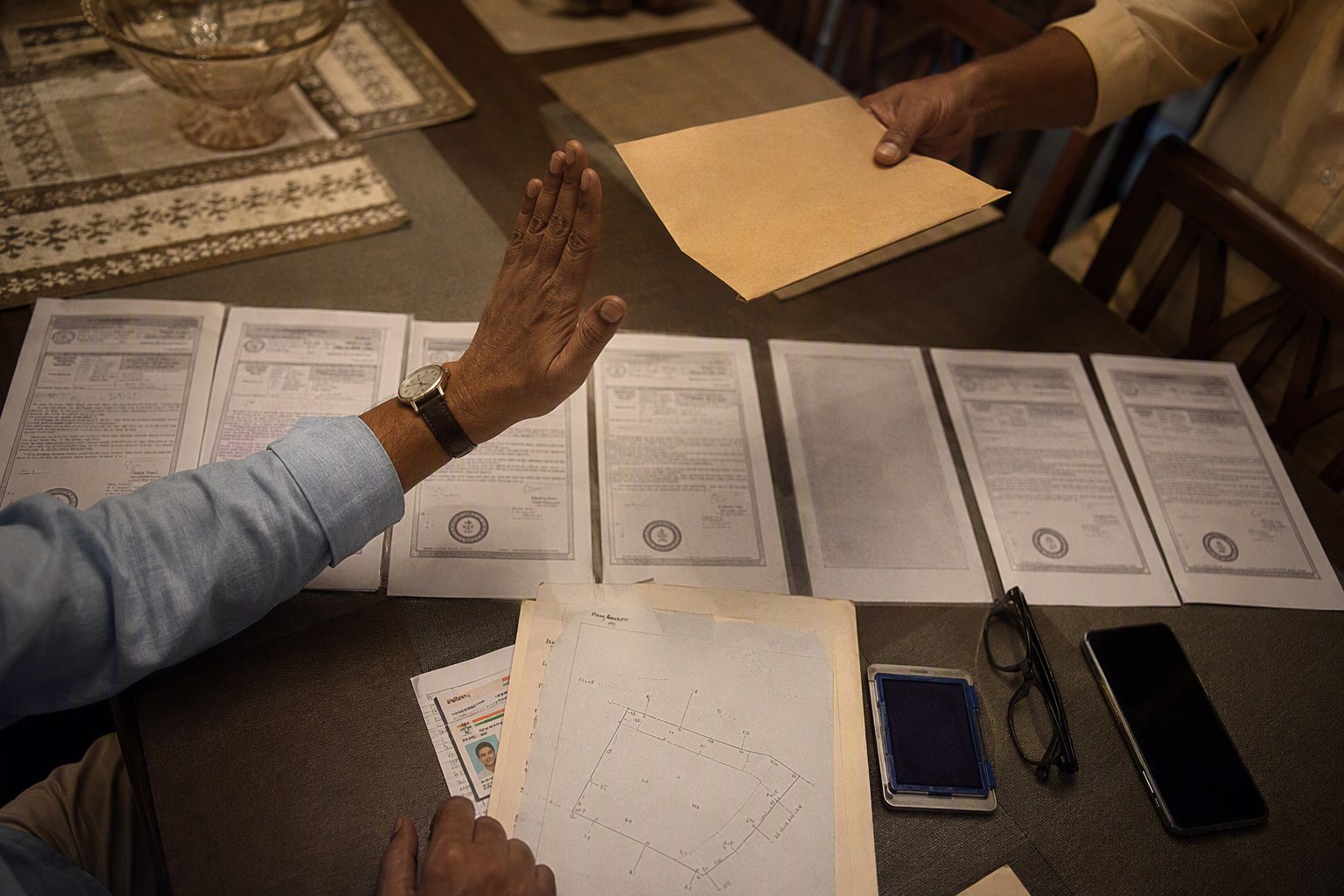



Telangana Case Study: Token Paid Before Assigned Land Check
Telangana has 1,47,934 prohibited property records under Section 22-A, and that one number should make every plot buyer slow down before paying even a small token advance. This Telangana Case Study: Token Paid Before Assigned Land Check is about a Hyderabad buyer who paid ₹5 lakh as token for an open plot near the western growth corridor, only to find later that the survey number carried assigned land and 22-A risk. The deal looked normal on WhatsApp, location pin and layout sketch. The land record told a different story.
We are changing names and a few identifying details because the family is still trying to recover the token. The verification pattern, however, is very common in Hyderabad, Sangareddy, Medchal-Malkajgiri, Rangareddy and Yadadri-Bhuvanagiri transactions. In our experience, the dangerous stage is not registration day. It is the happy stage before registration, when the buyer believes the seller, broker and layout marking without checking survey number history.
Our straight view: if the survey number has assigned land, government land, ceiling land, waqf/endowment issue, court attachment or 22-A entry, your token receipt will not protect you enough. Verification must happen before money moves.
Telangana Case Study: Token Paid Before Assigned Land Check — What Happened
The buyer, a salaried professional from Miyapur, wanted a 267 sq yd plot for future house construction. His target areas were Patancheru, Ameenpur, Beeramguda, Kollur and the stretch towards Isnapur because Tellapur and Nallagandla had already moved beyond his comfort budget. The plot shown to him was in a village belt under Sangareddy district, marketed as being close to ORR access and upcoming residential demand.
The quoted price was ₹42,000 per sq yd. Total deal value came to roughly ₹1.12 crore. The broker pushed urgency: another buyer was ready, the owner was travelling, and the seller would block the plot only if token was paid the same evening. The buyer transferred ₹5 lakh and took a simple handwritten token receipt. The receipt mentioned plot number, extent and agreed price. It did not mention survey number, khata number, village, mandal, SRO jurisdiction, 22-A status or pahani reference.
This is where the case went wrong. In Telangana, plot number is not the foundation of title. Survey number is. A layout can show Plot 38, but the real question is: from which survey number was Plot 38 carved out? Was that survey number private patta land? Was any part assigned land? Was it in the prohibited list? Was conversion done? Was layout approved by HMDA, DTCP or gram panchayat in the old system? Was the sale chain clean?
The buyer came to us only after his bank legal team asked for the survey number extract and EC. When we checked the land trail, the parent survey number had a troubling history. One sub-division was shown as assigned land in older revenue references. Another portion had conflicting entries between the seller’s documents and revenue records. The SRO route also carried registration risk because Section 22-A entries can stop registration even when parties are willing.
Assigned Land Check in Telangana: Why Section 22-A Changes the Deal
Section 22-A is not a small clerical entry. It is the system through which certain properties are blocked from registration. The list can include government land, assigned land, endowment land, waqf land, surplus land, land under legal restriction and other categories notified to the Registration Department. Telangana’s 1,47,934 prohibited property records are not theory; they are live transaction blockers for buyers, sellers, bankers and developers.
Assigned land is especially sensitive. Land assigned by government to landless poor or eligible beneficiaries generally comes with transfer restrictions. Many such lands changed hands informally over decades through agreements, GPA papers or local panchayat-style transactions. Some layouts were later sold to urban buyers who did not understand the original land character. When the buyer reaches SRO for registration or bank loan, the old problem returns.
In this case, the seller argued that the entire area had developed, roads were laid, and neighbouring plots were already sold. That is not a legal answer. We have seen this in Maheshwaram, Adibatla, Shankarpally, Chevella, Ghatkesar, Keesara and Shamirpet belts also. Development activity around a land parcel does not automatically cleanse title. A road, compound wall or electricity pole is not proof that assigned land restriction disappeared.
The buyer’s first mistake: treating token as harmless
Many Hyderabad buyers think token advance is only a booking amount. Legally and practically, it can become a pressure tool. Once token is paid, the seller and broker may say the buyer backed out, the amount is non-refundable, or verification delay caused loss. If the receipt is weak, the buyer has to spend time and money proving why he cancelled. That is exactly what happened here.
A better practice is to issue token only after minimum title checks, or pay a very small refundable amount through bank transfer with conditions written clearly. The token receipt should say that payment is subject to clean EC, clean 22-A check, assigned land verification, SRO confirmation, layout approval and legal opinion. If the seller refuses such wording, that itself is a signal.
Telangana Case Study: Token Paid Before Assigned Land Check — The Data Trail
Here is the timeline we reconstructed from the buyer’s papers, broker chats and public record checks.
| Stage | What Buyer Did | What Should Have Been Done |
|---|---|---|
| Site visit | Saw plot marking, road access and nearby villas | Ask for village, mandal, survey number, layout approval and parent documents |
| Price discussion | Agreed at ₹42,000 per sq yd for 267 sq yd | Compare SRO market value using Market Value / Guideline Value Search |
| Token payment | Paid ₹5 lakh on same day | Pay only after 22-A, EC and assigned land checks |
| Receipt | Receipt had plot number and amount | Include survey number, SRO, refund clause and verification conditions |
| Bank process | Legal issue surfaced later | Run Encumbrance Certificate Search before token |
| Risk finding | Possible assigned land and 22-A exposure found | Use Section 22-A Prohibited Property Check first |
The biggest gap was simple: no one verified the survey number before money moved. In Telangana land buying, survey number is not a back-office detail. It decides SRO jurisdiction, pahani trail, Dharani history, mutation records, layout parentage and prohibited property exposure. If you only know the plot number, you are not ready to pay token.
How Assigned Land Risk Appears in Hyderabad Periphery Deals
Hyderabad’s periphery has changed fast. Areas like Mokila, Kollur, Velimela, Shankarpally, Patancheru, Isnapur, Dundigal, Ghatkesar, Bibinagar, Maheshwaram and Kandukur have attracted buyers because apartment prices inside the city became heavy. Open plots feel attractive: lower maintenance, emotional value and possible appreciation. But the land history in these belts can be mixed.
One survey number may have clean patta land. The next survey number may have assigned land. Within the same village, some lands may be under old ceiling proceedings, some under court disputes, some under layout approval, and some not converted from agricultural use. A broker may show the best road and the nearest villa project, but he may not show the revenue history.
We have also seen cases where buyers confuse market rate with legal safety. For example, if plots in a belt are being quoted between ₹25,000 and ₹60,000 per sq yd, buyers assume the area is safe because money is already flowing. That is a poor assumption. High demand does not remove 22-A entries. A clean neighbouring sale deed does not guarantee your specific plot is clean.
Before paying token, a buyer should at least know:
- Exact village, mandal and district
- Survey number and sub-division number
- Extent in acres/guntas and plot extent in sq yd
- Name in revenue records and name in sale chain
- Whether land appears in prohibited property list
- Whether any part was assigned land
- Whether layout approval exists and matches the survey numbers
- Which SRO handles registration
You can start with Survey Number Finder if the seller gives only a location pin. Then check the SRO through Find Your SRO Office. For a wider pre-token screen, use our Property Verification Tool.
The Money Side: Token, Stamp Duty and Guideline Value
The buyer was focused on negotiating ₹1,000 per sq yd down from the quoted price. That would have saved ₹2.67 lakh. But he paid ₹5 lakh before checking whether the transaction could even be registered. This is common. Buyers bargain hard on price and go soft on title.
For a normal sale deed in Telangana, buyers generally budget around 7.5% towards stamp duty, transfer duty and registration fee, depending on document type and local body rules. On a ₹1.12 crore transaction, that can be roughly ₹8.4 lakh in transaction costs. Before planning this cash flow, the buyer should compare the agreement value with government market value, also called guideline value or ready reckoner value in common language.
Use the Stamp Duty Calculator to estimate registration costs and the Market Value / Guideline Value Search to understand the base value considered by the department. If the quoted price is far above guideline value, that is not automatically bad. Many Hyderabad periphery markets trade above official value. But if the seller is pushing for cash, undervaluation or vague document wording, slow down.
In this case, the buyer’s token receipt did not state whether the ₹5 lakh would be adjusted in sale consideration, refunded if legal defects appeared, or forfeited if registration failed. The seller later claimed he had blocked other buyers. The buyer claimed title was defective. A two-line receipt created a four-month fight.
What We Found During Verification
Our review was not a full court-level title opinion, but the early red flags were enough to stop the purchase.
- Survey number mismatch: The layout sketch shown by broker did not clearly match the parent survey number mentioned in older sale deeds.
- Assigned land reference: Revenue trail suggested that one portion of the parent land had assigned character in past records.
- Weak token receipt: No refund clause tied to legal verification.
- EC not enough: The EC showed registered documents but did not answer whether the original land could legally be transferred.
- SRO risk: The possibility of Section 22-A objection meant registration could be refused or delayed.
This is a point many buyers miss. EC is necessary, but EC alone is not enough. An Encumbrance Certificate shows registered transactions for a period. It may show sale deeds, mortgages, releases and gifts. It will not always explain whether the land was assigned, whether there is a revenue classification issue, or whether government has restricted registration under 22-A. That is why EC, Dharani/revenue record, prohibited list, layout approval and legal opinion must be read together.
Pre-Token Checklist for Telangana Plot Buyers
If you are buying in Hyderabad, Rangareddy, Medchal-Malkajgiri, Sangareddy, Vikarabad or Yadadri-Bhuvanagiri, follow this order before paying token advance:
- Get the survey number first. Do not accept only plot number or Google location.
- Check Section 22-A status. Use the prohibited property check and ask the seller for clarification if any entry appears.
- Read the pahani and Dharani trail. See whether names, extents and land nature are consistent.
- Verify assigned land angle. Ask specifically whether land was ever assigned, lavoni, government-granted or restricted.
- Check EC for at least 30 years where possible. Look for missing links, GPA sales, mortgages and court-related documents.
- Confirm layout approval. HMDA, DTCP, municipality or old gram panchayat approval must be studied based on date and location.
- Find correct SRO. The wrong SRO assumption can create document and jurisdiction confusion.
- Write token conditions. Refund if legal, revenue, 22-A, bank or layout issue is found.
For apartment buyers, the checklist changes slightly. You must also check RERA registration, building permissions, UDS, mortgage releases and occupancy status. Our RERA Project Lookup helps with project-level checks. For plot buyers, survey number and land classification remain the heart of the matter.
How the Buyer Could Have Avoided the Loss
The buyer did not act carelessly in the usual sense. He visited the site, met the seller, checked nearby development and negotiated price. But he followed the wrong sequence. Site visit came first, emotion came second, token came third, verification came last. In Telangana land deals, that sequence is expensive.
The better sequence is:
- Location interest
- Survey number collection
- 22-A and assigned land check
- EC and title chain review
- Guideline value and stamp duty estimate
- Layout approval verification
- Conditional token
- Legal opinion
- Agreement of sale
- Registration
We have seen buyers save lakhs simply by asking one line before visiting the site: “Please send survey number and village name.” Genuine sellers usually share it. If the broker says, “First come and see, sir, records later,” be alert. Records are not a favour. They are basic transaction material.
Our Opinion on Token Advances in Telangana Land Deals
Token advances are not bad by themselves. They help lock commercial understanding. But in Hyderabad’s land market, token culture has become too casual. People transfer ₹1 lakh, ₹2 lakh, ₹5 lakh and sometimes ₹10 lakh based on a location pin and broker confidence. That is not property buying; that is gambling with paperwork pending.
For clean transactions, sellers should also welcome early verification. A buyer who checks 22-A, EC, market value and SRO before token is more likely to close properly. Sellers with clean title can ask for a serious token after sharing documents. Sellers with weak title often create urgency.
My practical rule is simple: no survey number, no token. No 22-A check, no token. No refund condition, no meaningful token. If the property is truly clean, it can survive 48 hours of verification.
Final Takeaway from This Telangana Case Study
This Telangana Case Study: Token Paid Before Assigned Land Check shows a very specific lesson. The risk was not hidden in a 100-page legal file. It was visible at the survey number level. The buyer paid first and checked later. Telangana already has 1,47,934 prohibited property records under Section 22-A, so the odds of running into a restricted entry are not imaginary.
Before buying in Patancheru, Ameenpur, Kollur, Shankarpally, Maheshwaram, Adibatla, Ghatkesar, Shamirpet or any fast-growing belt, treat land verification as the first negotiation point. Price, road width and future appreciation matter. But title decides whether you can register, mortgage, build, sell or sleep peacefully.
Use the tools, ask for records, and put refund clauses in writing. A good deal should not fear verification.
Frequently Asked Questions
What is assigned land in Telangana?
Assigned land is land granted by the government to eligible persons, often with restrictions on transfer. If such land is sold without legal permission, the buyer can face registration refusal, cancellation risk or government objection.
How do I check if a Telangana property is under Section 22-A?
Start with the survey number, village and mandal. Then use a prohibited property check, verify with SRO records, and compare with revenue records such as pahani and Dharani entries.
Is an Encumbrance Certificate enough before buying a plot?
No. EC is necessary, but it mainly shows registered transactions. It may not fully reveal assigned land, government land classification, layout approval defects or Section 22-A restrictions.
Should I pay token advance before legal verification?
Avoid it. If you must pay, keep it small and write clear refund conditions linked to clean EC, 22-A status, assigned land check, layout approval and legal opinion.
What details should a token receipt contain?
It should mention buyer and seller names, amount, survey number, plot number, village, mandal, SRO, total sale price, payment mode, refund terms and verification conditions.