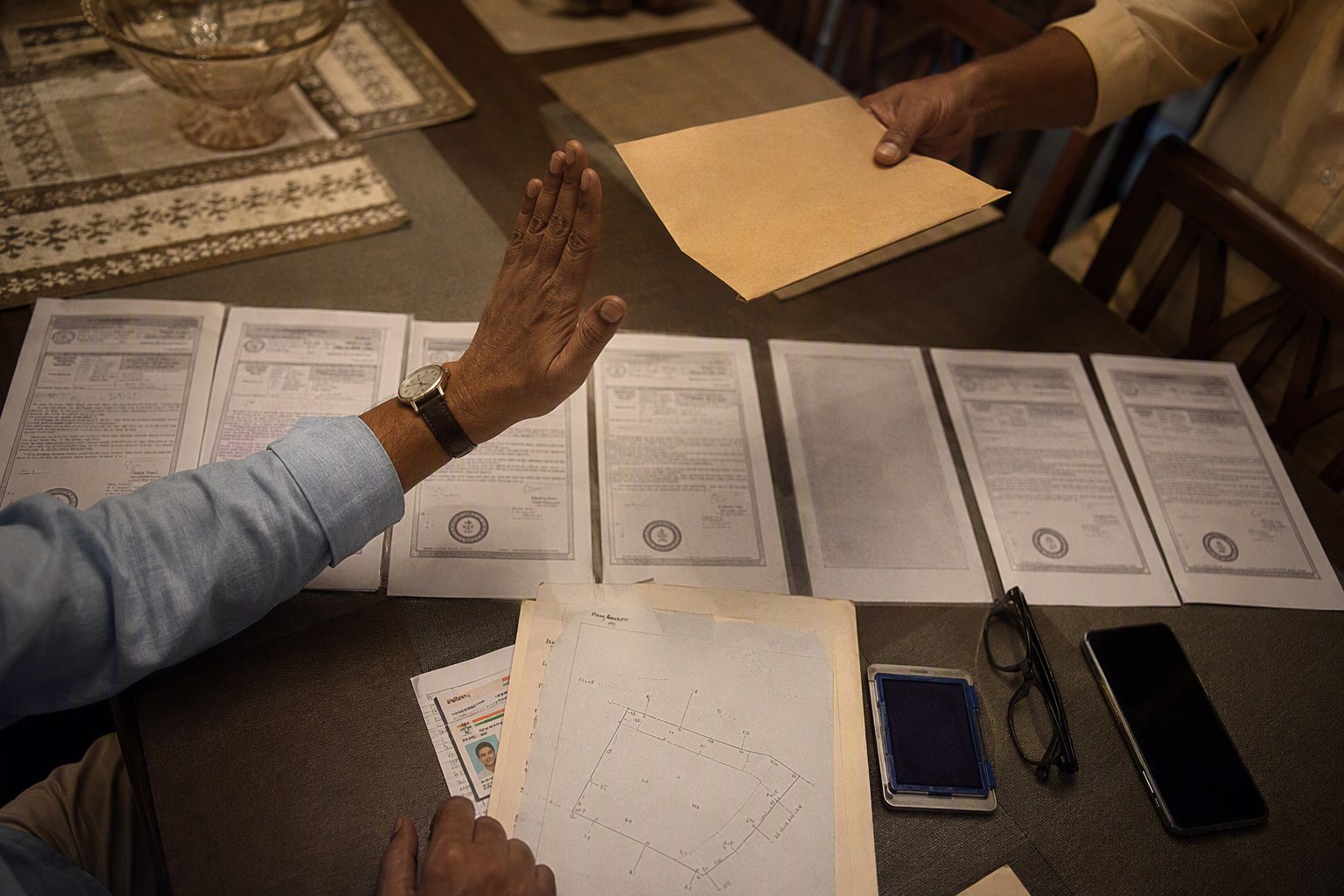



Telangana Case Study: When a Temple Land Note Stalled Sale is a warning from a near-miss resale plot deal in Hyderabad’s western corridor. A buyer was ready to pay a token advance for a 267 sq yd plot near Narsingi-Gandipet side, quoted at around ₹1.05 lakh per sq yd. The papers looked decent at first glance: old sale deed, layout sketch, tax receipts and an Encumbrance Certificate with no recent loan. Then one line in the prohibited property check changed the deal. The survey number carried a temple/endowment land note.
The buyer paused. The seller argued it was an old remark and would not affect registration. But the Sub-Registrar Office position was simple: if a property is reflected under Section 22-A prohibited categories, the registration can be refused or kept pending. In Telangana, there are 1,47,934 prohibited property records that buyers must screen before paying even a small token.
Our opinion is blunt: in Telangana plot purchases, token advance should come after Section 22-A verification, not before. EC alone is not enough.
Telangana Case Study: What Happened Before the Token Payment
The buyer, an IT professional working in Gachibowli, wanted a resale plot within 20-30 minutes of the Financial District. He had shortlisted areas like Narsingi, Kokapet fringe, Gandipet, Puppalaguda, Kollur and Mokila. The final plot was in a small resale layout, not a new RERA apartment project. The seller said the land fell under Gandipet mandal, Ranga Reddy district, and pushed for a quick ₹5 lakh token.
The price was not unusual for that belt. In the Narsingi-Gandipet micro-market, clear-title plotted land in decent internal roads is often quoted between ₹85,000 and ₹1.40 lakh per sq yd, depending on road width, layout status and distance from ORR access. Kokapet-side plotted assets can go much higher. Mokila and Shankarpally, by comparison, may still show resale quotes from ₹35,000 to ₹70,000 per sq yd in many layouts. The buyer felt the deal was fair, not cheap.
He first checked the Encumbrance Certificate using the document number from the earlier sale deed. The EC showed prior registered transactions. No mortgage appeared in the recent years. Many buyers stop here. In our experience, that is where mistakes happen. An EC tells you about registered encumbrances. It does not automatically clear land classification, temple/endowment issues, assigned land restrictions, wakf claims, government land entries or court-related prohibitions.
Before releasing token, the buyer ran the survey number through a Section 22-A check. The result showed a note connected to temple/endowment land. That one remark was enough to stall the sale.
Temple Land Note Stalled Sale: Why Section 22-A Matters in Telangana
Section 22-A is the practical gatekeeper at the registration stage. If a property is listed as prohibited, the SRO may not register the sale deed. These entries can relate to government land, endowment land, wakf land, assigned land, ceiling surplus land, lands under acquisition, court orders and other restricted categories. Telangana has 1,47,934 prohibited property records, and many are tied to survey numbers rather than neat plot numbers.
That is the danger in older layouts. A buyer may receive a plot number, a layout sketch and an old registered deed. But the underlying survey number may carry a note in revenue or registration records. If the survey number is partially affected, each plot has to be mapped carefully. A clean-looking plot number is not a substitute for checking the parent survey number.
For this case, the seller’s defence was familiar: the plot was sold multiple times, neighbours had built houses, and one bank had earlier given a loan in the layout. All three points are relevant, but none of them cancel a live prohibited property remark. We have seen this across Ranga Reddy, Medchal-Malkajgiri and Sangareddy districts. A property may have old registrations, yet a later update in the prohibited list can disturb the next transfer.
That is why we suggest starting with Section 22-A Prohibited Property Check before making any payment. Pair it with Survey Number Finder if the seller only gives a plot number or vague location. If the land is in a village boundary that has seen multiple layout conversions, this step is not optional.
Documents Checked in the Resale Plot Case
The buyer’s file had the usual resale plot bundle. On paper, it looked better than many rushed deals in Hyderabad outskirts. Still, the temple/endowment note overpowered the comfort created by other documents.
| Document or check | What it showed | Risk reading |
|---|---|---|
| Old sale deed | Seller had a registered document from an earlier owner | Helpful, but not final proof against 22-A prohibition |
| Encumbrance Certificate | No recent bank charge or sale dispute appeared in EC period | EC does not confirm land category or endowment status |
| Layout sketch | Plot was shown with internal roads and neighbouring plots | Needed approval verification and survey mapping |
| Revenue reference | Survey number matched the village record trail | Same survey number carried a prohibited note |
| Section 22-A check | Temple/endowment land note found | Registration risk became serious |
The buyer then checked likely stamp duty exposure through Stamp Duty Calculator and market value through Market Value / Guideline Value Search. This gave him the government value range for registration planning. But after the prohibited note, stamp duty planning became secondary. First comes registrability. Only then comes price, duty, TDS, capital gains and loan processing.
Why EC Search Did Not Catch the Temple Land Note
This is the part many buyers misunderstand. An EC is a transaction history from registration records for a given property description and period. It can show sales, gifts, mortgages, releases and certain registered charges. It is valuable. But it is not a full land-title certificate.
If a temple/endowment remark sits in a prohibited property list, revenue record, department communication or survey-number classification, it may not appear as a normal encumbrance entry. That is why the buyer’s Encumbrance Certificate Search looked acceptable while the Section 22-A check raised a red flag.
Think of it like this: EC answers, ‘What registered dealings happened?’ Section 22-A answers, ‘Can this property be registered at all, given the restriction list?’ Pahani and Dharani-linked checks answer, ‘What does revenue classification say?’ SRO and market value checks answer, ‘Where will registration happen and at what minimum value?’ These are connected, but they are not the same.
In this case, the temple note was not a small spelling issue. It pointed to a possible endowment claim over the underlying survey number. If the seller wanted to proceed, he had to produce a proper clarification from the competent authority, not only verbal confidence from a document writer.
Temple Land Note Stalled Sale: The Price Looked Attractive, But Risk Was Bigger
The plot was quoted at roughly ₹2.80 crore for 267 sq yd. For a western Hyderabad resale plot with access towards Narsingi, Gandipet and the ORR belt, that did not look suspiciously low. That is exactly why the buyer almost paid.
We have seen buyers use price as the first fraud detector. Very low price, they suspect. Market price, they relax. That is not safe. Title risk does not always come with a discount. Some sellers genuinely may not know the land has a 22-A note. Some may know and still push for token. Some brokers may say, ‘Sir, registration will happen, we know people in SRO.’ Buyers should ignore such lines.
Here is a quick rate context from current Hyderabad plot conversations:
- Narsingi and Gandipet side: resale plots often quote around ₹85,000 to ₹1.40 lakh per sq yd for better-located pockets.
- Kokapet and Financial District influence zone: smaller clear-title plots can cross ₹1.50 lakh per sq yd depending on access and scarcity.
- Kollur and Tellapur belt: approved plotted communities and resale inventory may range widely, often from ₹55,000 to ₹1 lakh per sq yd.
- Mokila and Shankarpally: many plotted ventures trade between ₹35,000 and ₹70,000 per sq yd, with premium gated layouts higher.
- Maheshwaram and Tukkuguda side: quotes can vary from ₹18,000 to ₹55,000 per sq yd depending on HMDA approval, road width and airport corridor access.
These market rates help negotiation, but they do not clear title. A ₹3 crore plot with a temple/endowment note can become harder to sell than a cheaper plot with clean records.
What the Buyer Did Right
The buyer’s best decision was not paying token under pressure. In Telangana, token advances are often written on simple paper or WhatsApp with lines like ‘non-refundable if buyer cancels.’ Once money moves, the discussion changes. The seller may delay refund, the broker may push for compromise, and the buyer may feel trapped.
He also insisted on checking the survey number, not only the plot number. In many outskirts transactions, the broker says, ‘Plot number is enough.’ It is not enough. For land, the survey number is the spine of due diligence. Plot number is a layout-level identity. Survey number connects the property to pahani, Dharani, SRO market value and prohibited records.
He used the correct sequence: survey number, prohibited property check, EC, guideline value, SRO identification and physical inspection. If the plot had passed these, he could then look at road width, land use and development potential through tools like Road Width Check, Land Use Zone Finder and FSI/FAR Calculator.
What the Seller Needed to Prove
A temple/endowment note does not always mean the buyer must permanently reject the property. But the burden shifts heavily to the seller. The seller has to show why the entry does not apply to this plot, or why it was wrongly carried forward, or whether a competent authority has cleared it.
In such cases, we normally ask for:
- Parent documents from the earliest available registered transaction.
- Survey number correlation statement showing how the plot falls within the parent land.
- Latest pahani or revenue extract where applicable.
- Dharani status or equivalent revenue record trail for the village.
- HMDA/DTCP/gram panchayat layout approval file, depending on the period and jurisdiction.
- Written clarification from Endowments Department or relevant authority if the note refers to temple land.
- SRO-level confirmation on whether the sale deed can be accepted for registration.
One practical step is to identify the correct office using Find Your SRO Office. Many buyers search in the wrong jurisdiction, especially around border areas like Kokapet-Narsingi, Tellapur-Osman Nagar, Kollur-Mokila and Tukkuguda-Maheshwaram. SRO jurisdiction decides where the deed lands for registration, and that office’s prohibited property data matters.
How to Check a Telangana Plot Before Paying Token
For resale plots in Telangana, I prefer a payment rule that sounds strict but saves families from big losses: no token before basic title screening. Not even ₹50,000. Once a buyer emotionally commits, due diligence becomes weak.
Use this order:
- Get exact identity: plot number, survey number, village, mandal, district, layout name and seller document number.
- Map the survey number: use Survey Number Finder and verify the land location physically.
- Run 22-A screening: check through Section 22-A Prohibited Property Check before advance payment.
- Check EC: use Encumbrance Certificate Search for transaction history and mortgages.
- Check value: use Market Value / Guideline Value Search and compare with quoted resale rate.
- Check SRO: confirm jurisdiction through Find Your SRO Office.
- Estimate duty: use Stamp Duty Calculator only after the property clears basic title risk.
- Track changes: for long negotiations, monitor with Property Change Tracker.
If it is an apartment, also check RERA Project Lookup. For independent houses and plotted villas, check land title plus permissions. RERA registration does not automatically cure defects in parent land, though it gives extra project-level disclosures.
Lessons from the Temple Land Note Stalled Sale
The biggest lesson is that Hyderabad’s price growth has made buyers faster than their paperwork. Western Hyderabad, ORR villages, airport corridor and pharma city side locations are seeing aggressive plot marketing. Brokers use words like ‘last plot’, ‘owner going abroad’ and ‘token today only’. A serious buyer should smile, take the documents and verify.
Second, Section 22-A is not a small clerical column. With 1,47,934 prohibited property records in Telangana, the probability of encountering a restricted survey number is not imaginary. It is a daily market risk, especially in older village lands that have become urban plots.
Third, temple and endowment land matters require extra caution. Religious institution lands have their own legal protections and administrative history. If the record shows such a note, do not rely on neighbour registrations. Ask for official clearance. If the seller cannot provide it, walking away is not fear; it is discipline.
In this case, the buyer did not lose money. He lost a week and some document charges. That is a good outcome. A failed deal before token is far better than a stuck sale deed after paying lakhs.
Verified.RealEstate View
My view is simple: Telangana land buying has become data-heavy. The old style of trusting only EC, xerox sale deed and broker confidence is outdated. Buyers must check survey number, SRO, prohibited list, ready reckoner value, land use and layout status together.
For a resale plot in Narsingi, Gandipet, Kollur, Mokila, Tellapur, Shankarpally, Maheshwaram or Tukkuguda, the first question should not be ‘What is the final rate?’ It should be ‘Is this land registerable and clean enough to resell later?’ A temple/endowment note answers that question with caution.
If a seller objects to verification before token, treat that itself as a signal. Clean-title sellers may negotiate hard, but they usually do not fear proper checks.
Frequently Asked Questions
Can a Telangana property with a temple land note be registered?
It depends on the exact record and authority clarification. If the property appears under Section 22-A prohibited records, the SRO may refuse or keep registration pending unless the seller produces valid clearance from the competent authority.
Is an Encumbrance Certificate enough before buying a resale plot?
No. EC shows registered transactions and charges for a period, but it may not show land classification, endowment claims, assigned land restrictions or all prohibited property issues. Check EC along with survey number, pahani, Dharani status and Section 22-A records.
When should I pay token advance for a plot in Hyderabad outskirts?
Pay token only after basic verification: survey number match, Section 22-A check, EC search, seller title chain, layout approval and SRO jurisdiction. Token before verification is risky, even if the amount looks small.
How many prohibited property records are there in Telangana?
Telangana has 1,47,934 prohibited property records under Section 22-A categories. Buyers should check this list before purchasing plots, houses or land parcels.
What should a seller provide if land is marked as endowment or temple land?
The seller should provide parent documents, survey mapping, revenue records and written clarification or clearance from the Endowments Department or competent authority. Verbal assurances from brokers or document writers are not enough.