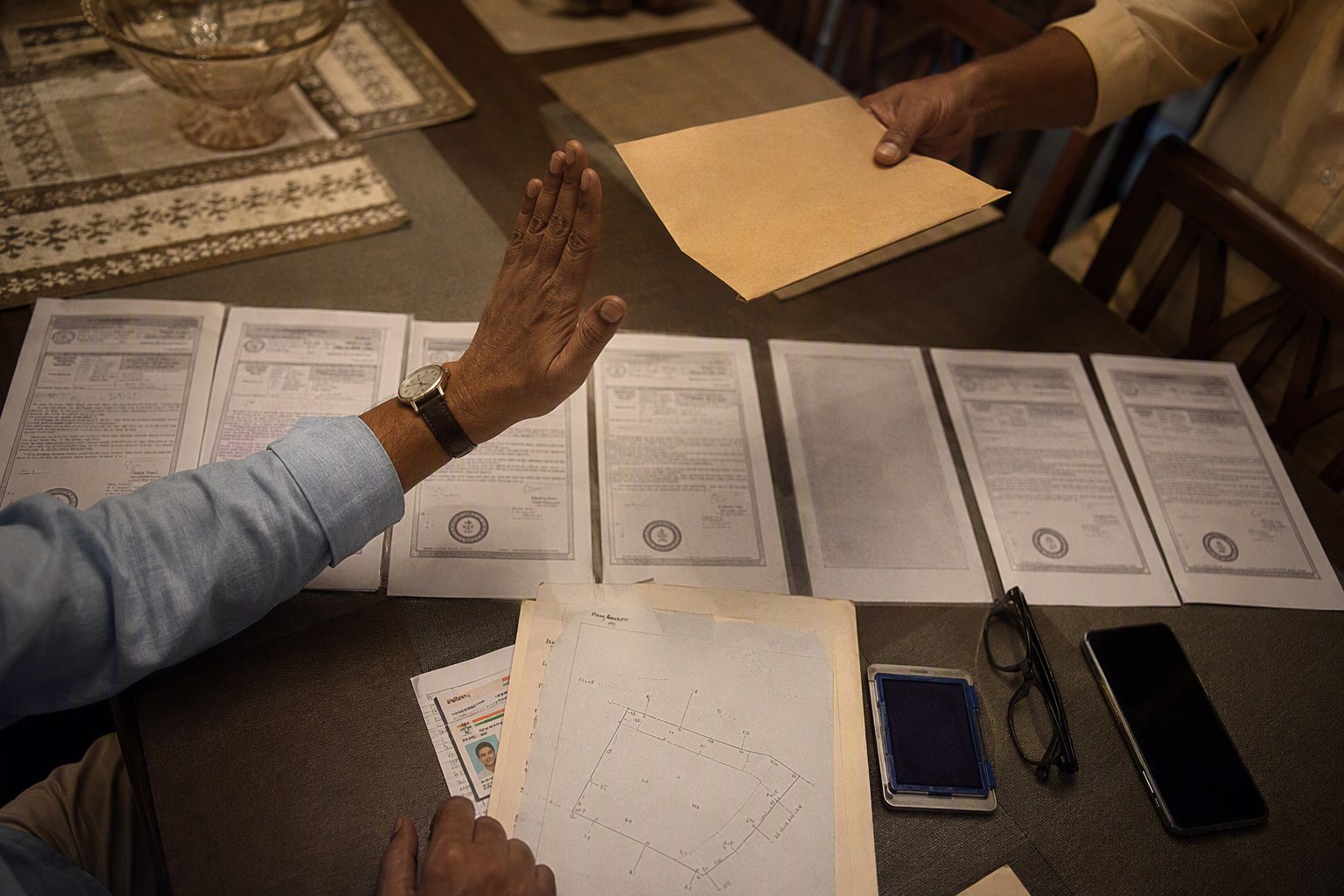



Telangana Case Study: Did a Road-Widening Note Stop Sale?
Can one small road-widening remark stop a Hyderabad plot sale? Yes, it can slow it down, change the price, or kill the deal completely. In this Telangana case study, a buyer in West Hyderabad almost paid token advance for a plot near a fast-growing corridor. Before signing, he checked the EC, survey records, SRO trail and Section 22-A status. That last step mattered because Telangana currently has 147934 prohibited property records under Section 22-A. One line in a local record about proposed road widening changed the whole negotiation.
This is not a court story. It is a practical market story from the kind of plot transaction we see around Narsingi, Manikonda, Kollur, Bachupally, Shamshabad and Mokila every week. A seller shows a layout, says the road is already formed, quotes a clean rate, asks for quick token, and tells the buyer, “Sir, everything is clear.” Sometimes it is clear. Sometimes the Encumbrance Certificate is clean but the land itself carries a planning or revenue risk.
Our view is simple: a clean EC is not equal to a clean property. EC tells you about registered transactions. It does not always warn you about road widening, land use mismatch, 22-A prohibition, survey overlap, court claims, nala buffer or layout deviations.
Telangana Case Study: Did a Road-Widening Note Stop Sale in West Hyderabad?
The buyer, whom I will call Ravi, was looking for a 300 sq yd open plot for future house construction. His budget was around ₹1.75 crore to ₹2.10 crore, which is very normal for approved plotted pockets in the West Hyderabad belt, depending on exact location, road width and layout status. The broker showed him a plot in a village area falling under a mandal that has seen heavy demand due to ORR access and IT corridor spillover.
The seller quoted ₹68,000 per sq yd. For a 300 sq yd plot, that meant a base consideration of ₹2.04 crore. The seller wanted ₹5 lakh token the same evening, saying another buyer was ready. This is a common pressure tactic in Hyderabad land deals, especially in Narsingi, Puppalaguda, Kollur, Tellapur, Mokila and Adibatla side. Good plots do move fast, but bad paperwork also moves fast.
Ravi did one sensible thing. He did not argue about price first. He checked risk first. He used the Encumbrance Certificate Search to pull the registered transaction trail, checked market value through the Market Value / Guideline Value Search, identified the jurisdiction through Find Your SRO Office, and ran the survey details through the Section 22-A Prohibited Property Check.
The EC did not show a mortgage. No visible sale dispute. The seller had purchased the plot through a registered sale deed. On the surface, it looked acceptable. But the survey extract and local enquiry showed a remark connected to proposed road widening on the approach stretch. Not exactly on the plot document in bold red letters, not a dramatic warning, just a small remark in planning conversation and local record reference.
That one line was enough to pause the token.
Why the Telangana Case Study: Did a Road-Widening Note Stop Sale matters for buyers
Hyderabad buyers often treat road width as a lifestyle point. “Is the road 30 feet or 40 feet?” they ask mainly for car movement and resale value. Actually, road width is also a legal and planning issue. It affects building permission, setbacks, FSI, loan comfort and future acquisition risk.
If a road is proposed to be widened from 30 feet to 60 feet, some land on either side may be affected. If the plot is at a corner, near a junction, or on a village main road, the impact can be bigger. Even if no immediate demolition happens, the buyer may face uncertainty while applying for building permission. In areas under HMDA, GHMC, municipality or gram panchayat transition zones, this can become messy.
In this case, the plot itself was not listed as prohibited under Section 22-A. That was good. But the road-widening remark affected valuation. A 300 sq yd plot quoted at ₹68,000 per sq yd is not the same if 20 to 40 sq yd may become unusable in future or if permission will be granted after leaving extra front setback. If effective usable land comes down, the actual rate per usable sq yd shoots up.
That is why I keep telling buyers: don’t only ask “what is the rate?” Ask “what am I really buying?”
The first red flag: seller wanted token before documents
The seller was not a fraudster based on the records seen. But he was in a hurry. That itself is a market signal. Genuine sellers also hurry, no doubt. But when the seller says, “Pay token first, then we will share full papers,” the buyer should slow down.
Ravi asked for these documents before paying token:
- Current sale deed and link documents
- Latest EC for at least 30 years where possible
- Layout approval copy or LRS/BRS status if applicable
- Survey number and sub-division details
- Pahani / adangal trail for agricultural origin land
- Dharani extract where relevant
- Mutation details
- Property tax or vacant land tax proof, if available
- Road width shown in layout and on ground
- 22-A prohibited property check result
Most buyers ask for sale deed and EC. Very few ask for survey sketch, village map reference and road marking. In our experience, the third set is where the hidden issue sits.
What EC showed, and what it did not show
The EC showed registered transactions. It confirmed that the seller’s name entered the registration chain. There was no registered mortgage during the checked period. No agreement of sale was visible. No court attachment appeared in the EC extract.
That gave Ravi comfort, but not final comfort. EC is generated from registration records maintained by the Sub-Registrar Office. It is excellent for checking registered sales, gifts, mortgages, releases and some court-related entries if registered or reflected. But it will not always capture planning notes, proposed master plan roads, old village road claims, nala alignment, lake buffer restrictions or pending municipal road expansion discussions.
For that, he checked survey and planning angle separately. He also used the Survey Number Finder to avoid a common mistake: relying only on the plot number in a private layout. Plot number is useful, but survey number is the backbone in Telangana land verification.
In many Hyderabad deals, the broker will say, “Plot No. 42 is west-facing, 40 feet road.” Good. But which survey number? Which village? Which mandal? Which SRO? Is the layout carved out of one survey number or multiple survey numbers? Was any portion in government land, assigned land, wakf, endowment, ceiling surplus, lake bed or road reservation? Those questions matter.
The 22-A check against Telangana’s 147934 prohibited property records
Section 22-A is where many buyers wake up late. Telangana has 147934 prohibited property records. These records can include government lands, assigned lands, endowment lands, wakf lands, ceiling surplus lands and other categories where registration may be barred or restricted.
In Ravi’s case, the specific plot did not appear as prohibited in the check. That was a relief. But the exercise was still useful because it forced everyone to identify the exact survey number, village and mandal. Without that, 22-A checking is weak.
We have seen buyers search only by seller name or plot number and assume all is fine. That is not enough. 22-A checks must be done using correct location details. If the land is in a village like Puppalaguda, Kokapet, Narsingi, Kollur, Velimela, Mokila, Ghatkesar, Dundigal, Tukkuguda or Shamshabad side, survey-level accuracy is essential because adjacent survey numbers may have completely different status.
One survey number may be private patta. The next may be government land. A layout may use a marketing name like “County”, “Enclave”, “Heights” or “Green Meadows”, but the legal identity remains survey number, village, mandal and SRO.
How the road-widening note changed the price discussion
Once the road-widening remark surfaced, Ravi did not reject the deal immediately. That is also sensible. Not every remark means disaster. Some road proposals never move. Some are already accounted for in layout approval. Some affect only the approach road and not individual plots. Some require leaving a setback but still allow decent construction.
So the team did a basic impact table.
| Item checked | Seller position | Buyer finding | Impact on sale |
|---|---|---|---|
| Quoted plot size | 300 sq yd | 300 sq yd as per sale deed | Size matched document |
| Quoted price | ₹68,000 per sq yd | ₹2.04 crore total | Premium pricing |
| Road on ground | About 30 feet usable | Possible future widening reference | Risk to front usage |
| EC | Clear | No visible mortgage or sale dispute | Positive, but limited |
| 22-A status | Seller said clear | Not found in prohibited check | Positive |
| Survey/planning angle | Not discussed initially | Road-widening remark noticed | Token paused |
The buyer then recalculated. If future widening or setback effectively reduced usable frontage and buildable area, he did not want to pay full premium rate. A plot that looked like ₹68,000 per sq yd on paper could feel like ₹75,000 to ₹80,000 per effective sq yd after risk adjustment. That is not a small difference.
He also checked probable stamp duty and registration outgo through the Stamp Duty Calculator. Many buyers forget this while negotiating. On a ₹2 crore-plus property, registration cost is not pocket change. If later a title or planning issue appears, the cost of correction, cancellation or resale discount can be painful.
Road width, FSI and building permission: the hidden link
In Hyderabad and surrounding Telangana urban areas, road width is not only about access. It can influence building height, setbacks, parking feasibility and floor area calculations. A buyer planning G+2 or G+3 construction should not treat a road-widening remark casually.
Ravi used the Road Width Check and also reviewed development potential through the FSI/FAR Calculator. These tools do not replace official permission, but they help a buyer ask sharper questions.
For example, a 300 sq yd plot on a clear 40 feet road may support a better house design than a plot where the road is 30 feet on ground, 60 feet proposed in future, and the front boundary may be impacted. Parking ramp, compound wall, gate placement, balcony projection and municipal permission can all get affected.
In high-demand pockets like Manikonda, Narsingi, Bachupally and Tellapur, buyers often pay extra for road-facing plots. But if that road is under widening proposal, the premium must be questioned. A wider future road may improve value after execution, yes. But during the uncertain period, the buyer carries risk.
What happened to the sale?
The road-widening note did not automatically stop the sale. It stopped the blind token payment. That distinction matters.
Ravi told the seller that he would pay token only after three clarifications:
- Written confirmation of road width as per approved layout or planning record
- Survey sketch clarity showing whether the plot boundary is affected
- Price adjustment or indemnity clause if any portion is hit by future road widening
The seller first resisted. Then the rate softened. The discussion moved from ₹68,000 per sq yd to a risk-adjusted band closer to ₹61,000-₹63,000 per sq yd, subject to document confirmation. On 300 sq yd, that is a difference of roughly ₹15 lakh to ₹21 lakh. This is why verification is not a formality. It has direct negotiation value.
Finally, Ravi did not pay token on the first day. He took a few more days, checked with the local office and spoke to a document writer familiar with that SRO. The deal was kept alive, but the token clause was rewritten. Instead of a non-refundable casual receipt, the buyer asked for a conditional token: refundable if road widening, 22-A, survey mismatch or permission issue was found.
That is the practical lesson. Verification should happen before token, not after token. Once money is paid, every “small issue” becomes your problem.
How buyers should verify a Hyderabad plot before token
Here is the workflow I recommend for Telangana plots, especially in Hyderabad growth corridors.
1. Start with exact identity, not marketing name
Collect plot number, survey number, village, mandal, district and SRO. If the seller cannot give these basic details, do not pay token. Use Find Your SRO Office to confirm registration jurisdiction.
2. Pull EC before believing the link chain
Check the EC through Encumbrance Certificate Search. Look for sale deeds, mortgages, release deeds, gift deeds, development agreements and unusual transactions. If there is a gap in the chain, ask why.
3. Run Section 22-A check
Use the Section 22-A Prohibited Property Check. Telangana’s 147934 prohibited property records are not a small number. If a survey number is flagged, do not accept verbal explanations. Get legal opinion and official clarification.
4. Check guideline value and market quote gap
Use the Market Value / Guideline Value Search. Guideline value is not the same as market price, but it helps calculate registration cost and detect unusual under-valuation pressure.
5. Study road width and land use
Use the Road Width Check and Land Use Zone Finder. If the plot is in a conservation zone, industrial zone, road reservation, buffer or affected master plan alignment, residential construction may not be straightforward.
6. If it is a project, check RERA
For villa plots, plotted developments with promised amenities, gated community sales or apartment projects, use RERA Project Lookup. RERA registration does not cure land title defects by itself, but it gives another layer of disclosure.
My opinion on road-widening remarks in Telangana land deals
A road-widening note is not always a deal-breaker. In some cases, it can even improve long-term value because wider roads bring better access and commercial visibility. But the buyer must know who bears the cost, how much land is affected, whether compensation is possible, and whether building permission will be delayed.
If you are buying for investment and can hold for 8-10 years, you may accept some planning uncertainty at the right discount. If you are buying to build a house in the next 12 months, even a small uncertainty can become a daily headache. Banks may also ask questions during legal scrutiny.
In places like Kokapet and Neopolis, road planning is usually more structured but prices are high. In older village-growth pockets like Manikonda, Nizampet, Bachupally, Boduppal, Ghatkesar and Shamshabad outskirts, old roads, new master plan roads and private layout roads can overlap in confusing ways. That is where buyers need field verification, not just PDF verification.
Buyer checklist before paying token in Telangana
- Never pay token only on broker assurance.
- Ask for sale deed, link documents and EC before negotiation reaches final stage.
- Check survey number, village, mandal and SRO carefully.
- Run 22-A check because Telangana has 147934 prohibited property records.
- Verify road width on document and on ground.
- Ask whether any master plan road, road widening or nala buffer affects the plot.
- Use conditional token wording if any verification is pending.
- Put refund conditions in writing, not on WhatsApp only.
- Do not ignore small remarks in pahani, Dharani, layout copy or municipal discussions.
- Take local legal opinion for high-value plots.
The final answer to this case is clear: the road-widening note did not fully stop the sale, but it stopped a risky token payment and forced a better negotiation. That is exactly how property verification should work. It may save a deal, correct the price, or protect you from a bad purchase.
Frequently Asked Questions
Can a road-widening note stop registration of a Telangana plot?
Usually, a road-widening note alone may not stop registration unless the property is formally restricted or falls under a prohibited category. But it can affect building permission, valuation, loan comfort and future usability. Buyers should verify survey records, layout approval and planning remarks before paying token.
Is a clean EC enough to buy a plot in Hyderabad?
No. A clean EC only shows registered transaction history such as sale deeds and mortgages. It may not show road widening, land use restrictions, nala buffer, lake buffer, 22-A prohibition, survey overlap or layout approval issues.
What is Section 22-A check in Telangana property buying?
Section 22-A check helps identify properties where registration may be prohibited or restricted, such as government land, assigned land, endowment land, wakf land or other notified categories. Telangana has 147934 prohibited property records, so survey-level checking is essential.
Should I pay token before checking survey number and SRO?
No. At minimum, collect the survey number, village, mandal, SRO, sale deed copy and EC before token. If token is unavoidable, make it conditional and refundable if title, 22-A, survey, road widening or approval issues are found.
Does road width affect FSI and house permission in Hyderabad?
Yes. Road width can affect setbacks, height, parking planning and development potential. A plot on a clear wider road is usually easier to plan than one facing uncertain road widening or disputed access.