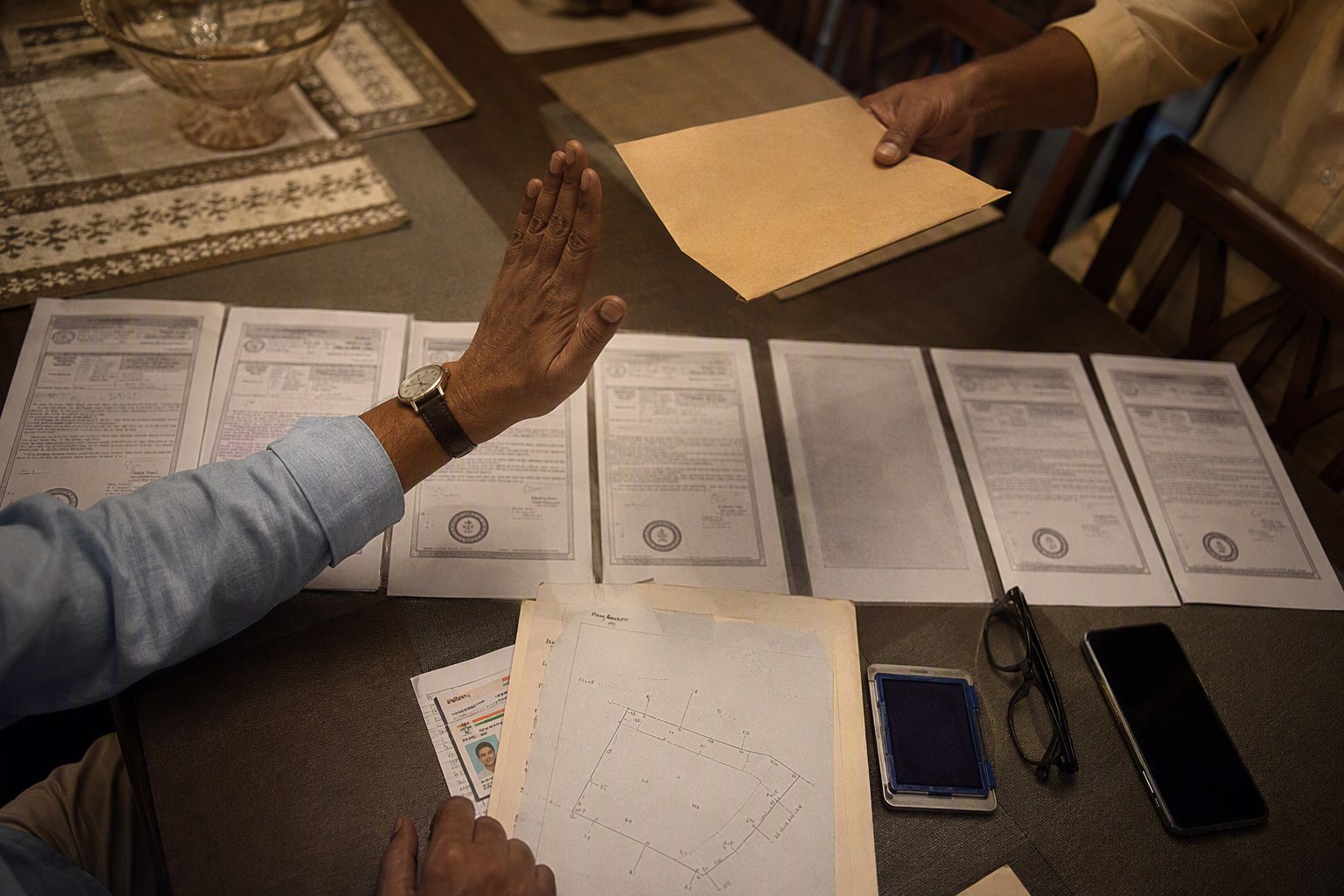



Telangana Case Study: Old Mortgage Found Before Deed Day
Telangana Case Study: Old Mortgage Found Before Deed Day is a story I keep repeating to buyers in Hyderabad because it shows how one small EC search can stop a very expensive mistake. The buyer had arranged the DDs, the seller had fixed a slot at the SRO, and both families were already discussing shifting dates. Then, one evening before registration, an Encumbrance Certificate showed an old bank mortgage that was never released on record.
The flat was not in some far-off, unclear layout. It was a normal resale apartment in Kondapur, under Serilingampally mandal, one of the most active residential pockets in west Hyderabad. The agreement value was ₹1.08 crore for a 1,525 sft apartment. The buyer had already paid ₹10 lakh as token and agreement advance. The balance payment was to be made on deed day. In our experience, this is exactly when people become careless — because emotionally, the deal is already done.
My opinion is simple: never pay the final amount until the latest EC, link documents, loan closure proof and property status are checked together. A clean-looking sale deed is not enough.
This case became even more relevant because Telangana already has 1,47,934 prohibited property records under Section 22-A. That number alone tells us why document checks are not a formality. Whether the issue is a government restriction, court attachment, old mortgage, family dispute or wrong survey reference, the buyer pays the price if verification is skipped.
Telangana Case Study: Old Mortgage Found Before Deed Day — What Happened
The buyer, whom I will call Ravi, works in HITEC City and had been searching around Kondapur, Hafeezpet and Nallagandla for nearly five months. Like many IT professionals, he preferred a ready-to-move resale flat rather than waiting for construction. The apartment he selected was in a gated community near Botanical Garden Road, close to Gachibowli and Kothaguda. The location was solid, rents were healthy, and the society maintenance records looked decent.
The seller had bought the flat in 2018 through a home loan from a private bank. In 2021, he claimed the loan was closed. He showed Ravi a photocopy of a loan closure letter and said the original documents were collected from the bank. On the face of it, nothing looked suspicious. The 2018 sale deed was available. The electricity bill, property tax receipt and society NOC were in the seller’s name. The Aadhaar and PAN matched. The flat number, undivided share and parking details matched the mother deed and schedule.
Ravi’s family was satisfied. The seller was also under pressure because he had to make a payment for a villa plot near Shankarpally. So both sides fixed the registration date at the Sub-Registrar Office serving the area. Stamp duty and registration charges were calculated at the usual Telangana sale deed cost pattern: 4% stamp duty, 1.5% transfer duty and 0.5% registration fee, making the total government charge around 6% of the applicable value, subject to the registration department’s market value and deed rules.
For a ₹1.08 crore transaction, that meant roughly ₹6.48 lakh towards duties and registration cost, before incidental expenses. Ravi had also kept TDS, society transfer charges and shifting costs ready. He was one step away from becoming the owner.
Then his lawyer asked one final question: “Did you take a fresh EC till yesterday?”
Ravi had an EC from the seller, but it was three months old. That is common in Hyderabad resale deals. Sellers often pull an EC during marketing and keep sending the same PDF to every buyer. But a stale EC is not a current title check. A property can get mortgaged, attached, gifted, sold, litigated or restricted after that date.
Ravi ran a fresh search through the registration records and also cross-checked using our Encumbrance Certificate Search. That is when the old bank charge appeared.
Telangana Case Study: Old Mortgage Found Before Deed Day — Why the EC Changed Everything
The Encumbrance Certificate showed a mortgage entry in favour of the bank from 2018. That part was expected because the seller had taken a home loan while purchasing the flat. The problem was this: there was no corresponding release deed or reconveyance entry after the alleged loan closure.
In simple words, the bank’s charge was still visible in the official registration history. The seller may have closed the loan financially, but the mortgage was not cleared from the public record. For a buyer, that is a serious gap.
A bank mortgage is not just a private understanding between borrower and lender. Once it appears in registration records, future buyers must see a proper release. If the release is missing, the buyer cannot assume that the bank has no claim. Banks may have returned original documents, or they may not have. Sometimes a closure letter is issued but the registered mortgage release is missed. Sometimes the seller has only a provisional letter. Sometimes there is another top-up loan or equitable mortgage not properly explained.
In this Kondapur case, Ravi did the right thing. He stopped the final payment. Not delayed politely — stopped. He informed the seller that registration would happen only after the bank release was confirmed and reflected in records.
The numbers in the deal
| Item | Case detail |
|---|---|
| Locality | Kondapur, near Gachibowli-Kothaguda belt |
| Mandal | Serilingampally mandal |
| Property type | Resale apartment |
| Flat size | 1,525 sft |
| Agreement value | ₹1.08 crore |
| Advance already paid | ₹10 lakh |
| Approx. Telangana registration cost pattern | 6% total for sale deed charges, as generally applied through stamp duty, transfer duty and registration fee |
| Issue found | Old bank mortgage visible in EC, no release entry |
| Risk avoided | Paying balance amount before clear title confirmation |
West Hyderabad buyers should pay attention here. In Kondapur, Gachibowli, Narsingi, Kokapet, Nanakramguda and Financial District-adjacent pockets, resale deals commonly cross ₹1 crore. Final payments are large. A missed encumbrance is not a small paperwork defect; it can freeze your ownership, loan eligibility and resale value.
Before committing to government charges, buyers should also check the department value using the Market Value / Guideline Value Search and estimate the payable duty through the Stamp Duty Calculator. The agreement value and ready reckoner value must be understood before the deed is drafted. If the department value is higher than your agreement value, duty can be calculated on the higher value.
Old Mortgage Found Before Deed Day: The Seller’s Explanation
The seller’s first reaction was irritation. He said the loan was closed long back and that Ravi was creating last-minute drama. This is also common. Sellers take questions on title personally, especially after an agreement is signed.
But documents do not respond to emotion. The EC entry was there. The bank charge was there. The release was missing.
After two days of follow-up, the seller contacted his bank branch. The bank confirmed that the loan was closed, but the registered release formalities had not been completed. The seller had collected some papers, but the proper release deed had not been registered. The bank asked for time to prepare the release documents and coordinate signatures.
This is where many buyers make a mistake. They say, “Bank has confirmed, so we can register.” I would not advise that. A WhatsApp message from a bank employee, an email from a branch, or a photocopy of closure letter is not equal to a registered release showing in the encumbrance history. For high-value Hyderabad properties, especially in active SROs like Serilingampally, Kukatpally, Gandipet, Rajendranagar and Uppal, the safest route is to let the record get corrected before the sale deed.
Ravi waited. It took about three weeks. The bank executed the release deed. A fresh EC was taken after the release registration. Only then did Ravi proceed with the purchase.
Why Telangana Buyers Must Check Encumbrances Before Final Payment
In Telangana, property documents move across several layers: sale deed, link documents, pahani or revenue records for land, municipal permissions, RERA status for projects, SRO market value, Dharani entries where applicable, and Section 22-A prohibited property lists. A clean agreement draft cannot replace these checks.
The scale of the risk is visible from one official data point: 1,47,934 properties are recorded as prohibited under Section 22-A. These records can include government lands, assigned lands, endowment lands, wakf-related restrictions, court or authority-restricted properties and other categories notified to stop registration. A buyer who checks only the seller’s deed may miss this larger status.
For plots and land parcels, the risk is even sharper. In places like Mokila, Tellapur, Patancheru, Adibatla, Tukkuguda, Maheshwaram, Shamshabad, Medchal and Shamirpet, buyers often hear attractive stories: HMDA layout coming, ORR access, future metro, pharma city growth, data centre demand. Some of those stories are valid. Still, the survey number must be checked, the mandal records must match, and the land must not fall under a prohibited or restricted category.
Use the Section 22-A Prohibited Property Check before taking a final call. For land, the Survey Number Finder and Property Verification Tool are useful starting points. These tools do not replace a lawyer’s title opinion, but they reduce blind spots before you pay.
What an EC Shows — and What It Does Not Show
An Encumbrance Certificate is one of the most practical title documents in a Telangana property transaction. It records registered transactions for a property during the selected period. Sale deeds, gift deeds, mortgages, releases, partitions, development agreements and some court-related registrations may appear if registered against the property.
But an EC is not magic. It has limits.
- It shows registered encumbrances: If a mortgage or sale deed is registered and indexed correctly, it should appear.
- It may not show unregistered claims: Oral family arrangements, unregistered agreements, private disputes and some possession claims may not appear.
- Indexing mistakes happen: Wrong flat number, wrong survey number or spelling differences can hide entries.
- Old manual records may need care: Older link documents may not be perfectly digitised.
- It must be current: An EC taken three or six months ago is not enough for deed day.
For Ravi’s flat, the EC did its job because the bank mortgage had been registered. If he had skipped the fresh search, he would have paid almost ₹98 lakh more and then discovered that the record still carried a lender’s charge. His own bank could have refused the loan disbursement or asked for release documents before processing.
Buyers taking home loans should be extra careful. Bank legal teams do check documents, but they work for the bank’s security, not for your full peace of mind. They may not verify every society issue, every family consent issue or every development history issue. A buyer needs an independent review.
Hyderabad Locality Lessons: Kondapur Is Not the Only Risk Area
Some people think title problems happen only in gram panchayat layouts or outskirts. That is not correct. We have seen mortgage, release, UDS, parking and link document issues in established residential belts also.
In Miyapur and Hafeezpet, older apartment complexes sometimes have confusing land histories because layouts and survey references changed over time. In Manikonda and Puppalaguda, buyers must be careful about old gram panchayat permissions, later municipal status and approach road details. In Narsingi and Kokapet, premium pricing does not automatically mean clean title. In Uppal, Nagole and LB Nagar, older family-owned properties may have partition or inheritance gaps. In Kompally, Bachupally and Dundigal side, buyers should check layout approvals, mortgage releases and road widening impacts.
For new projects, RERA checking is a must. Use the RERA Project Lookup for project registration details, promoter information and declared timelines. For resale flats, RERA may not solve your title concern, but it helps if you are buying from an ongoing or recently completed project.
For SRO mapping, use Find Your SRO Office. Many buyers assume the nearest SRO is the correct office. That is not always safe. Jurisdiction depends on village, ward, survey number and registration boundaries. Wrong SRO assumptions can delay registration and create confusion during document collection.
Document Checklist We Used in This Case
Here is the practical checklist followed before Ravi finally registered the Kondapur flat. I am sharing it because it works for many Hyderabad resale apartment deals.
- Latest EC up to the most recent possible date, not an old PDF from the seller.
- Parent deed and complete link documents from landowner or builder chain.
- Seller’s sale deed with schedule, UDS, flat number and parking details.
- Bank loan closure letter and registered release deed where mortgage existed.
- Original document inspection before final payment.
- Society NOC confirming dues, maintenance, transfer charges and no internal objection.
- Property tax receipt and municipal assessment details.
- Electricity bill and water connection details, where applicable.
- Identity and PAN verification of seller and spouse where needed.
- Check for Section 22-A status, especially if land share or survey history is unclear.
- Draft sale deed review before SRO submission.
- Stamp duty calculation on correct market value and agreement value.
For independent houses and plots, I would add pahani, Dharani status, mutation record, layout approval, LRS or BRS position where relevant, road access, land use zone, and survey sketch. In HMDA growth corridors, land use matters a lot. A plot that looks residential on ground can still sit in a different planning zone. The Land Use Zone Finder can help buyers ask better questions before they pay a large advance.
How the Deal Was Saved Without a Fight
This case did not end in litigation. That is the good part. Ravi did not accuse the seller of fraud. The seller eventually accepted that the release entry had to be completed. The bank cooperated. The registration was postponed, not cancelled.
The final sale deed was registered only after the fresh EC showed the release. Ravi’s balance payment was made through bank instruments on the day of registration. The document numbers were noted, certified copies were requested, and the society transfer was completed after registration.
The delay was inconvenient, yes. But compare a three-week delay with a disputed ₹1.08 crore purchase. There is no contest.
We’ve seen buyers bargain hard for ₹1 lakh and then ignore a ₹1 crore title risk. That thinking must change. In Hyderabad, where property prices have moved sharply in west, north and south growth corridors, verification is now part of the cost of buying. It is not an optional legal luxury.
What Buyers Should Do Before Deed Day
If you are close to registration, do not rush only because the seller is pushing or the auspicious date is near. Do these checks before releasing the final amount:
- Take a fresh EC for the full relevant period, including the latest dates.
- Match every EC entry with a supporting document.
- If a mortgage appears, insist on the registered release deed.
- Check Section 22-A prohibited property status.
- Confirm SRO jurisdiction and market value.
- Review whether the property is under any court, family, society or bank restriction.
- For plots, match survey number, extent, village and mandal records.
- For apartments, verify UDS, parking, building permission and occupancy status.
- Never depend only on screenshots or verbal assurances.
One more practical point: pay the final amount in a way that is traceable and tied to registration. Avoid large cash components. Apart from legal and tax risks, cash payments weaken your position if the deal collapses.
The Verified.RealEstate View
The Kondapur case is not rare. It is just one clear example of a risk that was caught in time. Hyderabad buyers are becoming sharper about price, amenities and location. But title discipline is still weak. Many people check interiors more carefully than the encumbrance history.
My view is firm: the last seven days before registration are the most dangerous days in a property purchase. Everyone is excited. Packers are booked. Loans are sanctioned. Families are calling the house “ours”. That is exactly when a buyer must become boring, strict and document-minded.
An old mortgage found before deed day is not bad luck. It is a warning that worked. The real tragedy is finding it after registration, after payment, and after the seller has moved on.
If you are buying in Telangana, especially in Hyderabad’s high-value markets, make document verification non-negotiable. The state already has 1,47,934 prohibited property records. Add unclosed mortgages, family claims and wrong survey references to that picture, and the message is clear: verify first, pay later.
Frequently Asked Questions
Can I buy a property if an old mortgage appears in the EC?
You can consider buying only after the mortgage is properly released and the release deed is reflected in the registration records. Do not pay the final amount based only on verbal confirmation or a photocopy of a closure letter.
Is a bank loan closure letter enough for registration in Telangana?
No. A closure letter is useful, but if the mortgage was registered, buyers should insist on a registered release deed or reconveyance document. The latest EC should show that the charge has been cleared.
How recent should the Encumbrance Certificate be before deed day?
Take the EC as close to registration as possible. An EC that is three months old is not enough for final payment because a new mortgage, sale, attachment or other entry may have been registered later.
Why should I check Section 22-A prohibited property status?
Telangana has 1,47,934 prohibited property records under Section 22-A. If a property falls in a restricted category, registration may be blocked or the title may become risky. Always check before paying advance or final amount.
Which tools should a Hyderabad buyer use before registration?
Start with EC search, guideline value search, stamp duty calculation, SRO lookup and Section 22-A prohibited property check. For plots, also verify survey number, land use zone and revenue records.